 TrackMedia
 TrackRev

 Alibaba Cloud
 Huawei Cloud
 Tencent Cloud
 Linode
 Scaleway Object Storage
 Exoscale Object Storage
 OVHcloud
 UpCloud
 IDrive
 Filebase
 DreamHost
 Rackspace Email
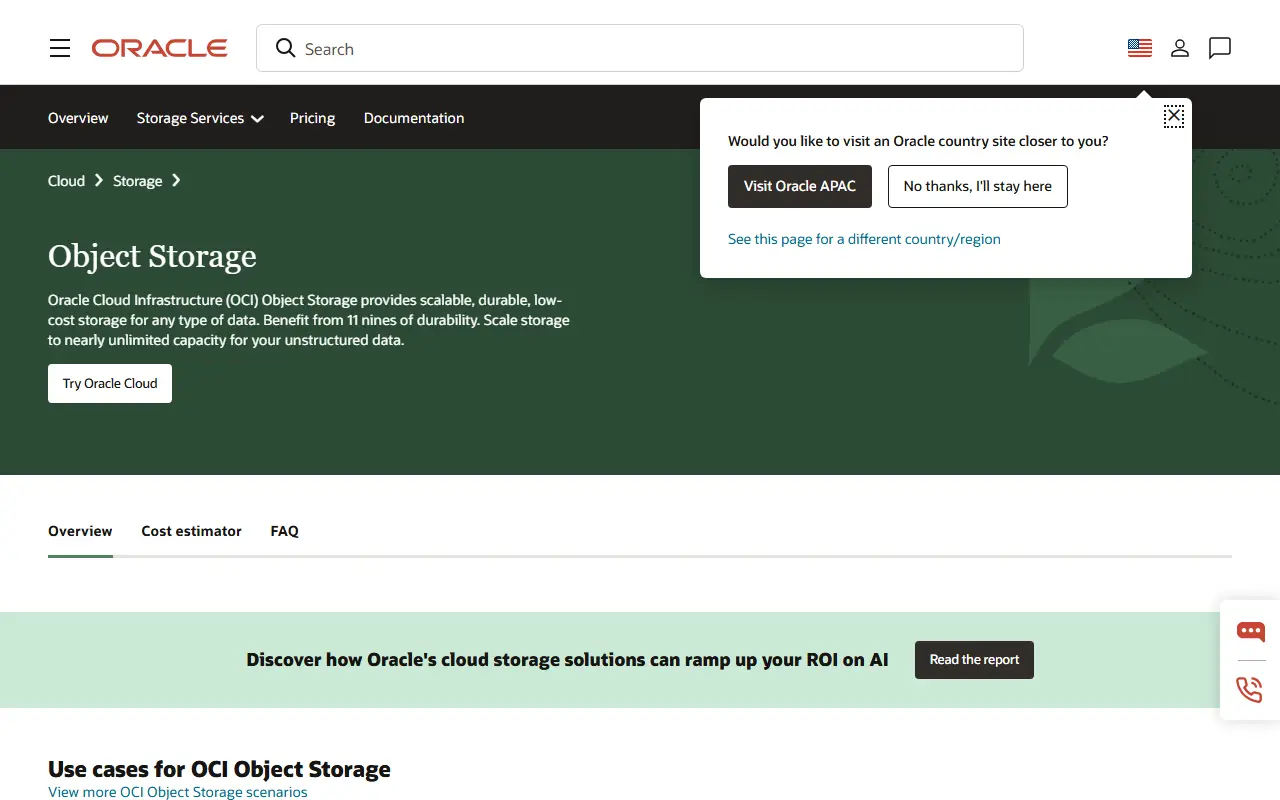
About Oracle Cloud Object Storage
Oracle Cloud Infrastructure Object Storage stores unstructured data of any content type, including analytic data and rich content such as images and videos. Oracle describes it as scalable, durable storage with 11 nines of durability, and says capacity scales to nearly unlimited levels.
Data can be managed through the Console, CLI, API and SDK. Each object is stored redundantly on multiple storage servers within an OCI Region, and operations can be run in bulk on billions of objects in a single task.
Distinct storage class tiers let teams trade access performance against cost. Buckets can be replicated for disaster recovery, versioning keeps every version of every object, and retention dates and legal holds block deletion or overwriting.
Oracle lists database connections, media files, data lakes and archiving as typical uses, and publishes reference architectures such as scanning files with ClamAV and triggering OCI Functions when objects are uploaded.
Key features
- Multiple management interfaces: Console, CLI, API, SDK
- Bulk operations on billions of objects
- Replication between buckets
- Object versioning to recover from mistakes
- Retention periods and legal holds
- Storage tiers for performance or cost
- Connects to Autonomous AI Database and MySQL HeatWave
Good fit for
- Media file storage
- Data lakes
- Long-term archiving
- Data for Oracle databases
Oracle Cloud Object Storage: questions and answers
- What is Oracle Cloud Object Storage used for?
- Oracle Cloud Object Storage is an Oracle Cloud Infrastructure's object storage service for unstructured data, with storage tiers, versioning, replication and retention controls. It is a good fit for media file storage, data lakes and long-term archiving.
- Is Oracle Cloud Object Storage free?
- Yes. Oracle Cloud Object Storage has a free plan.
- Is Oracle Cloud Object Storage open source?
- No. Oracle Cloud Object Storage is proprietary (closed-source) software. Open-source alternatives to Oracle Cloud Object Storage include Storj, RustFS and SeaweedFS.
- What are some alternatives to Oracle Cloud Object Storage?
- Oracle Cloud Object Storage competes with Amazon S3, Google Cloud Storage and Azure Blob Storage. For open-source options, see Enlisted's ranked list of open-source Oracle Cloud Object Storage alternatives.
Open-source alternatives to Oracle Cloud Object Storage
See all
Storj
File Storage & Sharing
Ongoing Storj v3 development. Decentralized cloud object storage that is affordable, easy
AGPL-3.0vs Wasabi★ 3.3k
RustFS
File Storage & Sharing
RustFS is an open-source, S3-compatible high-performance object storage system supporting
Apache-2.0vs Amazon S3★ 36k
SeaweedFS
File Storage & Sharing
SeaweedFS is a distributed storage system for object storage (S3), file systems, and Icebe
Apache-2.0vs Amazon S3★ 36k
Ceph
Infrastructure & Containers
Ceph is a distributed object, block, and file storage platform
OSSvs Amazon S3★ 17k
Swift
Open source
OpenStack Storage (Swift). Mirror of code maintained at opendev.org.
Apache-2.0vs Wasabi★ 2.8k
Bareos
File Storage & Sharing
Bareos is a cross-network Open Source backup solution (licensed under AGPLv3) which preser
OSSvs Veeam★ 1.3k
SaaS alternatives to Oracle Cloud Object Storage
See all
Amazon S3
File Storage & Sharing
Amazon S3 is AWS's cloud object storage service for data lakes, backup and restore, archival, mobile apps and analytics workloads.
SaaS
Google Cloud Storage
File Storage & Sharing
Google Cloud object storage with multiple storage classes and global availability
SaaS
Azure Blob Storage
File Storage & Sharing
Microsoft Azure object storage for unstructured data, backups and data lakes
SaaS
IBM Cloud Object Storage
File Storage & Sharing
Scalable object storage service on IBM Cloud with an S3-compatible API
SaaS
Wasabi
File Storage & Sharing
S3-compatible hot cloud storage with flat per-terabyte pricing and no egress fees
SaaS
Backblaze B2
File Storage & Sharing
S3-compatible object storage priced per terabyte, used for backups and media
SaaS