5 open-source alternatives ranked by real activity

Open-source Amazon EFS alternatives

A curated, ranked list of the 5 best open-source alternatives to Amazon EFS.

The best open-source alternative to Amazon EFS is SeaweedFS. If that doesn't suit you, other good options are JuiceFS, Ceph, GlusterFS and MooseFS.

Commercial alternatives to Amazon EFS include Azure Files, Google Memorystore, Oracle GoldenGate and Amazon S3. See all 10.

Amazon EFS alternatives are mainly infrastructure & container tools, but some are also file storage & sharing tools. 4 of them shipped code in the last 30 days, 5 can be self-hosted, and 2 use a permissive licence.

Last updated November 12, 2026 · ranked by GitHub stars, growth and recent commits

SeaweedFS

SeaweedFS is a distributed storage system that serves an S3 object store, a file system and Iceberg tables from one scalable binary.

GitHub stars
36k
Last commit
yesterday
Latest release
4.53
Licence
Apache-2.0
Self-hosted
Yes
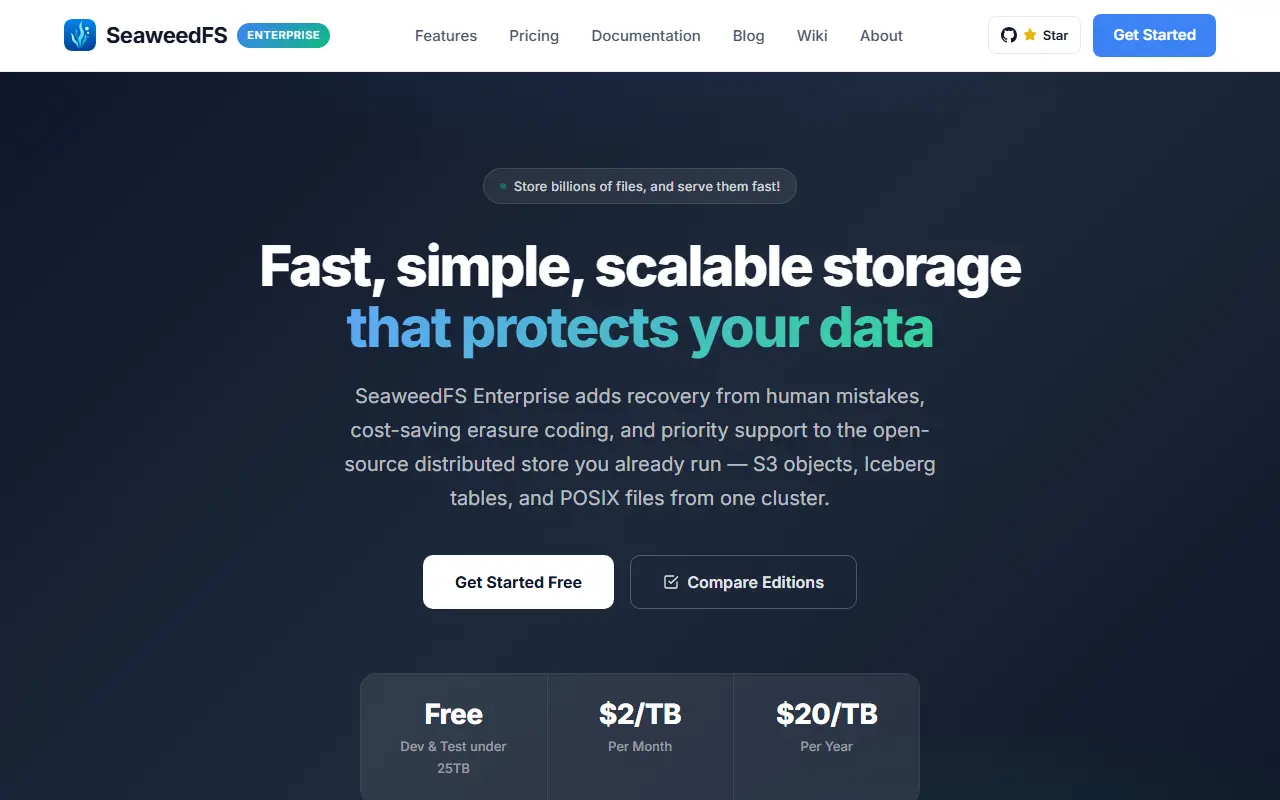
seaweedfs.comSeaweedFS homepage screenshot

SeaweedFS is a distributed storage system built to store very large numbers of files and serve them quickly. A single weed binary can provide an S3-compatible object store, a POSIX file system and S3 Tables for lakehouse use, all over the same data. The project is written in Go and released under the Apache-2.0 license.

Its design aims for constant-time disk access per file, and capacity grows by starting another volume server. Cloud storage can be cached or tiered transparently, and replication and erasure coding are supported. The same process can also run the master, volume servers, a filer, WebDAV, an Iceberg REST catalog and an Admin UI. You can start with one command, Docker, Docker Compose or Helm on Kubernetes, or build from source. The README includes comparisons with HDFS, Ceph, GlusterFS, MooseFS and MinIO.

Key features

  • S3-compatible object storage
  • POSIX file system access via FUSE
  • Iceberg tables and S3 Tables support
  • Tiering and caching for cloud storage
  • Replication and erasure coding
  • Install with Docker, Helm or one binary

Pricing: Free for dev and test under 25TB. Enterprise is priced per terabyte at $2 per month, or $20 per TB per year.

JuiceFS

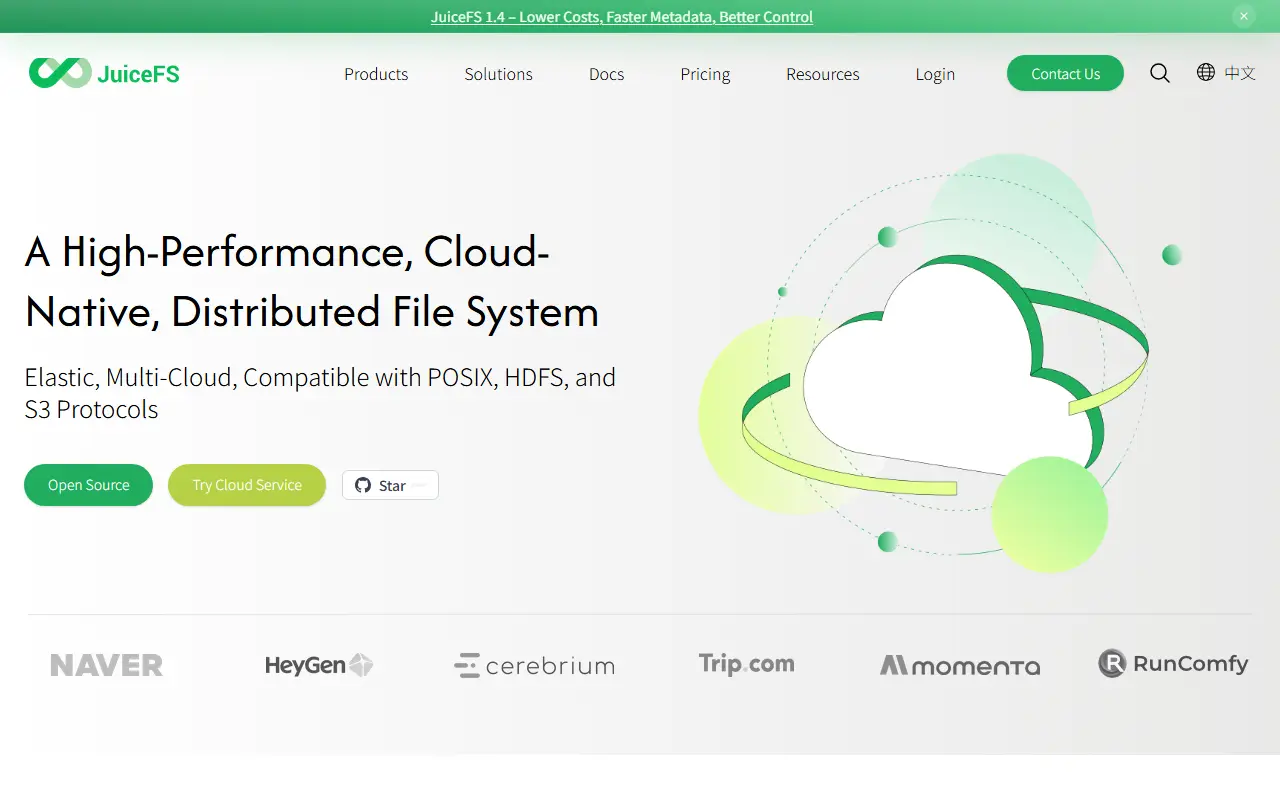
JuiceFS is a distributed POSIX file system that stores data in object storage like S3 and metadata in Redis, MySQL or TiKV.

GitHub stars
15k
Last commit
yesterday
Latest release
v1.4.2
Licence
Apache-2.0
Self-hosted
Yes
juicefs.comJuiceFS homepage screenshot

JuiceFS is a POSIX file system designed for cloud-native environments and released under the Apache License 2.0. Data written through it is persisted in object storage such as Amazon S3, while the matching metadata is kept in database engines such as Redis, MySQL or TiKV, chosen according to the scenario. It is written in Go.

Its aim is to let large amounts of cloud storage be used by big data, machine learning and AI platforms as efficiently as local storage, without code changes. Highlights include full POSIX compatibility, a Hadoop Java SDK compatible with Hadoop 2.x and 3.x, an S3 gateway, and a Kubernetes CSI driver for use in clusters.

The file system can be shared and read or written by thousands of clients, with strong consistency so that confirmed changes are immediately visible on all mounts. Data encryption in transit and at rest is supported, along with global file locks, both BSD flock and POSIX locks. A quick start guide is in the documentation.

Key features

  • Full POSIX file system compatibility
  • Data stored in S3-compatible object storage
  • Metadata in Redis, MySQL or TiKV
  • Hadoop-compatible Java SDK
  • S3 gateway and Kubernetes CSI driver
  • Encryption in transit and at rest

Pricing: The Community Edition is free to self-host. The managed Cloud Service is $0.02 per GiB per month with a free trial; Enterprise Edition uses volume pricing via sales.

Read more about JuiceFSWebsiteGitHub#2 Amazon EFS alternative

Ceph

Ceph is a scalable, distributed storage system that provides object, block and file storage from a single software-defined platform.

GitHub stars
17k
Last commit
yesterday
Self-hosted
Yes
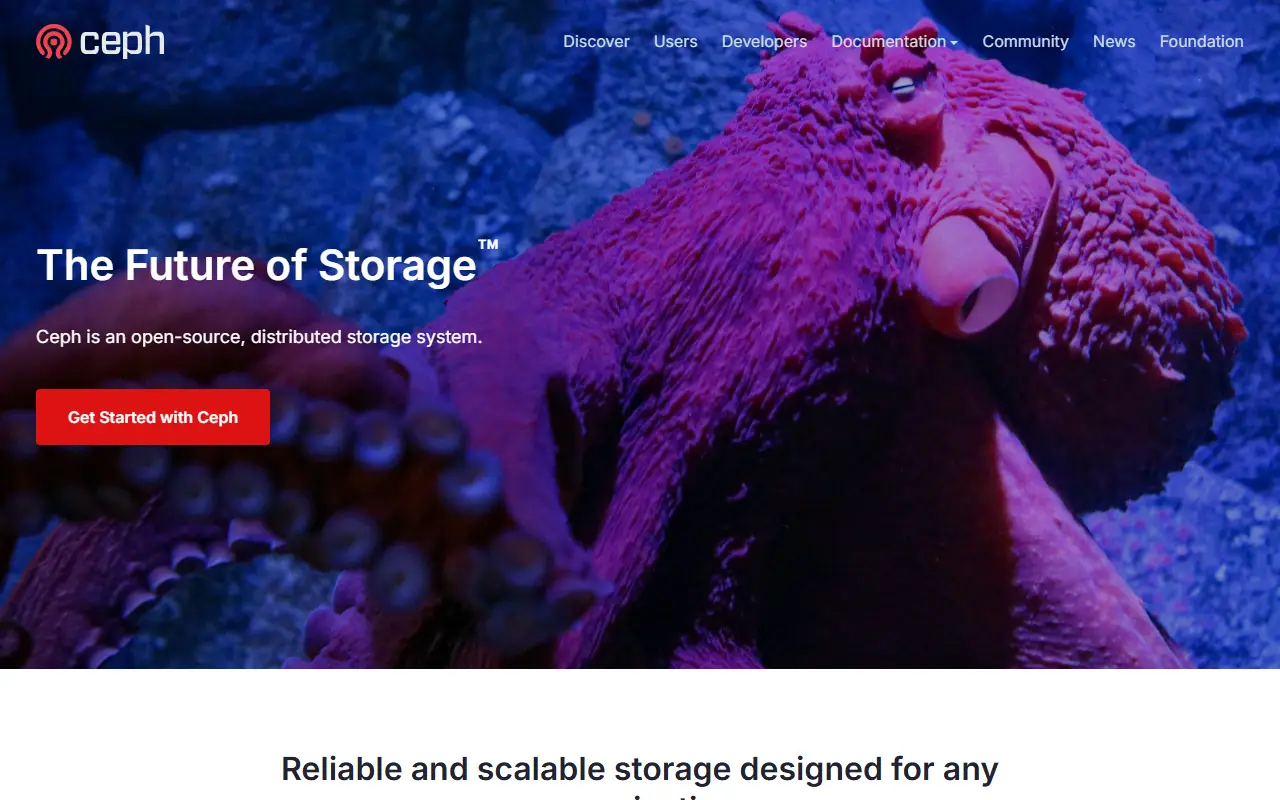
ceph.ioCeph homepage screenshot

Ceph is a distributed storage platform that offers object, block and file storage from one software-defined system. It is designed to scale across many servers and provide highly available storage, and it is written mainly in C++.

Repository topics show the range of protocols and features it covers: S3-compatible object storage, block storage, a POSIX distributed file system with FUSE access, protocols such as NFS, SMB, iSCSI and NVMe over Fabrics, and replication and erasure coding for data protection. The topics also mention Kubernetes and HDFS.

Most of Ceph is dual-licensed under the LGPL version 2.1 or 3.0, with some code in the public domain or under BSD-style licenses, which is why the repository lists the license as 'Other'. The documentation uses CC-BY-SA-3.0, and contributions need a Signed-off-by line without copyright assignment. Ceph is deployed on your own hardware or cloud infrastructure.

Key features

  • Unified object, block and file storage
  • S3-compatible object storage
  • POSIX distributed file system
  • Replication and erasure coding
  • NFS, SMB and iSCSI access
  • Scales across many servers

Pricing: Free and open source, mostly dual-licensed under LGPL 2.1 or 3.0.

Read more about CephWebsiteGitHub#3 Amazon EFS alternative

GlusterFS

A scalable, free and open source network filesystem that pools ordinary servers into distributed storage with automatic failover.

GitHub stars
5.3k
Last commit
20 days ago
Latest release
v11.2
Licence
GPL-2.0
Self-hosted
Yes
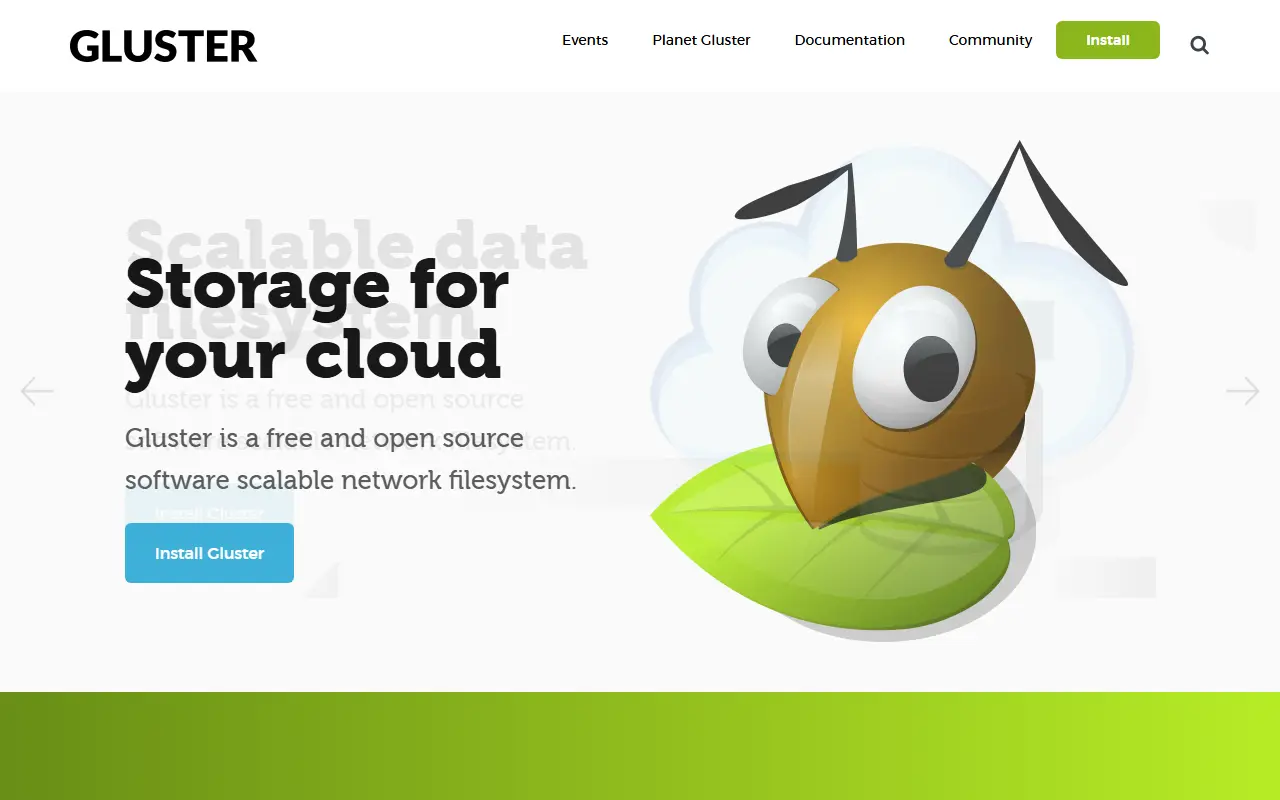
gluster.orgGlusterFS homepage screenshot

Gluster is described as software defined distributed storage that can scale to several petabytes. It provides interfaces for object, block and file storage, and the install guide calls it a distributed scale-out filesystem that allows rapid provisioning of additional storage as consumption grows.

It is designed to run on commodity hardware and on top of most unix filesystems, with XFS and ext4 named as the most popular choices. Failover is built in and works without a centralized metadata server. If a server goes down, the copy of the data on a node that is still running keeps being served, and nothing needs to be done manually when the failed server returns.

Data can be reached over traditional NFS, SMB/CIFS for Windows clients, or the native GlusterFS client. The code is written in C and dual licensed under GPLv2 and LGPLv3+. Documentation includes a quick start guide, a more detailed installation guide, an administrator guide and a developer guide, and the community is open source.

Key features

  • Scales to several petabytes
  • Offers object, block and file storage interfaces
  • Automatic failover without a central metadata server
  • Runs on commodity hardware
  • Sits on top of most unix filesystems, usually XFS or ext4
  • Accessible over NFS, SMB/CIFS or native client
  • Storage can be extended by adding more servers

MooseFS

MooseFS is distributed storage software that spreads data across servers and presents it as one POSIX file system, block device, or C API resource.

GitHub stars
2k
Last commit
5 mo ago
Latest release
v4.59.2
Licence
GPL-2.0
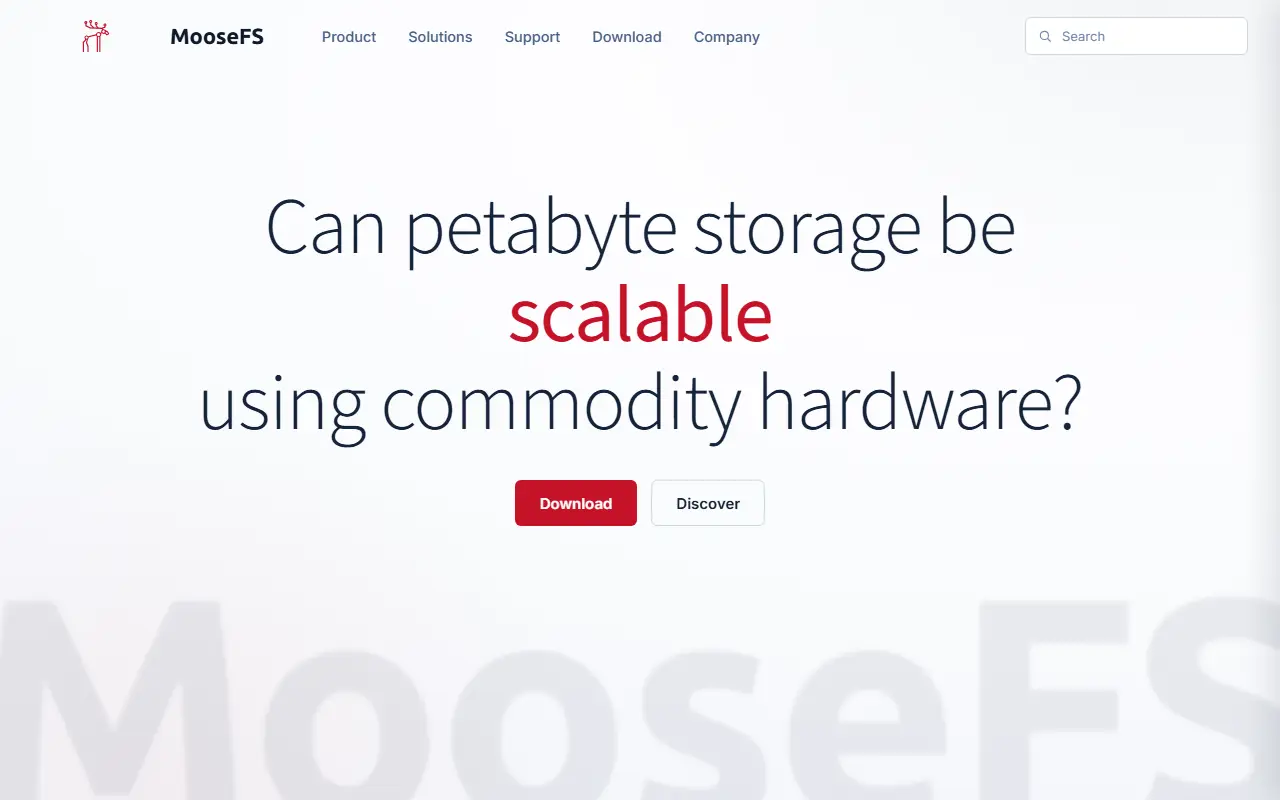
moosefs.comMooseFS homepage screenshot

MooseFS is a fault-tolerant, network-distributed parallel storage system. It spreads data across multiple servers while keeping it reachable as a single resource. You can mount it as a POSIX file system, use it as a block device for virtual machines and databases, or access it directly through the C API.

Capacity grows by adding commodity hardware, and the site says losing a disk or a storage node does not break the system. It has been in production since 2005. The newest release, MooseFS v5, adds geo-aware storage with per-location storage policies and cluster-wide authentication that gates data access through the master.

It comes in two editions from one codebase. Community Edition is open source and described as free forever. PRO adds high availability, advanced redundancy, multi-location support, and a native Windows client. PRO Personal unlocks all PRO features for personal, non-commercial use at a lower cost, and migration between editions is possible.

Key features

  • Data spread across servers and presented as one resource
  • Mounts as POSIX file system, block device, or C API
  • Scales by adding commodity hardware
  • Tolerates the loss of a disk or storage node
  • Geo-aware storage with per-location policies in v5
  • Cluster-wide authentication through the master

Pricing: Community Edition is open source and described as free forever. PRO Personal unlocks all PRO features for personal, non-commercial use at a lower cost; no prices are listed in the sources.

Read more about MooseFSWebsiteGitHub#5 Amazon EFS alternative

Commercial Amazon EFS alternatives

Hosted, closed-source products that compete with Amazon EFS.

Amazon EFS alternatives: questions

What is the best open-source alternative to Amazon EFS?
SeaweedFS is the top-ranked open-source alternative to Amazon EFS on Enlisted: SeaweedFS is a distributed storage system that serves an S3 object store, a file system and Iceberg tables from one scalable binary. Other strong options are JuiceFS, Ceph, GlusterFS and MooseFS.
What are the best commercial alternatives to Amazon EFS?
Azure Files, Google Memorystore, Oracle GoldenGate, Amazon S3 and Google Cloud Storage are among the hosted, closed-source alternatives to Amazon EFS listed on Enlisted, which lists 10 in total. Compare their pricing and features on each tool page.
Are these Amazon EFS alternatives free?
All 5 are open source, so the code is free to use under its licence, and all of them can be self-hosted on your own server or computer.
How is this list of Amazon EFS alternatives ranked?
By a score built from GitHub stars, star growth over the last 30 days and how recently the code changed. 4 of these projects shipped code in the last 30 days. Data is refreshed daily, and nobody can pay to move up.

People also look for alternatives to…

View all