
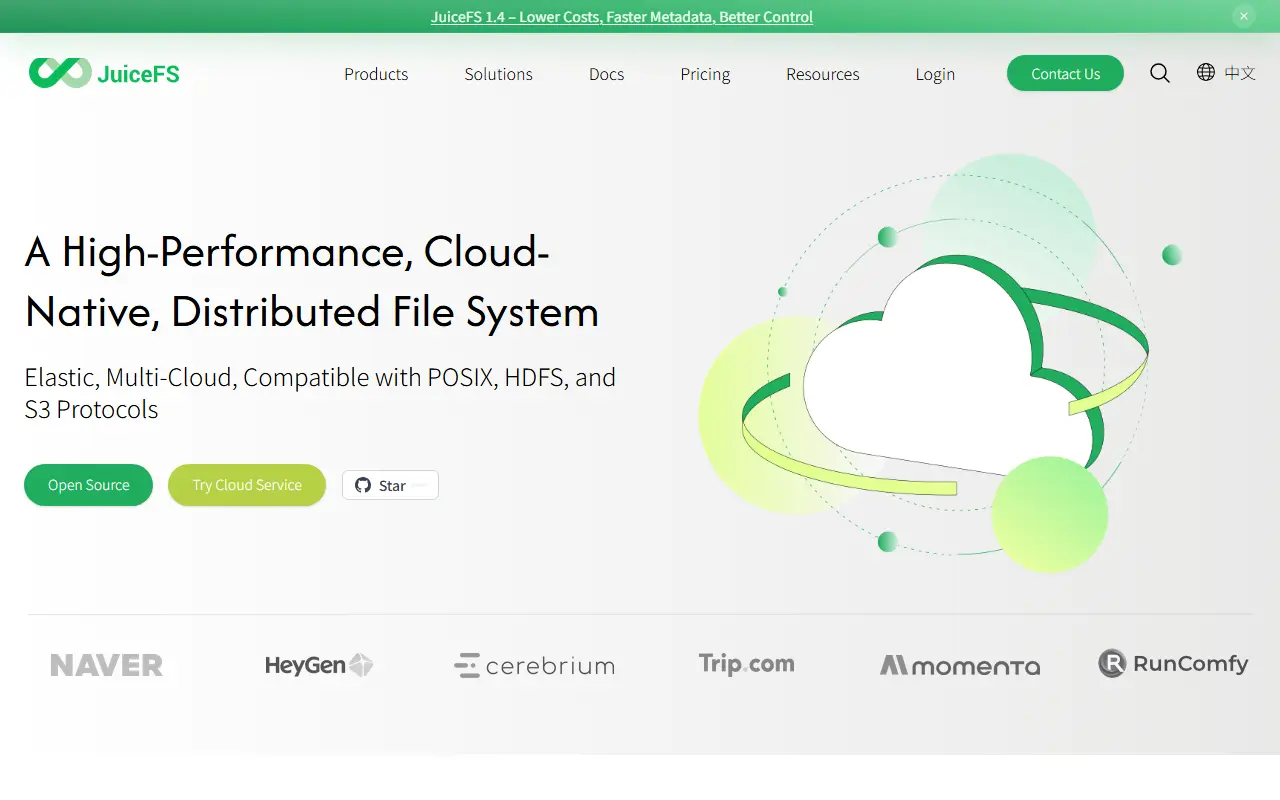
About JuiceFS
JuiceFS is a POSIX file system designed for cloud-native environments and released under the Apache License 2.0. Data written through it is persisted in object storage such as Amazon S3, while the matching metadata is kept in database engines such as Redis, MySQL or TiKV, chosen according to the scenario. It is written in Go.
Its aim is to let large amounts of cloud storage be used by big data, machine learning and AI platforms as efficiently as local storage, without code changes. Highlights include full POSIX compatibility, a Hadoop Java SDK compatible with Hadoop 2.x and 3.x, an S3 gateway, and a Kubernetes CSI driver for use in clusters.
The file system can be shared and read or written by thousands of clients, with strong consistency so that confirmed changes are immediately visible on all mounts. Data encryption in transit and at rest is supported, along with global file locks, both BSD flock and POSIX locks. A quick start guide is in the documentation.
Key features
- Full POSIX file system compatibility
- Data stored in S3-compatible object storage
- Metadata in Redis, MySQL or TiKV
- Hadoop-compatible Java SDK
- S3 gateway and Kubernetes CSI driver
- Encryption in transit and at rest
Good fit for
- →Shared storage for machine learning workloads
- →Mounting object storage as a file system
- Tags
- file-system
- posix
- object-storage
- s3
- redis
- kubernetes
- distributed-storage
- golang
JuiceFS: questions and answers
- What is JuiceFS used for?
- JuiceFS is a distributed POSIX file system that stores data in object storage like S3 and metadata in Redis, MySQL or TiKV. It is a good fit for shared storage for machine learning workloads and mounting object storage as a file system.
- Is JuiceFS open source?
- Yes. JuiceFS is open source under the Apache-2.0 licence. Its source code is on GitHub at juicedata/juicefs and is written mainly in Go.
- Is JuiceFS free?
- Yes. JuiceFS is open source, so the software itself is free to use.
- Can I self-host JuiceFS?
- Yes. JuiceFS can be self-hosted on your own server or infrastructure.
- What is JuiceFS an alternative to?
- JuiceFS is an open-source alternative to Amazon EFS and Azure Files. Other open-source alternatives to Amazon EFS include Ceph and SeaweedFS.
- Is JuiceFS actively maintained?
- Yes. The most recent commit to JuiceFS was on 29 September 2026, and the latest release is v1.4.1, published on 30 July 2026. The project has 14k stars on GitHub.
Open-source alternatives to JuiceFS
See all
Ceph
Infrastructure & Containers
Ceph is a distributed object, block, and file storage platform
OSSvs Amazon S3★ 17k
SeaweedFS
File Storage & Sharing
SeaweedFS is a distributed storage system for object storage (S3), file systems, and Icebe
Apache-2.0vs Amazon S3★ 35k
Kubernetes
Infrastructure & Containers
Production-Grade Container Scheduling and Management
Apache-2.0vs Amazon EKS★ 128k
Rancher
Infrastructure & Containers
Complete container management platform
Apache-2.0vs Amazon EKS★ 26k
KubeVela
Infrastructure & Containers
The Modern Application Platform.
Apache-2.0vs Humanitec★ 7.9k
Claudie
Infrastructure & Containers
Cloud-agnostic managed Kubernetes
Apache-2.0vs Amazon EKS★ 794
SaaS alternatives to JuiceFS
See all
Amazon EFS
File Storage & Sharing
Managed elastic NFS file system for AWS compute services
SaaS
Azure Files
File Storage & Sharing
Fully managed SMB and NFS file shares in the cloud from Microsoft Azure
SaaS
Amazon EKS
Infrastructure & Containers
Managed Kubernetes control plane and worker nodes on AWS
SaaS
Azure Kubernetes Service
Infrastructure & Containers
Managed Kubernetes service on Microsoft Azure
SaaS
DigitalOcean Kubernetes
Infrastructure & Containers
Managed Kubernetes service on DigitalOcean
SaaS
Docker Desktop
Infrastructure & Containers
Desktop app for building and running containers locally, with Kubernetes support
SaaS