 TrackMedia
 TrackRev

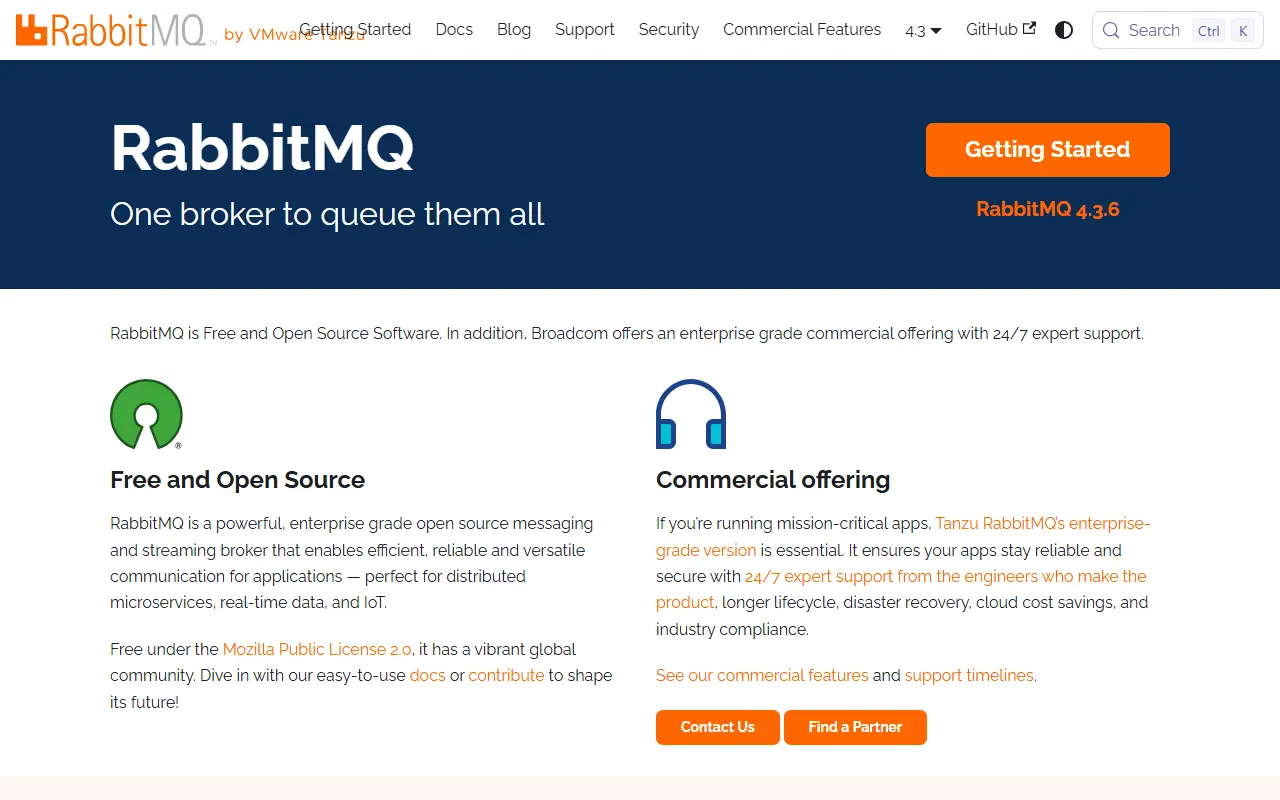
About RabbitMQ
RabbitMQ is an open-source message broker that also supports streaming. Applications publish messages to the broker and other applications consume them, which lets services communicate without depending on each other being available at the same moment. This repository contains the core server and the built-in tier 1 plugins.
The broker speaks several protocols: AMQP 0-9-1, AMQP 1.0, its own Stream Protocol, MQTT versions 3.1, 3.1.1 and 5.0, STOMP 1.0 through 1.2, and MQTT and STOMP over WebSocket. Quorum queues provide replicated, consistency-oriented queues, while streams offer a persistent, replicated append-only log that consumers can read without removing messages. Monitoring works with Prometheus and Grafana.
The server is licensed under the MPL 2.0 and can be installed on many platforms, with a Kubernetes Cluster Operator for container deployments. The documentation includes tutorials, a production checklist and clustering guides. Commercial editions and paid support from Broadcom exist alongside the community edition, which is supported through GitHub Discussions and Discord.
Key features
- AMQP 0-9-1 and AMQP 1.0 messaging
- MQTT and STOMP protocol support
- Replicated quorum queues
- Persistent replicated streams
- Kubernetes Cluster Operator
- Prometheus and Grafana monitoring
Good fit for
- Decoupling microservices with queues
- Bridging MQTT devices to backend services
- Event streaming with replicated logs
RabbitMQ: questions and answers
- What is RabbitMQ used for?
- RabbitMQ is a multi-protocol message and streaming broker supporting AMQP, MQTT and STOMP, used to decouple services in distributed systems. It is a good fit for decoupling microservices with queues, bridging MQTT devices to backend services and event streaming with replicated logs.
- Is RabbitMQ open source?
- Yes. RabbitMQ is open source under a custom licence. Its source code is on GitHub at rabbitmq/rabbitmq-server and is written mainly in JavaScript.
- Is RabbitMQ free?
- Yes. RabbitMQ is open source, so the software itself is free to use under the terms of its own licence.
- Can I self-host RabbitMQ?
- Yes. RabbitMQ can be self-hosted on your own server or infrastructure.
- What is RabbitMQ an alternative to?
- RabbitMQ is an open-source alternative to PubNub, Confluent, Azure IoT Hub and Amazon Kinesis. Other open-source alternatives to PubNub include NATS, Kafka and EMQX.
- Is RabbitMQ actively maintained?
- Yes. The most recent commit to RabbitMQ was on 11 November 2026, and the latest release is v4.4.0, published on 19 October 2026. The project has 14k stars on GitHub, with 50 added in the last 30 days.
Open-source alternatives to RabbitMQ
See all
NATS
Infrastructure & Containers
High-Performance server for NATS.io, the cloud and edge native messaging system.
Apache-2.0vs Stream★ 21k
Kafka
Data Pipelines & ETL
Apache Kafka - A distributed event streaming platform
Apache-2.0vs Striim★ 34k
Flink
Open source
Apache Flink
Apache-2.0vs Matillion★ 26k
Redpanda
Infrastructure & Containers
Redpanda is a streaming data platform for developers. Kafka API compatible. 10x faster. No
OSSvs Tinybird★ 13k
Apache Spark
Data Pipelines & ETL
Apache Spark - A unified analytics engine for large-scale data processing
Apache-2.0vs Databricks★ 44k
EMQX
Team Chat
The most scalable and reliable MQTT broker for AI, IoT, IIoT and connected vehicles
OSSvs Particle★ 17k
SaaS alternatives to RabbitMQ
See all
PubNub
Backend as a Service
Realtime messaging and presence APIs for chat, IoT and live apps
SaaS
Confluent
Data Pipelines & ETL
Managed Apache Kafka platform for streaming data in the cloud
SaaS
Azure IoT Hub
Home Automation & IoT
Managed Azure service for secure two-way communication with IoT devices
SaaS
Amazon Kinesis
Data Pipelines & ETL
AWS services for collecting, processing and analyzing real-time streaming data
SaaS
Amazon EventBridge
Workflow Automation
Serverless event bus for routing events between AWS services, SaaS apps and custom applications
SaaS
StreamNative
Data Pipelines & ETL
Streamhouse for apps, analytics, and AI agents
SaaS