#1
A fair-code workflow automation platform that mixes a visual canvas with custom code and AI agent features, for teams connecting apps and automating processes.
- GitHub stars
- 210k
- Last commit
- today
- Latest release
- n8n@2.47.5
- Self-hosted
- Yes
- Hosted version
- Available
n8n.io
n8n is a workflow automation platform for connecting apps, moving data between them and triggering actions without writing a full integration from scratch. Workflows are built on a visual canvas, and when a step needs more logic you can drop in JavaScript or Python and use npm packages. It is often compared with Zapier and Make, but the source is public and it can run on your own infrastructure.
Recent versions put a lot of weight on AI. You can build multi-step agents and LLM workflows that call OpenAI, Anthropic, Google or open-source models, add human approval steps, and inspect what happened afterward. The project advertises over a thousand integrations and a large library of ready-made workflow templates, and you can extend it with your own nodes.
n8n is distributed under a fair-code model: the Sustainable Use License, plus a separate enterprise license for additional features. The code is always visible and can be self-hosted, for example with Docker, but it is not an OSI-approved open-source license, so commercial redistribution is restricted. A managed cloud edition is available if you would rather not run it yourself.
Key features
- Visual workflow canvas with branching logic
- JavaScript and Python code steps with npm packages
- Multi-step AI agents with human approval
- Over 1,500 integrations plus reusable templates
- Connects to OpenAI, Anthropic, Google or local models
- Role-based access and audit trails
- Self-hosting with Docker or managed cloud
Pricing: Free self-hosted Community Edition. Hosted plans cost 20€ (Starter), 50€ (Pro) and 667€ (Business) per month billed annually, scaled by workflow executions; Enterprise is custom. Free trial available.
#2
Temporal is a durable execution platform whose server runs application workflows resiliently, retrying failed operations automatically.
- GitHub stars
- 24k
- Last commit
- yesterday
- Latest release
- v1.32.2
- Licence
- MIT
- Self-hosted
- Yes
- Hosted version
- Available
docs.temporal.io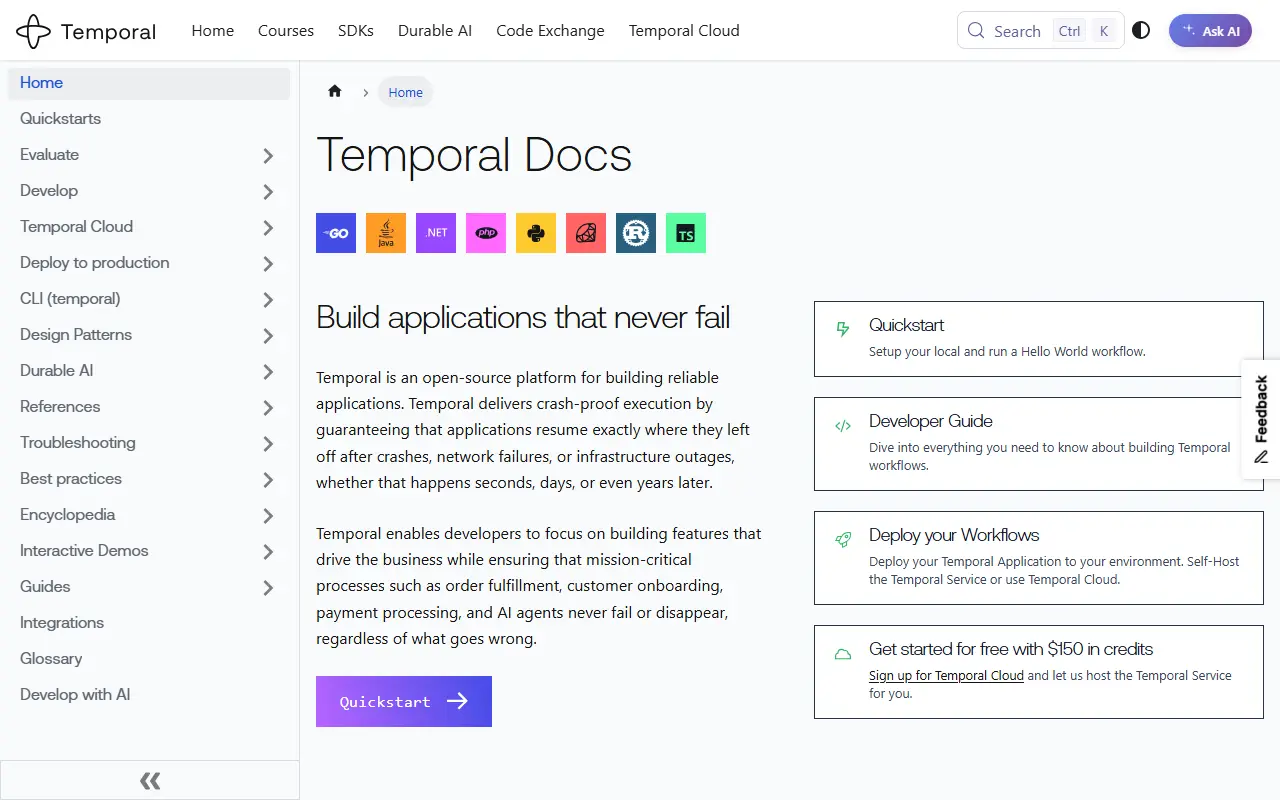
Temporal is a durable execution platform that helps developers create scalable applications while keeping both productivity and reliability. The Temporal server runs units of application logic called Workflows, handling intermittent failures and retrying failed operations automatically. It started as a fork of Uber's Cadence and is developed by Temporal Technologies, a company founded by Cadence's creators. The server is written in Go and released under the MIT license.
This repository contains the source of the server only. To implement Workflows, Activities and Workers you use one of the supported language SDKs. The getting started guide shows how to download and run a pre-built image with its dependencies locally, try samples written for Go or Java, interact with the server through the Temporal CLI, and watch workflows in the Web UI at port 8233. Repository topics cover workflow engines, distributed cron, microservice orchestration and durable execution.
Key features
- Durable execution of long-running workflows
- Automatic retries for failed operations
- SDKs for writing Workflows and Activities
- Temporal CLI for interacting with the server
- Web UI for viewing running workflows
- Distributed cron-style scheduling
Pricing: Server is free and open source under the MIT license; a managed cloud service is also offered by Temporal Technologies.
#3
An open-source, event-driven orchestration and scheduling platform where data, AI and infrastructure workflows are defined declaratively in YAML and managed from a UI.
- GitHub stars
- 30k
- Last commit
- today
- Latest release
- v2.0.10
- Licence
- Apache-2.0
- Self-hosted
- Yes
go.kestra.io
Kestra is an orchestration platform, open source, for data pipelines, AI workflows and infrastructure automation. It brings scheduled and event-triggered automation together under one declarative interface that does not depend on a programming language, applying infrastructure-as-code practices to pipelines so that reliable workflows can be defined in a few lines of YAML.
Workflows can be built in the UI, written by a built-in AI Copilot, or generated from coding agents such as Claude Code and Cursor using agent skills, and everything can be kept as code with Git integration even when it was authored visually. A large plugin ecosystem connects it to external systems, and key concepts cover tasks, triggers and flows. The project is written in Java, with topics covering orchestration, high availability, pipeline-as-code and DevOps, and the 2.0 release adds new capabilities.
Kestra is Apache-2.0 licensed and can be self-hosted, with a quick start that gets a first workflow running in minutes. It targets data engineers, platform teams and automation developers who want an alternative to schedulers such as Airflow with a more declarative style.
Key features
- Declarative YAML workflow definitions
- Scheduled and event-driven triggers
- Visual editor and AI Copilot
- Git version control integration
- Large plugin ecosystem
- Agent skills for coding agents
Pricing: Free and open source under the Apache-2.0 license.
#4
Apache Kafka is an open-source platform for distributed event streaming, used in data pipelines, streaming analytics and data integration.
- GitHub stars
- 34k
- Last commit
- yesterday
- Licence
- Apache-2.0
- Self-hosted
- Yes
kafka.apache.org
Apache Kafka is a platform for distributed event streaming. Teams use it to move and process streams of events for data pipelines, streaming analytics, data integration and business-critical applications. The code lives in the Apache Software Foundation repository, is written mainly in Java with Scala for parts of the broker, and is released under the Apache-2.0 license.
Kafka is installed software that you run yourself. The project builds and tests against recent Java versions, supports Scala 2.13 only, and documents how to build a JAR and start a broker through its quickstart. The repository also contains client and streams modules, along with test tooling for unit and integration runs. Because Kafka is operated as infrastructure, adopters typically run clusters on their own servers or on Kubernetes, though managed services from other vendors exist.
Key features
- Distributed event streaming platform
- Durable publish and subscribe topics
- Client libraries and a streams module
- Suited to data pipelines and integration
- Runs on Java with Scala 2.13
- Quickstart for building and running a broker
Pricing: Free and open source under the Apache-2.0 license.
#5
NATS Server is a high-performance messaging server for distributed systems, microservices and edge devices, written in Go.
- GitHub stars
- 21k
- Last commit
- 2 days ago
- Latest release
- v2.15.3
- Licence
- Apache-2.0
- Self-hosted
- Yes
nats.io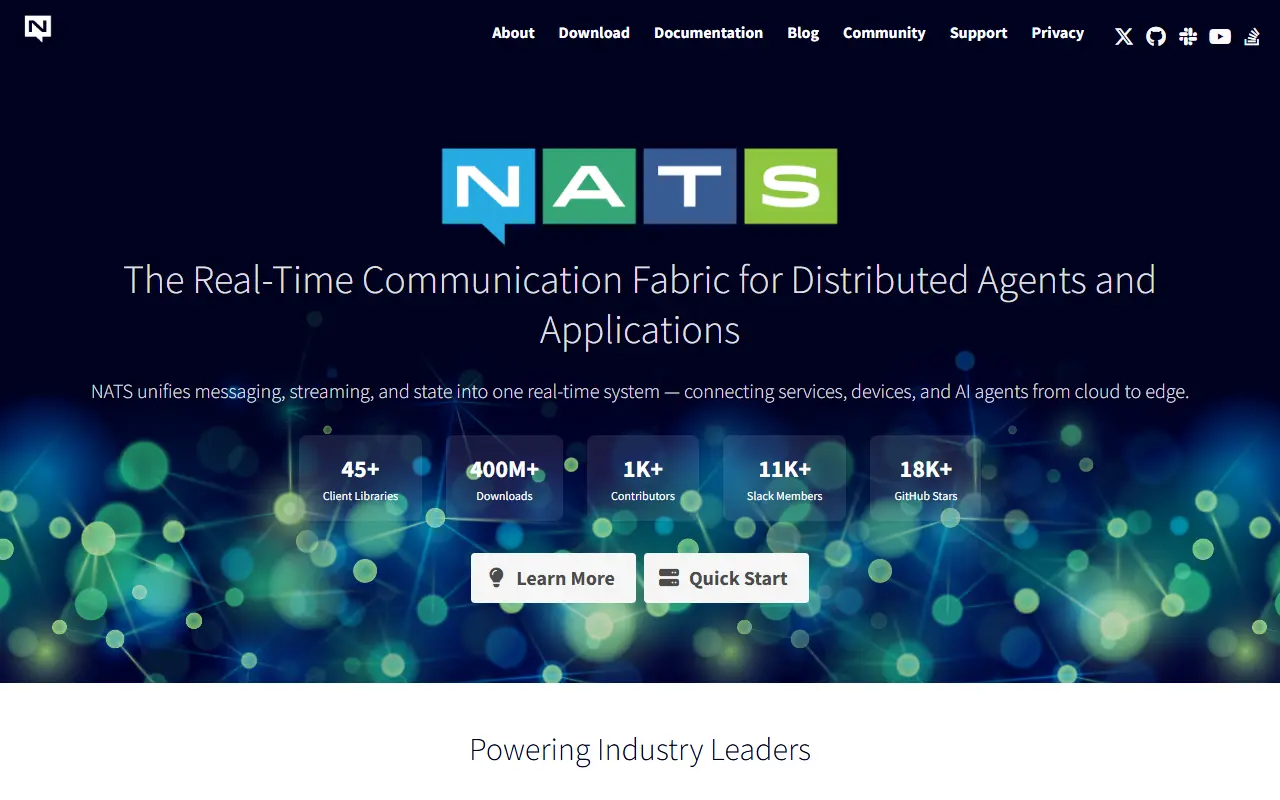
NATS is a messaging system for connecting applications, services and devices, and nats-server is its Go implementation. It works as a message bus and queue for microservices and other distributed systems, and the server is a single lightweight program that runs in many different environments.
The server can run on-premise, in the cloud, at the edge and even on a Raspberry Pi. The project lists more than 40 client language implementations, so services written in different languages can talk to one another. NATS is part of the Cloud Native Computing Foundation and aims to simplify the design and operation of modern distributed systems.
NATS Server is free software under the Apache 2.0 license and is distributed through Docker images and GitHub releases. Repository topics point to uses in cloud-native microservices, connected vehicles and edge computing.
Key features
- High-performance messaging server written in Go
- Message bus and queue patterns
- Over 40 client language libraries
- Runs on-premise, in the cloud or at the edge
- Small footprint that fits a Raspberry Pi
- Docker images available
Pricing: Free and open source under the Apache 2.0 license.
#6
Apache Flink is a framework and distributed processing engine for stateful computations over unbounded and bounded data streams, designed to run in all common cluster environments.
- GitHub stars
- 26k
- Last commit
- yesterday
- Licence
- Apache-2.0
- Self-hosted
- Yes
flink.apache.org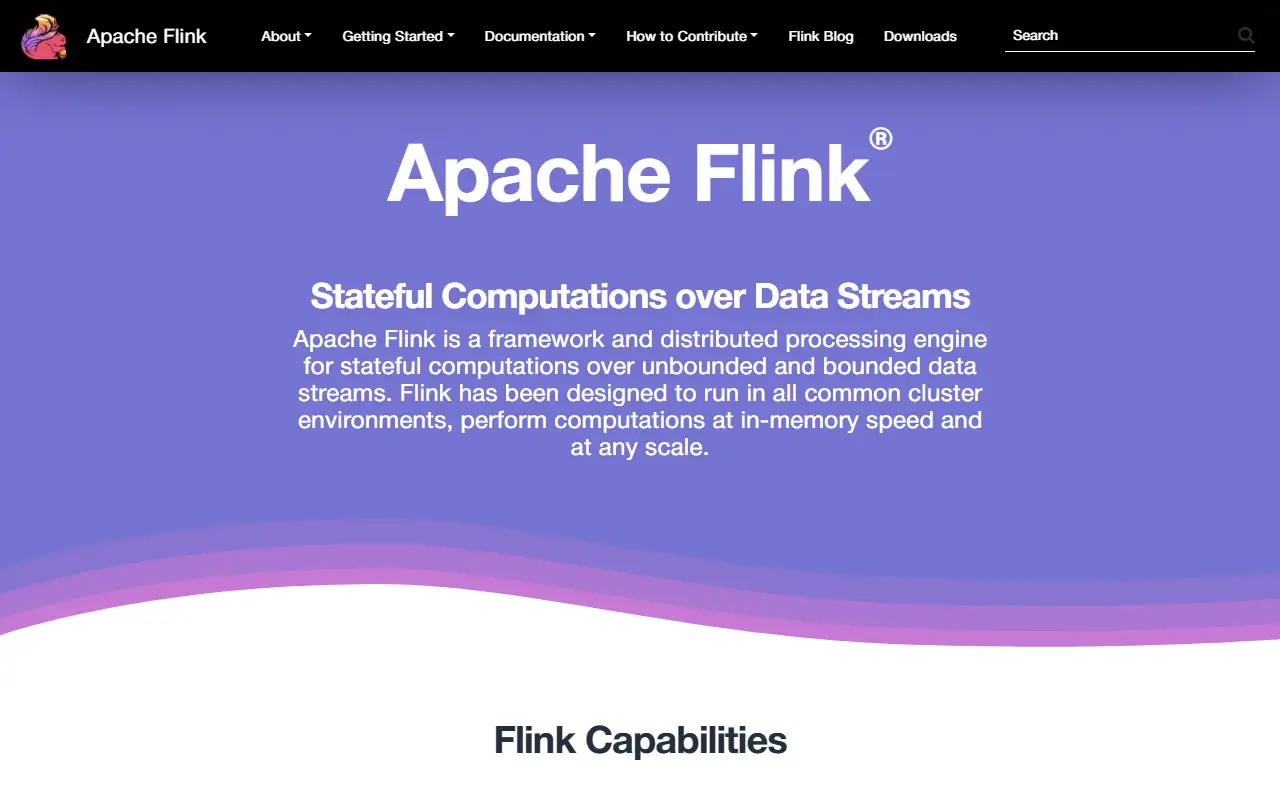
Apache Flink is a framework and distributed processing engine for stateful computations over unbounded and bounded data streams. It has been designed to run in all common cluster environments, perform computations at in-memory speed and at any scale.
Flink provides correctness guarantees including exactly-once state consistency, event-time processing, and sophisticated late data handling. It offers layered APIs such as SQL on stream and batch data, DataStream API, and ProcessFunction for time and state.
Key features
- Exactly-once state consistency
- Event-time processing
- Sophisticated late data handling
- Layered APIs including SQL, DataStream API, and ProcessFunction
- Flexible deployment and high-availability setup
- Scale-out architecture with support for very large state and incremental checkpoints

Multi-protocol message and streaming broker supporting AMQP, MQTT and STOMP, used to decouple services in distributed systems.
- GitHub stars
- 14k
- Last commit
- 2 days ago
- Latest release
- v4.4.0
- Self-hosted
- Yes
rabbitmq.com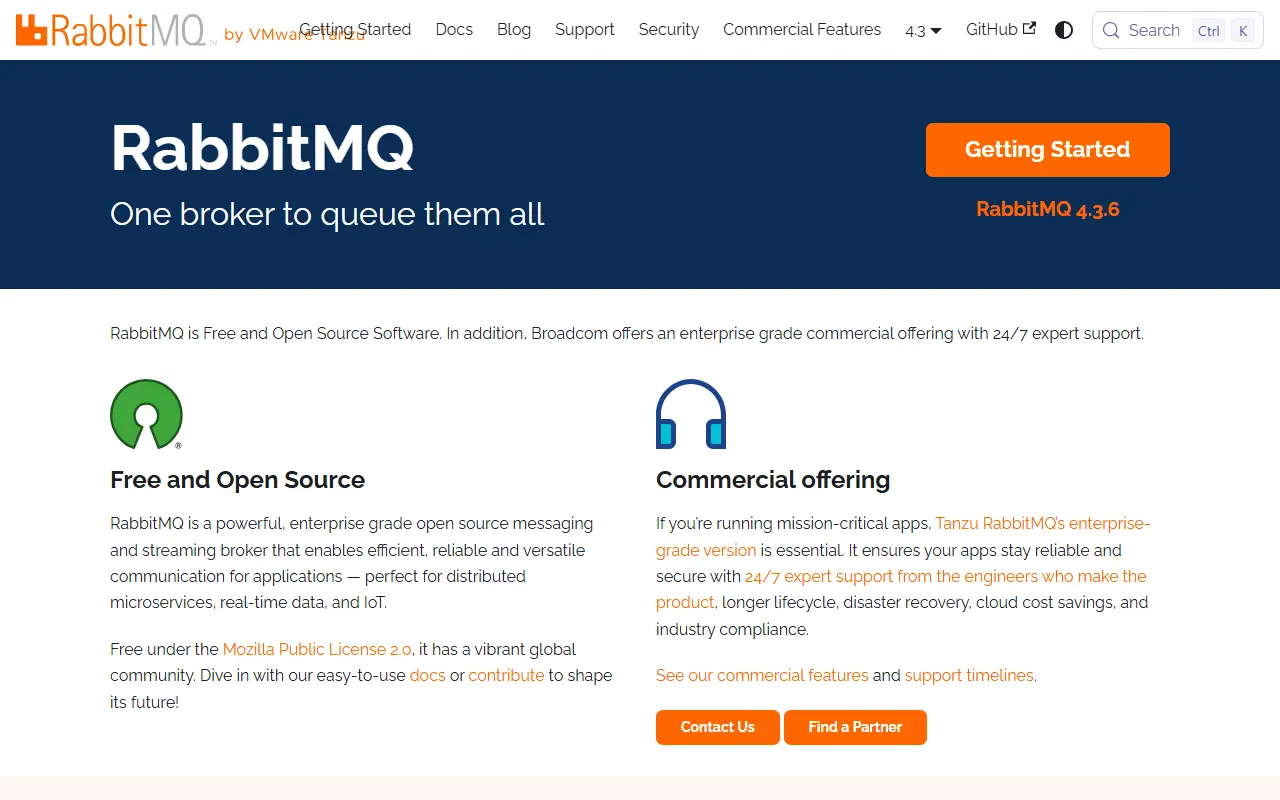
RabbitMQ is an open-source message broker that also supports streaming. Applications publish messages to the broker and other applications consume them, which lets services communicate without depending on each other being available at the same moment. This repository contains the core server and the built-in tier 1 plugins.
The broker speaks several protocols: AMQP 0-9-1, AMQP 1.0, its own Stream Protocol, MQTT versions 3.1, 3.1.1 and 5.0, STOMP 1.0 through 1.2, and MQTT and STOMP over WebSocket. Quorum queues provide replicated, consistency-oriented queues, while streams offer a persistent, replicated append-only log that consumers can read without removing messages. Monitoring works with Prometheus and Grafana.
The server is licensed under the MPL 2.0 and can be installed on many platforms, with a Kubernetes Cluster Operator for container deployments. The documentation includes tutorials, a production checklist and clustering guides. Commercial editions and paid support from Broadcom exist alongside the community edition, which is supported through GitHub Discussions and Discord.
Key features
- AMQP 0-9-1 and AMQP 1.0 messaging
- MQTT and STOMP protocol support
- Replicated quorum queues
- Persistent replicated streams
- Kubernetes Cluster Operator
- Prometheus and Grafana monitoring
Pricing: Open source under the MPL 2.0; commercial editions and paid support are available from Broadcom.
#8
Inngest is a workflow orchestration platform for durable step functions and AI workflows, runnable on its cloud platform or a self-hosted server.
- GitHub stars
- 6k
- Last commit
- yesterday
- Latest release
- v1.52.0
- Self-hosted
- Yes
- Hosted version
- Available
inngest.com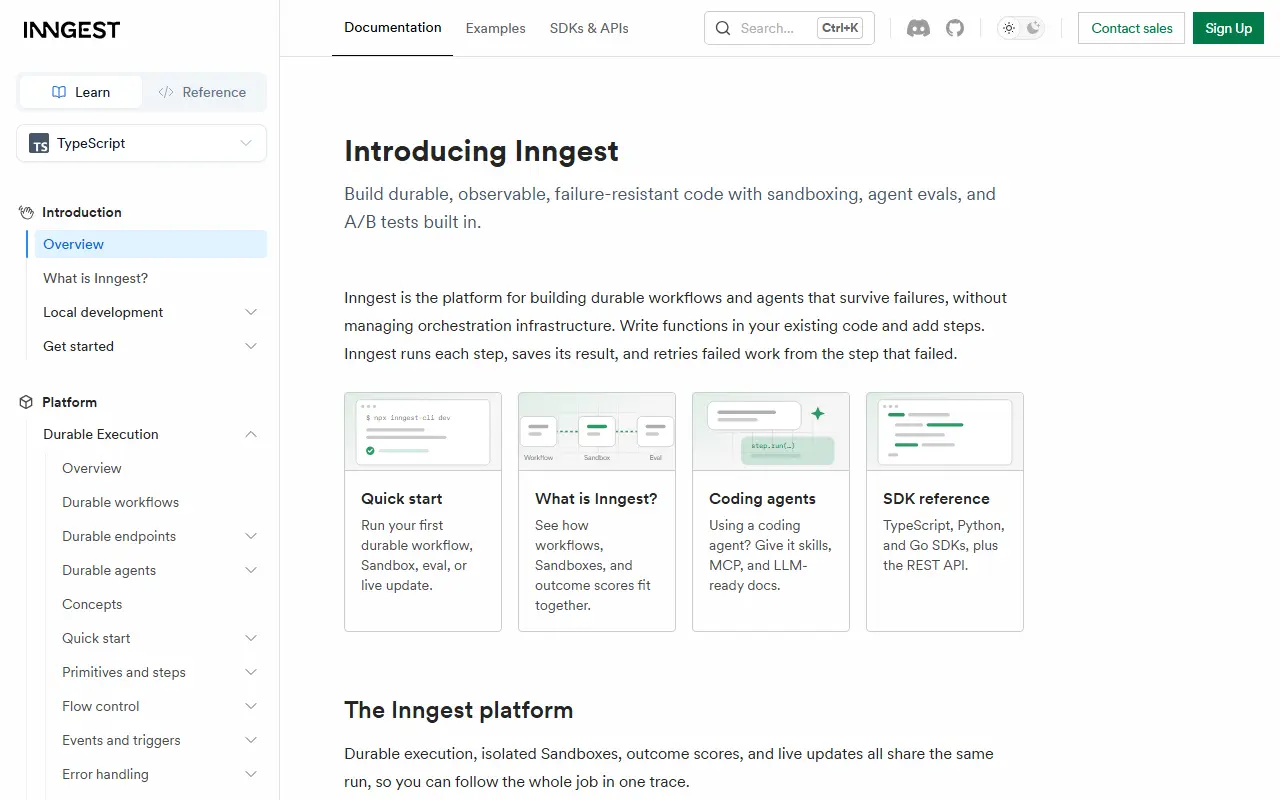
Inngest is a workflow orchestration platform built around durable functions. These functions replace separate queues, state management and scheduling so developers can write reliable step functions and background jobs without managing the underlying infrastructure.
An Inngest function has three parts. Triggers are events, cron schedules or webhook events, flow control configures how runs are queued and executed through concurrency, throttling, debouncing, rate limiting and prioritization, and steps are the building blocks that can retry on error and run for months. You write functions with a language SDK, test them with the Inngest Dev Server, deploy them to your own infrastructure and sync them with the Inngest Platform or a self-hosted server, which then calls them securely over HTTPS when events arrive.
Inngest is written in Go. Its quick starts cover Next.js, Node.js and Python, and the documentation includes project architecture and self-hosting guides. The repository lists its licence as other, so check the terms before running it yourself.
Key features
- Durable step functions with automatic retries
- Event, cron and webhook triggers
- Concurrency, throttling and rate limiting controls
- Local Dev Server with dashboard
- SDKs for several languages
- Cloud platform or self-hosted server

Redis Insight is a visual developer tool from Redis for browsing, querying and optimizing Redis data, with a workbench, profiler and slow log analysis.
- GitHub stars
- 8.9k
- Last commit
- 2 days ago
- Latest release
- 3.8.0
redis.io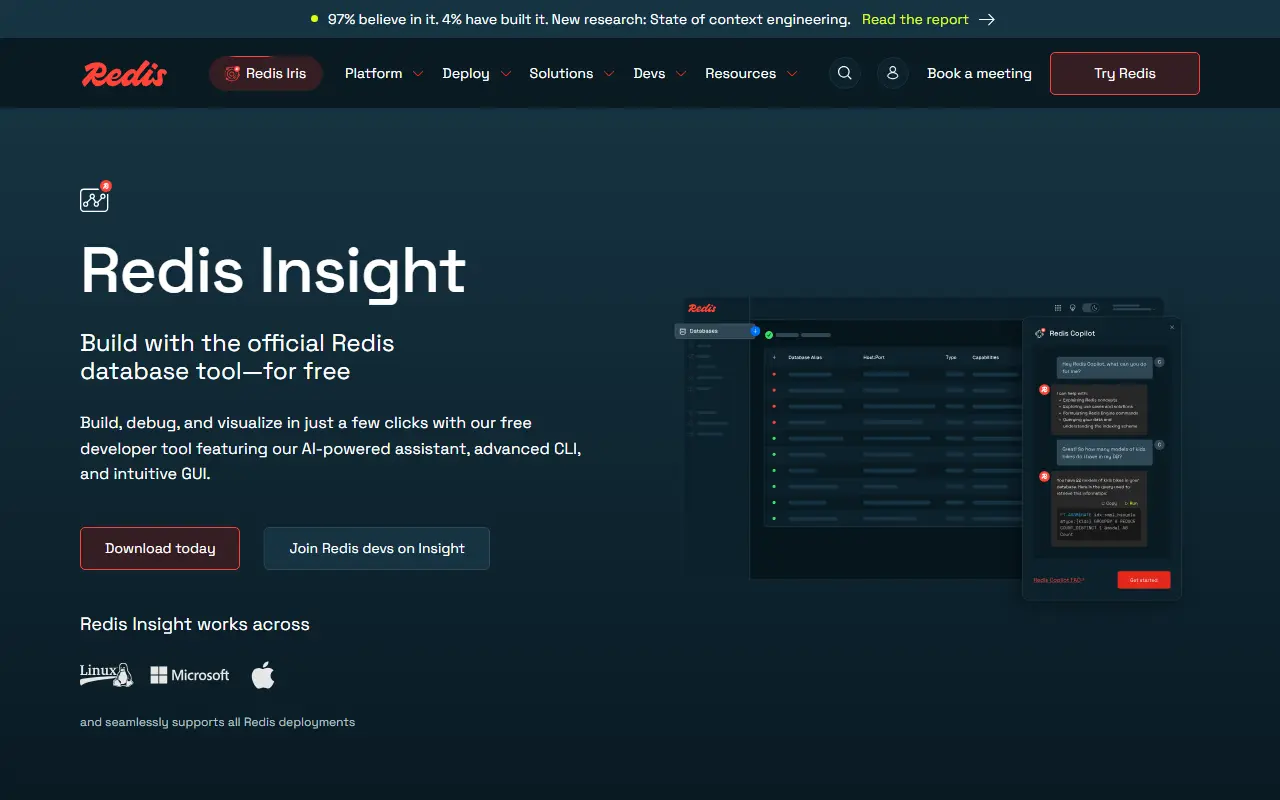
Redis Insight is a graphical client for Redis, published by Redis. It helps developers design, build and tune applications by letting them browse, filter and visualize key-value data and view values in formats such as JSON, Hex and ASCII.
It offers create, read, update and delete support for lists, hashes, strings, sets, sorted sets, streams and JSON, plus management of vector sets, including similarity search. A Workbench provides a command-line interface with command auto-complete, while Profiler shows commands sent to Redis in real time and SlowLog highlights slow operations. Pub/Sub support, bulk deletion by filter and in-context recommendations for performance and memory use round out the tool, along with interactive tutorials.
The application is built with Electron, the Monaco editor and Node.js, and it works with Redis modules. The repository licence is listed as non-standard rather than a common open-source licence, so check the repository for the exact terms before redistributing.
Key features
- Browse and filter Redis keys visually
- CRUD for core data types and JSON
- Vector set creation and similarity search
- Workbench with command auto-complete
- Real-time command profiler
- SlowLog analysis and Pub/Sub support

Apache Camel Karavan is a low-code platform and VS Code extension for visually designing, running and deploying Apache Camel integration microservices.
- GitHub stars
- 599
- Last commit
- 3 days ago
- Latest release
- 4.22.2
- Licence
- Apache-2.0
- Self-hosted
- Yes
camel.apache.org
Apache Camel Karavan is a low-code data integration platform that simplifies the Apache Camel experience by letting teams design integration microservices visually and deploy them quickly. It aims to give the full power of Apache Camel through a visual tool, from low-code use cases to pro-code projects, drawing on more than ten years of community experience.
The designer supports Enterprise Integration Patterns, over 300 integration components, a REST API designer with an OpenAPI to REST DSL generator, YAML for integrations with Java for custom code, a route designer and a topology view. The deployer provides shell scripts for building and deploying and predefined customizable configurations for different platforms, and a developer dashboard offers hot reload, live logs and tracing of exchange data. Architecturally, the Karavan app manages projects, a build container packages and runs integrations, a Git repository stores project files as the source of truth, and an image registry holds built container images.
A VS Code extension provides a local developer experience for designing and running integrations on a laptop and deploying to Kubernetes or OpenShift. The platform can be installed on Docker, Kubernetes or OpenShift, is part of the Apache Software Foundation and is licensed under Apache-2.0.
Key features
- Visual route and REST API designer
- 300+ Camel integration components
- Enterprise Integration Patterns
- Hot reload and live logs
- VS Code extension for local development
- Deployment to Docker, Kubernetes and OpenShift
Pricing: Free and open source under the Apache-2.0 license.
Amazon EventBridge alternatives: questions
- What is the best open-source alternative to Amazon EventBridge?
- n8n is the top-ranked open-source alternative to Amazon EventBridge on Enlisted: A fair-code workflow automation platform that mixes a visual canvas with custom code and AI agent features, for teams connecting apps and automating processes. Other strong options are Temporal, Kestra, Kafka and NATS.
- What are the best commercial alternatives to Amazon EventBridge?
- Google Cloud Workflows, Azure Logic Apps, Confluent, MuleSoft and Red Hat OpenShift are among the hosted, closed-source alternatives to Amazon EventBridge listed on Enlisted, which lists 14 in total. Compare their pricing and features on each tool page.
- Are these Amazon EventBridge alternatives free?
- All 10 are open source, so the code is free to use under its licence, and all of them can be self-hosted on your own server or computer. 3 also offer a paid or managed cloud version if you'd rather not host it yourself.
- How is this list of Amazon EventBridge alternatives ranked?
- By a score built from GitHub stars, star growth over the last 30 days and how recently the code changed. 10 of these projects shipped code in the last 30 days. Data is refreshed daily, and nobody can pay to move up.
 TrackMedia
 TrackRev