 TrackMedia
 TrackRev

 Parallels Desktop
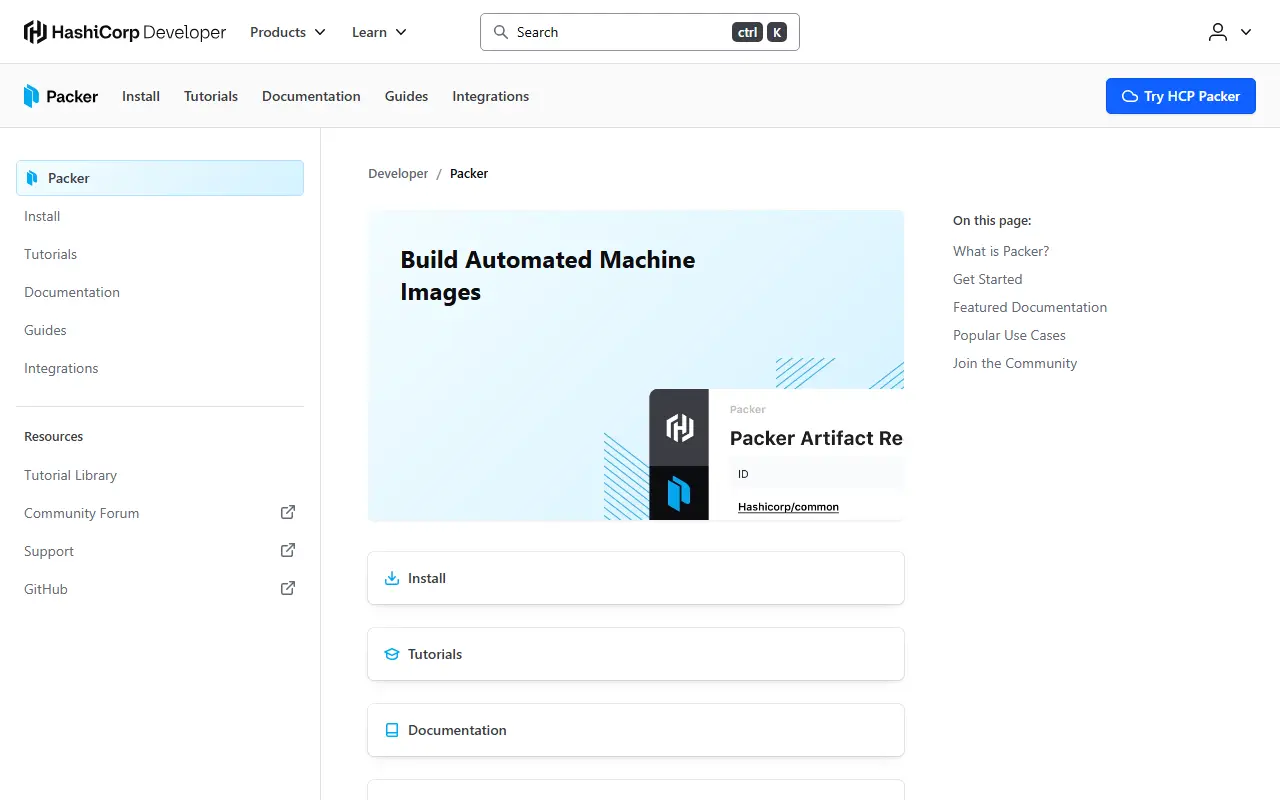
About Packer
Packer creates machine images for several platforms from one source template, so the same definition produces identical images in each place. HashiCorp's description says it can be used to create golden images for image pipelines.
Templates describe how Packer should build machine images, and the Packer CLI drives its command-line workflows. The documentation also covers integrations, and the getting-started tutorials include Amazon Web Services and Docker.
HCP Packer is a separate HashiCorp cloud service for managing machine images across an organization and automating build management across cloud providers, with a free trial offered on the site. Tutorials show it used with Terraform to build a golden image pipeline, schedule revocation of artifact versions for compliance and detect compromised artifacts.
Key features
- Builds identical images for many platforms from one template
- Creates golden images for image pipelines
- Templates define how images are built
- Schedules revocation of outdated artifact versions
- Detects Terraform use of revoked artifact versions
Good fit for
- Golden image pipelines
- Provisioning built images on AWS with Terraform
- Revoking outdated image versions
Packer: questions and answers
- What is Packer used for?
- Packer is a HashiCorp tool that builds identical machine images for multiple platforms from a single source template, used for golden image pipelines. It is a good fit for golden image pipelines, provisioning built images on AWS with Terraform and revoking outdated image versions.
- Is Packer open source?
- Yes. Packer is open source under a custom licence. Its source code is on GitHub at hashicorp/packer and is written mainly in Go.
- Is Packer free?
- Yes. Packer is open source, so the software itself is free to use under the terms of its own licence. A managed cloud version is also available.
- Can I self-host Packer?
- Yes. Packer can be self-hosted on your own server or infrastructure.
- What is Packer an alternative to?
- Packer is an open-source alternative to Parallels Desktop. Other open-source alternatives to Parallels Desktop include Vagrant, Podman Desktop and UTM.
- Is Packer actively maintained?
- Yes. The most recent commit to Packer was on 12 November 2026, and the latest release is v1.16.2, published on 22 October 2026. The project has 16k stars on GitHub, with 14 added in the last 30 days.
Open-source alternatives to Packer
See all
Vagrant
Developer Tools
Vagrant is a tool for building and distributing development environments.
OSSvs OrbStack★ 27k
Podman Desktop
Infrastructure & Containers
Podman Desktop is the best free and open source tool to work with Containers and Kubernete
Apache-2.0vs Docker Desktop★ 8.2k
UTM
Infrastructure & Containers
Virtual machines for iOS and macOS
Apache-2.0vs Parallels Desktop★ 37k
Tart
Infrastructure & Containers
macOS and Linux VMs on Apple Silicon to use in CI and other automations
OSSvs OrbStack★ 7.9k
Podman
Infrastructure & Containers
Podman: A tool for managing OCI containers and pods.
Apache-2.0vs Docker Desktop★ 33k
QEMU
Infrastructure & Containers
Official QEMU mirror. Please see https://www.qemu.org/contribute/ for how to submit change
OSSvs VMware Workstation★ 14k