
 Permit.io
 Oso
Oso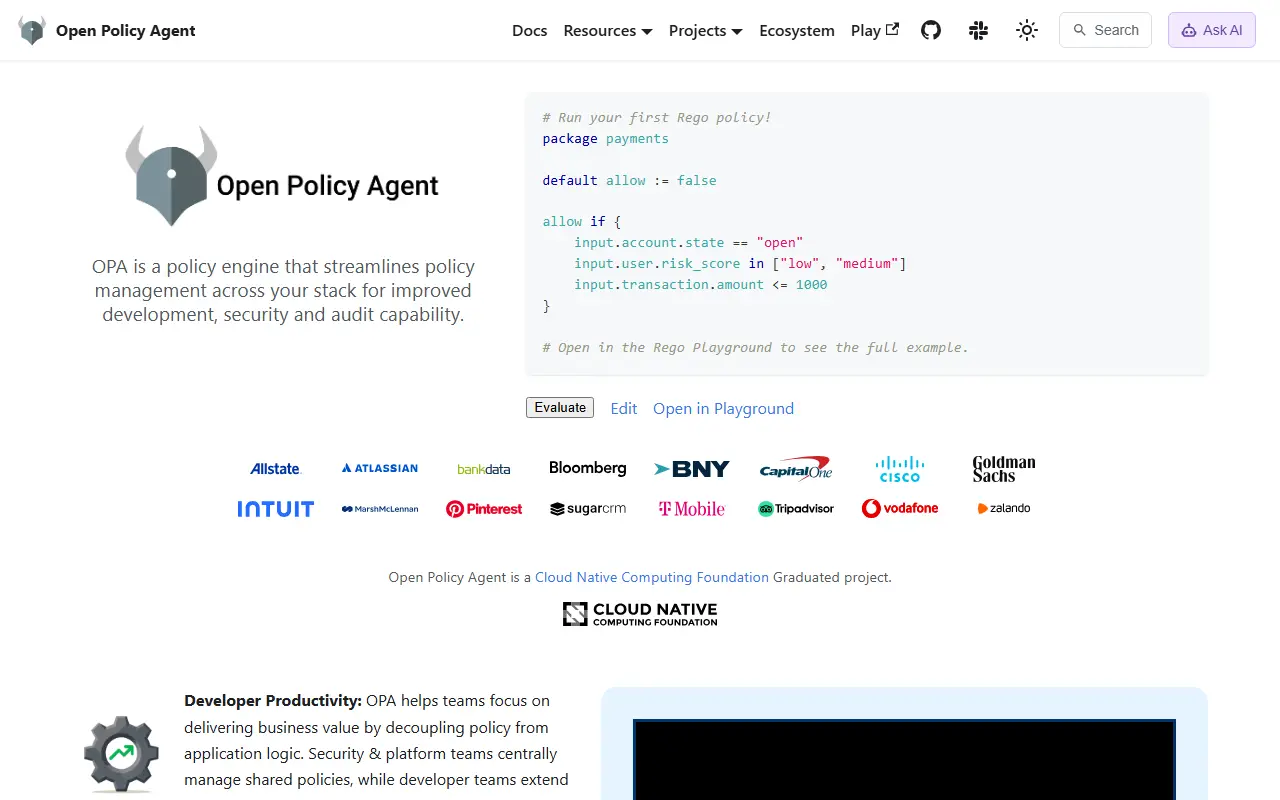
About OPA
OPA is a policy engine that streamlines policy management across the stack for improved development, security and audit capability. It provides a high-level declarative language (Rego) that lets you specify policy for a wide range of use cases. You can use OPA to enforce policies in applications, proxies, Kubernetes, CI/CD pipelines, API gateways, and more.
OPA helps teams focus on delivering business value by decoupling policy from application logic. Security and platform teams centrally manage shared policies, while developer teams extend them as needed within the policy system. OPA generates comprehensive audit trails for every policy decision, supporting auditing and compliance efforts.
Key features
- Decouples policy from application logic
- Uses Rego, a domain-specific policy language built for speed
- Operates on pre-loaded, in-memory data for fast policy decisions
- Generates comprehensive audit trails for every policy decision
- Supports integration via SDKs or REST API
- Can enforce policies in applications, proxies, Kubernetes, CI/CD pipelines, API gateways, and more
Good fit for
- Enforcing authorization policies in applications
- Managing shared policies across teams
- Auditing and compliance with replayable decision history
OPA: questions and answers
- What is OPA used for?
- OPA is an open source, general-purpose policy engine that decouples policy from application logic. It is a good fit for enforcing authorization policies in applications, managing shared policies across teams, and auditing and compliance with replayable decision history.
- Is OPA open source?
- Yes. OPA is open source under the Apache-2.0 licence. Its source code is on GitHub at open-policy-agent/opa and is written mainly in Go.
- Is OPA free?
- Yes. OPA is open source, so the software itself is free to use.
- Can I self-host OPA?
- Yes. OPA can be self-hosted on your own server or infrastructure.
- What is OPA an alternative to?
- OPA is an open-source alternative to Permit.io and Oso. Other open-source alternatives to Permit.io include SpiceDB, OpenFGA and Keto.
- Is OPA actively maintained?
- Yes. The most recent commit to OPA was on 13 October 2026, and the latest release is v1.21.2, published on 12 October 2026. The project has 12k stars on GitHub.
Open-source alternatives to OPA
See all
SpiceDB
Auth & Identity
Open Source, Google Zanzibar-inspired database for scalably storing and querying fine-grai
Apache-2.0vs Oso★ 7.1k
OpenFGA
Security
A high-performance and flexible authorization/permission engine built for developers and i
Apache-2.0vs Permit.io★ 6k
Keto
Open source
The most scalable and customizable permission server on the market. Fix your slow or broke
Apache-2.0vs Permit.io★ 5.4k
Keycloak
Auth & Identity
Open Source Identity and Access Management For Modern Applications and Services
Apache-2.0vs Auth0★ 37k
Polar
Finance & Accounting
Polar — A billing platform for the intelligence era
Apache-2.0vs Lemon Squeezy★ 10k
Pomerium
Security
Pomerium is an identity and context-aware access proxy.
Apache-2.0vs Cloudflare Zero Trust★ 5k