 TrackMedia
 TrackRev

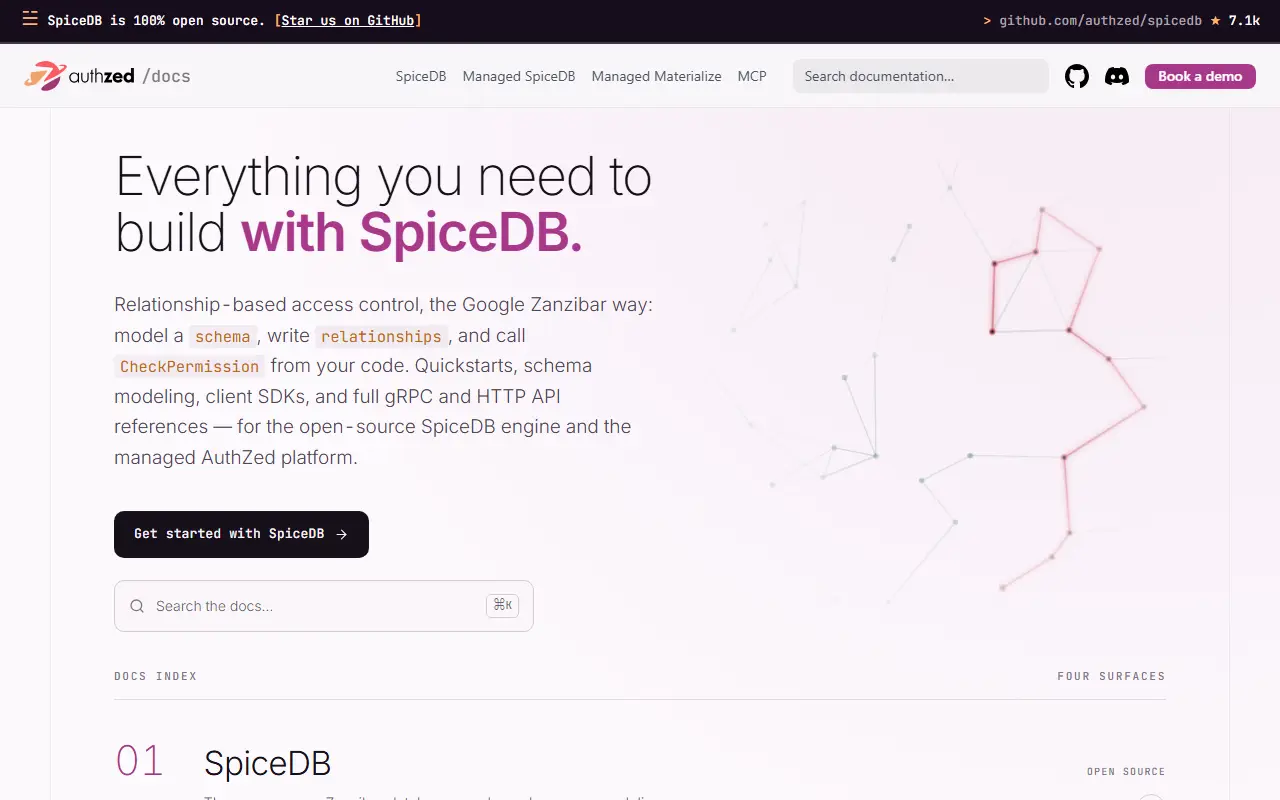
About SpiceDB
This entry covers SpiceDB, the open-source authorization database from Authzed. It is inspired by Google's Zanzibar paper and lets platform and product teams answer questions such as whether a given subject can perform an action on a given resource, which addresses broken access control, a major web security risk.
Like a relational database, you define a schema, write data as relationships and then use client libraries to issue permission checks from your application. Other queries are possible too, such as what a subject can do or who can access a resource. SpiceDB typically runs as one central service used by several products and microservices, and it focuses purely on authorization, staying agnostic to authentication and identity providers. Topics mention RBAC, ABAC, ReBAC and fine-grained access control.
SpiceDB is written in Go, runs on Kubernetes and elsewhere, and is licensed under Apache-2.0. Authzed also offers commercial products around it. It suits engineering teams that need consistent, scalable permissions for multi-tenant or collaborative applications.
Key features
- Zanzibar-style relationship-based permissions
- Schema language for authorization models
- Permission check and lookup queries
- Centralized authorization service
- Independent of identity providers
- Distributed, cloud-native design
Good fit for
- Fine-grained permissions in SaaS apps
- Sharing and access control for documents
- Centralized authorization across microservices
SpiceDB: questions and answers
- What is SpiceDB used for?
- SpiceDB from Authzed is an open-source, Google Zanzibar-inspired database for storing and querying fine-grained authorization data, answering whether a subject can perform an action on a resource. It is a good fit for fine-grained permissions in SaaS apps, sharing and access control for documents, and centralized authorization across microservices.
- Is SpiceDB open source?
- Yes. SpiceDB is open source under the Apache-2.0 licence. Its source code is on GitHub at authzed/spicedb and is written mainly in Go.
- Is SpiceDB free?
- Yes. SpiceDB is open source, so the software itself is free to use.
- Can I self-host SpiceDB?
- Yes. SpiceDB can be self-hosted on your own server or infrastructure.
- What is SpiceDB an alternative to?
- SpiceDB is an open-source alternative to Oso, Permit.io and Authress. Other open-source alternatives to Oso include Keto, OpenFGA and OPA.
- Is SpiceDB actively maintained?
- Yes. The most recent commit to SpiceDB was on 13 November 2026, and the latest release is v1.57.1, published on 10 November 2026. The project has 7.2k stars on GitHub, with 72 added in the last 30 days.
Open-source alternatives to SpiceDB
See all
Keto
Open source
The most scalable and customizable permission server on the market. Fix your slow or broke
Apache-2.0vs Permit.io★ 5.4k
OpenFGA
Security
A high-performance and flexible authorization/permission engine built for developers and i
Apache-2.0vs Permit.io★ 6.1k
Keycloak
Auth & Identity
Open Source Identity and Access Management For Modern Applications and Services
Apache-2.0vs Auth0★ 38k
OPA
Open source
Open Policy Agent (OPA) is an open source, general-purpose policy engine.
Apache-2.0vs Permit.io★ 12k
Logto
Auth & Identity
🧑🚀 Authentication and authorization infrastructure for SaaS and AI apps, built on OIDC
MPL-2.0vs Auth0★ 15k
ZITADEL
Auth & Identity
ZITADEL - Identity infrastructure, simplified for you.
AGPL-3.0vs Auth0★ 16k
SaaS alternatives to SpiceDB
See all
Oso
Auth & Identity
Authorization service for modeling and enforcing app permissions with a policy language
SaaS
Permit.io
Auth & Identity
Authorization-as-a-service with RBAC, ABAC and policy management
SaaS
Authress
Auth & Identity
Hosted login with fine-grained access control for SaaS applications
SaaS
Keyring
Auth & Identity
Role-based access control (RBAC) service for AI agent applications
SaaS
Scalekit
Auth & Identity
Auth platform for AI agents and B2B apps with SSO, scoped tokens and connectors
SaaS
Aserto
Auth & Identity
Fine-grained authorization service for applications and APIs
SaaS