
About KDash
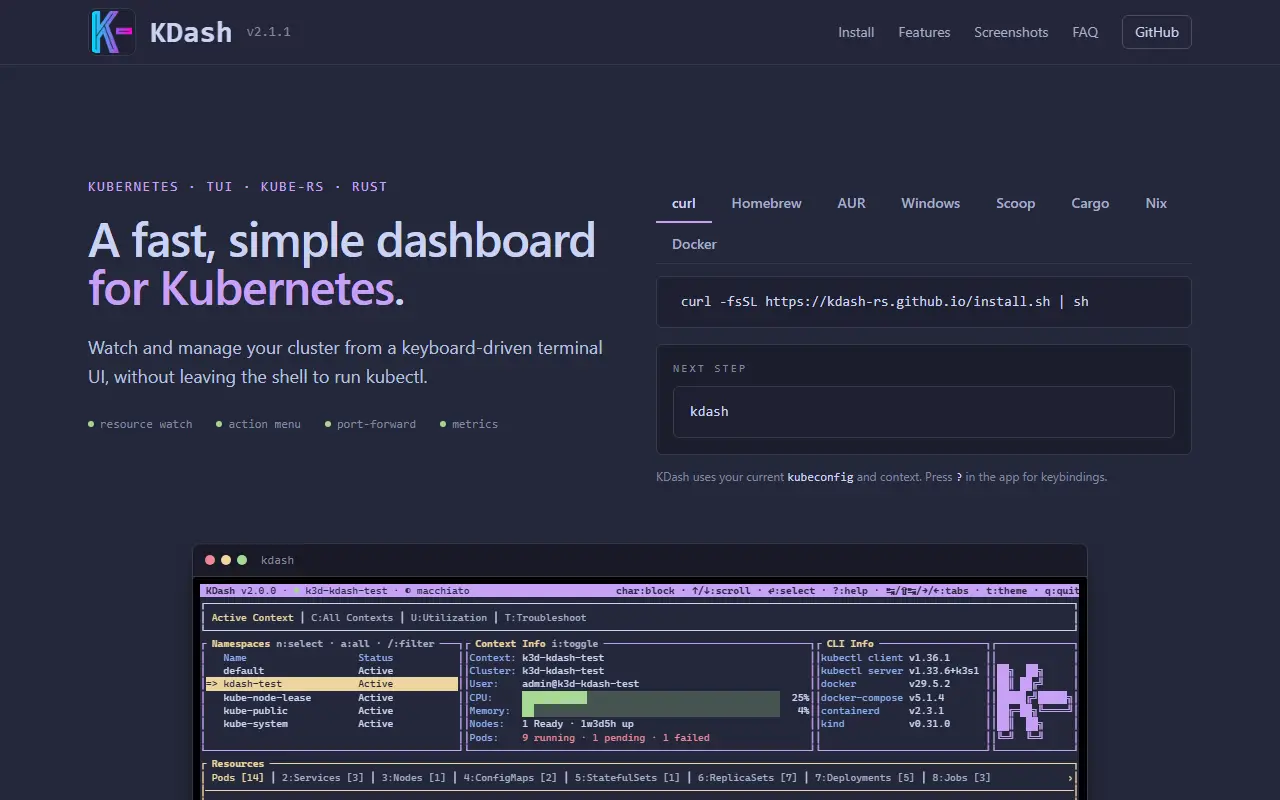
KDash is a terminal user interface for Kubernetes, built in Rust. It gives a quick overview of cluster resources and lets you work with them from the keyboard without leaving the terminal. It is released under the MIT license.
Version 2.0 added resource management actions: delete any resource, edit a resource in your editor, rollout-restart workloads, view the logs of previous containers, scale workloads, cordon nodes, and suspend, resume, or trigger CronJobs from an action menu. Impactful actions ask for confirmation. You can also port-forward a pod or service, and list and stop active forwards, with forwards running in the background.
The README covers installation, usage, keybindings, configuration, flags, known limitations, and screenshots. KDash suits Kubernetes administrators and developers who prefer a lightweight terminal tool, a role similar to other TUI dashboards, over a browser-based console.
Key features
- Terminal dashboard for Kubernetes resources
- Delete and edit resources in place
- Rollout restart and workload scaling
- Previous container log viewing
- Node cordon and CronJob controls
- Pod and service port forwarding
Good fit for
- →Inspecting a cluster from an SSH session
- →Quickly restarting or scaling workloads
- Tags
- kubernetes
- tui
- dashboard
- rust
- terminal
- k8s
- devops
- monitoring
KDash: questions and answers
- What is KDash used for?
- KDash is a fast terminal dashboard for Kubernetes written in Rust, with resource views, logs, and actions such as scaling, restarting, and port forwarding. It is a good fit for inspecting a cluster from an SSH session and quickly restarting or scaling workloads.
- Is KDash open source?
- Yes. KDash is open source under the MIT licence. Its source code is on GitHub at kdash-rs/kdash and is written mainly in Rust.
- Is KDash free?
- Yes. KDash is open source, so the software itself is free to use.
- What is KDash an alternative to?
- KDash is an open-source alternative to Lens. Other open-source alternatives to Lens include Kubebox, Kite and Portainer.
- Is KDash actively maintained?
- Yes. The most recent commit to KDash was on 24 September 2026, and the latest release is v2.1.1, published on 22 July 2026. The project has 2.5k stars on GitHub.
Open-source alternatives to KDash
See allKubebox
Infrastructure & Containers
⎈❏ Terminal and Web console for Kubernetes
MITvs Lens★ 2.2k
Kite
Infrastructure & Containers
🪁 A lightweight, modern Kubernetes dashboard. All your clusters. One workspace.
Apache-2.0vs Lens★ 3.2k
Portainer
Infrastructure & Containers
Making Docker and Kubernetes management easy.
Zlibvs Lens★ 39k
Minikube
Infrastructure & Containers
Run Kubernetes locally
Apache-2.0★ 32k
Kubernetes
Infrastructure & Containers
Production-Grade Container Scheduling and Management
Apache-2.0vs Amazon EKS★ 128k
MicroK8s
Infrastructure & Containers
MicroK8s is a small, fast, single-package Kubernetes for datacenters and the edge.
Apache-2.0vs Amazon EKS★ 9.4k
SaaS alternatives to KDash
See all
Lens
Infrastructure & Containers
Desktop Kubernetes IDE for managing clusters and workloads
SaaS
Komodor
Infrastructure & Containers
Kubernetes troubleshooting and cluster management platform
SaaS
Amazon EKS
Infrastructure & Containers
Managed Kubernetes control plane and worker nodes on AWS
SaaS
Azure Kubernetes Service
Infrastructure & Containers
Managed Kubernetes service on Microsoft Azure
SaaS
Docker Desktop
Infrastructure & Containers
Desktop app for building and running containers locally, with Kubernetes support
SaaS
IBM Cloud Kubernetes Service
Infrastructure & Containers
Managed Kubernetes service on IBM Cloud
SaaS