
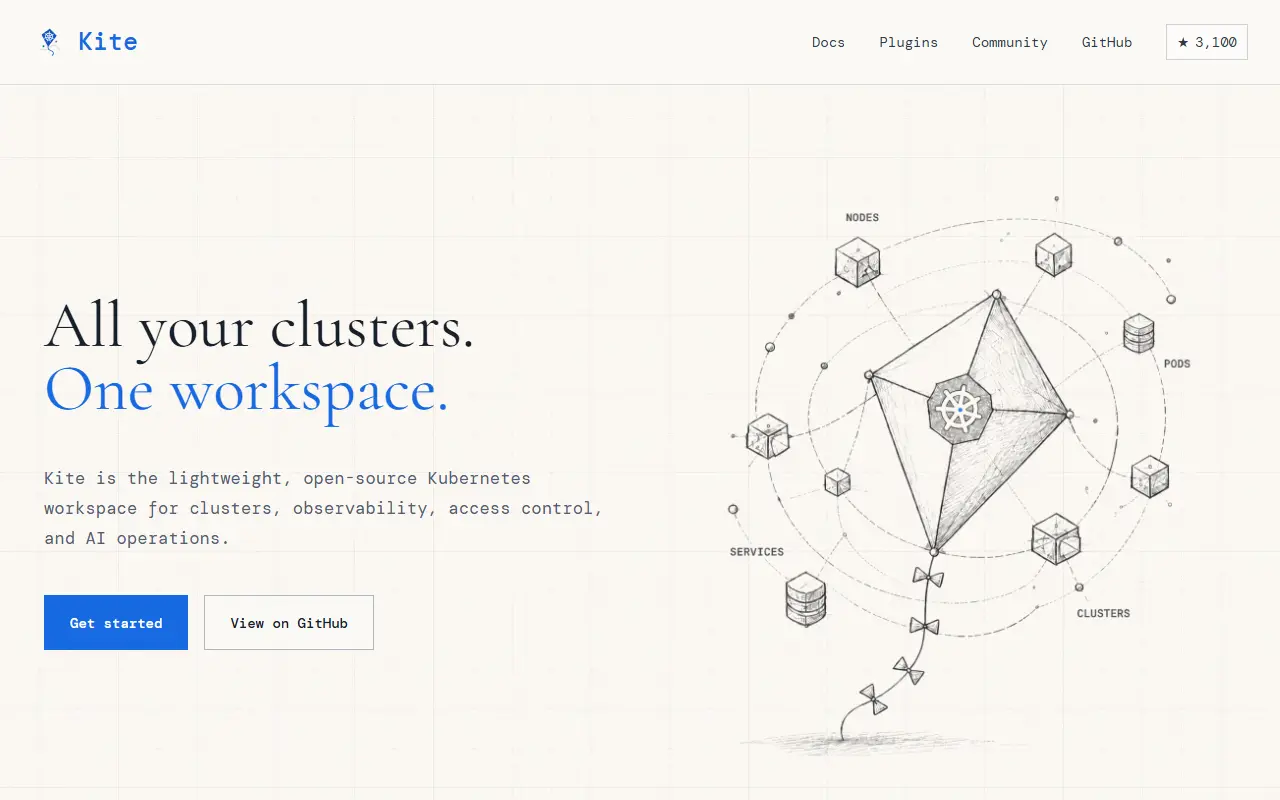
About Kite
Kite is an open-source Kubernetes workspace that brings several clusters into a single web interface. It is designed for multi-cluster operations, observability, access control, and troubleshooting with an optional AI assistant, and the project describes itself as lightweight. It is released under the Apache-2.0 license.
For observability it shows CPU, memory, and network usage through per-cluster Prometheus integrations, streams and filters pod logs, and shows events, conditions, and related resources in context. For operations you can manage core resources, custom resource definitions, and Helm releases, edit live YAML, scale or restart workloads, and open browser-based terminals for pods, nodes, and kubectl, plus global search across resources.
Access can be governed with OAuth, LDAP, local accounts, MFA, and passkeys, along with RBAC, per-cluster permissions, and audit logs. The AI assistant can inspect resources, logs, and metrics and asks you to confirm write operations while respecting RBAC. Installation is by Helm chart, and it suits platform and DevOps teams that manage more than one cluster.
Key features
- Multi-cluster management in one workspace
- Prometheus-backed CPU, memory, and network charts
- Live pod log streaming and filtering
- Browser-based pod, node, and kubectl terminals
- Helm release and CRD management
- RBAC, audit logs, and OAuth or LDAP login
- AI assistant with confirmation for writes
Good fit for
- →Platform teams managing several clusters
- →Troubleshooting workloads without local kubectl setup
- Tags
- kubernetes
- dashboard
- multi-cluster
- devops
- helm
- monitoring
- prometheus
- rbac
Kite: questions and answers
- What is Kite used for?
- Kite is a lightweight open-source Kubernetes dashboard for managing multiple clusters, with metrics, logs, terminals, Helm releases, RBAC, and an AI assistant. It is a good fit for platform teams managing several clusters and troubleshooting workloads without local kubectl setup.
- Is Kite open source?
- Yes. Kite is open source under the Apache-2.0 licence. Its source code is on GitHub at kite-org/kite and is written mainly in TypeScript.
- Is Kite free?
- Yes. Kite is open source, so the software itself is free to use.
- Can I self-host Kite?
- Yes. Kite can be self-hosted on your own server or infrastructure.
- What is Kite an alternative to?
- Kite is an open-source alternative to Lens. Other open-source alternatives to Lens include KDash, Portainer and Kubebox.
- Is Kite actively maintained?
- Yes. The most recent commit to Kite was on 1 October 2026, and the latest release is v0.15.1, published on 8 September 2026. The project has 3.2k stars on GitHub.
Open-source alternatives to Kite
See all
KDash
Infrastructure & Containers
A simple and fast dashboard for Kubernetes
MITvs Lens★ 2.5k
Portainer
Infrastructure & Containers
Making Docker and Kubernetes management easy.
Zlibvs Lens★ 39kKubebox
Infrastructure & Containers
⎈❏ Terminal and Web console for Kubernetes
MITvs Lens★ 2.2k
Helm
Infrastructure & Containers
The Kubernetes Package Manager
Apache-2.0★ 30k
Kubernetes
Infrastructure & Containers
Production-Grade Container Scheduling and Management
Apache-2.0vs Amazon EKS★ 128k
Rancher
Infrastructure & Containers
Complete container management platform
Apache-2.0vs Amazon EKS★ 26k
SaaS alternatives to Kite
See all
Lens
Infrastructure & Containers
Desktop Kubernetes IDE for managing clusters and workloads
SaaS
Komodor
Infrastructure & Containers
Kubernetes troubleshooting and cluster management platform
SaaS
Amazon EKS
Infrastructure & Containers
Managed Kubernetes control plane and worker nodes on AWS
SaaS
Azure Kubernetes Service
Infrastructure & Containers
Managed Kubernetes service on Microsoft Azure
SaaS
Docker Desktop
Infrastructure & Containers
Desktop app for building and running containers locally, with Kubernetes support
SaaS
IBM Cloud Kubernetes Service
Infrastructure & Containers
Managed Kubernetes service on IBM Cloud
SaaS