7,363 open-source and SaaS tools, with GitHub stats refreshed every day.

6 alternatives ranked by real activity

Open-source Voiceflow alternatives

A curated, ranked list of the 6 best open-source alternatives to Voiceflow.

The best open-source alternative to Voiceflow is Dify. If that doesn't suit you, other good options are Langflow, Botpress, Typebot and Rasa.

Voiceflow alternatives are mainly AI infrastructure tools, but some are also AI tools and form & survey tools. 5 of them shipped code in the last 30 days, 6 can be self-hosted, and 4 use a permissive licence.

Last updated October 2, 2026 · ranked by GitHub stars, growth and recent commits

Dify

An LLM application platform for building AI workflows, RAG pipelines and agents on one canvas, deployable in the cloud, a private VPC or self-hosted.

GitHub stars
158k
Last commit
today
Latest release
1.17.1
Self-hosted
Yes
Hosted version
Available
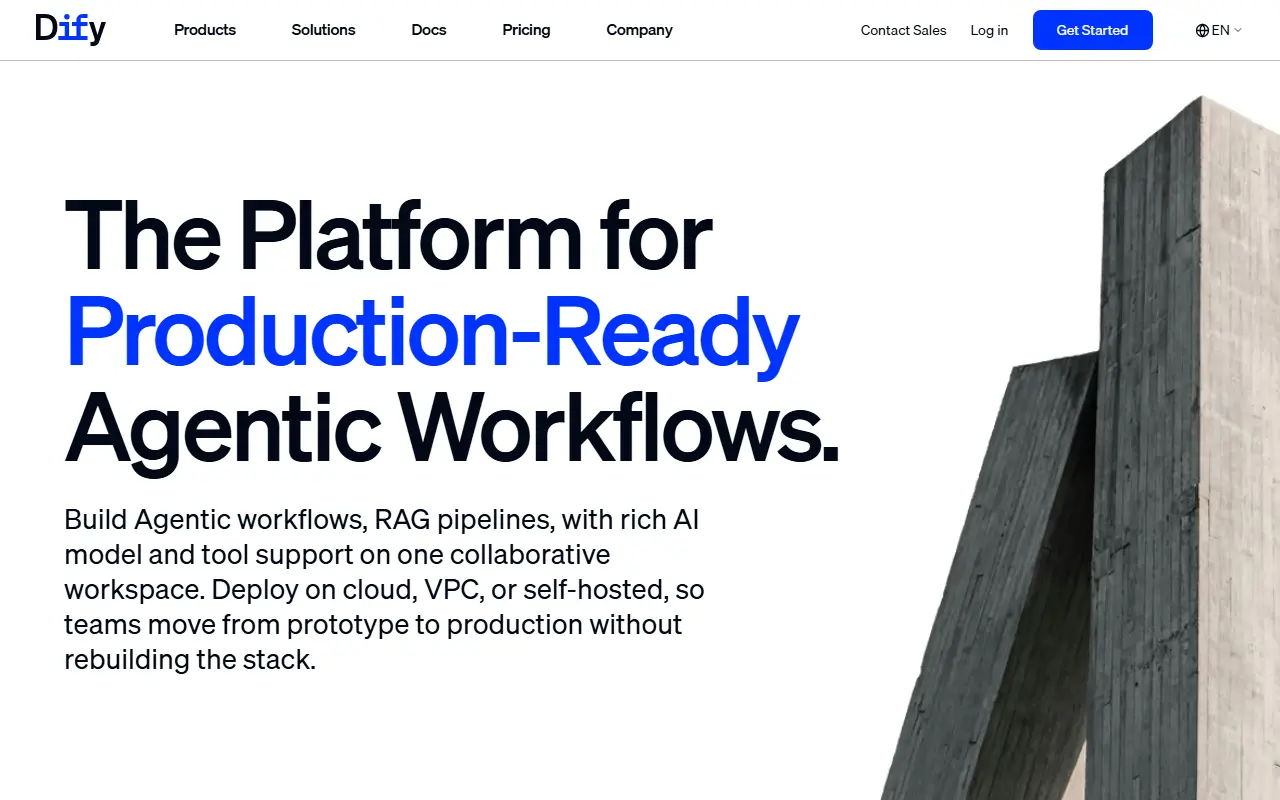
dify.aiDify homepage screenshot

Dify is a platform for building applications on top of large language models. Instead of wiring together prompts, retrieval code and model APIs by hand, teams assemble AI workflows, knowledge pipelines and agents in a shared visual workspace, then move them from prototype to production without changing stacks.

The product covers a workflow studio for agentic flows, a knowledge pipeline that prepares searchable knowledge bases for retrieval-augmented generation, model management across many providers, and a marketplace of tools, models and integrations. Observability integrations such as Opik, Langfuse and Arize Phoenix help trace and debug runs once an app is live.

Dify comes in a few editions: a community edition you deploy yourself with Docker, a hosted cloud service, and an enterprise edition for private deployments. The repository carries a custom license rather than a standard one, so check its terms before offering Dify as a service to others.

Key features

  • Visual workflow studio for agentic apps
  • Knowledge pipelines for retrieval-augmented generation
  • Model management across many LLM providers
  • Marketplace of tools, models and integrations
  • Observability integrations such as Langfuse
  • Deploy on cloud, VPC or Docker

Pricing: Free Sandbox on Dify Cloud and a free self-hosted Community edition. Cloud Professional costs $590 and Team $1590 per workspace per year; Enterprise is custom.

Read more about DifyWebsite GitHub

Langflow

A visual platform for building and deploying AI agents and workflows, with Python-customizable components and built-in API and MCP server support.

GitHub stars
155k
Last commit
today
Latest release
v1.12.4
Licence
MIT
Self-hosted
Yes
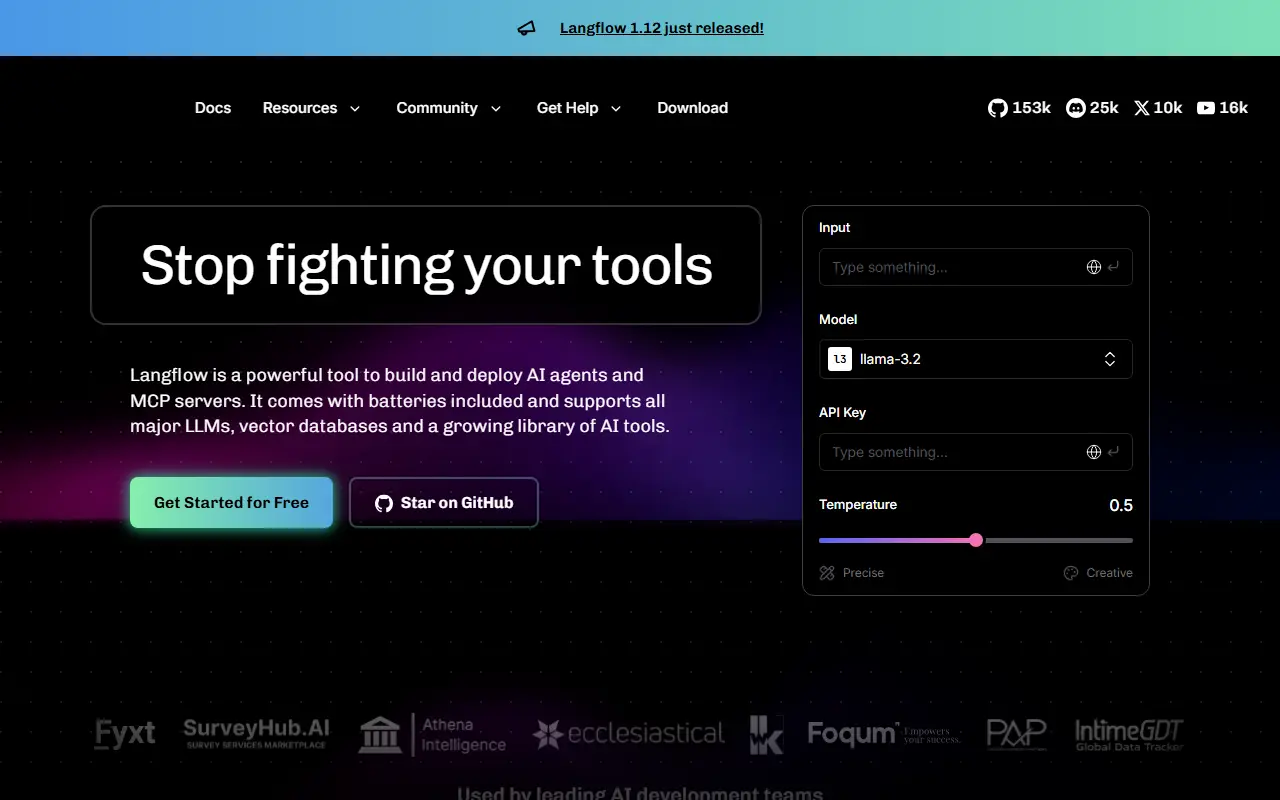
langflow.orgLangflow homepage screenshot

Langflow is an open-source platform for building AI-powered agents and workflows. Developers assemble flows in a visual authoring interface and can then deploy each flow as an API or export it as JSON for use in Python applications. It is written in Python and released under the MIT license.

The visual builder is paired with source-code access, so any component can be customized in Python, and an interactive playground lets you test and refine flows step by step. Langflow can orchestrate several agents with conversation handling and retrieval, works with the major LLMs and vector databases, and can expose flows as an MCP server so they become tools for MCP clients. Observability integrations include LangSmith and LangFuse.

You can install the Python package locally with uv, after which it serves the app at a local address, or use Langflow Desktop for Windows and macOS, which bundles its dependencies. It suits developers and AI teams prototyping retrieval and agent workflows who want both a drag-and-drop canvas and the freedom to write code.

Key features

  • Visual builder for agents and workflows
  • Python source access to customize components
  • Interactive playground for testing flows
  • Multi-agent orchestration with retrieval
  • Deploy flows as APIs or export as JSON
  • MCP server mode exposing flows as tools
  • Observability integrations such as LangFuse

Pricing: Free and open source under the MIT license.

Botpress

Botpress is a platform for building and deploying GPT and LLM-powered chatbots and agents, with an open-source hub of integrations and developer tools.

GitHub stars
15k
Last commit
today
Latest release
v12.30.9
Licence
MIT
Self-hosted
Yes
Hosted version
Available
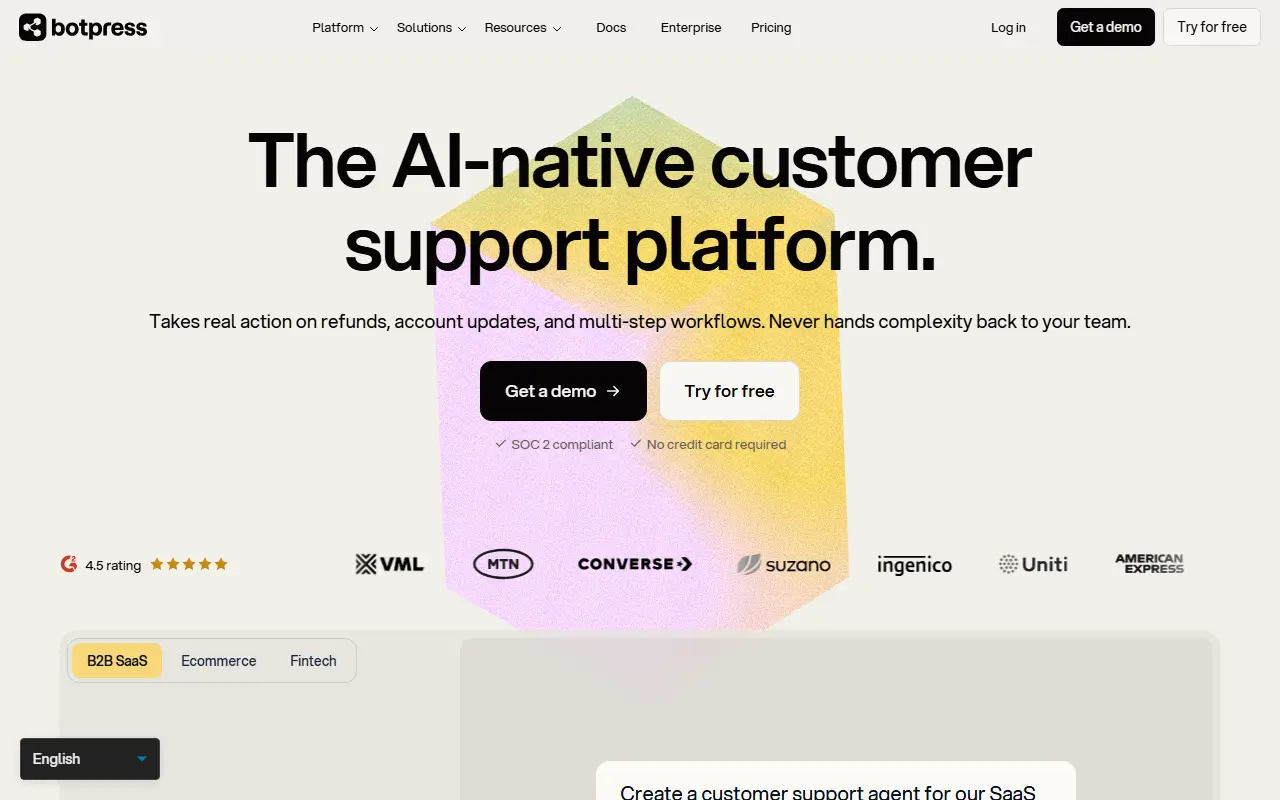
botpress.comBotpress homepage screenshot

Botpress is a platform for building chatbots and AI assistants powered by large language models such as OpenAI's GPT. Its Botpress Cloud product is the main way to build and run agents, and this repository holds the open-source parts that surround it. It is written in TypeScript and released under the MIT license.

The repository contains the public integrations on the Botpress Hub that Botpress maintains, the developer tools for Botpress Cloud including the CLI, SDK and API client, examples of bots written as code with the SDK and CLI, and plugins for Botpress Studio. Developers can create their own integration from a template using the CLI and publish it to the Hub without forking the repository.

Contributions are welcome through pull requests and issues for the code in the repository, while Discord is suggested for faster responses about Cloud issues. On-premise Botpress version 12 is maintained in a separate repository, which is where problems with that version belong.

Key features

  • Open-source integrations for the Botpress Hub
  • CLI, SDK and API client for developers
  • Example bots written as code
  • Integration templates for new connectors
  • Botpress Cloud for building and running agents

Pricing: Free plan with 25 conversations. Plus is $150 and Team $750 per month billed annually, priced by included conversations rather than seats; Enterprise is custom.

Typebot

Visual chatbot builder with conditional logic, integrations and embeds, available as a managed service or self-hosted.

GitHub stars
10k
Last commit
2 days ago
Latest release
v3.19.0
Self-hosted
Yes
Hosted version
Available
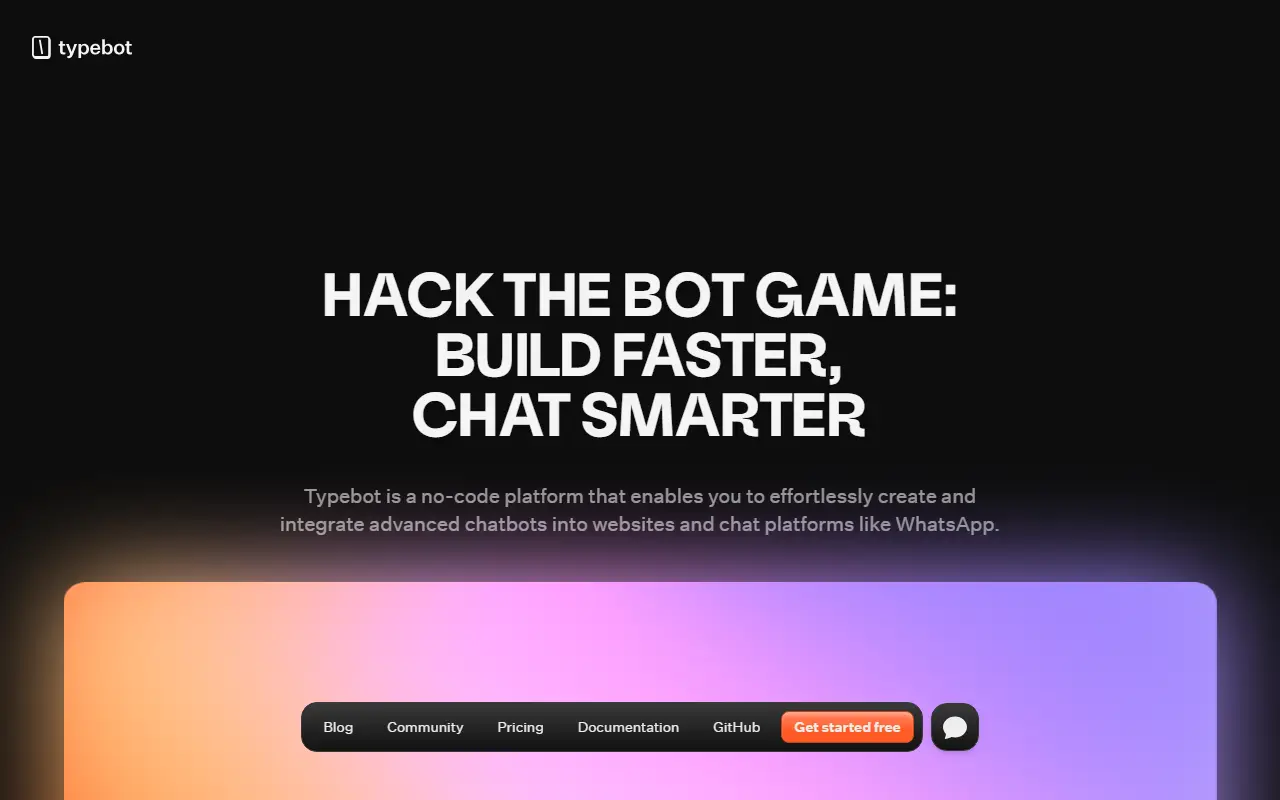
typebot.ioTypebot homepage screenshot

Typebot is a chatbot builder released under a Fair Source license. It lets you create conversational flows visually, embed them in web or mobile apps, and collect the results as they come in. The building blocks are meant to adapt to many business cases such as lead capture, forms and support triage.

The editor offers more than 30 blocks across bubbles for text, images, video, audio and embeds, inputs for email, phone, buttons, dates, files and Stripe payments, logic for conditions, redirects, scripts and A/B tests, and integrations with webhooks, OpenAI, Google Sheets, Google Analytics, Meta Pixel, Zapier, Make and Chatwoot. Themes cover fonts, colors and custom CSS, and analytics show drop-off and completion rates, with CSV export.

Bots can be shared on a custom domain or embedded as a container, popup or chat bubble using a native JavaScript library. The app is built with Next.js, TypeScript and Tailwind CSS. An official managed service is available, and the project can also be self-hosted. APIs are provided for developers.

Key features

  • Visual chat flow builder with 30+ blocks
  • Conditional logic, scripting and A/B testing
  • Webhook, OpenAI and Google Sheets integrations
  • Embed as container, popup or chat bubble
  • Custom themes and custom CSS
  • Analytics with CSV export

Pricing: Free Personal plan allows 200 chats a month. Starter costs $39 and Pro $89 per month, billed monthly only; Enterprise is quoted on request.

Rasa

Rasa Open Source is a Python framework for building text and voice chatbots with NLU and dialogue management, now in maintenance mode.

GitHub stars
21k
Last commit
2 mo ago
Latest release
3.6.21
Licence
Apache-2.0
Self-hosted
Yes
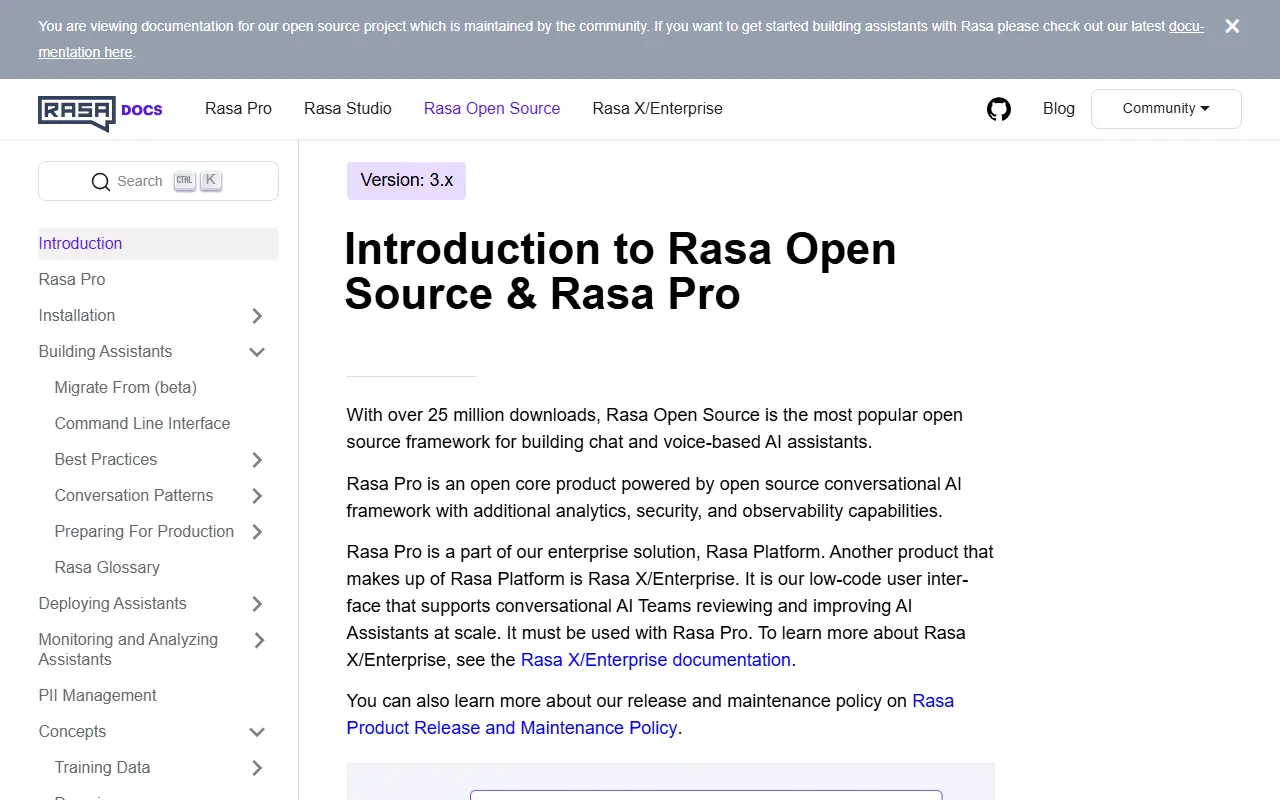
rasa.comRasa homepage screenshot

Rasa Open Source is a machine learning framework for automating text-based and voice-based conversations. It provides natural language understanding and dialogue management, so developers can build chatbots and voice assistants and connect them to channels such as Slack and Facebook.

Rasa's README states that this open source edition is now in maintenance mode. The vendor directs new work toward Hello Rasa, a browser playground for prototyping AI agents, built on the CALM engine, which pairs a language model that interprets the user with business logic that enforces rules. Agents can be exported to the Rasa Platform for production.

The framework is written in Python and licensed under Apache-2.0, and its repository topics reference NLU, spaCy and conversational agents. Teams already using the classic intent-based approach can keep running it on their own infrastructure, while new projects may want to review the vendor's newer products first.

Key features

  • Natural language understanding for chatbots
  • Dialogue management for text and voice
  • Connectors for Slack and Facebook
  • Python machine learning framework
  • Conversation-driven development workflow

Pricing: Rasa Open Source is free under the Apache-2.0 licence; the vendor's newer Rasa Platform is a separate offering.

Read more about RasaWebsite GitHub

Dograh

Dograh is an open-source, self-hostable voice AI platform for building phone agents with a visual workflow builder, positioned against Vapi and Retell.

GitHub stars
5.8k
Last commit
yesterday
Latest release
dograh-v1.47.0
Licence
BSD-2-Clause
Self-hosted
Yes
Hosted version
Available
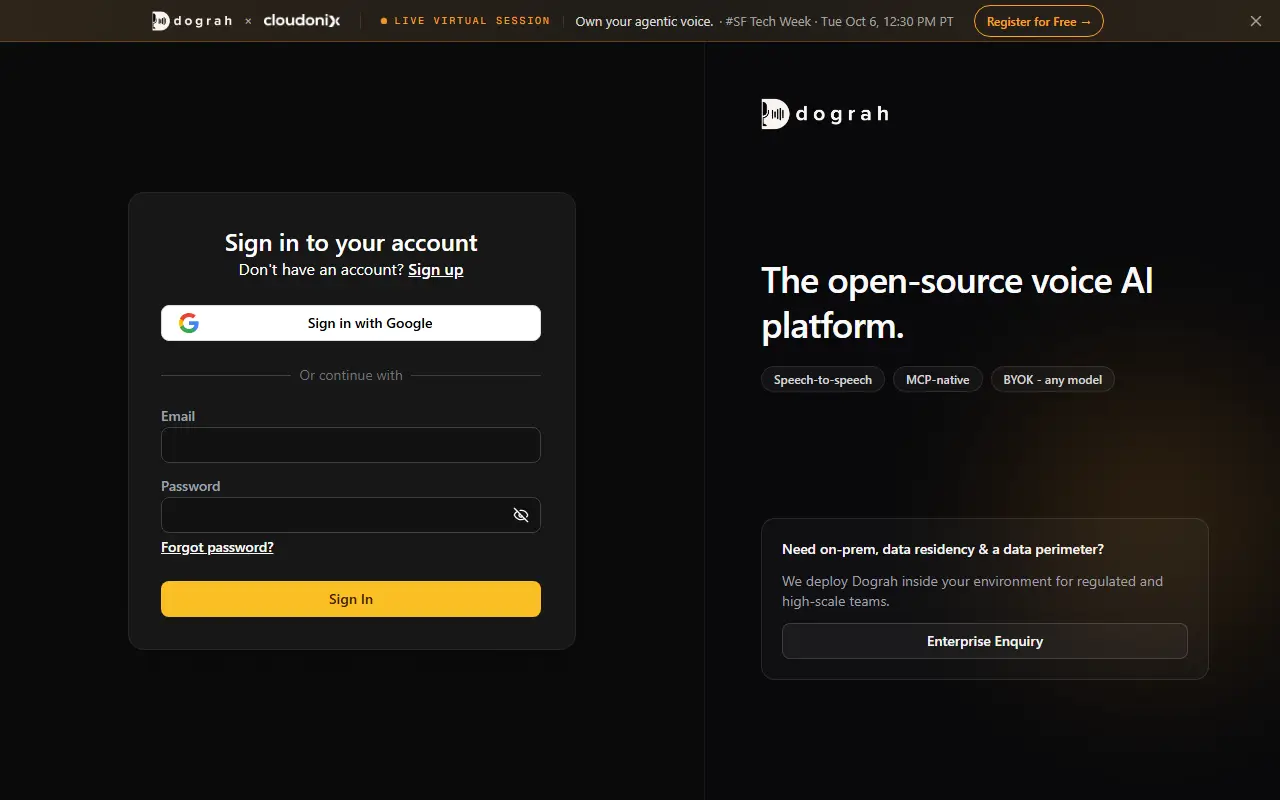
app.dograh.comDograh homepage screenshot

Dograh is an open-source platform for building voice AI agents that can make and receive phone calls. It describes itself as a self-hostable alternative to Vapi and Retell, and promises full code transparency with no vendor lock-in. Agents are designed in a visual workflow builder and can be tested quickly before going live.

The platform supports bring-your-own-key setups across speech-to-speech models or a pipeline of language model, speech-to-text and text-to-speech providers, including local models. It is MCP-native, so AI coding assistants can help design and edit agents, and it includes telephony support for inbound and outbound calling, with Asterisk ARI among its topics. It is written in Python and builds on the Pipecat framework.

Dograh is released under the BSD 2-Clause license and can run on premises or in a hosted cloud, with the vendor operating an app site. It suits support, sales and operations teams that want to automate calls while controlling data and provider choice.

Key features

  • Visual workflow builder for voice agents
  • Bring-your-own-key model and provider choice
  • Speech-to-speech or LLM, STT and TTS pipelines
  • MCP-native agent editing
  • Inbound and outbound telephony support
  • Self-hosted or on-premises deployment

Pricing: Open source under BSD 2-Clause; you bring your own AI provider keys, and a hosted version is available.

Voiceflow alternatives: questions

What is the best open-source alternative to Voiceflow?
Dify is the top-ranked open-source alternative to Voiceflow on Enlisted: An LLM application platform for building AI workflows, RAG pipelines and agents on one canvas, deployable in the cloud, a private VPC or self-hosted. Other strong options are Langflow, Botpress, Typebot and Rasa.
Are these Voiceflow alternatives free?
All 6 are open source, so the code is free to use under its licence, and all of them can be self-hosted on your own server or computer. 4 also offer a paid or managed cloud version if you'd rather not host it yourself.
How is this list of Voiceflow alternatives ranked?
By a score built from GitHub stars, star growth over the last 30 days and how recently the code changed. 5 of these projects shipped code in the last 30 days. Data is refreshed daily, and nobody can pay to move up.

People also look for alternatives to…

View all