7,363 open-source and SaaS tools, with GitHub stats refreshed every day.

16 alternatives ranked by real activity

Open-source Salesforce alternatives

A curated, ranked list of the 16 best open-source alternatives to Salesforce.

The best open-source alternative to Salesforce is Twenty. If that doesn't suit you, other good options are Chatwoot, Krayin CRM, SuiteCRM and EspoCRM.

Salesforce alternatives are mainly CRM tools, but some are also low-code & internal tools and customer support tools. 14 of them shipped code in the last 30 days, 16 can be self-hosted, and 4 use a permissive licence.

Last updated October 2, 2026 · ranked by GitHub stars, growth and recent commits

Twenty

An open-source CRM built as a modular, code-extensible platform, positioned as an alternative to Salesforce for technical teams, with cloud and Docker self-hosting.

GitHub stars
58k
Last commit
yesterday
Latest release
twenty/v2.44.0
Self-hosted
Yes
Hosted version
Available
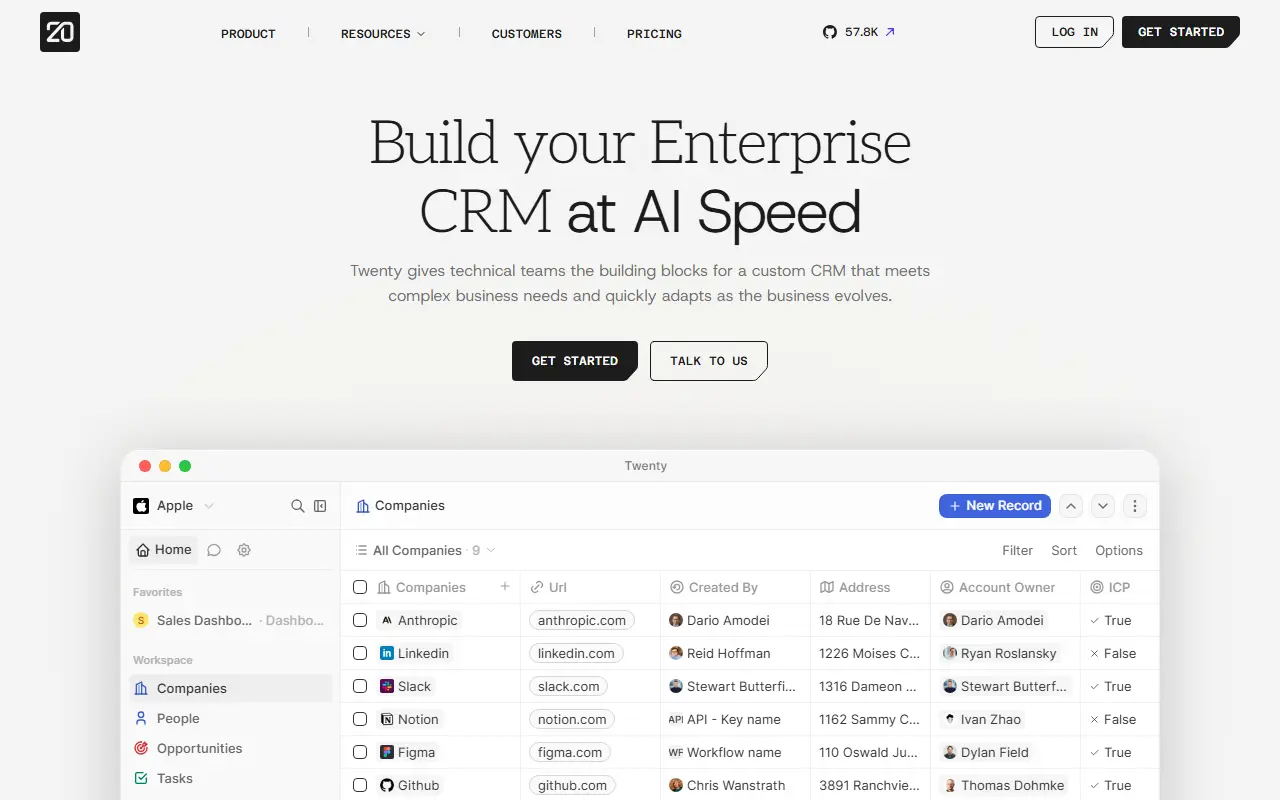
twenty.comTwenty homepage screenshot

Twenty is an open-source CRM presented as an open alternative to Salesforce and designed for AI. It supplies technical teams with the components to assemble a custom CRM that adapts as the business changes, and the idea is that you build, ship and version it like the rest of your software stack.

The core building blocks are objects, views, workflows and agents, and all of them can be extended as code. A Twenty CLI scaffolds new apps, where you define objects, fields and views as code and then publish them to your workspace, with a guide covering views, agents and logic functions. For people using coding agents, the project provides official skills that work with Claude Code, Codex, Cursor and other harnesses. The stack is TypeScript with NestJS, React, GraphQL and PostgreSQL.

You can sign up at twenty.com for the managed cloud, which needs no infrastructure, or self-host with Docker Compose. The repository's license is listed as 'Other', so review it before commercial redistribution. Twenty suits teams that want a CRM they can shape in code instead of being limited by a fixed SaaS data model.

Key features

  • Custom objects, fields and views
  • Workflows and agents extendable as code
  • CLI for scaffolding and publishing apps
  • Official skills for coding agents
  • GraphQL API on a PostgreSQL backend
  • Cloud workspace or Docker Compose self-hosting

Pricing: Cloud Pro costs $9 and Organization $19 per user per month on yearly billing, with a 30-day trial. Enterprise starts from $50k per year; Twenty can also be self-hosted.

Read more about TwentyWebsite GitHub

Chatwoot

An open-source omnichannel customer support desk with live chat, email and social inbox, an AI agent and a help center, positioned against Intercom and Zendesk.

GitHub stars
37k
Last commit
yesterday
Latest release
v4.18.0
Self-hosted
Yes
Hosted version
Available
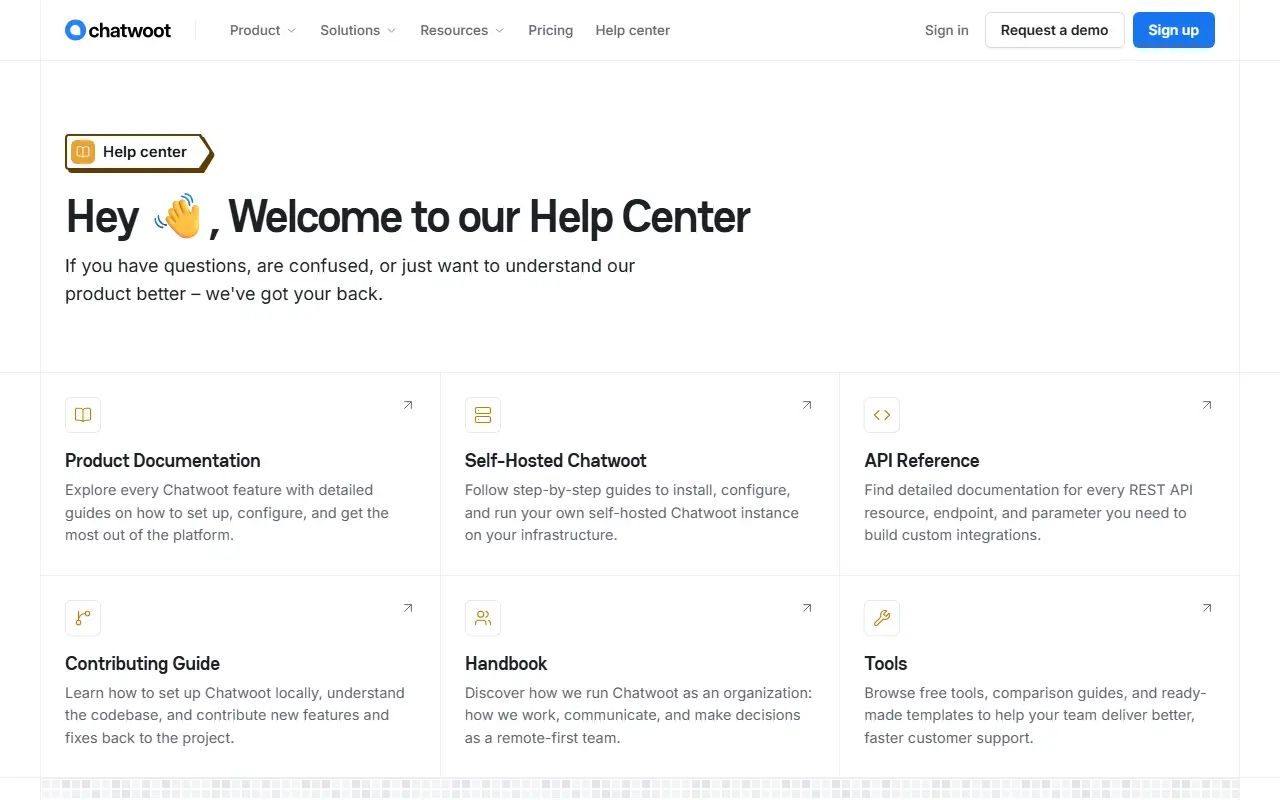
chatwoot.comChatwoot homepage screenshot

Chatwoot is an open-source, self-hostable customer support platform that gathers all customer conversations into one inbox. It is presented as an alternative to Intercom, Zendesk and Salesforce Service Cloud, and aims to give businesses control over their customer data while managing conversations across channels.

The shared inbox takes in website live chat, email, SMS and messaging channels such as Facebook, Instagram, Twitter, WhatsApp, Telegram and Line. An AI agent called Captain automates replies to common questions to reduce agent workload, and a built-in Help Center portal lets you publish articles and FAQs so customers can find answers themselves. Collaboration tools include private notes with mentions, labels, canned responses, auto-assignment based on availability, custom views and filters, a command bar and multi-language support.

Chatwoot is built with Ruby on Rails and Vue and can be run with Docker, with deployment guides on its help center. The repository license is listed as 'Other', so confirm which parts are open source. A hosted cloud version is also available for teams that prefer not to maintain their own server.

Key features

  • Shared inbox across chat, email and social channels
  • Captain AI agent for automated replies
  • Built-in Help Center portal
  • Private notes and @mentions
  • Canned responses and auto-assignment
  • Custom views and filters
  • Support for multiple languages

Pricing: Hacker is free for up to 2 agents. Startups costs $19, Business $39 and Enterprise $99 per agent per month, with a 15-day free trial; extra Captain AI credits are $20 per 1,000.

Krayin CRM

Krayin CRM is a free, open-source CRM built with Laravel and Vue.js for managing customers, leads and sales, aimed at small businesses and enterprises.

GitHub stars
24k
Last commit
4 days ago
Latest release
v2.2.6
Licence
MIT
Self-hosted
Yes
Hosted version
Available
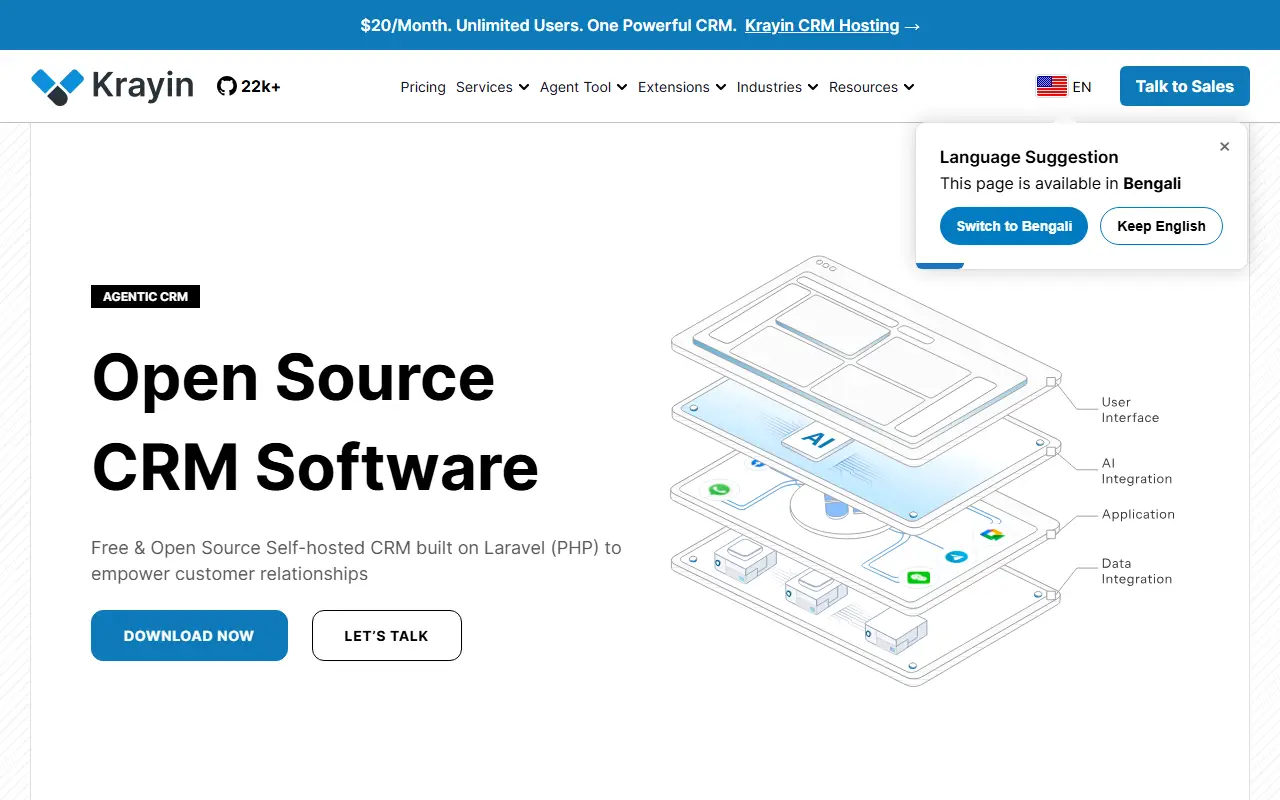
krayincrm.comKrayin CRM homepage screenshot

Krayin CRM, published in this repository as Laravel CRM, is a free and open-source customer relationship management system for small and medium businesses and larger organizations. It covers the customer lifecycle, from capturing leads through managing customers and sales, and is described as a hand-tailored CRM framework built on Laravel and Vue.js.

The README lists a descriptive and simple admin panel, a dashboard, custom attributes, a modular architecture and email parsing via SendGrid among its features. Developers get the benefit of building on two popular frameworks, PHP's Laravel and the progressive JavaScript framework Vue. The project provides documentation, a forum for questions and feature requests, a live demo, Docker installation instructions and a section on the Krayin Cloud system for people who prefer hosted use.

Krayin CRM is MIT licensed, so it can be self-hosted and modified freely. It suits agencies and companies that already work with Laravel and want a customizable CRM core rather than a closed SaaS product, as well as teams that want to extend the data model through custom attributes.

Key features

  • Lead, customer and sales management
  • Admin panel and dashboard
  • Custom attributes for records
  • Modular, extensible architecture
  • Email parsing via SendGrid
  • Docker installation instructions

Pricing: The open-source CRM is free to self-host. Managed cloud hosting starts at $20 per month with unlimited users, priced by server resources rather than seats.

SuiteCRM

SuiteCRM is an open-source CRM written in PHP that manages accounts, contacts, leads, opportunities, quotes, cases and workflows.

GitHub stars
5.8k
Last commit
15 days ago
Latest release
v7.15.2
Licence
AGPL-3.0
Self-hosted
Yes
Hosted version
Available
suitecrm.comSuiteCRM homepage screenshot

SuiteCRM is an open-source customer relationship management application for businesses that want control over their data and the freedom to customize their CRM. Its module list covers accounts, contacts, leads, opportunities, quotes, contracts, cases, documents, reports and workflow automation, and it supports multiple languages and currencies.

The README separates two generations of the product. SuiteCRM 7 is described as a mature and stable line with a large community and regular releases of features, security patches and fixes, while SuiteCRM 8 is the newer version that was still catching up on features at the time of writing. The project also maintains an extensions directory, a demo, a community forum and a partner network. It is written in PHP.

SuiteCRM is licensed under AGPL-3.0 and is usually installed on your own web server with a database. Managed hosting and support are available through the vendor and partners. It suits small and mid-sized businesses and agencies that want an open-source alternative to commercial CRMs.

Key features

  • Accounts, contacts and leads management
  • Opportunities, quotes and contracts
  • Cases and customer portal
  • Workflow automation and reports
  • Multi-language and multi-currency support
  • Extension directory for add-ons

Pricing: The software is free with no per-user fees. Fully managed hosting starts at £50 per month, Quick Start setup from £2,520 one-time, and SuiteASSURED support from £3,350 per year.

EspoCRM

Open-source CRM for managing leads, contacts, opportunities, marketing campaigns, and support cases, with a single-page web interface and a PHP REST API.

GitHub stars
3.4k
Last commit
yesterday
Latest release
10.0.9
Licence
AGPL-3.0
Self-hosted
Yes
Hosted version
Available
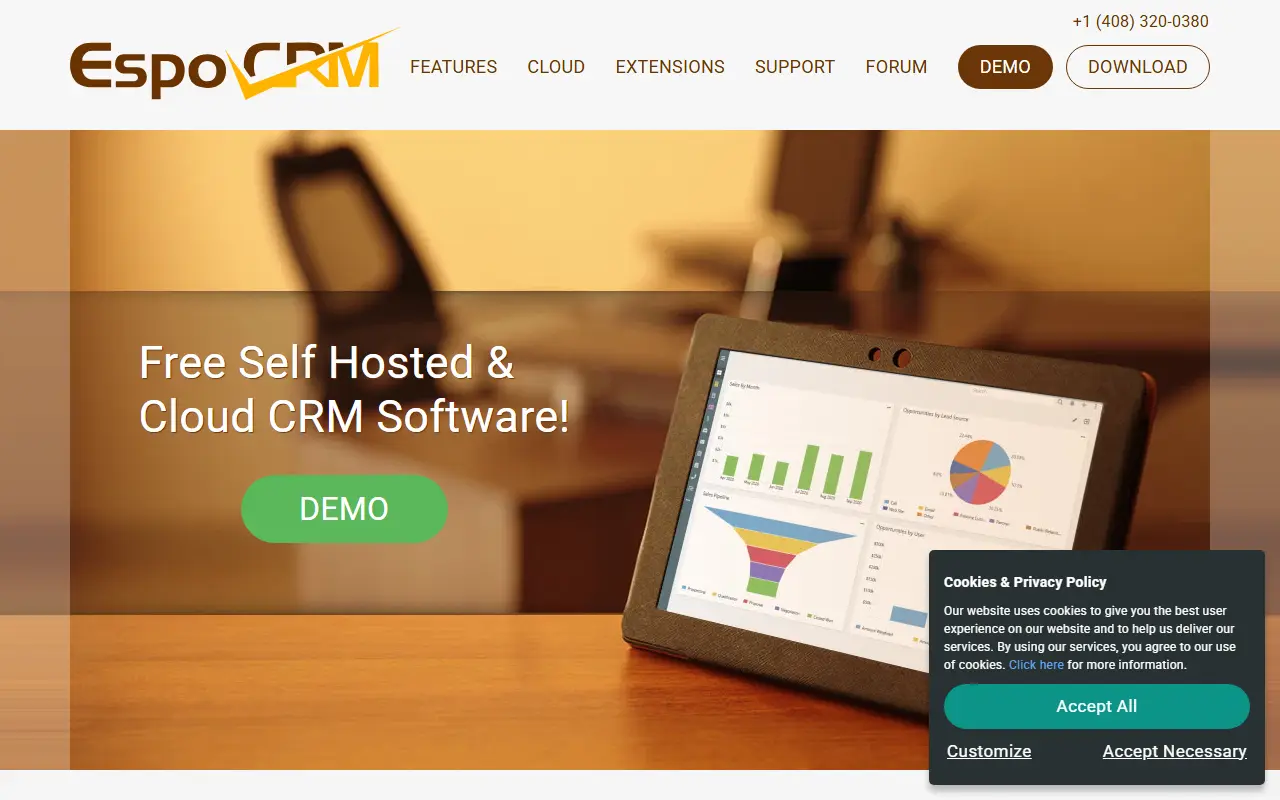
espocrm.comEspoCRM homepage screenshot

EspoCRM is a free, open-source customer relationship management platform that helps organizations store and manage leads, contacts, sales opportunities, marketing campaigns, and support cases in one web application. The project is released under the AGPL-3.0 license and has been developed since 2014.

The front end is a single-page application backed by a REST API written in PHP, which makes it easy to integrate with other systems. Its feature areas cover sales automation, email marketing, a calendar, kanban views, documents, a customer portal, and customer-support case handling. The data model can be customized to match different business processes.

EspoCRM runs on your own server with PHP 8.3 to 8.5 and MySQL 8, MariaDB 10.6 or later, or PostgreSQL 15 or later. An online demo is available for evaluation. It suits small and mid-sized organizations that want a configurable CRM they can host and modify themselves, and the vendor also sells paid extensions and hosting.

Key features

  • Lead, contact, and opportunity management
  • Sales automation workflows
  • Email marketing campaigns
  • Customer support case tracking
  • Calendar and kanban views
  • Customer portal for external users
  • Document storage linked to records
  • REST API for integrations

Pricing: Cloud plans are priced per user per month: Basic $15 (minimum 3 users), Enterprise $25 (minimum 5) and Ultimate $69 (minimum 10). Basic and Enterprise have a 30-day free trial.

CordysCRM

Open-source AI-enabled CRM from FIT2CLOUD for private deployment, with sales management, DataEase analytics, and skills for AI assistants.

GitHub stars
2.8k
Last commit
3 days ago
Latest release
v1.9.3
Self-hosted
Yes
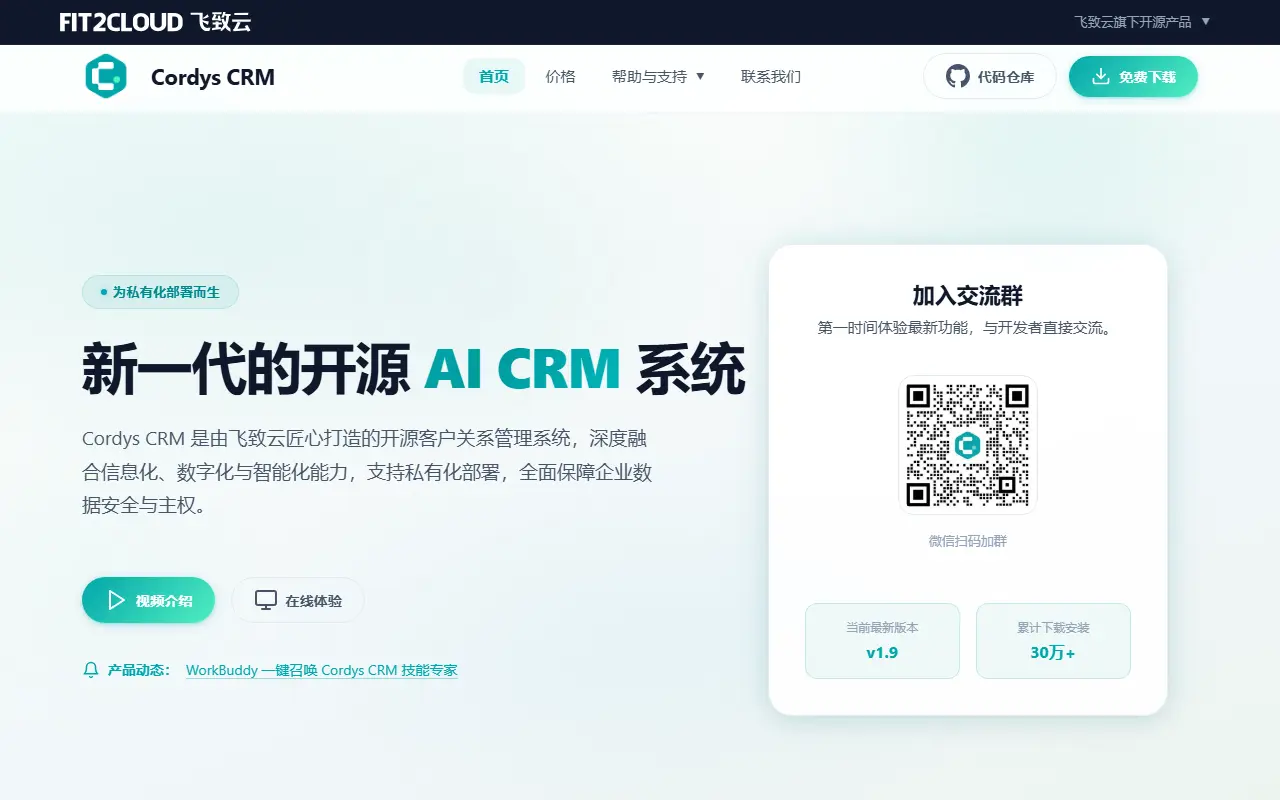
cordys.cnCordysCRM homepage screenshot

Cordys CRM is an open-source customer relationship management system from FIT2CLOUD, written in Java and aimed at private deployment so that companies keep control of their data. The project documentation is in Chinese, and the input lists its license only as other. It is described as combining informatization, digitalization, and AI capabilities.

Its stated strengths are flexible configuration with fine-grained permissions and integration with mainstream office platforms; an open API and standard interfaces for custom development; business intelligence through the DataEase analytics engine for sales data visualization; and an open CRM Skills interface that lets AI assistants such as OpenClaw and WorkBuddy take part in tasks from lead screening to deal analysis. A built-in agent harness arrived in version 1.9.0.

Installation requires a Linux server with Docker and a one-line install script, with alternatives through the 1Panel app store or an offline package for networks without internet access. It suits Chinese-speaking companies and teams that want a self-hosted CRM with AI integration.

Key features

  • Self-hosted CRM for sales management
  • Fine-grained permissions and modular configuration
  • DataEase-powered sales analytics
  • CRM Skills interface for AI assistants
  • Open API for custom integration
  • Docker one-line, 1Panel, and offline installation

Pricing: The Community edition is open source and free. The Enterprise edition is an annual subscription listed at ¥3万, ¥6万 or ¥12万 per year depending on company revenue and deployment, with no per-seat pricing; an enterprise trial can be requested.

BottleCRM

Self-hosted, multi-tenant open-source CRM (BottleCRM) with a Django REST backend, SvelteKit web app, and Flutter mobile app.

GitHub stars
2.4k
Last commit
yesterday
Latest release
v1.14.5
Licence
MIT
Self-hosted
Yes
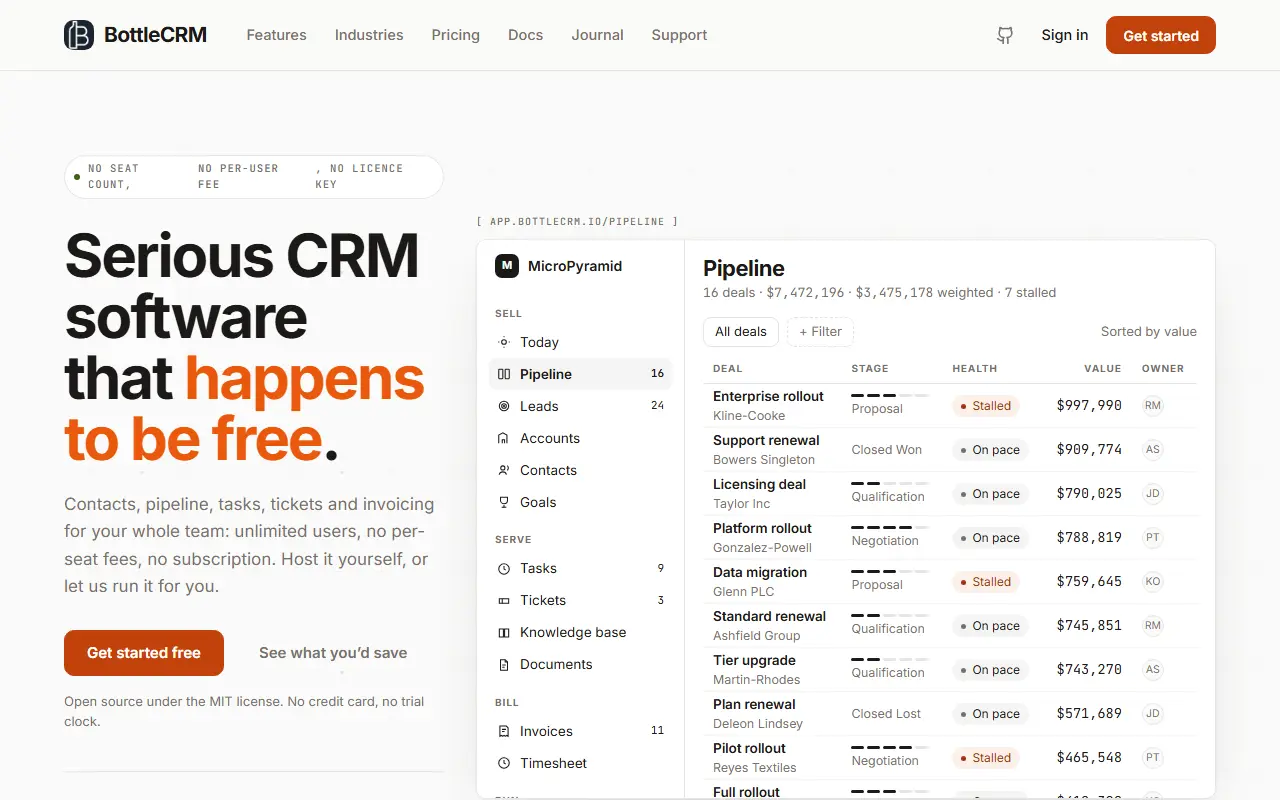
bottlecrm.ioBottleCRM homepage screenshot

BottleCRM, published as django-crm, is a free, self-hosted, multi-tenant CRM for startups and larger organizations. It covers the customer lifecycle across leads, accounts, contacts, opportunities, support tickets, tasks, and invoices, and positions itself against Salesforce, HubSpot, and Pipedrive. It is released under the MIT license.

The architecture combines a Django REST Framework backend with a SvelteKit web app and a native Flutter mobile app, all sharing one documented REST API. PostgreSQL Row-Level Security isolates each organization's data at the database layer, so one deployment can serve a single startup or hundreds of tenants. Topics also mention CPQ, helpdesk, and invoice management.

The README states there are no per-seat prices, user caps, or feature paywalls, and says you own your data when you self-host. The site also links to a free trial, a pricing page, and migration guides from Salesforce and HubSpot. It suits small companies and agencies wanting a customizable CRM they can host, fork, and extend.

Key features

  • Leads, accounts, contacts, and opportunities
  • Support tickets, tasks, and invoices
  • Multi-tenant isolation with Row-Level Security
  • SvelteKit web app and Flutter mobile app
  • Documented REST API
  • Migration guides from Salesforce and HubSpot

Pricing: The software is free to self-host with unlimited users. Managed hosting, support and custom setup are paid services priced after a conversation.

Corteza

Open-source low-code platform for building CRM, business process, and structured data apps, with workflows, RBAC, privacy features, and data integrations.

GitHub stars
2.2k
Last commit
yesterday
Latest release
2024.9.10
Licence
Apache-2.0
Self-hosted
Yes
Hosted version
Available
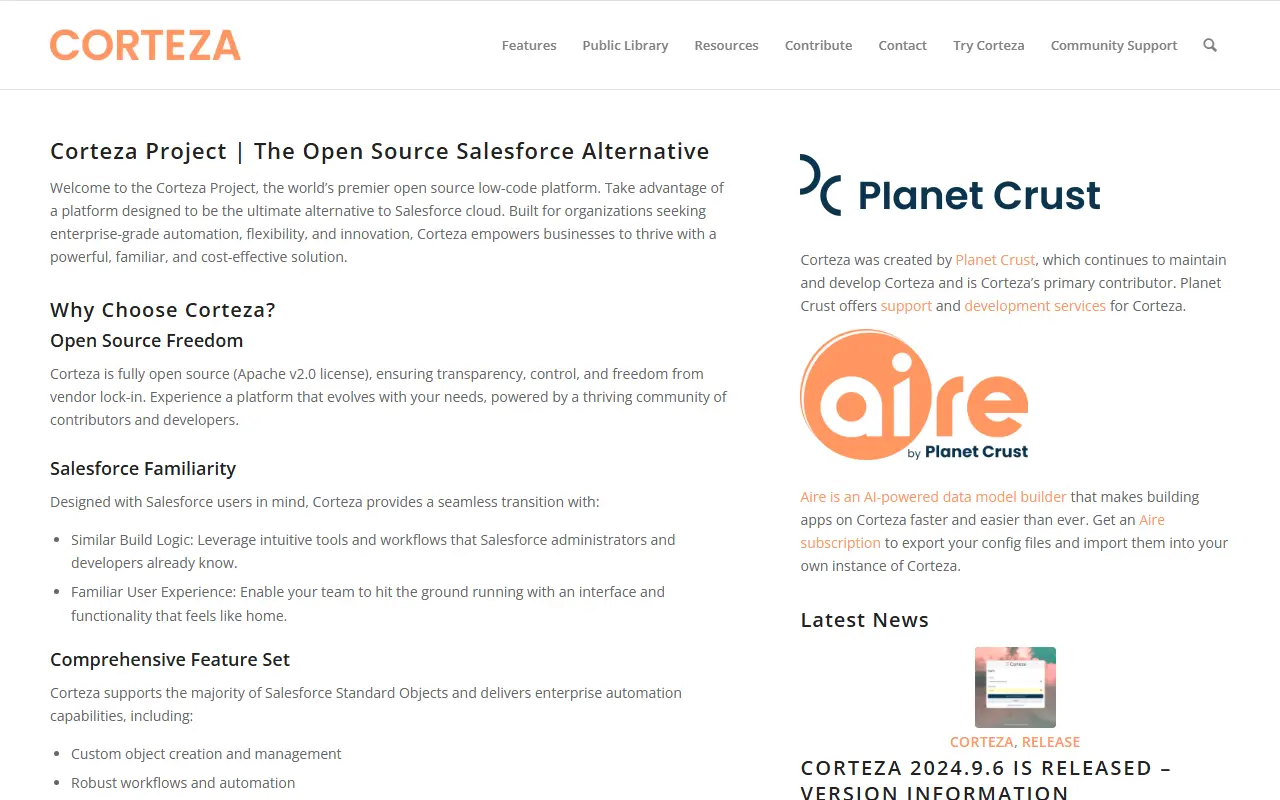
cortezaproject.orgCorteza homepage screenshot

Corteza is a low-code platform that lets teams build and iterate on CRM, business process, and other structured data applications quickly. It also supports intelligent business process workflows and connects to almost any data source. It is written in Go, with a Vue front end, and released under the Apache-2.0 license. It is maintained by Planet Crust, its founder.

Key characteristics include a standards-oriented approach using established data formats, flat role-based access control that supports complex internal security policies, privacy features that help comply with data protection regulations, accessibility following WCAG 2.1, and an API-centric design that makes integration with external services and other Corteza instances straightforward. Applications can be customized from translations and terminology up to entirely new low-code apps.

Planet Crust offers hosted Corteza cloud instances as the easiest way to start, and a DevOps guide covers self-hosting along with backup, restore, and email relay topics. Corteza suits organizations that want an open-source alternative to proprietary low-code CRM platforms and need control over their data.

Key features

  • Low-code builder for CRM and data apps
  • Workflow automation for business processes
  • Role-based access control
  • Privacy and data protection features
  • API-centric integration with data sources
  • WCAG 2.1 accessibility

Pricing: Free and open source under the Apache-2.0 license; Planet Crust offers hosted instances.

Steedos

A metadata-driven low-code platform for building enterprise apps, evolving into the AI-native ObjectStack architecture for generating software from prompts.

GitHub stars
1.6k
Last commit
8 days ago
Latest release
v2.7.32
Licence
AGPL-3.0
Self-hosted
Yes
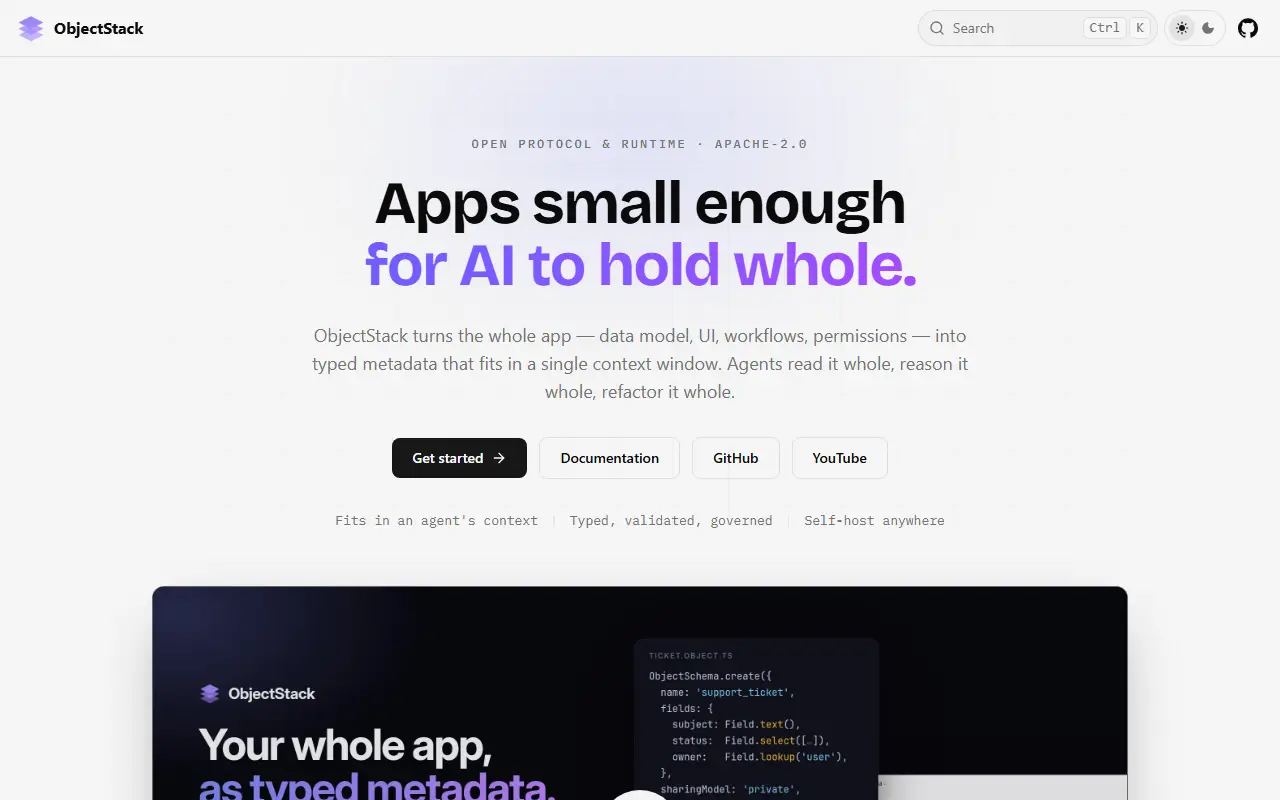
objectstack.aiSteedos homepage screenshot

Steedos Platform is an open-source low-code and no-code platform for building enterprise applications. It follows a metadata-driven architecture similar to Salesforce, where objects, fields, permissions and workflows are described as configuration instead of hand-written code, which speeds up building business apps such as CRM and ERP-style tools.

The project is evolving into ObjectStack, a modular headless stack made of ObjectQL as a protocol for data, logic and UI, ObjectOS as a runtime providing APIs, authentication, permissions and workflow automation, and Object UI as a schema-driven renderer based on React and Tailwind. The README says Steedos v2.x remains supported while future development focuses on ObjectStack and AI-generated applications.

Steedos is written in TypeScript and licensed under AGPL-3.0, with documentation, examples and a community linked from the repository. It is a self-hosted platform and its topics reference tools such as Salesforce, Appsmith, Budibase and Airtable, indicating the space it competes in. It suits development teams and agencies that want to build internal business software on a configurable, open foundation.

Key features

  • Metadata-driven object and field definitions
  • Headless runtime with APIs and permissions
  • Workflow and BPM automation
  • Schema-driven React user interface renderer
  • Prompt-to-app direction through ObjectStack
  • OpenAPI support

Rebuild

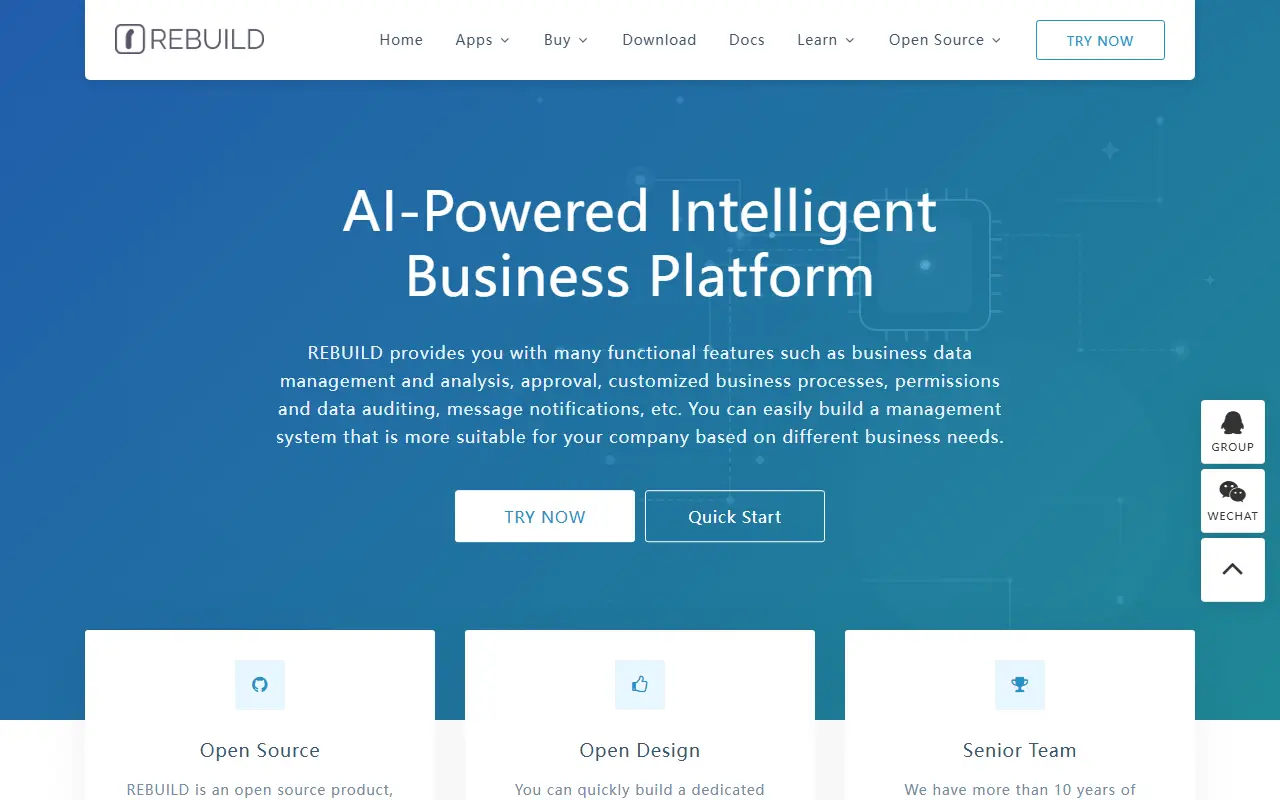
REBUILD is a Chinese-language, Java-based business platform for building CRM, WMS, MES and HR systems with zero-code modeling, workflows and AI assistance.

GitHub stars
1.1k
Last commit
5 days ago
Latest release
4.4.11
Licence
GPL-3.0
Self-hosted
Yes
getrebuild.comRebuild homepage screenshot

REBUILD is an enterprise business platform that focuses on implementing business requirements rather than offering a generic technical framework. Its documentation and interface are in Chinese, and it lets organizations design entities, fields, layouts and forms graphically to assemble systems such as CRM, warehouse management, production reporting, HR and more.

Main capabilities include zero-code modeling, workflow automation with triggers, approval flows and scheduled tasks, fine-grained permissions by team, role and department, web and mobile access with embedding in enterprise messaging apps, and an OpenAPI for integrations and Java or Spring Boot extension. Recent versions add an AI assistant that can operate on business data through natural language, with support for skills, tools, a knowledge base and MCP.

REBUILD is written in Java and licensed under GPL-3.0, with installation by Docker, a standalone package or a Spring Boot jar, and MySQL recommended for production. According to the project, the open-source version is free for internal commercial use by enterprises, while a commercial edition provides more advanced features. It suits small and mid-sized companies that lack development resources.

Key features

  • Graphical zero-code entity and form design
  • Approval flows and trigger automation
  • Role, team, and department permissions
  • Web and mobile access
  • OpenAPI and Spring Boot extension
  • AI assistant with MCP support

Pricing: The open-source edition is free, including for internal enterprise use according to the project; a commercial edition adds advanced features.

Read more about RebuildWebsite GitHub

6 more Salesforce alternatives

Salesforce alternatives: questions

What is the best open-source alternative to Salesforce?
Twenty is the top-ranked open-source alternative to Salesforce on Enlisted: An open-source CRM built as a modular, code-extensible platform, positioned as an alternative to Salesforce for technical teams, with cloud and Docker self-hosting. Other strong options are Chatwoot, Krayin CRM, SuiteCRM and EspoCRM.
Are these Salesforce alternatives free?
All 16 are open source, so the code is free to use under its licence, and all of them can be self-hosted on your own server or computer. 8 also offer a paid or managed cloud version if you'd rather not host it yourself.
How is this list of Salesforce alternatives ranked?
By a score built from GitHub stars, star growth over the last 30 days and how recently the code changed. 14 of these projects shipped code in the last 30 days. Data is refreshed daily, and nobody can pay to move up.

People also look for alternatives to…

View all