#1
Thunderbird for Android is an open-source, privacy-focused email app for managing multiple accounts, based on K-9 Mail.
- GitHub stars
- 14k
- Last commit
- 2 days ago
- Latest release
- K9MAIL_25_0
- Licence
- Apache-2.0
- Self-hosted
- Yes
thunderbird.net
Thunderbird for Android is an open-source email app for Android that manages multiple email accounts from one place, with an optional Unified Inbox. It is the Android edition of Thunderbird, developed by a team of developers with help from a community of volunteers, and it is based on K-9 Mail, formerly the project's name. It is written in Kotlin.
The project states that Thunderbird never treats private data as a product. The app can be installed from Google Play or F-Droid, in stable or beta versions, from GitHub releases, through FFUpdater, or with Obtainium. The beta channel gives early access to features still under development, and signing certificate fingerprints are published in the security document.
Help comes from a knowledge base, a support forum and a GitHub issue tracker, and feature ideas are discussed on connect.mozilla.org. Release notes describe what changed in each version. The app is released under the Apache 2.0 license and runs on the phone itself, connecting to the email providers you configure.
Key features
- Multiple email accounts in one app
- Unified Inbox option
- Stable and beta release channels
- Available on Google Play and F-Droid
- Based on K-9 Mail
- Written in Kotlin
Pricing: Free and open source under the Apache 2.0 license.
#2
Tuta Mail is an encrypted email, contacts and calendar service with open-source clients for web, desktop and mobile devices, focused on privacy.
- GitHub stars
- 8.2k
- Last commit
- 2 days ago
- Latest release
- tutanota-release-368.261110.0
- Licence
- GPL-3.0
- Self-hosted
- No
- Hosted version
- Available
tuta.com
Tuta, formerly known as Tutanota, is an email service built around security and privacy. It uses built-in end-to-end encryption to protect emails, contacts and calendar entries across devices, and it lets users communicate securely with other people regardless of what provider they use.
The open-source repository contains the client applications, which include a web client, an iOS app and a desktop client, along with separate calendar releases for mobile platforms. The code is written in TypeScript and JavaScript on top of the Mithril framework and is licensed under GPL-3.0. Build, translation and development instructions are provided in dedicated files, and the roadmap and feature requests are handled through Reddit and the vendor website.
Tuta is a hosted service operated by the vendor rather than a product you install on your own server. The repository states that it does not accept contributions or bug reports produced with the help of large language models, and maintainers close such submissions without explanation.
Key features
- End-to-end encrypted email
- Encrypted contacts and calendar entries
- Web, desktop and iOS clients
- Open-source client code
- Community translations
Pricing: Free plan with 1 GB of storage, plus paid Revolutionary (20 GB) and Legend (500 GB) plans. Plan prices were not visible on the page, so check the vendor site.
#3
A small CalDAV and CardDAV server for sharing calendars, to-do lists and contacts, written in Python and storing data as plain files.
- GitHub stars
- 5.2k
- Last commit
- yesterday
- Latest release
- v3.9.1
- Licence
- GPL-3.0
- Self-hosted
- Yes
radicale.org
Radicale is a lightweight CalDAV and CardDAV server for sharing calendars, to-do lists and contacts. It speaks CalDAV, CardDAV and HTTP, handles events, todos, journal entries and contact cards, and works with many calendar and contact clients.
It is meant to work out of the box without complicated setup. Access can be limited through authentication, connections can be secured with TLS, and all data is kept on the file system in a simple folder structure. Behavior can be extended with plugins, and the project provides documentation, a wiki and a discussion board.
Radicale is written in Python and distributed as free software under GPL-3.0. Because it needs only a file system for storage, it suits individuals, families and small teams who want to host their own calendar and address book instead of depending on a hosted provider.
Key features
- CalDAV calendar and to-do sharing
- CardDAV contact sharing
- Events, todos, journals and contact cards
- Authentication and TLS support
- File system storage in plain folders
- Plugin-based extensibility
Pricing: Free and open source under the GPL-3.0 licence.
#4
DAVx5 is an Android app that syncs contacts, calendars and tasks over CalDAV and CardDAV and gives access to WebDAV files.
- GitHub stars
- 3k
- Last commit
- 3 days ago
- Latest release
- v4.5.21-ose
- Licence
- GPL-3.0
davx5.com
DAVx5 is an open-source CalDAV and CardDAV synchronization app for Android. It keeps contacts, calendars and tasks on a phone in sync with a server that speaks those open standards, and it can also open online files over WebDAV through Android's Storage Access Framework. The project is focused on privacy and works with self-hosted servers as well as hosted ones.
Setup is designed to be easy, with automatic configuration for supported services. The project website lists the services DAVx5 has been tested with, along with a manual and an FAQ. Parts of the codebase have been split into reusable libraries: cert4android for custom certificate handling, dav4jvm as a WebDAV, CalDAV and CardDAV framework, and synctools for iCalendar and vCard processing.
The app is written in Kotlin and licensed under GPLv3. Support, contribution and security disclosure policies are documented, and news is posted on Mastodon. The README asks people who want to back development to donate or purchase the app, so the open-source edition coexists with a paid distribution.
Key features
- CalDAV and CardDAV sync on Android
- Contacts, calendars and tasks synchronization
- WebDAV file access via Storage Access Framework
- Automatic configuration for tested services
- Works with self-hosted servers
Pricing: Managed DAVx5 for organizations costs €1.99 (Teams, minimum 5 users) or €1.49 (Business, from 20 users) per user per month, billed annually excluding VAT. A free 30-day demo license is offered.
#5
The desktop sync client for Nextcloud, which keeps files on a Nextcloud server in sync with a Windows, macOS or Linux computer.
- GitHub stars
- 4k
- Last commit
- yesterday
- Latest release
- v35.0.3
- Licence
- GPL-2.0
nextcloud.com
The Nextcloud Desktop Client is an app that synchronizes files from a Nextcloud server with your computer. It is available for Windows, macOS and Linux and is the companion to a Nextcloud server that you run or use.
Official downloads, daily builds and release lists are available from the Nextcloud site, and user, administration and developer manuals are on the central documentation site. Contributors can follow the repository's guidelines and code of conduct, help with testing by installing daily builds, and report bugs in the issue tracker.
The client is written mostly in C++ with Qt6 since version 3.14, with Swift components on macOS, and builds with CMake and compilers such as clang or gcc. Windows 10 and 11, macOS 13 Ventura or newer and Linux are supported, and the build instructions use KDE Craft. The code is licensed under GPL-2.0.
Key features
- File synchronization with Nextcloud servers
- Windows, macOS and Linux clients
- Daily builds for testing
- Qt6-based C++ codebase
- User and admin manuals online
Pricing: Standard plan starts at 42€ per user per year for 100+ users; pricing decreases at higher user volumes.
#6
Baikal is a lightweight CalDAV and CardDAV server written in PHP for hosting your own calendars and contacts.
- GitHub stars
- 3.4k
- Last commit
- 9 days ago
- Latest release
- 0.13.0
- Licence
- GPL-3.0
- Self-hosted
- Yes
sabre.io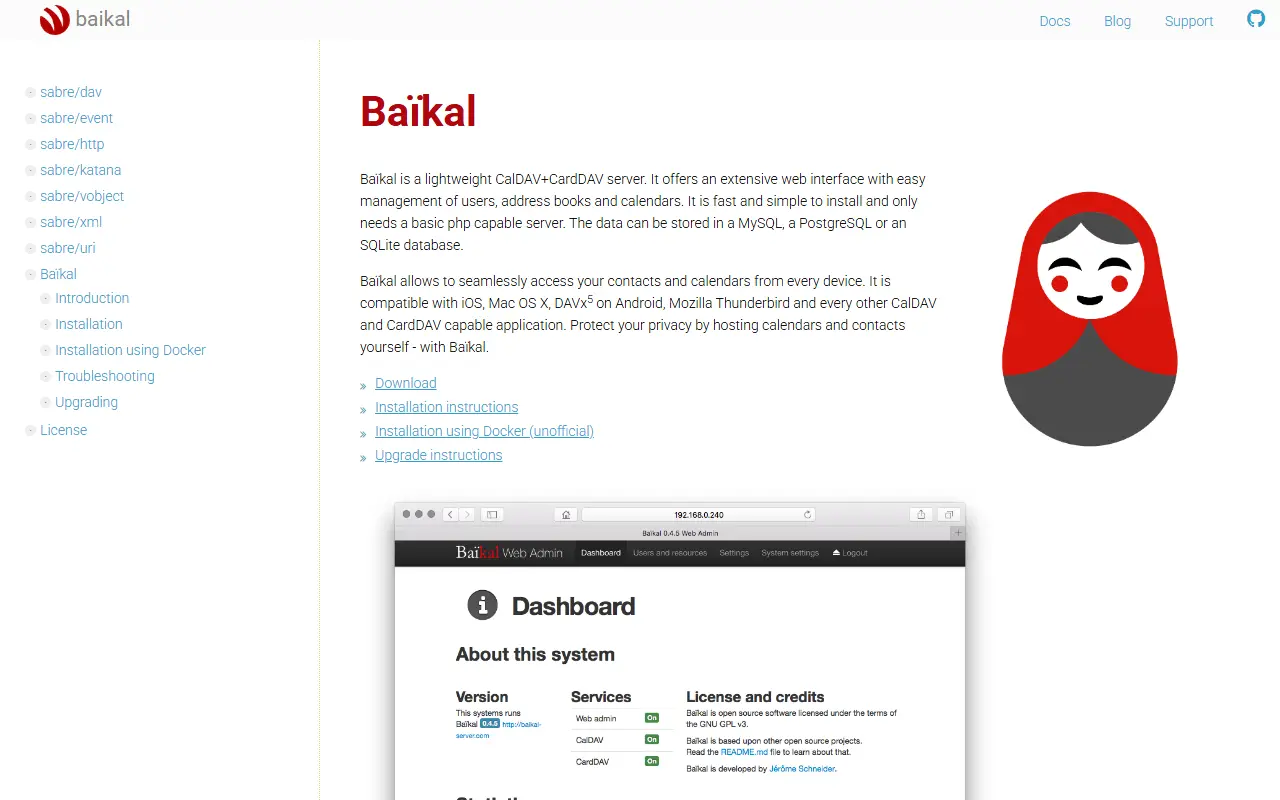
Baikal is a calendar and contacts server that implements the CalDAV and CardDAV protocols. It lets you host your own calendars and address books and sync them with clients that speak those standards. It is written in PHP, based on the sabre project, and licensed under GPL-3.0. The latest release listed is 0.12.1.
Installation, upgrading and troubleshooting information is on the sabre.io project page. The README also links two detailed community tutorials written for people with little IT experience: a German guide that sets up Baikal on a Raspberry Pi and covers Thunderbird, Android with DAVx5, sharing calendars, database maintenance and security, and a French guide covering installation on Debian and iOS clients.
Baikal was created by Jérôme Schneider of Net Gusto together with fruux and is now developed by volunteers. It suits individuals, families and small groups who want to keep calendars and contacts on their own server rather than with a large provider. Upgrade instructions are provided for moving between versions.
Key features
- CalDAV calendar server
- CardDAV contacts server
- Written in PHP on the sabre library
- Works with Thunderbird, DAVx5 and iOS
- Upgrade instructions between versions
Pricing: Free and open source under the GPL-3.0 license.
#7
SOGo is a scalable groupware suite offering webmail, calendars and address books, with native support for standard clients via IMAP, CalDAV and CardDAV.
- GitHub stars
- 2.2k
- Last commit
- yesterday
- Latest release
- SOGo-5.12.13
- Licence
- GPL-2.0
- Self-hosted
- Yes
sogo.nu
SOGo is an open-source groupware suite that combines calendaring, address book management and a full webmail client, along with resource sharing and permission handling. It is described as fast and scalable, and it is written mainly in Objective-C with an AngularJS Material web interface. It is licensed under GPL-2.0 and developed by Alinto.
Because SOGo relies on documented standards such as IMAP, CalDAV and CardDAV, it provides native connectivity without plugins to many clients, including Microsoft Outlook, Apple iCal, the iPhone, Mozilla Lightning and many mobile devices. A Thunderbird connector extension for Thunderbird 78 and later is available in a separate repository.
Building SOGo requires the source of both SOGo and SOPE, the underlying application server framework, and a FAQ covers compilation. A dev container is available for development. The project welcomes documentation work, feature requests, mailing list participation, patches and translations, and the README lists official translations in many languages with their maintainers.
Key features
- Webmail client
- Calendar and address book management
- Resource sharing and permission handling
- IMAP, CalDAV and CardDAV standards
- Native connectivity to Outlook, iCal and iPhone
- Thunderbird connector extension
Pricing: Free and open source under the GPL-2.0 license.
#8
Manage My Damn Life is a self-hosted web front end for CalDAV tasks and calendars with list, Gantt and calendar views, currently in beta.
- GitHub stars
- 647
- Last commit
- 4 days ago
- Latest release
- v0.10.1
- Licence
- GPL-3.0
- Self-hosted
- Yes
intri.in
Manage My Damn Life (MMDL) is a self-hosted front end for managing CalDAV tasks and calendars. It is a web app, built with Next.js, that talks to your existing CalDAV server, so your tasks and events stay on the server you already run. The project is in beta, so caution is advised with production data.
It supports subtasks and many task fields such as due date, status, description and recurrence, calendar event management, multiple CalDAV accounts and multiple user accounts. Tasks can be viewed as a list, in a Gantt view or on a calendar, and you can create task filters to see them as you prefer. It has OAuth support for CalDAV accounts, with Google Calendar supported, and a desktop-first, somewhat responsive layout. Planned features include full RFC 5545 field support, drag and drop, customizable views and plugins.
MMDL has been tested with Nextcloud, Radicale and Baikal and should work with servers supported by the tsdav library. It is licensed under GPL-3.0 and uses Weblate for translations.
Key features
- CalDAV task management with subtasks
- Calendar event management
- List, Gantt and calendar views
- Custom task filters
- Multiple CalDAV and user accounts
- OAuth for Google Calendar accounts
Pricing: Free and open source under the GPL-3.0 license.
#9
Mailpile is a web-based email client with PGP-focused encryption and a fast tag-based search engine; development of the original version has halted pending a Python 3 rewrite.
- GitHub stars
- 8.8k
- Last commit
- 3 yr ago
- Self-hosted
- Yes
mailpile.is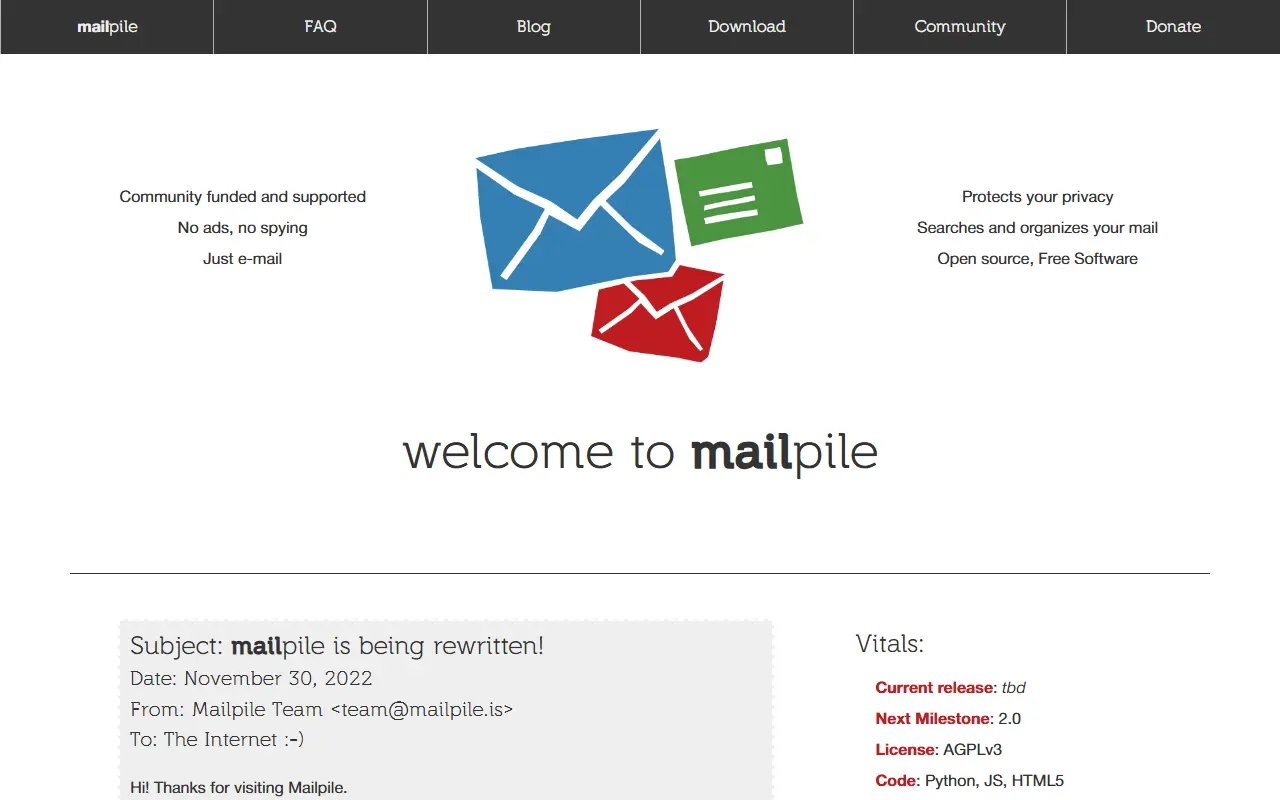
Mailpile is a modern web-mail client that aims to make private email easier, with user-friendly encryption and an emphasis on a clean interface. It was designed to make receiving and sending PGP-encrypted or signed email convenient, and its development was funded by a large community of backers.
Its core is a custom-written search engine built to handle large volumes of email on consumer hardware. Mail is organized with tags, similar to Gmail labels, and incoming messages can be tagged automatically through static rules or Bayesian classifiers. The primary interface is web-based, with a basic command-line interface and an API for developers, so it can run as a local desktop application or as web-mail on a personal server.
The README now carries a notice that development on this codebase has halted until the Python 3 rewrite is complete, and it points to legacy Docker images for anyone who needs to open version 1 data. The repository metadata lists the license as Other, while the project says its code is released under an OSI-approved free software license.
Key features
- PGP encrypted and signed email support
- Fast custom search engine for large mailboxes
- Tag-based organization like Gmail labels
- Automatic tagging with rules and Bayesian classifiers
- Web interface with CLI and developer API
- IMAP and SMTP client support
Pricing: Free and open source. The repository lists the license as Other; the project says it uses an OSI-approved free software license.
Proton Calendar alternatives: questions
- What is the best open-source alternative to Proton Calendar?
- Thunderbird for Android is the top-ranked open-source alternative to Proton Calendar on Enlisted: Thunderbird for Android is an open-source, privacy-focused email app for managing multiple accounts, based on K-9 Mail. Other strong options are Tuta, Radicale, DAVx⁵ and Nextcloud Desktop.
- What are the best commercial alternatives to Proton Calendar?
- Zoho Calendar, Apple Calendar, Notion Calendar, Google Calendar and Morgen are among the hosted, closed-source alternatives to Proton Calendar listed on Enlisted, which lists 13 in total. Compare their pricing and features on each tool page.
- Are these Proton Calendar alternatives free?
- All 9 are open source, so the code is free to use under its licence, and 8 of them can be self-hosted on your own server or computer. 1 also offers a paid or managed cloud version if you'd rather not host it yourself.
- How is this list of Proton Calendar alternatives ranked?
- By a score built from GitHub stars, star growth over the last 30 days and how recently the code changed. 8 of these projects shipped code in the last 30 days. Data is refreshed daily, and nobody can pay to move up.
 TrackMedia
 TrackRev