 TrackMedia
 TrackRev

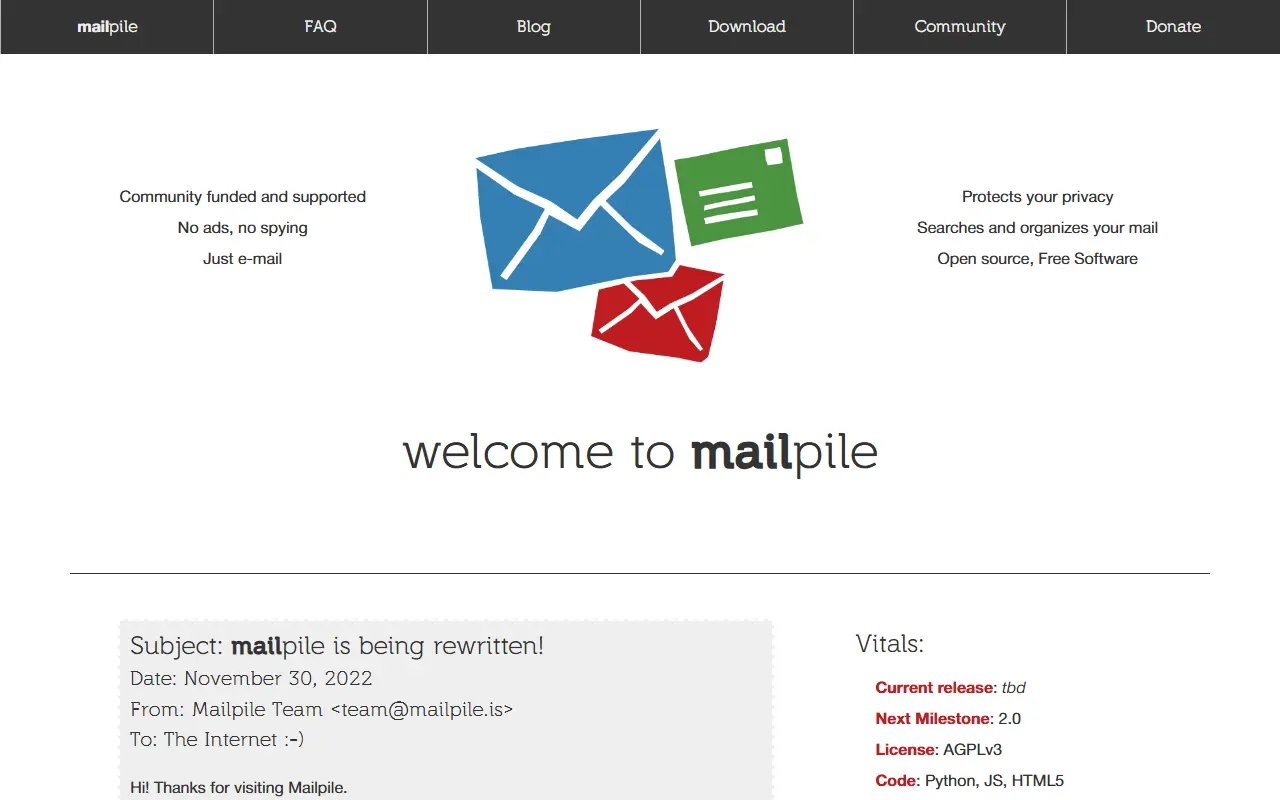
About Mailpile
Mailpile is a modern web-mail client that aims to make private email easier, with user-friendly encryption and an emphasis on a clean interface. It was designed to make receiving and sending PGP-encrypted or signed email convenient, and its development was funded by a large community of backers.
Its core is a custom-written search engine built to handle large volumes of email on consumer hardware. Mail is organized with tags, similar to Gmail labels, and incoming messages can be tagged automatically through static rules or Bayesian classifiers. The primary interface is web-based, with a basic command-line interface and an API for developers, so it can run as a local desktop application or as web-mail on a personal server.
The README now carries a notice that development on this codebase has halted until the Python 3 rewrite is complete, and it points to legacy Docker images for anyone who needs to open version 1 data. The repository metadata lists the license as Other, while the project says its code is released under an OSI-approved free software license.
Key features
- PGP encrypted and signed email support
- Fast custom search engine for large mailboxes
- Tag-based organization like Gmail labels
- Automatic tagging with rules and Bayesian classifiers
- Web interface with CLI and developer API
- IMAP and SMTP client support
Good fit for
- Private webmail on a personal server
- Local email with built-in PGP
Mailpile: questions and answers
- What is Mailpile used for?
- Mailpile is a web-based email client with PGP-focused encryption and a fast tag-based search engine; development of the original version has halted pending a Python 3 rewrite. It is a good fit for private webmail on a personal server and local email with built-in PGP.
- Is Mailpile open source?
- Yes. Mailpile is open source under a custom licence. Its source code is on GitHub at mailpile/Mailpile and is written mainly in Python.
- Is Mailpile free?
- Yes. Mailpile is open source, so the software itself is free to use under the terms of its own licence.
- Can I self-host Mailpile?
- Yes. Mailpile can be self-hosted on your own server or infrastructure; there is no official hosted version.
- What is Mailpile an alternative to?
- Mailpile is an open-source alternative to Spark Mail, Mailbird, Apple Mail and Missive. Other open-source alternatives to Spark Mail include Tuta, Mailspring and Thunderbird.
- Is Mailpile actively maintained?
- The most recent commit to Mailpile was on 1 November 2023. The project has 8.8k stars on GitHub.
Open-source alternatives to Mailpile
See all
Tuta
Email Clients & Servers
Tuta is an email service with a strong focus on security and privacy that lets you encrypt
GPL-3.0vs Gmail★ 8.2k
Mailspring
Email Clients & Servers
:love_letter: A beautiful, fast and fully open source mail client for Mac, Windows and Lin
GPL-3.0vs Microsoft Outlook★ 18k
Thunderbird
Email Clients & Servers
EXPERIMENTAL - copy of comm-central for forking on github
OSSvs Microsoft Outlook★ 198
Roundcube
Email Clients & Servers
The Roundcube Webmail suite
GPL-3.0vs Gmail★ 7.3k
FairEmail
Email Clients & Servers
Fully featured, open source, privacy friendly email app for Android
GPL-3.0vs Gmail★ 4.8k
Thunderbird for Android
Email Clients & Servers
Thunderbird for Android – Open Source Email App for Android (fka K-9 Mail)
Apache-2.0vs Gmail★ 14k
SaaS alternatives to Mailpile
See all
Spark Mail
Email Clients & Servers
Email client with shared inboxes, email delegation and AI writing aids
SaaS
Mailbird
Email Clients & Servers
Windows email client that merges multiple accounts and apps
SaaS
Apple Mail
Email Clients & Servers
Built-in Apple email client supporting iCloud, Gmail, Outlook and IMAP accounts
SaaS
Missive
Email Clients & Servers
Shared inbox that combines team email, chat and collaborative drafts
SaaS
Proton Calendar
Scheduling
Encrypted calendar app from Proton with shared calendars and event sharing
SaaS
HEY
Email Clients & Servers
Email service from Basecamp with sender screening and inbox bundles
SaaS