#1
An open-source CRM built as a modular, code-extensible platform, positioned as an alternative to Salesforce for technical teams, with cloud and Docker self-hosting.
- GitHub stars
- 61k
- Last commit
- today
- Latest release
- twenty/v2.57.1
- Self-hosted
- Yes
- Hosted version
- Available
twenty.com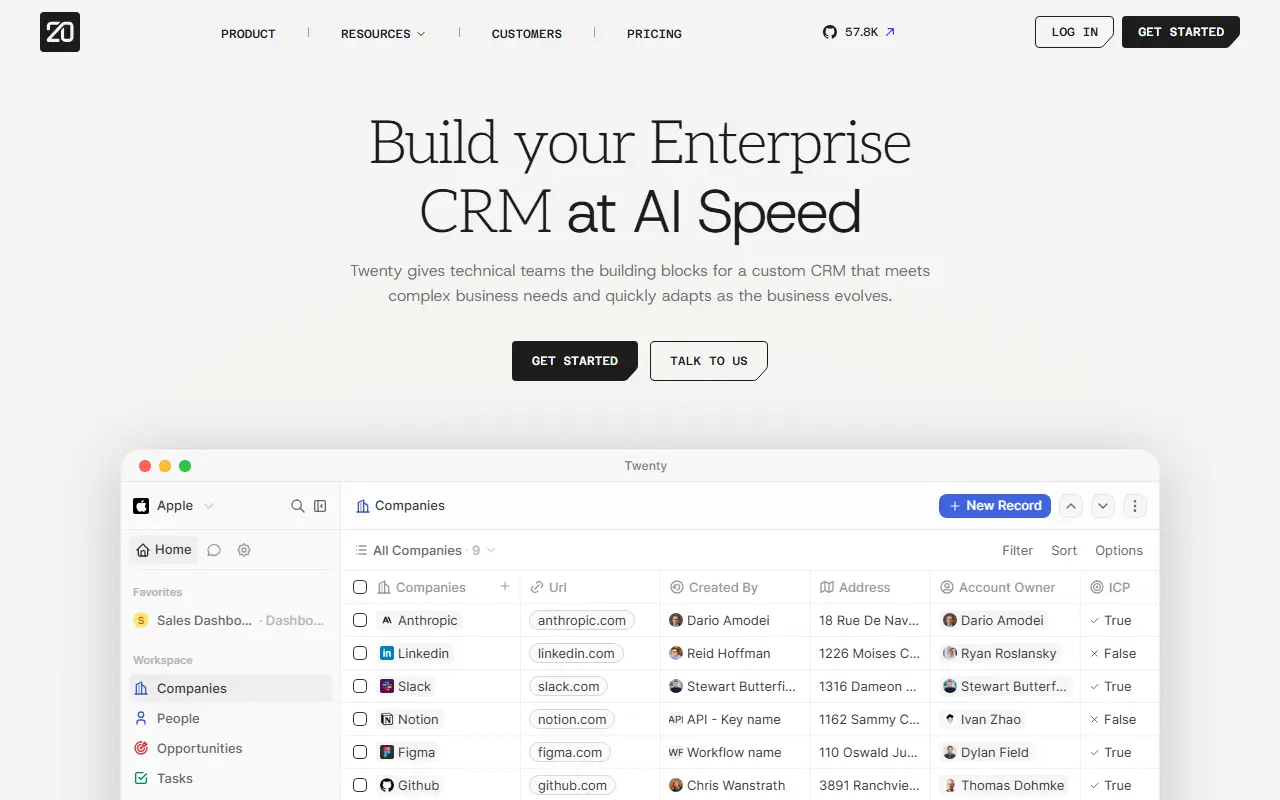
Twenty is an open-source CRM presented as an open alternative to Salesforce and designed for AI. It supplies technical teams with the components to assemble a custom CRM that adapts as the business changes, and the idea is that you build, ship and version it like the rest of your software stack.
The core building blocks are objects, views, workflows and agents, and all of them can be extended as code. A Twenty CLI scaffolds new apps, where you define objects, fields and views as code and then publish them to your workspace, with a guide covering views, agents and logic functions. For people using coding agents, the project provides official skills that work with Claude Code, Codex, Cursor and other harnesses. The stack is TypeScript with NestJS, React, GraphQL and PostgreSQL.
You can sign up at twenty.com for the managed cloud, which needs no infrastructure, or self-host with Docker Compose. The repository's license is listed as 'Other', so review it before commercial redistribution. Twenty suits teams that want a CRM they can shape in code instead of being limited by a fixed SaaS data model.
Key features
- Custom objects, fields and views
- Workflows and agents extendable as code
- CLI for scaffolding and publishing apps
- Official skills for coding agents
- GraphQL API on a PostgreSQL backend
- Cloud workspace or Docker Compose self-hosting
Pricing: Cloud Pro costs $9 and Organization $19 per user per month on yearly billing, with a 30-day trial. Enterprise starts from $50k per year; Twenty can also be self-hosted.
#2
ERPNext, a free open-source ERP built on the Frappe framework, covering accounting, inventory, orders, manufacturing, assets and projects in one system.
- GitHub stars
- 41k
- Last commit
- today
- Latest release
- v16.55.0
- Licence
- GPL-3.0
- Self-hosted
- Yes
- Hosted version
- Available
frappe.io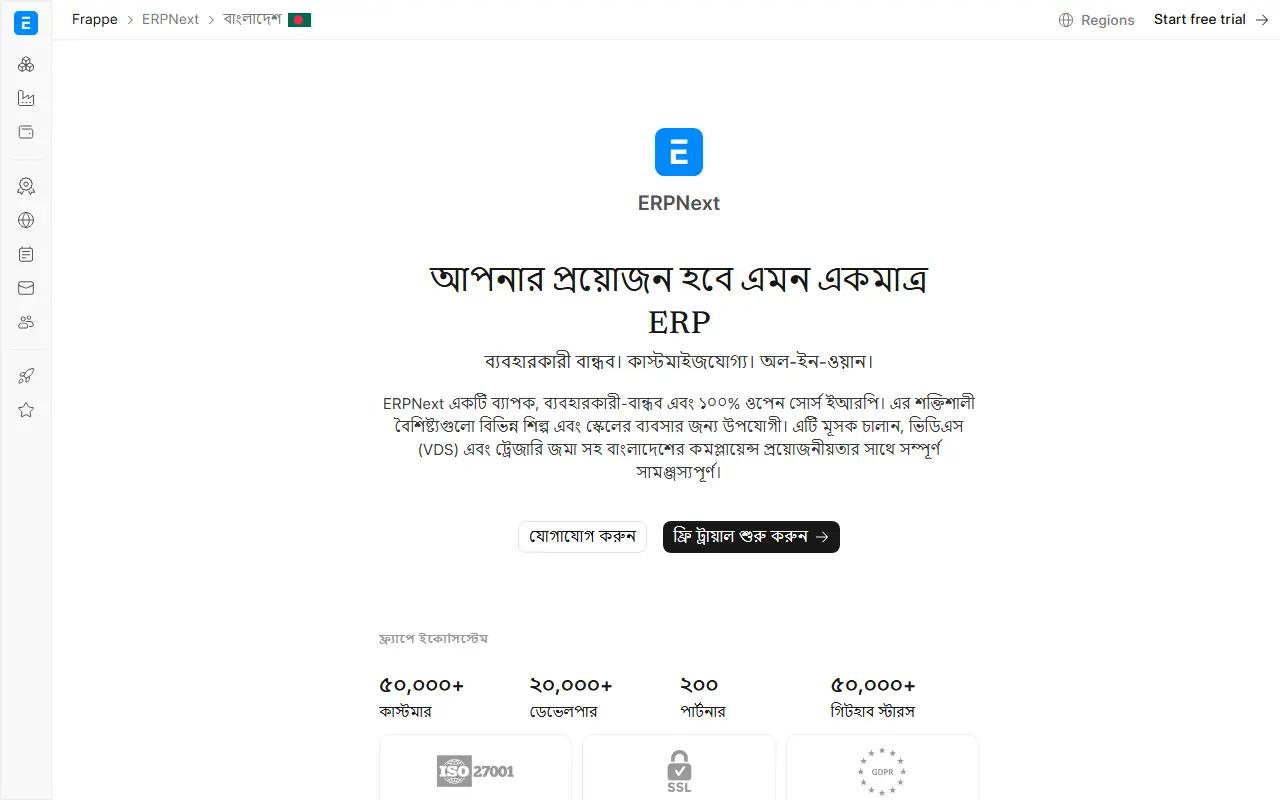
This entry points to ERPNext, the open-source enterprise resource planning system developed in the frappe/erpnext repository on top of the Frappe framework. It aims to replace the patchwork of separate programs a business often uses for invoices, stock, personnel and daily operations with a single integrated product.
Its modules include accounting for cash flow, transactions and financial reports; order management for inventory levels, replenishment, sales orders, customers, suppliers and shipments; manufacturing for production cycles, material consumption, capacity planning and subcontracting; asset management from purchase to disposal; and project delivery. Topics also list HR, CRM, procurement, retail, distribution, healthcare and support functions. It is written in Python, and a live demo is available.
ERPNext is GPL-3.0 licensed and can be self-hosted. The Frappe team also offers managed hosting, which suits companies that want the software without running servers. It is aimed at small and mid-size organizations that want an alternative to proprietary ERP suites.
Key features
- Accounting and financial reporting
- Inventory and order management
- Manufacturing planning and subcontracting
- Asset tracking across the organization
- Project planning and delivery tracking
- HR, CRM and procurement modules
Pricing: ERPNext software is free to self-host. Frappe Cloud hosting starts at $5 per month for a site and $20 per month for a server, not charged per user; a 14-day free trial is available.
#3
Frappe CRM is a simple, customizable open-source CRM for sales teams, built on the Frappe framework with a Vue interface and unlimited users.
- GitHub stars
- 4k
- Last commit
- yesterday
- Latest release
- v16.0.3
- Licence
- AGPL-3.0
- Self-hosted
- Yes
- Hosted version
- Available
frappe.io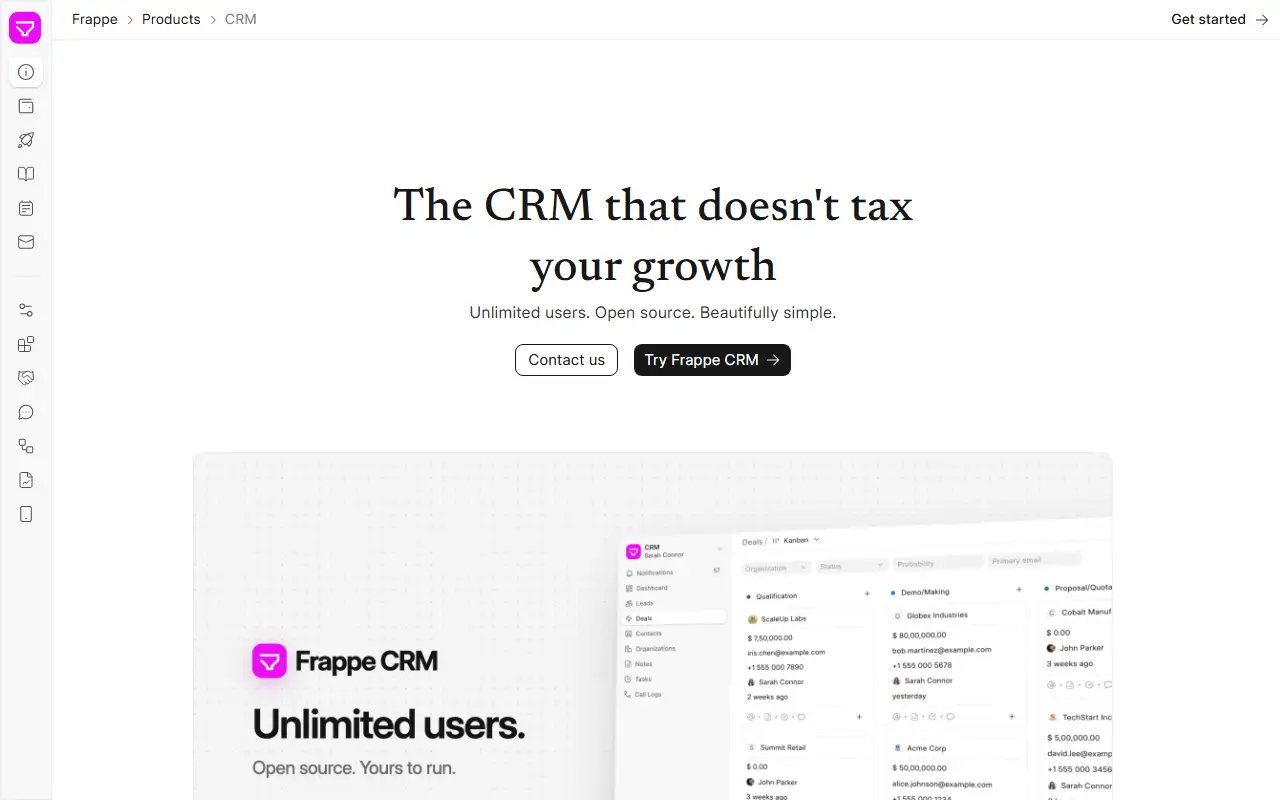
Frappe CRM is an open-source CRM aimed at modern sales teams, and it places no limit on users. It is crafted for a clean user experience and covers core CRM activities so teams can build strong customer relationships without clutter.
The authors say the motivation was to offer a simple, customizable, open-source solution, because many existing CRMs are too complex, too generic or locked behind steep pricing. It is built on the Frappe framework with a Vue front end and Python back end, and as a Frappe app it can be extended and combined with other apps from the same ecosystem. A live demo, website and documentation are provided.
Frappe CRM is licensed under AGPL-3.0. You can self-host it, or run it on the managed Frappe Cloud platform. It suits small and mid-sized sales teams, agencies and startups that want a lightweight CRM they can adapt to their own processes.
Key features
- Lead and deal management
- No limit on user count
- Clean, modern Vue interface
- Built on the Frappe framework
- Customizable to your process
- Live demo and documentation
Pricing: Self-hosting is free. Managed hosting on Frappe Cloud starts at $5 per month for a site and $20 per month for a server, with no per-user fees; enterprise plans are by quote.
#4
Krayin CRM is a free, open-source CRM built with Laravel and Vue.js for managing customers, leads and sales, aimed at small businesses and enterprises.
- GitHub stars
- 24k
- Last commit
- yesterday
- Latest release
- v2.2.8
- Licence
- MIT
- Self-hosted
- Yes
- Hosted version
- Available
krayincrm.com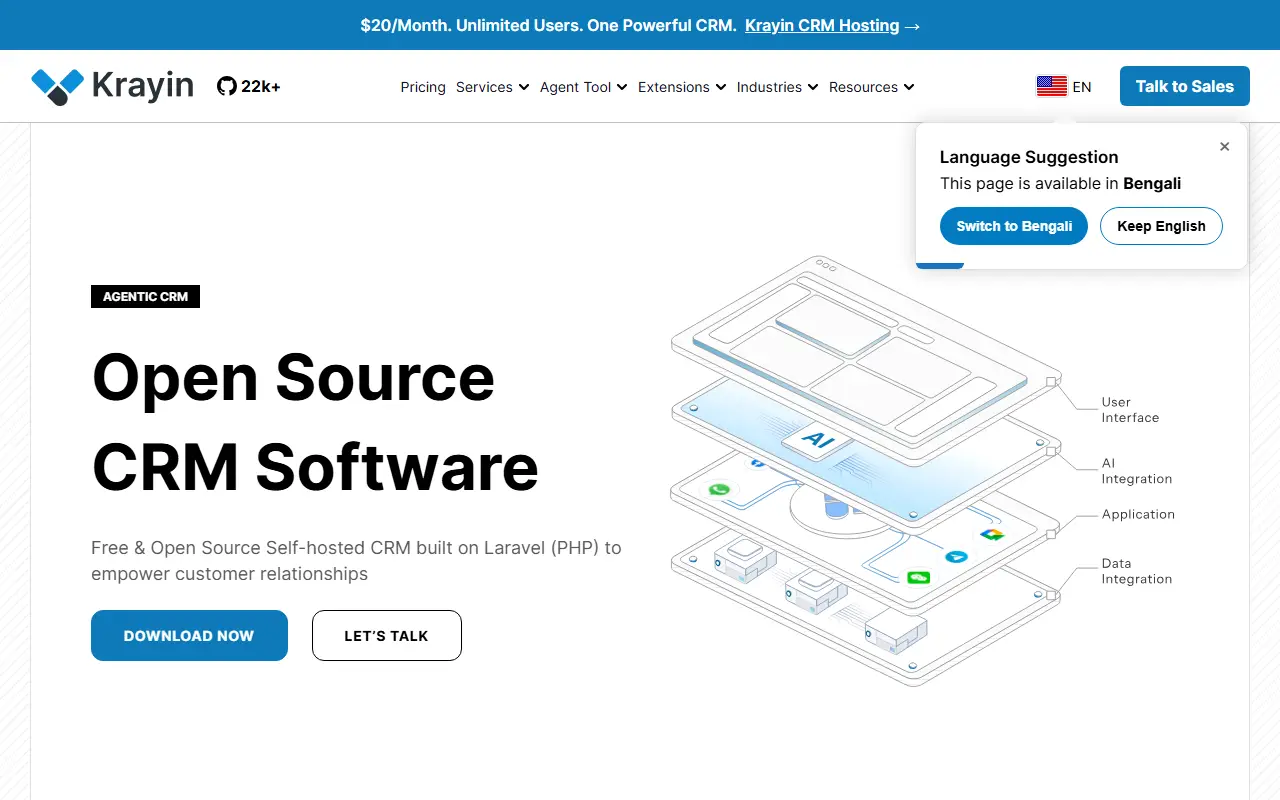
Krayin CRM, published in this repository as Laravel CRM, is a free and open-source customer relationship management system for small and medium businesses and larger organizations. It covers the customer lifecycle, from capturing leads through managing customers and sales, and is described as a hand-tailored CRM framework built on Laravel and Vue.js.
The README lists a descriptive and simple admin panel, a dashboard, custom attributes, a modular architecture and email parsing via SendGrid among its features. Developers get the benefit of building on two popular frameworks, PHP's Laravel and the progressive JavaScript framework Vue. The project provides documentation, a forum for questions and feature requests, a live demo, Docker installation instructions and a section on the Krayin Cloud system for people who prefer hosted use.
Krayin CRM is MIT licensed, so it can be self-hosted and modified freely. It suits agencies and companies that already work with Laravel and want a customizable CRM core rather than a closed SaaS product, as well as teams that want to extend the data model through custom attributes.
Key features
- Lead, customer and sales management
- Admin panel and dashboard
- Custom attributes for records
- Modular, extensible architecture
- Email parsing via SendGrid
- Docker installation instructions
Pricing: The open-source CRM is free to self-host. Managed cloud hosting starts at $20 per month with unlimited users, priced by server resources rather than seats.
#5
Open-source marketing automation platform for email campaigns, segmentation and multi-channel marketing that you can host yourself.
- GitHub stars
- 11k
- Last commit
- 2 days ago
- Latest release
- 7.2.2
- Self-hosted
- Yes
- Hosted version
- Available
mautic.org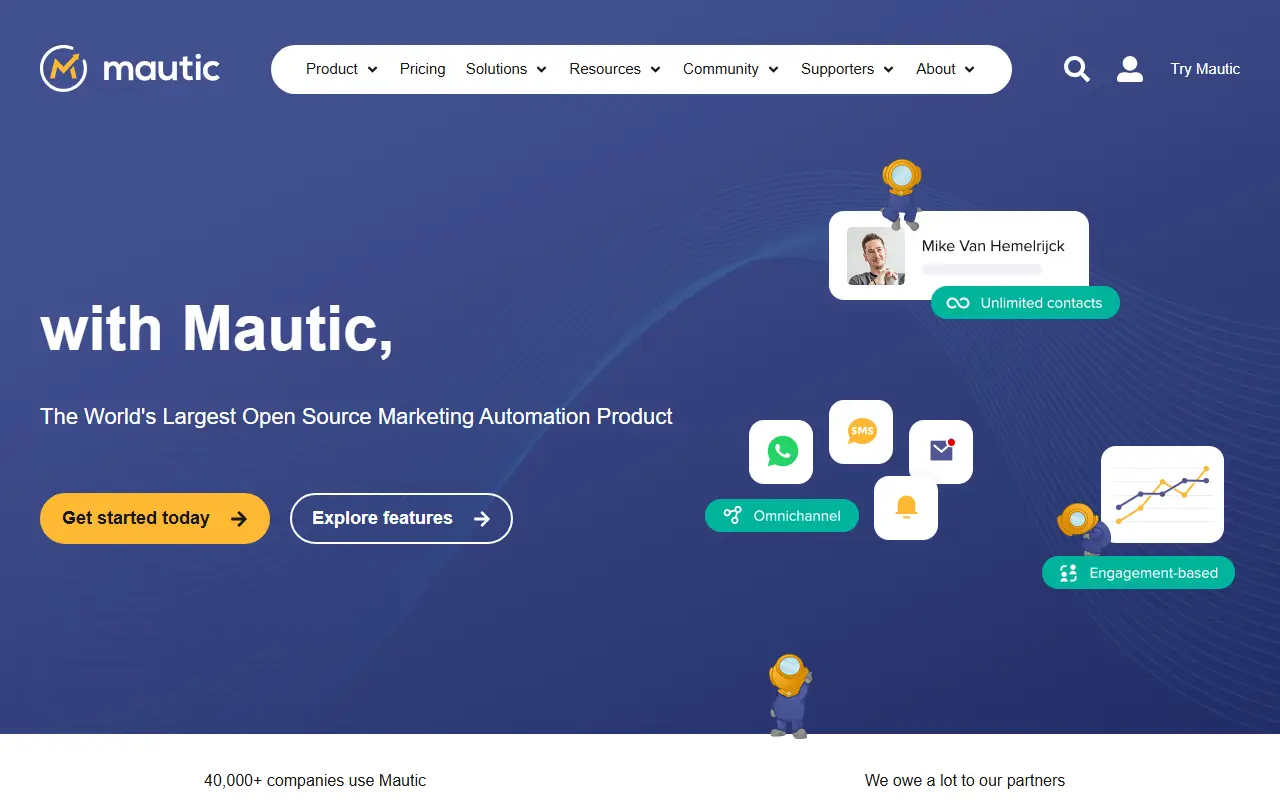
Mautic is open-source marketing automation software. It lets businesses and organizations build integrated marketing campaigns, including email marketing, while keeping control of their own data. The project is supported by a worldwide community of contributors and presents privacy and extensibility as core goals.
The README highlights several advantages over conventional hosted tools: it is free to use, you can run it on your own infrastructure with your own database, there is no vendor lock-in, integrations can be built as needed, and both the frontend and backend are customizable. It also describes multi-channel marketing without extra cost and unlimited segmentation and automation.
Mautic is written in PHP. It can be downloaded and self-hosted, or you can request a trial of a hosted option, and community channels and a blog share news, releases and strategy. Its license is stated in the repository. It suits marketing teams that want automation without relying entirely on a third-party SaaS provider.
Key features
- Email marketing and campaign automation
- Contact segmentation
- Multi-channel marketing
- Customizable frontend and backend
- Custom integrations
- Own your data in your own database
Pricing: Managed Mautic hosting through a partner starts from 275 euros a month billed quarterly (247.50 on annual billing) for Essential and from 1,237 euros a month for Professional; Enterprise is custom.
#6
Open-source CRM for managing leads, contacts, opportunities, marketing campaigns, and support cases, with a single-page web interface and a PHP REST API.
- GitHub stars
- 3.6k
- Last commit
- yesterday
- Latest release
- 10.1.1
- Licence
- AGPL-3.0
- Self-hosted
- Yes
- Hosted version
- Available
espocrm.com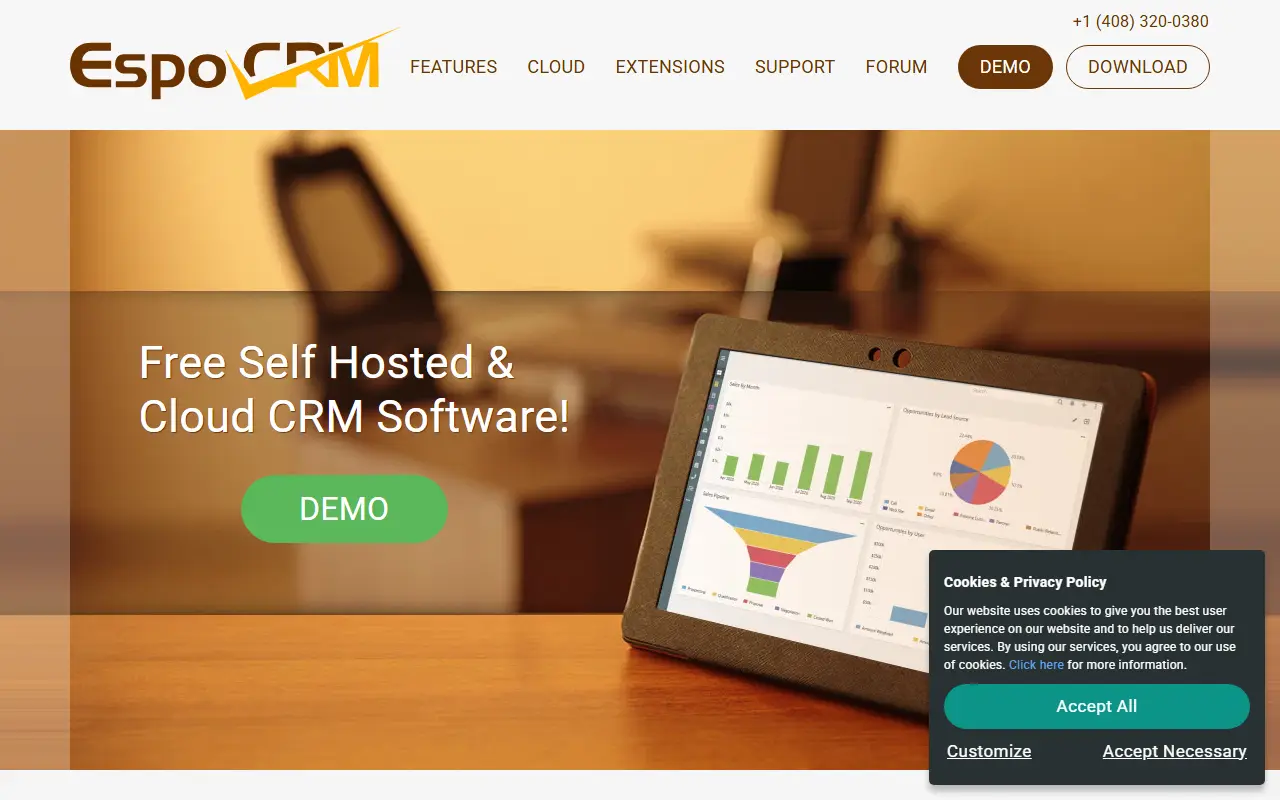
EspoCRM is a free, open-source customer relationship management platform that helps organizations store and manage leads, contacts, sales opportunities, marketing campaigns, and support cases in one web application. The project is released under the AGPL-3.0 license and has been developed since 2014.
The front end is a single-page application backed by a REST API written in PHP, which makes it easy to integrate with other systems. Its feature areas cover sales automation, email marketing, a calendar, kanban views, documents, a customer portal, and customer-support case handling. The data model can be customized to match different business processes.
EspoCRM runs on your own server with PHP 8.3 to 8.5 and MySQL 8, MariaDB 10.6 or later, or PostgreSQL 15 or later. An online demo is available for evaluation. It suits small and mid-sized organizations that want a configurable CRM they can host and modify themselves, and the vendor also sells paid extensions and hosting.
Key features
- Lead, contact, and opportunity management
- Sales automation workflows
- Email marketing campaigns
- Customer support case tracking
- Calendar and kanban views
- Customer portal for external users
- Document storage linked to records
- REST API for integrations
Pricing: Cloud plans are priced per user per month: Basic $15 (minimum 3 users), Enterprise $25 (minimum 5) and Ultimate $69 (minimum 10). Basic and Enterprise have a 30-day free trial.
#7
SuiteCRM is an open-source CRM written in PHP that manages accounts, contacts, leads, opportunities, quotes, cases and workflows.
- GitHub stars
- 5.9k
- Last commit
- 8 days ago
- Latest release
- v7.15.2
- Licence
- AGPL-3.0
- Self-hosted
- Yes
- Hosted version
- Available
suitecrm.com
SuiteCRM is an open-source customer relationship management application for businesses that want control over their data and the freedom to customize their CRM. Its module list covers accounts, contacts, leads, opportunities, quotes, contracts, cases, documents, reports and workflow automation, and it supports multiple languages and currencies.
The README separates two generations of the product. SuiteCRM 7 is described as a mature and stable line with a large community and regular releases of features, security patches and fixes, while SuiteCRM 8 is the newer version that was still catching up on features at the time of writing. The project also maintains an extensions directory, a demo, a community forum and a partner network. It is written in PHP.
SuiteCRM is licensed under AGPL-3.0 and is usually installed on your own web server with a database. Managed hosting and support are available through the vendor and partners. It suits small and mid-sized businesses and agencies that want an open-source alternative to commercial CRMs.
Key features
- Accounts, contacts and leads management
- Opportunities, quotes and contracts
- Cases and customer portal
- Workflow automation and reports
- Multi-language and multi-currency support
- Extension directory for add-ons
Pricing: The software is free with no per-user fees. Fully managed hosting starts at £50 per month, Quick Start setup from £2,520 one-time, and SuiteASSURED support from £3,350 per year.
#8
Open-source AI-enabled CRM from FIT2CLOUD for private deployment, with sales management, DataEase analytics, and skills for AI assistants.
- GitHub stars
- 2.9k
- Last commit
- today
- Latest release
- v1.9.7
- Self-hosted
- Yes
cordys.cn
Cordys CRM is an open-source customer relationship management system from FIT2CLOUD, written in Java and aimed at private deployment so that companies keep control of their data. The project documentation is in Chinese, and the input lists its license only as other. It is described as combining informatization, digitalization, and AI capabilities.
Its stated strengths are flexible configuration with fine-grained permissions and integration with mainstream office platforms; an open API and standard interfaces for custom development; business intelligence through the DataEase analytics engine for sales data visualization; and an open CRM Skills interface that lets AI assistants such as OpenClaw and WorkBuddy take part in tasks from lead screening to deal analysis. A built-in agent harness arrived in version 1.9.0.
Installation requires a Linux server with Docker and a one-line install script, with alternatives through the 1Panel app store or an offline package for networks without internet access. It suits Chinese-speaking companies and teams that want a self-hosted CRM with AI integration.
Key features
- Self-hosted CRM for sales management
- Fine-grained permissions and modular configuration
- DataEase-powered sales analytics
- CRM Skills interface for AI assistants
- Open API for custom integration
- Docker one-line, 1Panel, and offline installation
Pricing: The Community edition is open source and free. The Enterprise edition is an annual subscription listed at ¥3万, ¥6万 or ¥12万 per year depending on company revenue and deployment, with no per-seat pricing; an enterprise trial can be requested.
#9
Self-hosted, multi-tenant open-source CRM (BottleCRM) with a Django REST backend, SvelteKit web app, and Flutter mobile app.
- GitHub stars
- 2.5k
- Last commit
- 13 days ago
- Latest release
- v1.44.0
- Licence
- MIT
- Self-hosted
- Yes
bottlecrm.io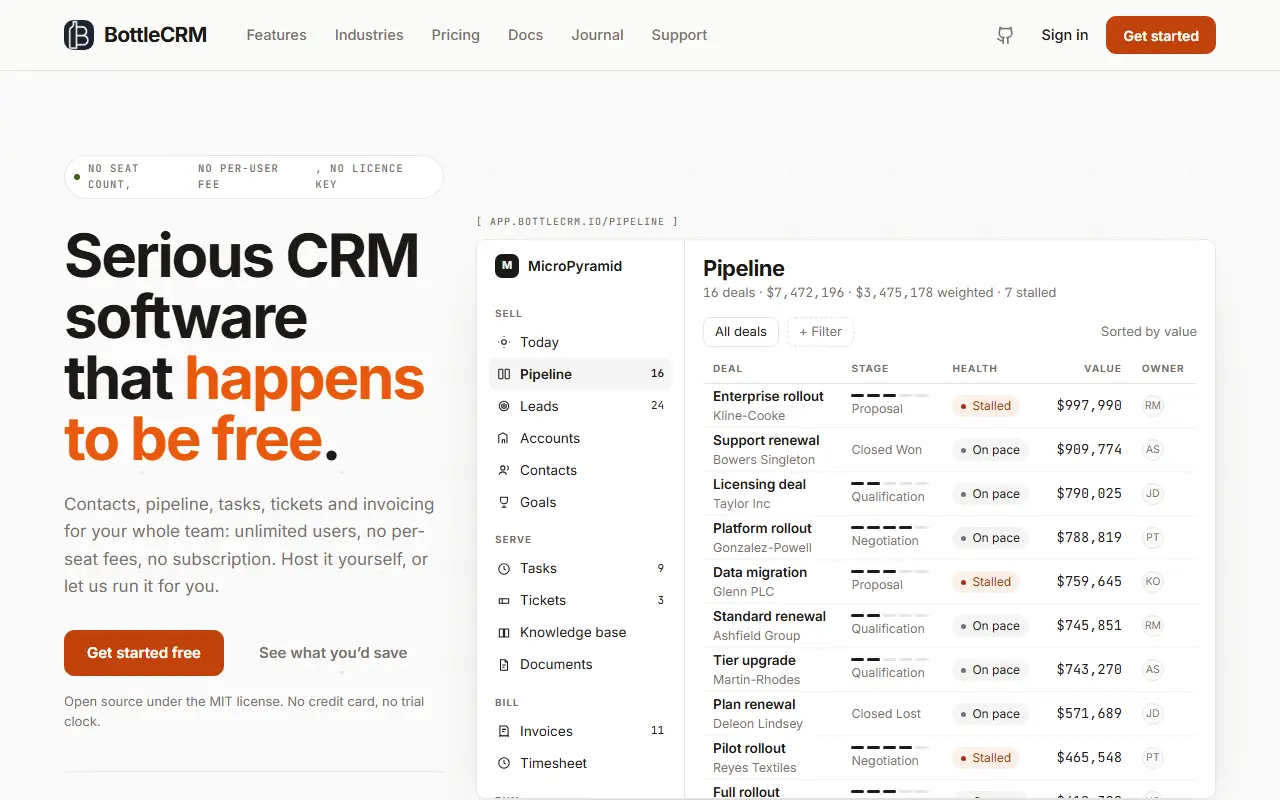
BottleCRM, published as django-crm, is a free, self-hosted, multi-tenant CRM for startups and larger organizations. It covers the customer lifecycle across leads, accounts, contacts, opportunities, support tickets, tasks, and invoices, and positions itself against Salesforce, HubSpot, and Pipedrive. It is released under the MIT license.
The architecture combines a Django REST Framework backend with a SvelteKit web app and a native Flutter mobile app, all sharing one documented REST API. PostgreSQL Row-Level Security isolates each organization's data at the database layer, so one deployment can serve a single startup or hundreds of tenants. Topics also mention CPQ, helpdesk, and invoice management.
The README states there are no per-seat prices, user caps, or feature paywalls, and says you own your data when you self-host. The site also links to a free trial, a pricing page, and migration guides from Salesforce and HubSpot. It suits small companies and agencies wanting a customizable CRM they can host, fork, and extend.
Key features
- Leads, accounts, contacts, and opportunities
- Support tickets, tasks, and invoices
- Multi-tenant isolation with Row-Level Security
- SvelteKit web app and Flutter mobile app
- Documented REST API
- Migration guides from Salesforce and HubSpot
Pricing: The software is free to self-host with unlimited users. Managed hosting, support and custom setup are paid services priced after a conversation.
#10
NextCRM is an open-source CRM built on Next.js and PostgreSQL that also covers projects, invoicing, documents, an email client and AI features.
- GitHub stars
- 741
- Last commit
- 2 days ago
- Latest release
- v0.39.5
- Licence
- MIT
- Self-hosted
- Yes
demo.nextcrm.io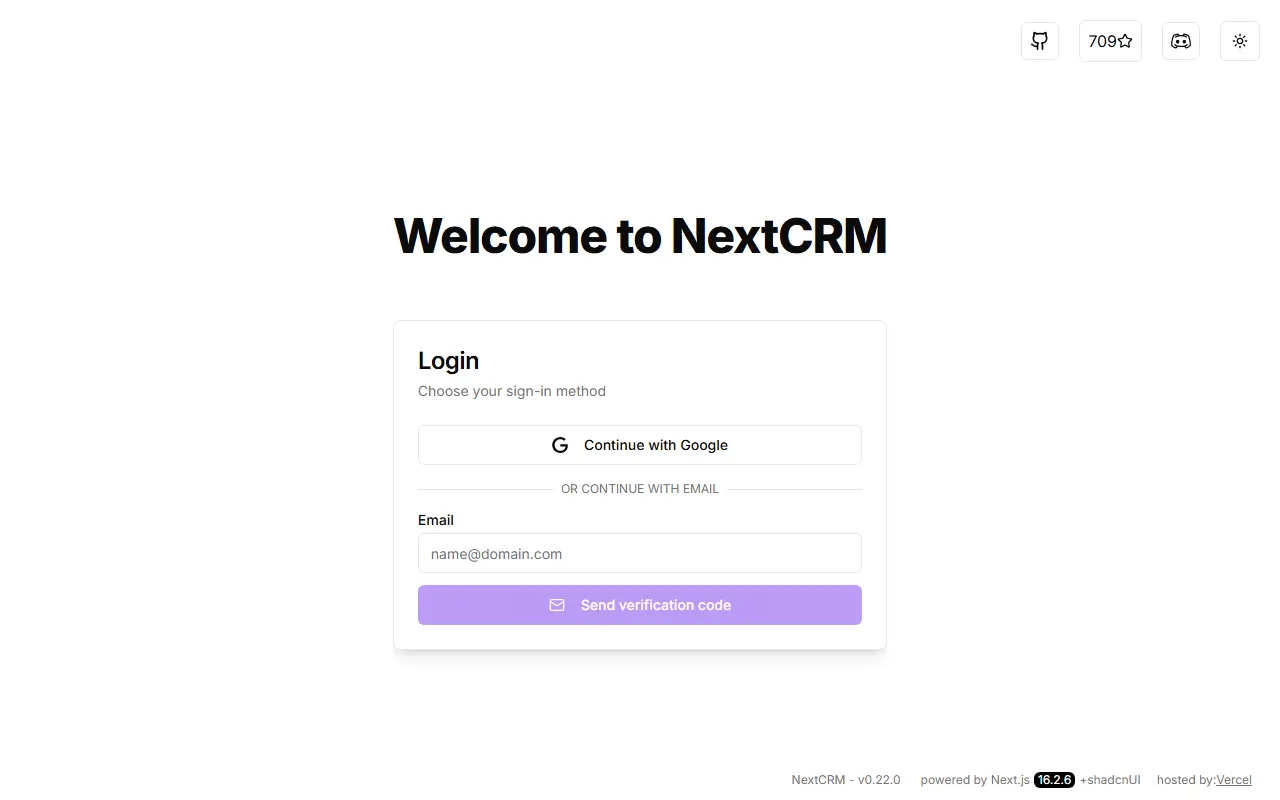
NextCRM is an open-source customer relationship management system built with Next.js 16, React 19, TypeScript, PostgreSQL through Prisma and shadcn/ui. Beyond contact and sales tracking, it combines project management, invoicing, document storage, an email client, AI-powered features, vector search and an MCP server so AI agents can access its data.
A recent addition is a full invoicing module that supports invoices, credit notes, proforma invoices and receipts, with line items, configurable tax rates and VAT summaries, auto-numbered invoice series, multi-currency formatting, a status lifecycle from draft to paid or cancelled, recorded payments and balances, one-click duplication, an activity log, email delivery through Resend and server-side PDF export. Administrators manage tax rates, series and currencies in settings.
NextCRM is licensed under MIT and can be self-hosted. An online demo lets you sign in with a Google account or create a user, and the project maintains a roadmap, a Discord community and installation documentation for developers.
Key features
- CRM for contacts and accounts
- Invoicing with tax and multi-currency support
- Project management module
- Document storage and email client
- AI features and vector search
- MCP server for AI agents
Pricing: Free and open source under the MIT license.
3 more Agile CRM alternatives
Agile CRM alternatives: questions
- What is the best open-source alternative to Agile CRM?
- Twenty is the top-ranked open-source alternative to Agile CRM on Enlisted: An open-source CRM built as a modular, code-extensible platform, positioned as an alternative to Salesforce for technical teams, with cloud and Docker self-hosting. Other strong options are ERPNext, Frappe CRM, Krayin CRM and Mautic.
- What are the best commercial alternatives to Agile CRM?
- Apptivo, monday CRM, Streak, Capsule and Close are among the hosted, closed-source alternatives to Agile CRM listed on Enlisted, which lists 31 in total. Compare their pricing and features on each tool page.
- Are these Agile CRM alternatives free?
- All 13 are open source, so the code is free to use under its licence, and all of them can be self-hosted on your own server or computer. 7 also offer a paid or managed cloud version if you'd rather not host it yourself.
- How is this list of Agile CRM alternatives ranked?
- By a score built from GitHub stars, star growth over the last 30 days and how recently the code changed. 13 of these projects shipped code in the last 30 days. Data is refreshed daily, and nobody can pay to move up.
 TrackMedia
 TrackRev