
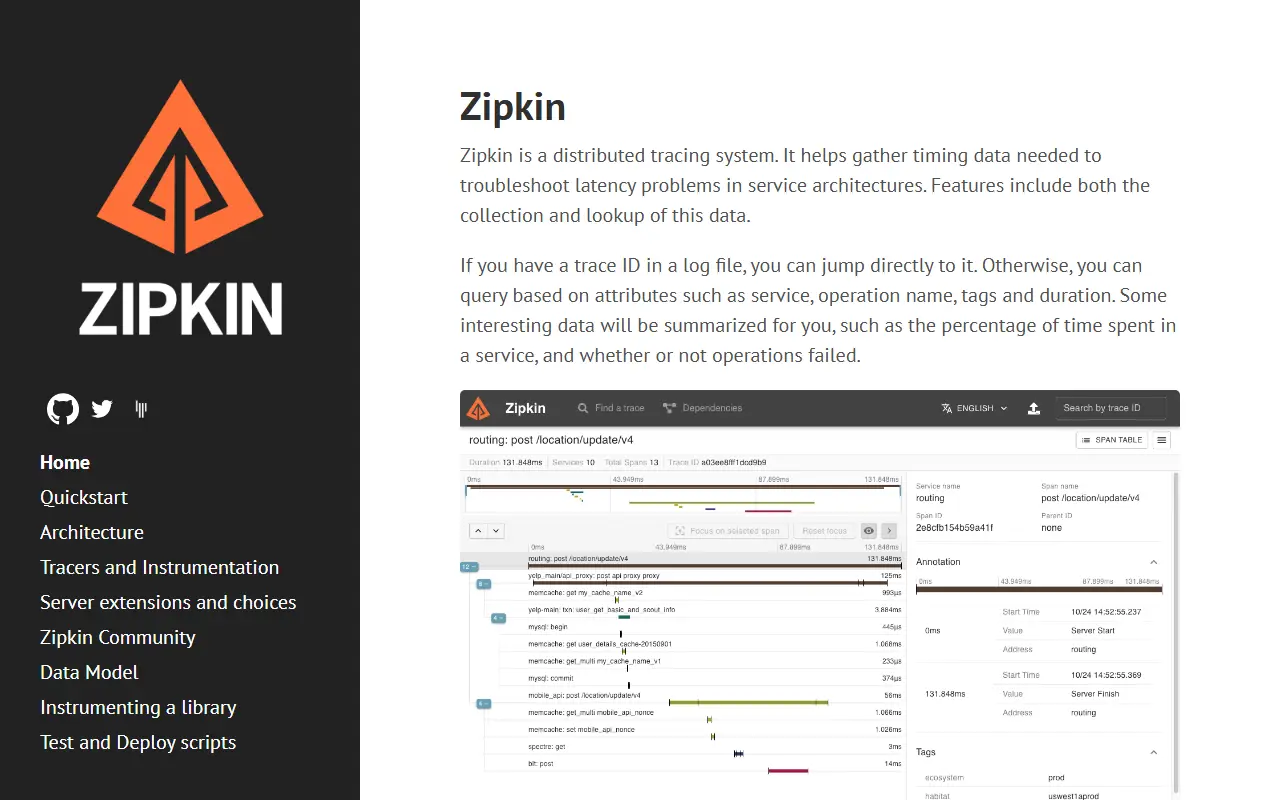
About Zipkin
Zipkin is a distributed tracing system that collects and looks up timing data to troubleshoot latency problems in service architectures. It allows users to query traces by attributes such as service, operation name, tags, and duration, and provides summaries like time spent per service and operation failure status.
The Zipkin UI includes a dependency diagram showing how many traced requests pass through each application, useful for identifying aggregate behavior like error paths or deprecated service calls. Applications must be instrumented to report trace data, typically via HTTP or Kafka, with storage options including in-memory, Apache Cassandra, or Elasticsearch.
Key features
- Collects and looks up timing data for distributed tracing
- Query traces by service, operation name, tags, and duration
- Summarizes percentage of time spent in a service and operation failure status
- Provides a dependency diagram of traced requests across applications
- Supports data reporting via HTTP, Kafka, Apache ActiveMQ, gRPC, and RabbitMQ
- Stores data in-memory or persistently with Apache Cassandra or Elasticsearch
Good fit for
- Troubleshooting latency problems in service architectures
- Identifying error paths or calls to deprecated services
Zipkin: questions and answers
- What is Zipkin used for?
- Zipkin is a distributed tracing system that helps gather timing data to troubleshoot latency problems in service architectures. It is a good fit for troubleshooting latency problems in service architectures and identifying error paths or calls to deprecated services.
- Is Zipkin open source?
- Yes. Zipkin is open source under the Apache-2.0 licence. Its source code is on GitHub at openzipkin/zipkin and is written mainly in Java.
- Is Zipkin free?
- Yes. Zipkin is open source, so the software itself is free to use.
- Can I self-host Zipkin?
- Yes. Zipkin can be self-hosted on your own server or infrastructure.
- What is Zipkin an alternative to?
- Zipkin is an open-source alternative to Logz.io, Honeycomb, Azure Monitor and Blackfire. Other open-source alternatives to Logz.io include SigNoz, Jaeger and Kibana.
- Is Zipkin actively maintained?
- Yes. The most recent commit to Zipkin was on 6 August 2026, and the latest release is 3.6.1, published on 8 April 2026. The project has 17k stars on GitHub.
Open-source alternatives to Zipkin
See all
SigNoz
Monitoring & Observability
SigNoz Cloud is a one-stop observability tool built on top of OpenTelemetry. Get APM, logs
OSSvs Datadog★ 32k
Jaeger
Monitoring & Observability
CNCF Jaeger, a Distributed Tracing Platform
Apache-2.0vs Datadog★ 23k
Kibana
Monitoring & Observability
Your window into all of your data
OSSvs Splunk★ 21k
k6
Testing & QA
A modern load testing tool, using Go and JavaScript
AGPL-3.0vs OpenText LoadRunner★ 32k
Prometheus
Monitoring & Observability
The Prometheus monitoring system and time series database.
Apache-2.0vs Datadog★ 67k
OpenObserve
Monitoring & Observability
High-performance, unified observability for the AI era. 140x lower storage cost.
AGPL-3.0vs Datadog★ 22k
SaaS alternatives to Zipkin
See all
Logz.io
Monitoring & Observability
Managed observability stack for logs, metrics and traces built on open tooling
SaaS
Honeycomb
Monitoring & Observability
Observability service for querying high-cardinality traces and events
SaaS
Azure Monitor
Monitoring & Observability
Azure service for collecting and analyzing metrics, logs and traces
SaaS
Blackfire
Monitoring & Observability
PHP and Python application profiler and performance monitoring service
SaaS
Google Cloud Observability
Monitoring & Observability
Google Cloud logging, monitoring, tracing and error reporting services
SaaS
Amazon CloudWatch
Monitoring & Observability
AWS service for metrics, logs, alarms and dashboards
SaaS