 TrackMedia
 TrackRev

About Virtual Kubelet
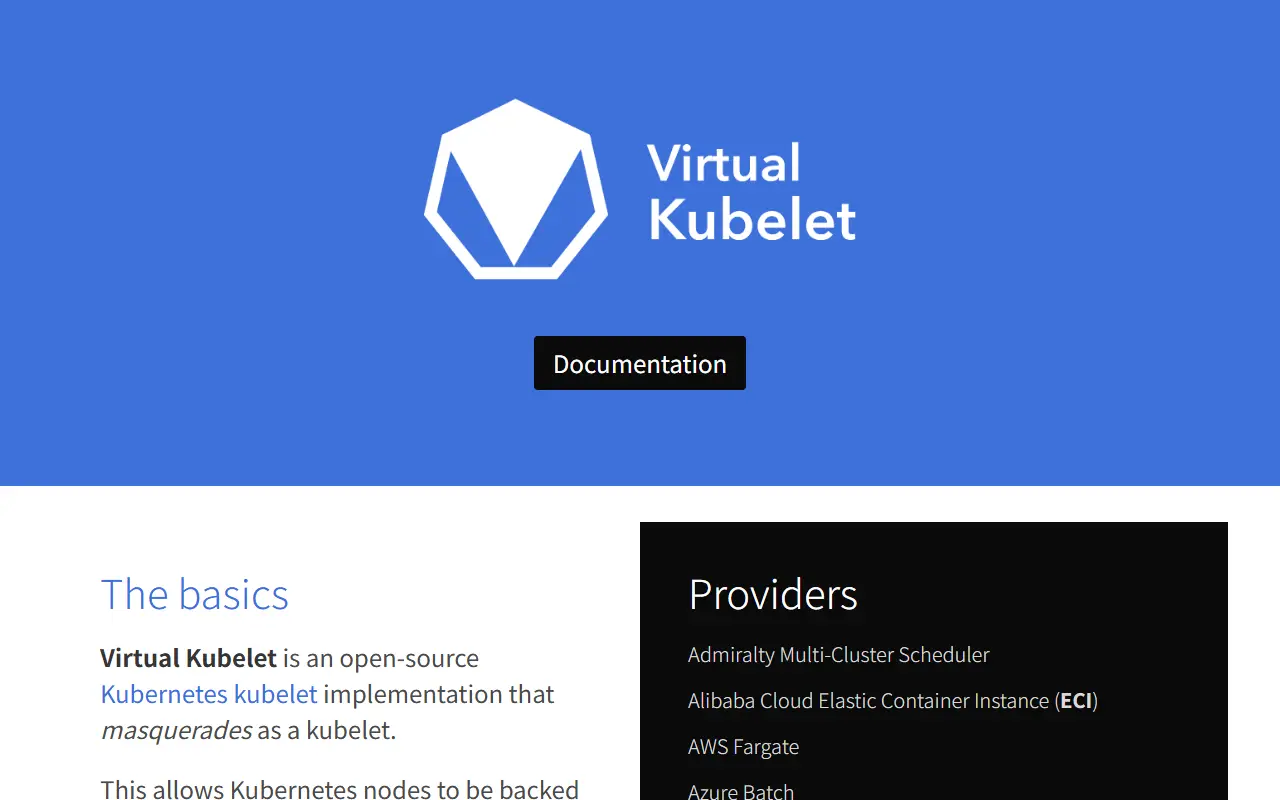
Virtual Kubelet is an open-source implementation of the Kubernetes kubelet that masquerades as a kubelet. Instead of a normal machine behind the node, a Virtual Kubelet provider sits behind it, which allows Kubernetes nodes to be backed by things like serverless cloud container platforms.
The project's home page lists a range of providers. These include Azure Container Instances, AWS Fargate, Alibaba Cloud Elastic Container Instance, Huawei Cloud Container Instance, HashiCorp Nomad, OpenStack Zun and StackPath Edge Compute, along with Liqo, InterLink and the Admiralty Multi-Cluster Scheduler.
Virtual Kubelet is a Cloud Native Computing Foundation sandbox project and is released under the Apache-2.0 licence. The site links to documentation, GitHub, Twitter and Slack.
Key features
- Acts as a kubelet for Kubernetes nodes
- Backs nodes with serverless container platforms
- Providers for Alibaba, AWS and Azure container services
- Providers include Nomad, OpenStack Zun and Liqo
Good fit for
- Backing Kubernetes nodes with serverless containers
- Connecting clusters to external schedulers
Virtual Kubelet: questions and answers
- What is Virtual Kubelet used for?
- Virtual Kubelet is a Kubernetes kubelet implementation that lets nodes be backed by providers such as serverless container platforms. It is a good fit for backing Kubernetes nodes with serverless containers and connecting clusters to external schedulers.
- Is Virtual Kubelet open source?
- Yes. Virtual Kubelet is open source under the Apache-2.0 licence. Its source code is on GitHub at virtual-kubelet/virtual-kubelet and is written mainly in Go.
- Is Virtual Kubelet free?
- Yes. Virtual Kubelet is open source, so the software itself is free to use.
- Can I self-host Virtual Kubelet?
- Yes. Virtual Kubelet can be self-hosted on your own server or infrastructure.
- What is Virtual Kubelet an alternative to?
- Virtual Kubelet is an open-source alternative to AWS Fargate. Other open-source alternatives to AWS Fargate include OpenFaaS, Nomad and Dokku.
- Is Virtual Kubelet actively maintained?
- Yes. The most recent commit to Virtual Kubelet was on 10 November 2026, and the latest release is v1.14.1, published on 6 October 2026. The project has 4.6k stars on GitHub.
Open-source alternatives to Virtual Kubelet
See all
OpenFaaS
Hosting & PaaS
OpenFaaS - Serverless Functions Made Simple
OSSvs AWS Lambda★ 26k
Nomad
Password Management
Nomad is an easy-to-use, flexible, and performant workload orchestrator that can deploy a
OSSvs Fly.io★ 17k
Dokku
Hosting & PaaS
A docker-powered PaaS that helps you build and manage the lifecycle of applications
MITvs Heroku★ 32k
CapRover
Hosting & PaaS
Scalable PaaS (automated Docker+nginx) - aka Heroku on Steroids
OSSvs Heroku★ 15k
Kubernetes
Infrastructure & Containers
Production-Grade Container Scheduling and Management
Apache-2.0vs Amazon EKS★ 129k
Minikube
Infrastructure & Containers
Run Kubernetes locally
Apache-2.0vs OrbStack★ 32k
SaaS alternatives to Virtual Kubelet
See all
AWS Fargate
Infrastructure & Containers
Serverless compute engine for running containers on AWS without managing servers
SaaS
Azure Container Apps
Infrastructure & Containers
Serverless container service on Azure for microservices and jobs
SaaS
Amazon EKS
Infrastructure & Containers
Managed Kubernetes control plane and worker nodes on AWS
SaaS
Azure Kubernetes Service
Infrastructure & Containers
Managed Kubernetes service on Microsoft Azure
SaaS
DigitalOcean Kubernetes
Infrastructure & Containers
Managed Kubernetes service on DigitalOcean
SaaS
Docker Desktop
Infrastructure & Containers
Desktop app for building and running containers locally, with Kubernetes support
SaaS