
About Sablier
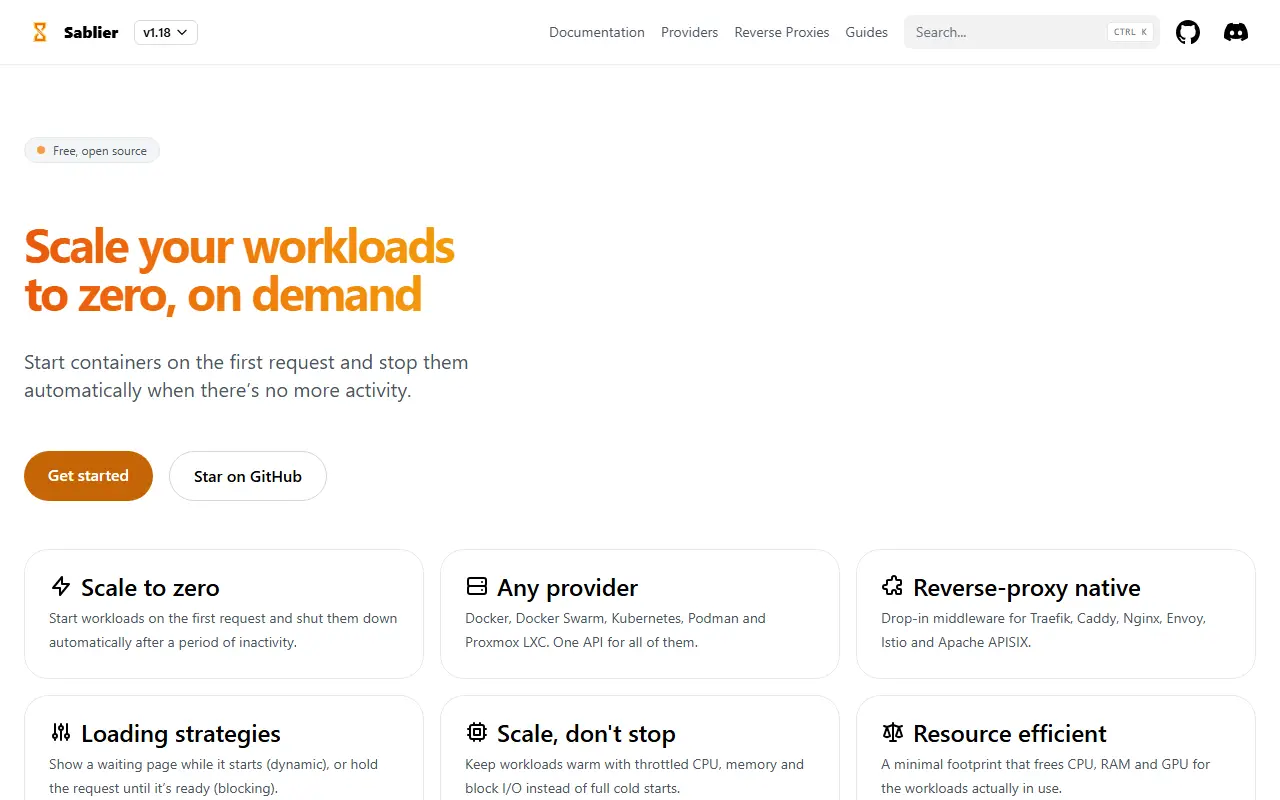
Sablier is free and open-source software that wakes workloads when requests arrive and shuts them down after a period of inactivity. It plugs into reverse proxies, intercepts incoming requests, starts the sleeping workload, and shows a waiting page until the service is ready. It is released under the AGPL-3.0 license and written in Go.
It supports Docker, Docker Swarm, Podman, Kubernetes, and Proxmox LXC. Additional options include a customizable waiting page with themes, webhook notifications when instances start or stop, Prometheus metrics, OpenTelemetry tracing, stop or pause strategies, a scale mode that throttles CPU and memory instead of stopping, and anti-affinity to avoid contention between GPU or RAM-heavy groups.
It can be installed as a Docker image, a binary, a Helm chart, or built from source. Sablier fits small machines such as a Raspberry Pi, QA environments used once a week, and cloud setups where idle workloads can be scaled to zero to cut costs. The audience is homelab users and DevOps engineers.
Key features
- On-demand start and automatic stop of workloads
- Plugins for Traefik, Caddy, Nginx, and Envoy
- Docker, Swarm, Podman, Kubernetes, and Proxmox LXC
- Customizable waiting page with themes
- Webhooks, Prometheus metrics, and OpenTelemetry tracing
- Scale mode to throttle idle workloads
Good fit for
- →Saving resources on a Raspberry Pi homelab
- →Scaling idle QA environments to zero
- Tags
- docker
- kubernetes
- reverse-proxy
- traefik
- autoscaling
- homelab
- cost-saving
- self-hosted
Sablier: questions and answers
- What is Sablier used for?
- Sablier: Starts containers and workloads on demand and stops them after inactivity, working with reverse proxies such as Traefik, Caddy, Nginx, and Envoy. It is a good fit for saving resources on a Raspberry Pi homelab and scaling idle QA environments to zero.
- Is Sablier open source?
- Yes. Sablier is open source under the AGPL-3.0 licence. Its source code is on GitHub at sablierapp/sablier and is written mainly in Go.
- Is Sablier free?
- Yes. Sablier is open source, so the software itself is free to use.
- Can I self-host Sablier?
- Yes. Sablier can be self-hosted on your own server or infrastructure; there is no official hosted version.
- What are some alternatives to Sablier?
- Similar open-source tools in the Infrastructure & Containers category include Portainer, Umbrel and Runtipi. SaaS products in the same category include Docker Desktop, Google Kubernetes Engine and OrbStack.
- Is Sablier actively maintained?
- Yes. The most recent commit to Sablier was on 29 September 2026, and the latest release is v1.18.0, published on 2 September 2026. The project has 3k stars on GitHub.
Open-source alternatives to Sablier
See all
Portainer
Infrastructure & Containers
Making Docker and Kubernetes management easy.
Zlibvs Lens★ 39k
Umbrel
Infrastructure & Containers
Bring the cloud to your home with umbrelOS - a beautiful home server OS for self-hosting,
OSS★ 12k
Runtipi
Infrastructure & Containers
Easy to use homeserver helper to manage all your favorite self-hosted services.
GPL-3.0★ 9.7k
Cosmos Server
Infrastructure & Containers
☁️ The Most Secure and Easy Selfhosted Home Server. Take control of your data and privacy
OSS★ 6.2k
Olares
Infrastructure & Containers
Open-Source Personal Cloud OS for Always-On Agents
AGPL-3.0★ 5.3k
HomeDock OS
Infrastructure & Containers
An intuitive, versatile, and powerful home server operating system for self-hosting. Featu
OSS★ 913
SaaS alternatives to Sablier
See all
Docker Desktop
Infrastructure & Containers
Desktop app for building and running containers locally, with Kubernetes support
SaaS
Google Kubernetes Engine
Infrastructure & Containers
Managed Kubernetes service on Google Cloud with autoscaling and autopilot mode
SaaS
OrbStack
Infrastructure & Containers
Lightweight macOS app for running Docker containers and Linux machines
SaaS
Amazon ECR
Infrastructure & Containers
Managed container image registry on AWS
SaaS
Amazon EKS
Infrastructure & Containers
Managed Kubernetes control plane and worker nodes on AWS
SaaS
Azure Container Registry
Infrastructure & Containers
Managed registry for storing container images and artifacts on Azure
SaaS