
About Nuclei
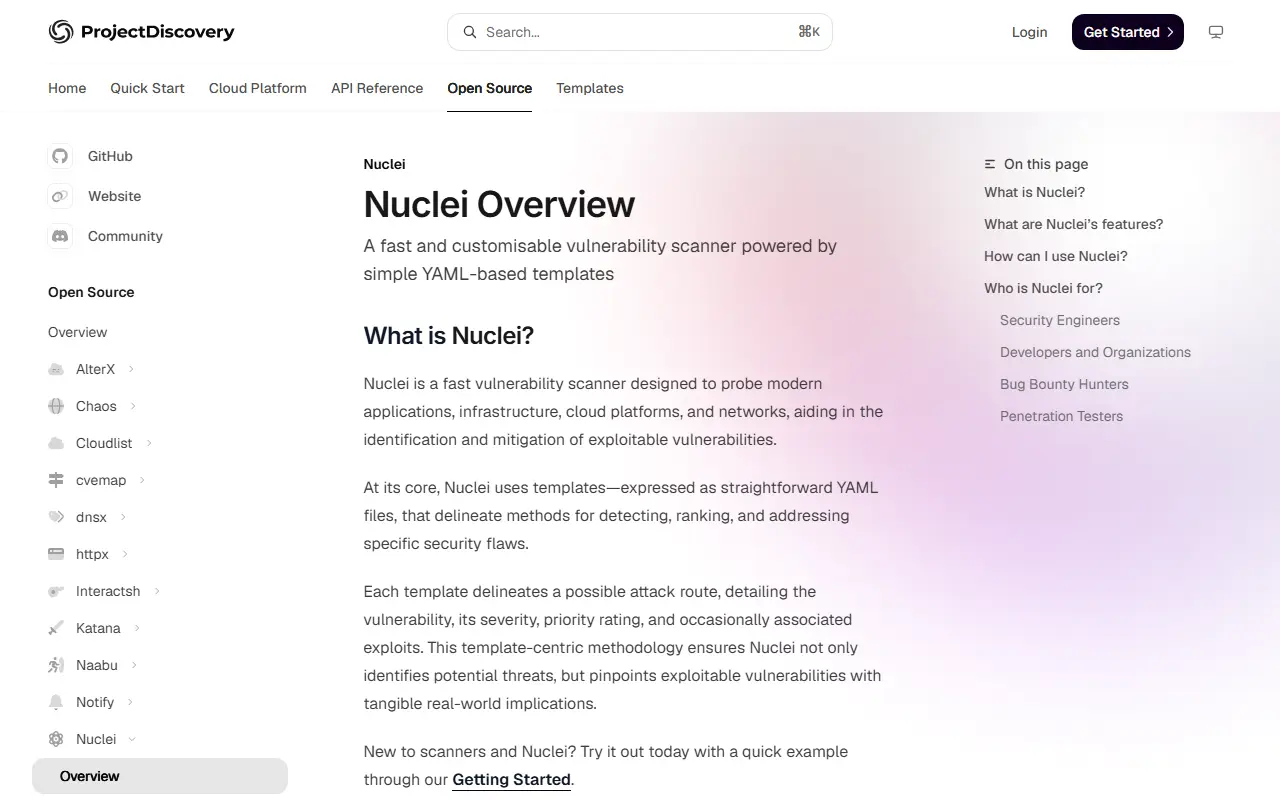
Nuclei is a vulnerability scanner designed to probe modern applications, infrastructure, cloud platforms, and networks. It uses templates expressed as YAML files to define methods for detecting, ranking, and addressing specific security flaws.
Each template outlines a possible attack route, including vulnerability details, severity, priority rating, and sometimes associated exploits. The tool is suitable for security engineers, developers, organizations, bug bounty hunters, and penetration testers.
Key features
- Extensive template library with community-powered templates for various vulnerabilities and attack vectors
- Versatile target specification: URLs, IP ranges, ASN range, and file input
- Bulk scanning of multiple targets at once
- Flexible customization of scanning templates
Good fit for
- Identifying vulnerabilities in applications, APIs, networks, DNS, and cloud configurations
- Bulk scanning of large numbers of assets or websites
- Targeted scans for specific vulnerabilities and attack vectors
Nuclei: questions and answers
- What is Nuclei used for?
- Nuclei is a fast vulnerability scanner that uses YAML templates to detect and prioritize exploitable vulnerabilities in applications, infrastructure, cloud platforms, and networks. It is a good fit for identifying vulnerabilities in applications, APIs, networks, DNS, and cloud configurations; bulk scanning of large numbers of assets or websites; and targeted scans for specific vulnerabilities and attack vectors.
- Is Nuclei open source?
- Yes. Nuclei is open source under the MIT licence. Its source code is on GitHub at projectdiscovery/nuclei and is written mainly in Go.
- Is Nuclei free?
- Yes. Nuclei is open source, so the software itself is free to use. A managed cloud version is also available.
- Can I self-host Nuclei?
- Yes. Nuclei can be self-hosted on your own server or infrastructure.
- What is Nuclei an alternative to?
- Nuclei is an open-source alternative to Checkmarx and Qualys. Other open-source alternatives to Checkmarx include DefectDojo, Trivy and Horusec.
- Is Nuclei actively maintained?
- Yes. The most recent commit to Nuclei was on 13 October 2026, and the latest release is v3.11.1, published on 8 August 2026. The project has 32k stars on GitHub.
Open-source alternatives to Nuclei
See all
DefectDojo
Security
Open-Source Unified Vulnerability Management, DevSecOps & ASPM
BSD-3-Clausevs Tenable★ 5k
Trivy
Security
Find vulnerabilities, misconfigurations, secrets, SBOM in containers, Kubernetes, code rep
Apache-2.0vs Snyk★ 38k
OpenVAS
Security
This repository contains the scanner component for Greenbone Community Edition.
GPL-2.0vs Tenable★ 4.9k
Horusec
Security
Horusec is an open source tool that improves identification of vulnerabilities in your pro
Apache-2.0vs Checkmarx★ 1.3k
Wazuh
Security
Wazuh - The Open Source Security Platform. Unified XDR and SIEM protection for endpoints a
OSSvs Splunk★ 17k
Semgrep
Security
Lightweight static analysis for many languages. Find bug variants with patterns that look
LGPL-2.1vs Snyk★ 17k
SaaS alternatives to Nuclei
See all
Checkmarx
Security
Application security testing platform with SAST, SCA and API security
SaaS
Qualys
Security
Cloud platform for vulnerability management, compliance and asset inventory
SaaS
Veracode
Security
Application security testing platform covering static, dynamic and software composition
SaaS
Socket
Security
Supply chain security that detects risky open source packages before install
SaaS
VeilScan
Security
Automated vulnerability scanner that maps your external perimeter and verifies findings with exploit evidence
SaaS
Aikido Security
Security
All-in-one application security platform for code, cloud and runtime scanning
SaaS