 TrackMedia
 TrackRev

About Ipfs
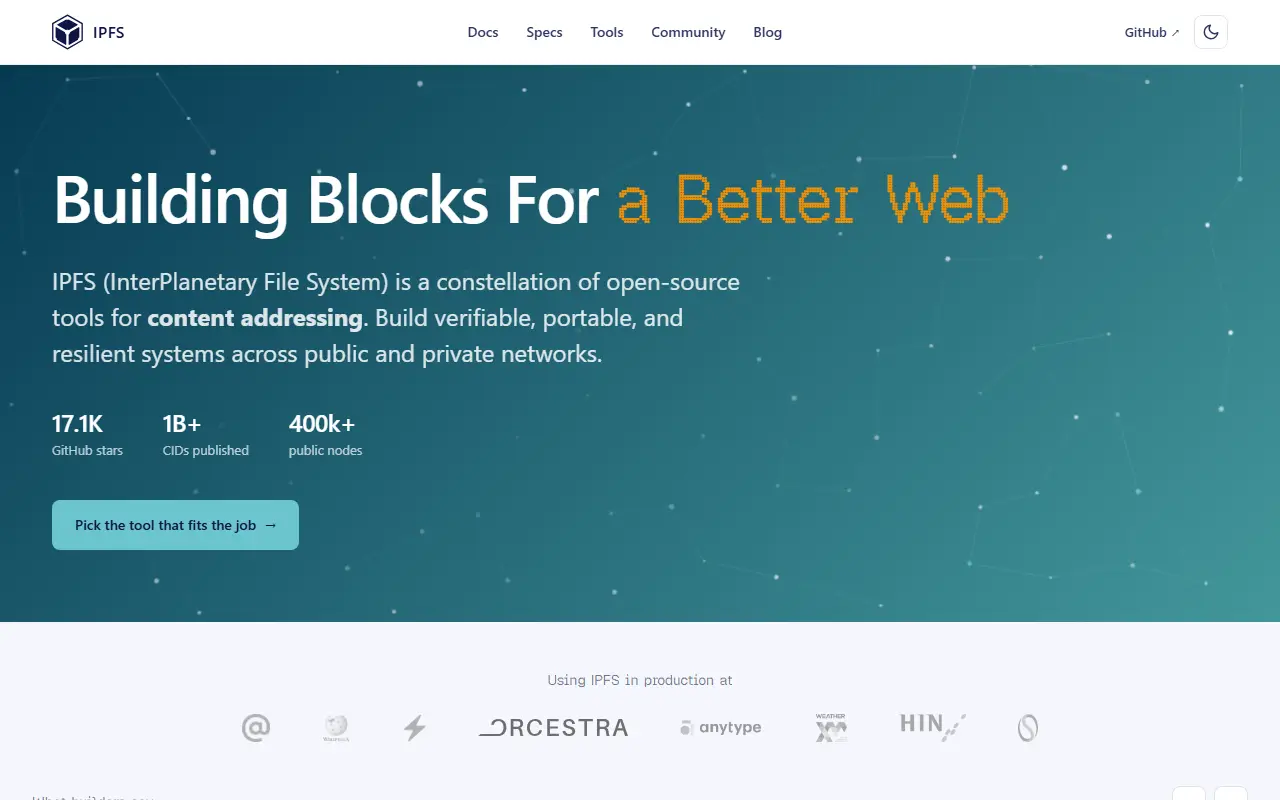
IPFS, the InterPlanetary File System, is described as a constellation of open-source tools for content addressing. The goal is verifiable, portable, and resilient systems across public and private networks. Data is identified by what it is, not where it lives, using a CID that works as a self-describing cryptographic fingerprint of the content.
Any party can generate a CID and any party can verify one. The same CID can travel over HTTP, libp2p with Bitswap, iroh-blobs over QUIC, or RASL, with verification always done at the endpoints. Hosts and routes can change, and you either receive the intact bytes or know they did not arrive.
The site cites 17.1K GitHub stars, more than 1B CIDs published, and over 400k public nodes. Testimonials come from projects in collaborative hypermedia, research data, healthcare messaging, and web publishing, and the navigation points to docs, specs, tools, and community pages.
Key features
- Content addressing with cryptographic fingerprints
- Identifies data by content rather than location
- Works across several transports
- Verification happens at the endpoints
- Usable across public and private networks
Good fit for
- Resilient website publishing
- Sharing research data between sites
- Verifiable storage of media
- IoT data
Ipfs: questions and answers
- What is Ipfs used for?
- IPFS is a set of open-source tools for content addressing, identifying data by a cryptographic CID instead of its location. It is a good fit for resilient website publishing, sharing research data between sites and verifiable storage of media.
- Is Ipfs open source?
- Yes. Ipfs is open source under the MIT licence. Its source code is on GitHub at ipfs/ipfs.
- Is Ipfs free?
- Yes. Ipfs is open source, so the software itself is free to use.
- Can I self-host Ipfs?
- Yes. Ipfs can be self-hosted on your own server or infrastructure.
- What is Ipfs an alternative to?
- Ipfs is an open-source alternative to GitHub Pages, Amazon S3 and Bunny Storage. Other open-source alternatives to Amazon S3 include RustFS, SeaweedFS and Garage.
- Is Ipfs actively maintained?
- The most recent commit to Ipfs was on 1 May 2025. The project has 23k stars on GitHub, with 6 added in the last 30 days.
Open-source alternatives to Ipfs
See all
RustFS
File Storage & Sharing
RustFS is an open-source, S3-compatible high-performance object storage system supporting
Apache-2.0vs Amazon S3★ 36k
SeaweedFS
File Storage & Sharing
SeaweedFS is a distributed storage system for object storage (S3), file systems, and Icebe
Apache-2.0vs Amazon S3★ 36k
Garage
File Storage & Sharing
(Mirror) S3-compatible object store for small self-hosted geo-distributed deployments. Mai
AGPL-3.0vs Azure Blob Storage★ 4.9k
Ceph
Infrastructure & Containers
Ceph is a distributed object, block, and file storage platform
OSSvs Amazon S3★ 17k
Storj
File Storage & Sharing
Ongoing Storj v3 development. Decentralized cloud object storage that is affordable, easy
AGPL-3.0vs Wasabi★ 3.3k
Swift
Open source
OpenStack Storage (Swift). Mirror of code maintained at opendev.org.
Apache-2.0vs Wasabi★ 2.8k
SaaS alternatives to Ipfs
See all
GitHub Pages
Hosting & PaaS
Static site hosting served directly from a GitHub repository
SaaS
Amazon S3
File Storage & Sharing
Amazon S3 is AWS's cloud object storage service for data lakes, backup and restore, archival, mobile apps and analytics workloads.
SaaS
Bunny Storage
File Storage & Sharing
Geo-replicated object storage paired with the bunny.net CDN
SaaS