 TrackMedia
 TrackRev

 AWS Device Farm
 Google Memorystore
 Microsoft Project
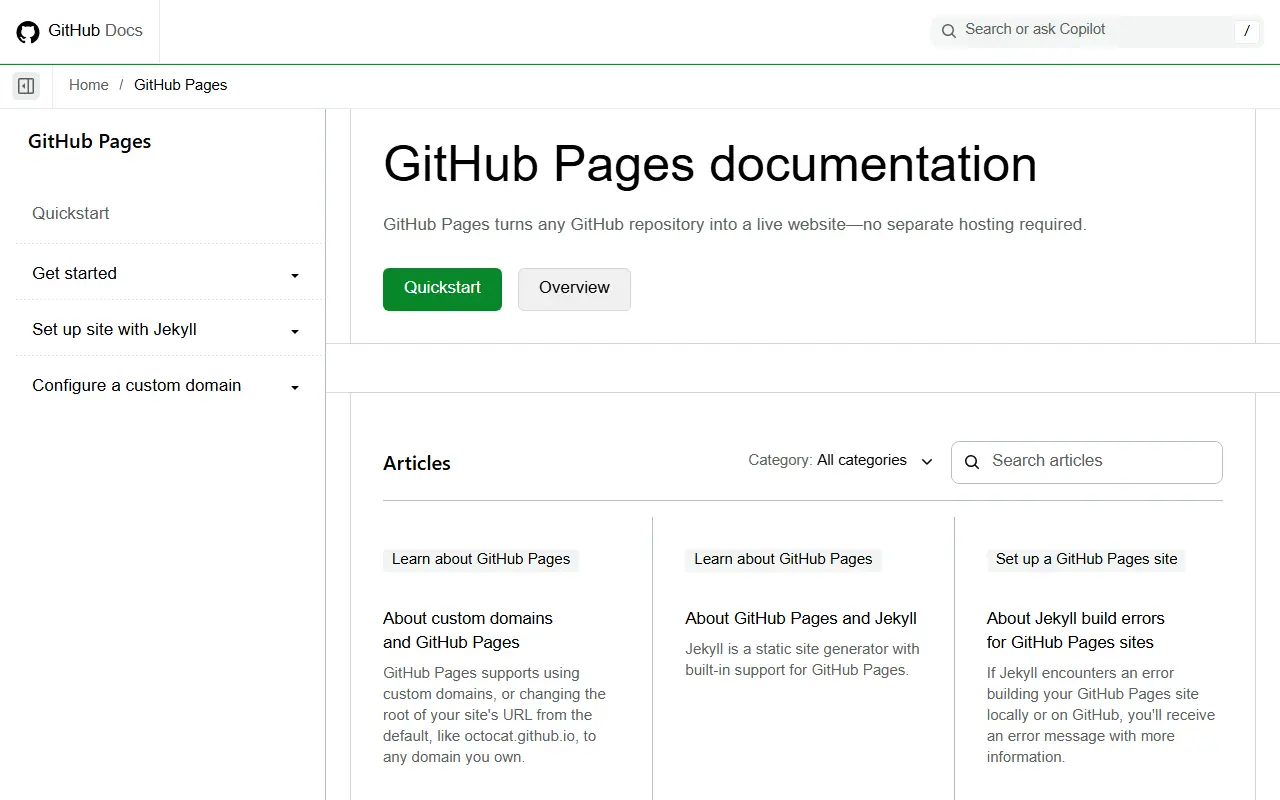
About GitHub Pages
GitHub Pages is a hosting feature of GitHub that publishes static websites directly from a repository. Files such as HTML, CSS and JavaScript are served from a chosen branch or folder, or from the output of a build workflow, so a site can be updated by pushing a commit.
It is widely used for project documentation, personal pages and small marketing sites. Custom domains and HTTPS are supported, and the service is part of GitHub itself, so there is nothing separate to install or run. Availability for private repositories depends on the GitHub plan, which GitHub documents.
Key features
- Publishes static sites from a GitHub repository
- Updates automatically when you push commits
- Custom domain support with HTTPS
- Optional build step through a workflow
- No servers to set up or maintain
Good fit for
- Project documentation sites
- Personal portfolios and blogs
GitHub Pages: questions and answers
- What is GitHub Pages used for?
- GitHub Pages is a static website hosting served straight from a GitHub repository, used for project sites, documentation and personal pages. It is a good fit for project documentation sites, and personal portfolios and blogs.
- Is GitHub Pages free?
- Yes. GitHub Pages is free to use.
- Is GitHub Pages open source?
- No. GitHub Pages is proprietary (closed-source) software and can't be self-hosted. Open-source alternatives to GitHub Pages include ZaneOps, Coolify and Dokploy.
- What are some alternatives to GitHub Pages?
- GitHub Pages competes with Netlify, Cloudflare Pages and Vercel. For open-source options, see Enlisted's ranked list of open-source GitHub Pages alternatives.
Open-source alternatives to GitHub Pages
See all
ZaneOps
Hosting & PaaS
A beautiful and fast self-hosted PaaS for deploying and managing web apps, databases, stat
OSSvs Heroku★ 1.4k
Coolify
Hosting & PaaS
Self-hosting platform with superpowers. Deploy apps, databases & 280+ services to your
Apache-2.0vs Heroku★ 66k
Dokploy
Hosting & PaaS
Open-source self-hostable Platform as a Service (PaaS) that simplifies the deployment and
OSSvs Heroku★ 38k
Openship
Hosting & PaaS
Deploy anything, own everything. Self-hostable, AI-powered deployment platform with free S
Apache-2.0vs Vercel★ 15k
Tau
Hosting & PaaS
Fullstack Workspace for Humans & Machines
BSD-3-Clausevs Vercel★ 5.2k
SwiftWave
Hosting & PaaS
Self-hosted lightweight PaaS solution to deploy and manage your applications on any VPS [Y
Apache-2.0vs Heroku★ 911
SaaS alternatives to GitHub Pages
See all
Netlify
Hosting & PaaS
Netlify is a web hosting and deployment platform for building and shipping sites and apps, with deploy previews, serverless functions and an edge network.
SaaS
Cloudflare Pages
Hosting & PaaS
Static and full-stack site hosting on Cloudflare's network with Git-based deploys
SaaS
Vercel
Hosting & PaaS
Vercel is a cloud platform for deploying web applications and AI agents, from the company behind Next.js, with a CDN, serverless compute and AI tooling.
SaaS
Render
Hosting & PaaS
Managed hosting for web services, static sites, databases and cron jobs
SaaS
Firebase Test Lab
Testing & QA
Google cloud infrastructure for testing Android and iOS apps on real and virtual devices
SaaS
Polyrouter
AI Infrastructure
Routes your AI traffic through a single endpoint
SaaS