
 Cumulocity
 Samsara
 Ubidots
 Adafruit IO
 Golioth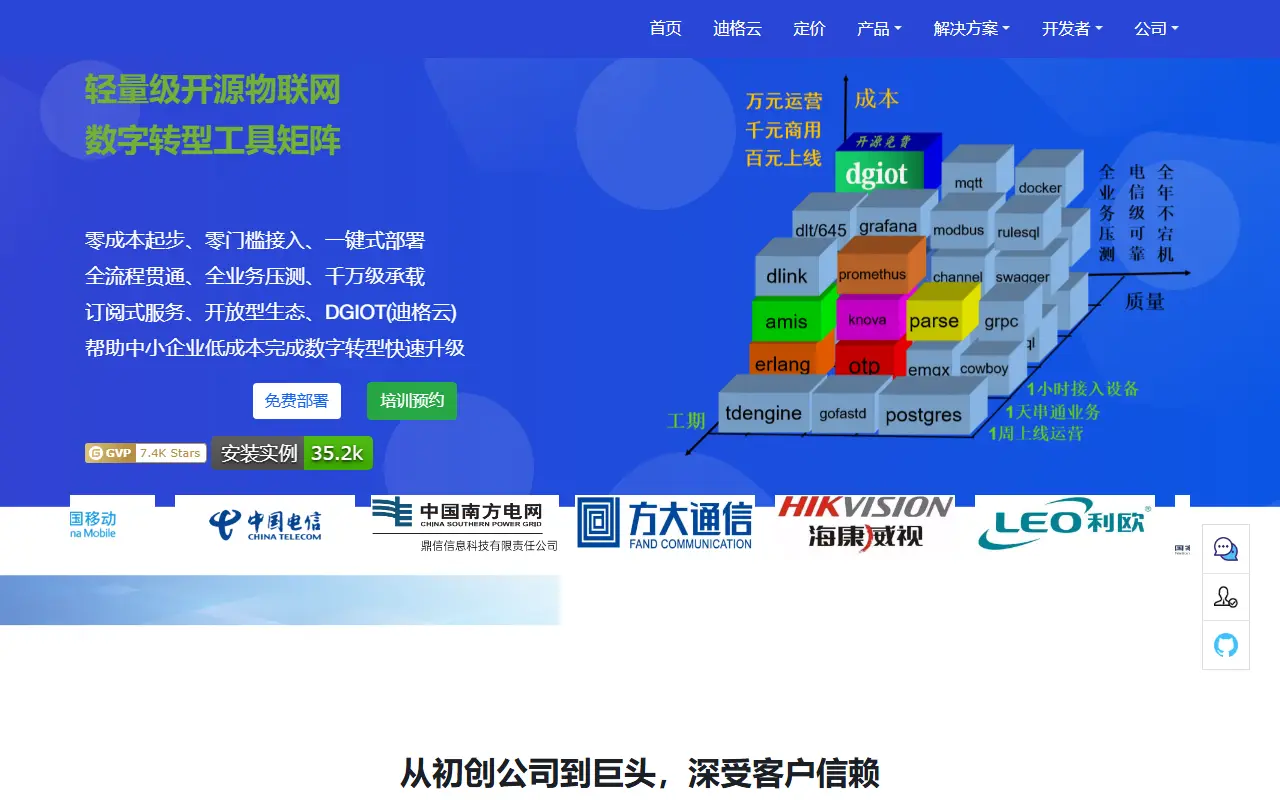
About DGIoT
DGIoT is an open-source industrial Internet of Things platform. It collects data from machines and sensors using industrial protocols such as Modbus, OPC UA and MQTT, with the project advertising support for more than 300 protocols, and it is aimed at factories, energy sites and system integrators building monitoring and control applications.
The README describes an aggregation engine built on Erlang/OTP in which every device gets its own process acting as a shadow, with an ontology layer that covers data, logic and action, and security with roles and access control. It stores time series data in TDengine, and topics reference digital twins, edge computing, SCADA and low-code configuration. Documentation includes architecture diagrams, storage design and station simulation.
DGIoT is licensed under Apache-2.0 and is deployed on your own servers, with a vendor website in Chinese. It suits industrial IoT teams who want an open platform for device connectivity, rules and visualization.
Key features
- Industrial protocol support including Modbus and OPC UA
- MQTT device connectivity
- Per-device shadow processes
- Ontology-based data and logic layers
- Role-based access control
- Time series storage with TDengine
Good fit for
- →Industrial equipment monitoring
- →SCADA and digital twin applications
- →Edge data collection
- Built with
- Erlang
- Tags
- iot
- industrial-iot
- mqtt
- modbus
- opc-ua
- scada
- digital-twin
- erlang
DGIoT: questions and answers
- What is DGIoT used for?
- DGIoT is an open-source industrial IoT platform written in Erlang that connects devices over Modbus, OPC UA and MQTT with digital twin and rules features. It is a good fit for industrial equipment monitoring, SCADA and digital twin applications, and edge data collection.
- Is DGIoT open source?
- Yes. DGIoT is open source under the Apache-2.0 licence. Its source code is on GitHub at dgiot/dgiot and is written mainly in Erlang.
- Is DGIoT free?
- Yes. DGIoT is open source, so the software itself is free to use.
- Can I self-host DGIoT?
- Yes. DGIoT can be self-hosted on your own server or infrastructure.
- What is DGIoT an alternative to?
- DGIoT is an open-source alternative to AWS IoT Core, Azure IoT Hub, Particle and Blynk. Other open-source alternatives to Blynk include Home Assistant and ESPHome.
- Is DGIoT actively maintained?
- Yes. The most recent commit to DGIoT was on 11 September 2026, and the latest release is v4.9.3, published on 11 August 2026. The project has 4.8k stars on GitHub.
Open-source alternatives to DGIoT
See all
Home Assistant
Home Automation & IoT
:house_with_garden: Open source home automation that puts local control and privacy first.
Apache-2.0vs SmartThings★ 91k
Mycodo
Home Automation & IoT
An environmental monitoring and regulation system
GPL-3.0vs Ubidots★ 3.3k
ESPHome
Home Automation & IoT
ESPHome is a system to control your ESP32, ESP8266, BK72xx, RP2040 by simple yet powerful
OSSvs Tuya Smart★ 12k
Traccar
Home Automation & IoT
Traccar is the leading GPS tracking software. Vehicle and personal tracking. Self-hosting
Apache-2.0vs Samsara★ 7.8k
Tasmota
Home Automation & IoT
Alternative firmware for ESP8266 and ESP32 based devices with easy configuration using web
GPL-3.0vs Tuya Smart★ 25k
Zigbee2MQTT
Home Automation & IoT
Zigbee 🐝 to MQTT bridge 🌉, get rid of your proprietary Zigbee bridges 🔨
GPL-3.0vs SmartThings★ 16k
SaaS alternatives to DGIoT
See all
AWS IoT Core
Home Automation & IoT
Managed AWS service for connecting IoT devices to the cloud
SaaS
Azure IoT Hub
Home Automation & IoT
Managed Azure service for secure two-way communication with IoT devices
SaaS
Particle
Home Automation & IoT
IoT platform with devices, cloud and fleet management tools
SaaS
Blynk
Home Automation & IoT
IoT platform for building mobile and web apps that control connected devices
SaaS
Losant
Home Automation & IoT
Enterprise IoT application platform with workflows and dashboards
SaaS
ThingWorx
Home Automation & IoT
Industrial IoT platform from PTC for building connected applications
SaaS