4 open-source alternatives ranked by real activity

Open-source Losant alternatives

A curated, ranked list of the 4 best open-source alternatives to Losant.

The best open-source alternative to Losant is OpenRemote. If that doesn't suit you, other good options are Node-RED, DGIoT and Kaa.

Commercial alternatives to Losant include AWS IoT Core, Cumulocity, Blynk and ThingWorx. See all 16.

Losant alternatives are mainly home automation & IoT tools, but some are also workflow automation tools and analytics tools. 2 of them shipped code in the last 30 days, 4 can be self-hosted, and 2 use a permissive licence.

Last updated November 13, 2026 · ranked by GitHub stars, growth and recent commits

OpenRemote

OpenRemote is an open source IoT platform for managing devices, automating rules and building dashboards and maps.

GitHub stars
2.1k
Last commit
yesterday
Latest release
1.34.0
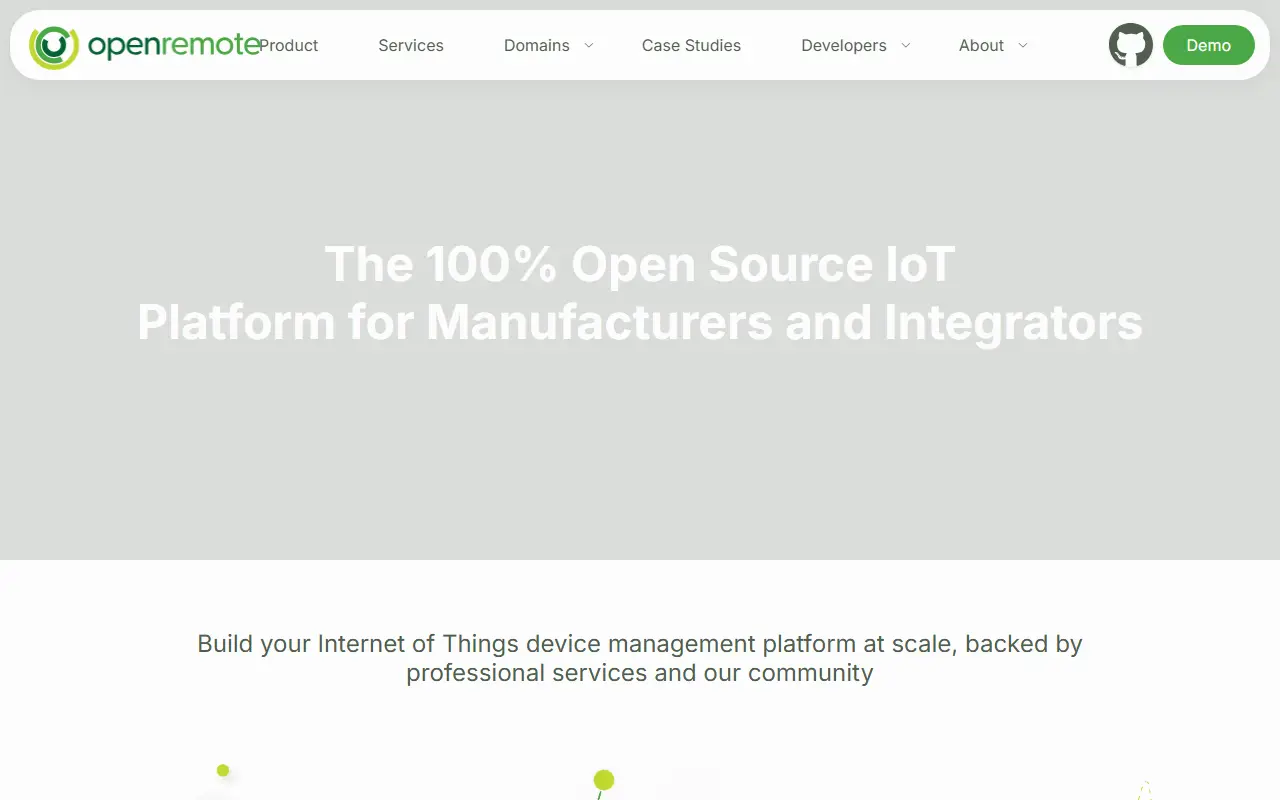
openremote.ioOpenRemote homepage screenshot

OpenRemote is an open source IoT device management platform aimed at manufacturers and integrators. The pitch is to build an Internet of Things platform at scale, backed by professional services and a community. Source code is on GitHub, and documentation, a community forum and a demo are linked from the site.

The Manager UI is the main interface. It is used to map and configure assets, script automation and build real-time dashboards, with integrations for external services such as Mapbox or enterprise APIs. The site lists solution areas including energy management, industrial IoT, fleet telematics, building management, smart city and agriculture.

The developer section of the site links to documentation covering API references, configuration schemas and deployment guides, a community forum where engineers troubleshoot with users, and open source licence terms.

Key features

  • Link any device or data source in one manager
  • Rules, flows and scripts for automation
  • Real-time dashboards and geographic maps
  • Vehicle tracking with Teltonika hardware recognition
  • External integrations such as Mapbox or enterprise APIs

Node-RED

A low-code, flow-based programming tool for event-driven applications, where you wire together devices, APIs and services in a browser-based editor.

GitHub stars
24k
Last commit
yesterday
Latest release
5.0.9
Licence
Apache-2.0
Self-hosted
Yes
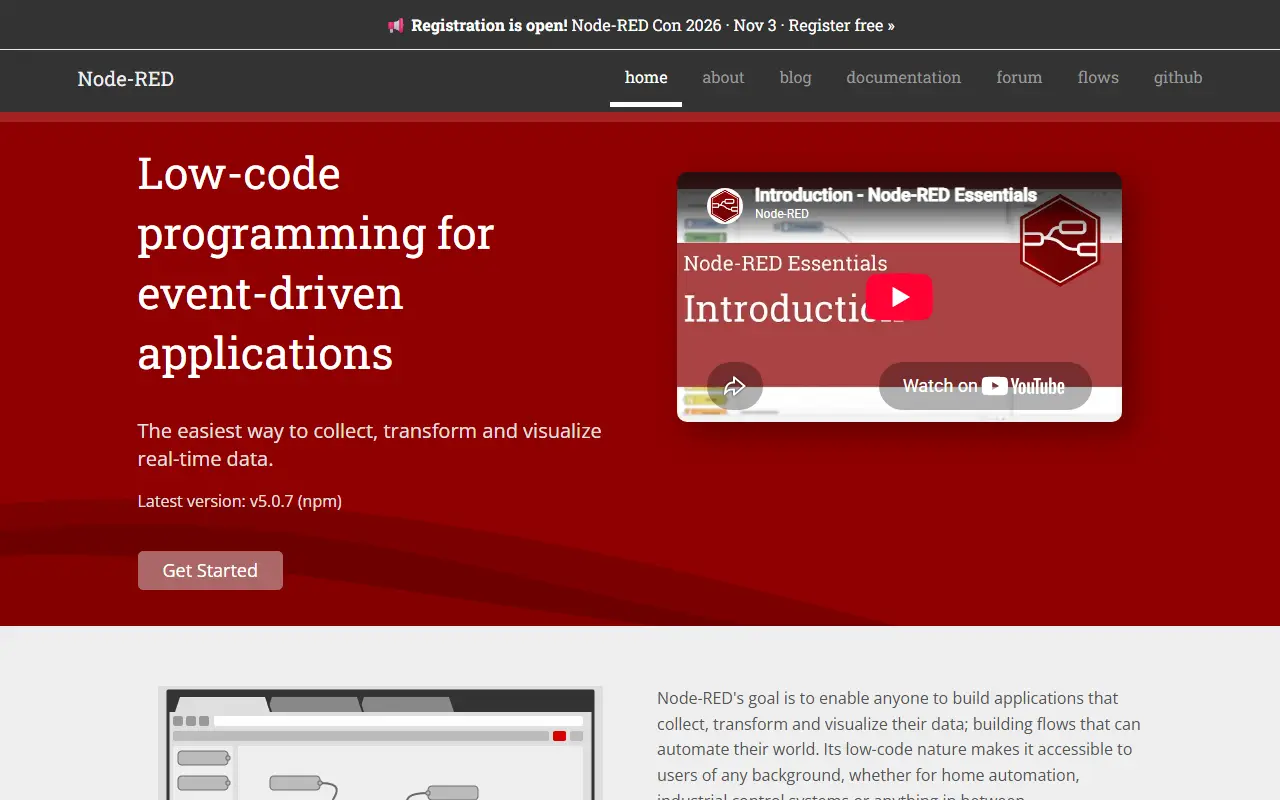
nodered.orgNode-RED homepage screenshot

Node-RED is a low-code programming tool for event-driven applications built on flow-based, visual programming. Instead of writing everything as code, you connect nodes that represent inputs, processing steps and outputs, which makes it popular for IoT projects, home automation and wiring together APIs and online services. It is a project of the OpenJS Foundation.

Getting started takes a couple of commands: install it globally with npm, start it with the node-red command, and open it in your browser. A large ecosystem sits around it, with a library of custom nodes and integrations, shared flows and node collections, plus documentation, a forum and a Slack community. Developers can also run the latest code from git by cloning the repository, installing dependencies and building it.

Node-RED is written in JavaScript on Node.js and licensed under Apache-2.0. You run it on your own computer, a Raspberry Pi, a server or in a container, so there is no hosted service to depend on. It suits makers, integrators and engineers who want to prototype and automate event-driven logic quickly.

Key features

  • Flow-based visual programming
  • Browser-based visual editor
  • Large library of community nodes
  • Shareable flows and node collections
  • Install with npm in one command
  • Runs on small devices and servers

Pricing: Free and open source under the Apache-2.0 license.

DGIoT

DGIoT is an open-source industrial IoT platform written in Erlang that connects devices over Modbus, OPC UA and MQTT with digital twin and rules features.

GitHub stars
4.9k
Last commit
1 mo ago
Latest release
v4.9.3
Licence
Apache-2.0
Self-hosted
Yes
dgiotcloud.cnDGIoT homepage screenshot

DGIoT is an open-source industrial Internet of Things platform. It collects data from machines and sensors using industrial protocols such as Modbus, OPC UA and MQTT, with the project advertising support for more than 300 protocols, and it is aimed at factories, energy sites and system integrators building monitoring and control applications.

The README describes an aggregation engine built on Erlang/OTP in which every device gets its own process acting as a shadow, with an ontology layer that covers data, logic and action, and security with roles and access control. It stores time series data in TDengine, and topics reference digital twins, edge computing, SCADA and low-code configuration. Documentation includes architecture diagrams, storage design and station simulation.

DGIoT is licensed under Apache-2.0 and is deployed on your own servers, with a vendor website in Chinese. It suits industrial IoT teams who want an open platform for device connectivity, rules and visualization.

Key features

  • Industrial protocol support including Modbus and OPC UA
  • MQTT device connectivity
  • Per-device shadow processes
  • Ontology-based data and logic layers
  • Role-based access control
  • Time series storage with TDengine

Pricing: Free and open source under the Apache-2.0 license.

Kaa

Kaa is an enterprise IoT platform from KaaIoT, offered as a subscription cloud, a KaaIoT-hosted private instance or a self-hosted install.

GitHub stars
1.4k
Last commit
2 yr ago
Self-hosted
Yes
Hosted version
Available
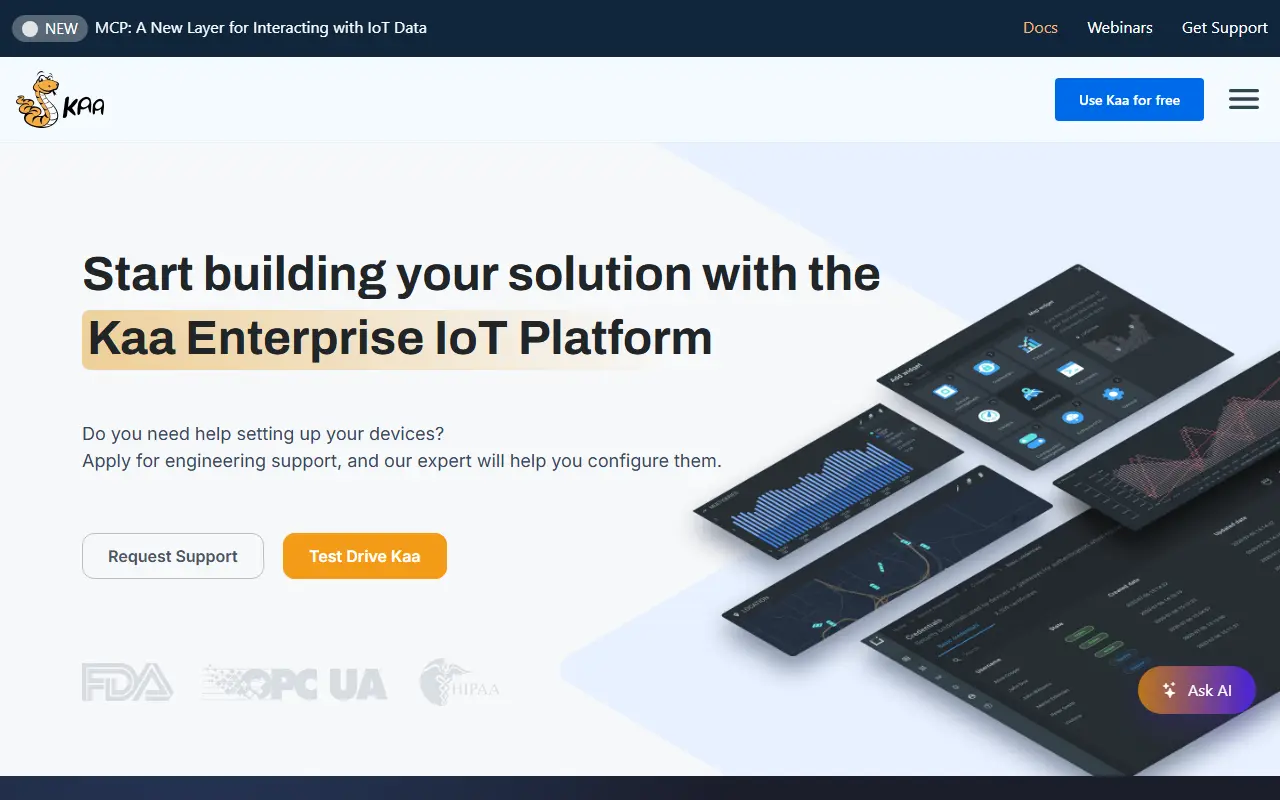
kaaiot.comKaa homepage screenshot

Kaa is an IoT platform sold by KaaIoT for building connected-device solutions. The product range on the vendor site includes the Kaa IoT Platform, Kaa Cloud, Kaa Next IoT Cloud, an IoT gateway, identity management, Node-RED hosting and a set of ready-made IoT dashboards for energy, farming, metering and fleet use.

It can be used in several ways. Kaa Cloud is described as a ready-to-go platform service, a private Kaa instance can be hosted by KaaIoT, and a self-hosted option allows unlimited Kaa instances hosted anywhere. Subscription pricing is based on the number of actively connected devices.

Beyond the core platform, the vendor lists a Universal Energy Controller edge gateway for Modbus-based inverters and a cloud backend aimed at connected medical device software. The Kaa Next cloud adds identity management, AI integration and reporting, with some features still in beta.

Key features

  • Edge gateway for vendor-neutral energy monitoring
  • Works with any Modbus-based inverter
  • Next cloud adds identity management, AI integration and reporting
  • Validatable backend for medical device software
  • Ready-made dashboards for IoT projects
  • Node-RED hosting on a small cloud server

Pricing: Kaa Cloud 100 is $ 99 / month for up to 100 devices, Kaa Cloud 250 is $ 175 / month for up to 250 devices and Kaa Cloud 500 is $ 325 / month for up to 500 devices. Node-RED Cloud (2 CPU, 2 GB RAM, 40Gb disk space) is $ 15 / month.

Commercial Losant alternatives

Hosted, closed-source products that compete with Losant. Showing 12 of 16.

See every Losant alternative on its tool page

Losant alternatives: questions

What is the best open-source alternative to Losant?
OpenRemote is the top-ranked open-source alternative to Losant on Enlisted: OpenRemote is an open source IoT platform for managing devices, automating rules and building dashboards and maps. Other strong options are Node-RED, DGIoT and Kaa.
What are the best commercial alternatives to Losant?
AWS IoT Core, Cumulocity, Blynk, ThingWorx and Ubidots are among the hosted, closed-source alternatives to Losant listed on Enlisted, which lists 16 in total. Compare their pricing and features on each tool page.
Are these Losant alternatives free?
All 4 are open source, so the code is free to use under its licence, and all of them can be self-hosted on your own server or computer. 1 also offers a paid or managed cloud version if you'd rather not host it yourself.
How is this list of Losant alternatives ranked?
By a score built from GitHub stars, star growth over the last 30 days and how recently the code changed. 2 of these projects shipped code in the last 30 days. Data is refreshed daily, and nobody can pay to move up.

People also look for alternatives to…

View all