
About Coveralls
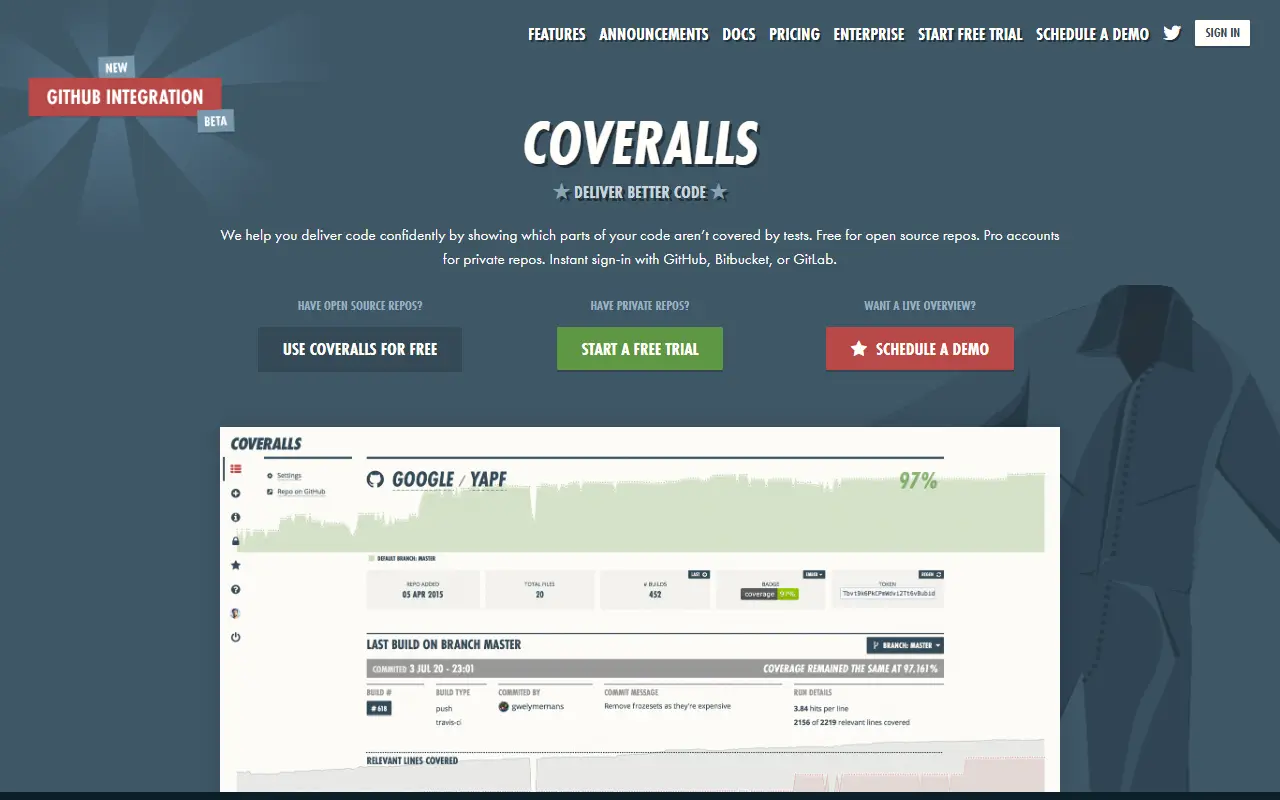
Coveralls is a hosted service for tracking test coverage over time. It shows which parts of a codebase are not covered by tests, and it reports coverage changes on commits and pull requests so teams can deliver code with more confidence.
It works with any CI service and provides integration packages for many languages, including C and C++, Go, Java, JavaScript and Node, Julia, Lua, .NET, PHP, Python, R, Ruby, Scala and Objective C. Features include repository coverage statistics and file coverage reports, and users can sign in with GitHub, Bitbucket or GitLab. An Enterprise edition is available for organizations that need to run Coveralls on their own servers.
Coveralls is proprietary software. The site says it is free for open-source repositories, with Pro accounts for private repositories and a free trial. It has been used by many open-source projects and suits teams wanting simple coverage history.
Key features
- Coverage history and statistics
- File-level coverage reports
- Pull request coverage reporting
- Works with any CI service
- Libraries for many languages
- Enterprise edition for self-hosting
Good fit for
- →Open-source projects tracking test coverage
- →Private repositories monitoring coverage trends
- →Enterprises running coverage tracking on their own servers
- Tags
- code-coverage
- testing
- ci
- open-source
- pull-requests
- devops
- test-reporting
Coveralls: questions and answers
- What is Coveralls used for?
- Coveralls is a hosted code coverage service that reports on commits and pull requests, free for open-source repositories. It is a good fit for open-source projects tracking test coverage, private repositories monitoring coverage trends and enterprises running coverage tracking on their own servers.
- Is Coveralls free?
- Yes. Coveralls has a free plan, and paid plans start at $10 per month. A free trial is also available.
- Is Coveralls open source?
- No. Coveralls is proprietary (closed-source) software. Open-source alternatives to Coveralls include Xcov.
- Can I self-host Coveralls?
- Yes. Although Coveralls is closed source, it can be self-hosted on your own servers, and the vendor also offers a hosted version.
- What are some alternatives to Coveralls?
- Coveralls competes with Codecov. For open-source options, see Enlisted's ranked list of open-source Coveralls alternatives.
Open-source alternatives to Coveralls
See all
Xcov
Testing & QA
Nice code coverage reporting without hassle
MITvs Codecov★ 573
k6
Testing & QA
A modern load testing tool, using Go and JavaScript
AGPL-3.0vs OpenText LoadRunner★ 32k
Tox
Testing & QA
Command line driven CI frontend and development task automation tool.
MIT★ 3.9k
QA Wolf CLI
Testing & QA
QA Wolf from anywhere — your terminal, your CI, your AI agent.
Apache-2.0★ 3.5k
github-action-benchmark
Testing & QA
GitHub Action for continuous benchmarking to keep performance
MIT★ 1.3k
Pa11y CI
Testing & QA
Pa11y CI is a CI-centric accessibility test runner, built using Pa11y
LGPL-3.0★ 637
SaaS alternatives to Coveralls
See all
Codecov
Testing & QA
Code coverage reporting and test analytics that comments on pull requests
SaaS
desplega.ai
Testing & QA
No-code AI platform that automates end-to-end QA test creation, running and maintenance
SaaS
Acceslab
Testing & QA
AI-powered WCAG scanner that checks website accessibility and produces compliance reports
SaaS
Cypress Cloud
Testing & QA
Dashboard and parallelization service for Cypress end-to-end test runs
SaaS
Parasoft
Testing & QA
Software testing tools for API, UI, unit and static analysis
SaaS
Agent Checker
Testing & QA
Sends an AI agent through your live site to find where search, sign-up and checkout flows break
SaaS