
About Xcov
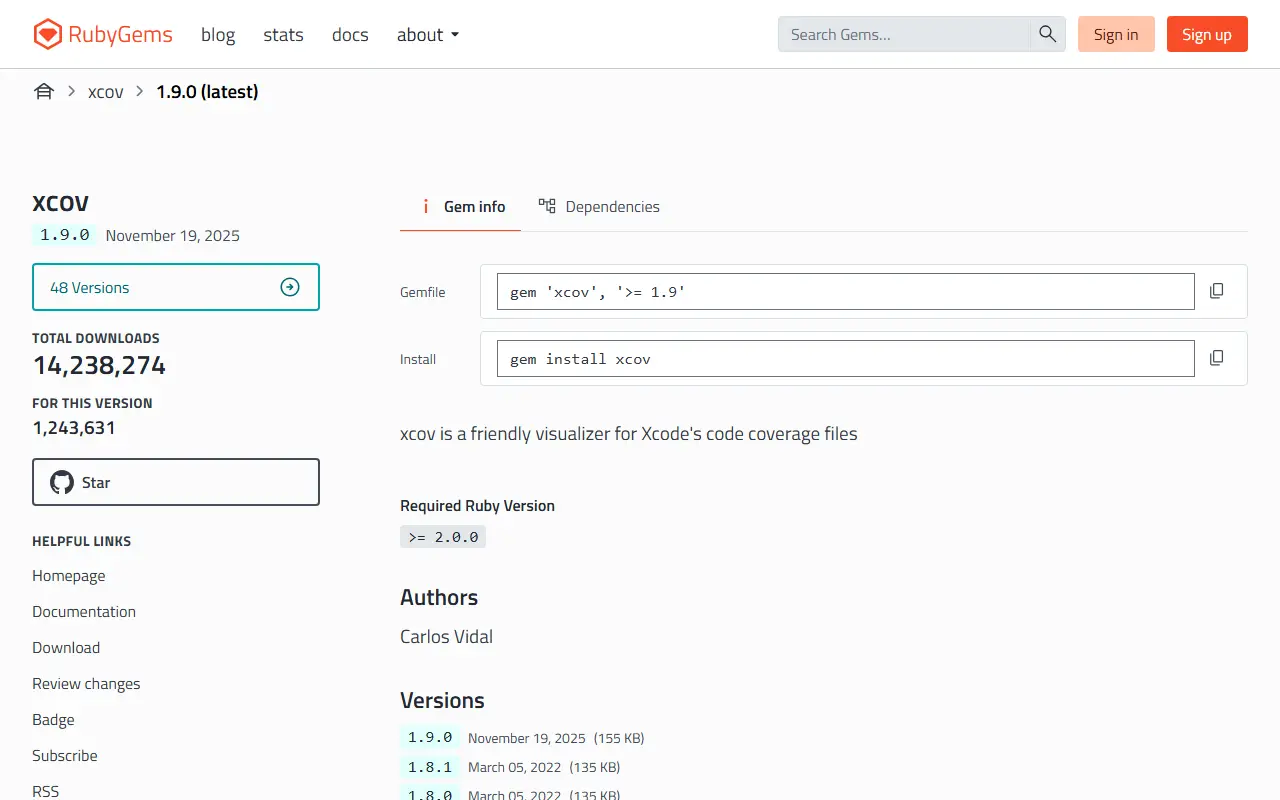
xcov is a visualizer for Xcode code coverage files. After your tests have run, it reads the coverage data and produces readable reports, which makes it useful in iOS and macOS continuous integration pipelines. It is built on fastlane, so it plugs into existing fastlane setups, and it is distributed as a Ruby gem.
The tool analyzes the coverage files that Xcode produces when tests run through Xcode, xcodebuild or scan. Reports can be generated in HTML, JSON and Markdown formats, and results can be posted to Slack. You can blacklist files whose coverage should be ignored, set a minimum acceptable coverage percentage so a build fails when it is not met, and send results to Coveralls. Command-line parameters cover the workspace, project, scheme, configuration, output directory and more.
To use it, you need Xcode 7 or later, up-to-date command line tools, a shared project scheme and the option to gather coverage data enabled on that scheme. xcov is MIT licensed and maintained by the fastlane community organization.
Key features
- Reads Xcode coverage files
- HTML, JSON and Markdown reports
- Minimum coverage threshold
- File blacklist for ignoring coverage
- Slack and Coveralls integration
- Built on fastlane for CI use
Good fit for
- →Failing iOS CI builds below a coverage target
- →Sharing coverage summaries with a team in Slack
- Built with
- Ruby
- Tags
- code-coverage
- xcode
- fastlane
- ios
- ruby
- ci
- testing
- reports
Xcov: questions and answers
- What is Xcov used for?
- Xcov is a Ruby command-line tool that turns Xcode code coverage data into HTML, JSON and Markdown reports, with a minimum-coverage check and Slack notifications. It is a good fit for failing iOS CI builds below a coverage target and sharing coverage summaries with a team in Slack.
- Is Xcov open source?
- Yes. Xcov is open source under the MIT licence. Its source code is on GitHub at fastlane-community/xcov and is written mainly in Ruby.
- Is Xcov free?
- Yes. Xcov is open source, so the software itself is free to use.
- Is Xcov actively maintained?
- Yes. The most recent commit to Xcov was on 12 August 2026, and the latest release is v1.9.0, published on 19 November 2025. The project has 573 stars on GitHub.
Open-source alternatives to Xcov
See all
Tox
Testing & QA
Command line driven CI frontend and development task automation tool.
MIT★ 3.9k
QA Wolf CLI
Testing & QA
QA Wolf from anywhere — your terminal, your CI, your AI agent.
Apache-2.0★ 3.5k
Pa11y CI
Testing & QA
Pa11y CI is a CI-centric accessibility test runner, built using Pa11y
LGPL-3.0★ 637
pytest-testmon
Testing & QA
Selects tests affected by changed files. Executes the right tests first. Continuous test r
MIT★ 1k
Playwright
Testing & QA
Playwright is a framework for Web Testing and Automation. It allows testing Chromium, Fire
Apache-2.0vs BrowserStack★ 97k
k6
Testing & QA
A modern load testing tool, using Go and JavaScript
AGPL-3.0vs OpenText LoadRunner★ 32k
SaaS alternatives to Xcov
See all
Codecov
Testing & QA
Code coverage reporting and test analytics that comments on pull requests
SaaS
Coveralls
Testing & QA
Hosted code coverage tracking that reports on commits and pull requests
SaaS
Acceslab
Testing & QA
AI-powered WCAG scanner that checks website accessibility and produces compliance reports
SaaS
Cypress Cloud
Testing & QA
Dashboard and parallelization service for Cypress end-to-end test runs
SaaS
Firebase Test Lab
Testing & QA
Google cloud infrastructure for testing Android and iOS apps on real and virtual devices
SaaS
Parasoft
Testing & QA
Software testing tools for API, UI, unit and static analysis
SaaS