2 open-source alternatives ranked by real activity

Open-source Coveralls alternatives

A curated, ranked list of the 2 best open-source alternatives to Coveralls.

The best open-source alternative to Coveralls is SonarQube. If that doesn't suit you, another good option is Xcov.

Commercial alternatives to Coveralls include Codecov, Codacy, GoLand and Relay. See all 9.

Coveralls alternatives are mainly developer tools, but some are also testing & QA tools. 1 of them shipped code in the last 30 days, 2 can be self-hosted, and 1 uses a permissive licence.

Last updated November 12, 2026 · ranked by GitHub stars, growth and recent commits

SonarQube

Static code analysis platform that finds bugs, vulnerabilities and maintainability problems in code, in IDEs, pull requests and CI.

GitHub stars
11k
Last commit
yesterday
Latest release
26.11.0.134175
Licence
LGPL-3.0
Self-hosted
Yes
sonarqube.orgSonarQube homepage screenshot

SonarQube is a code quality and security platform. Its static analysis uses techniques such as symbolic execution and data and control flow analysis to inspect source code, find bugs and vulnerabilities, and explain what to fix and why. Results appear in the IDE, in pull requests and in CI pipelines.

This repository holds the source of the SonarQube Community Build, the free, open-source edition that shares the analysis used across the product line. It reports reliability bugs, security vulnerabilities and security hotspots, maintainability and structural issues, and coverage on new code. More than 40 programming languages and frameworks are covered, and the same code always produces the same findings.

The project positions itself as a verification step for code written by people or by AI agents before it merges. SonarQube is written in Java and licensed under LGPL-3.0. Commercial editions from SonarSource add further features, while the Community Build can be run on your own servers.

Key features

  • Static analysis for bugs and vulnerabilities
  • Security hotspot review guidance
  • Maintainability and structural issue detection
  • Coverage tracking on new code
  • Support for 40+ languages and frameworks
  • Feedback in IDE, pull requests and CI

Pricing: A free tier covers private projects up to 50k lines of code and an open-source Community Build is available. The Team plan starts at $34 a month for up to 100k lines of code; Enterprise is quoted.

Xcov

Ruby command-line tool that turns Xcode code coverage data into HTML, JSON and Markdown reports, with a minimum-coverage check and Slack notifications.

GitHub stars
573
Last commit
1 mo ago
Latest release
v1.9.0
Licence
MIT
Self-hosted
Yes
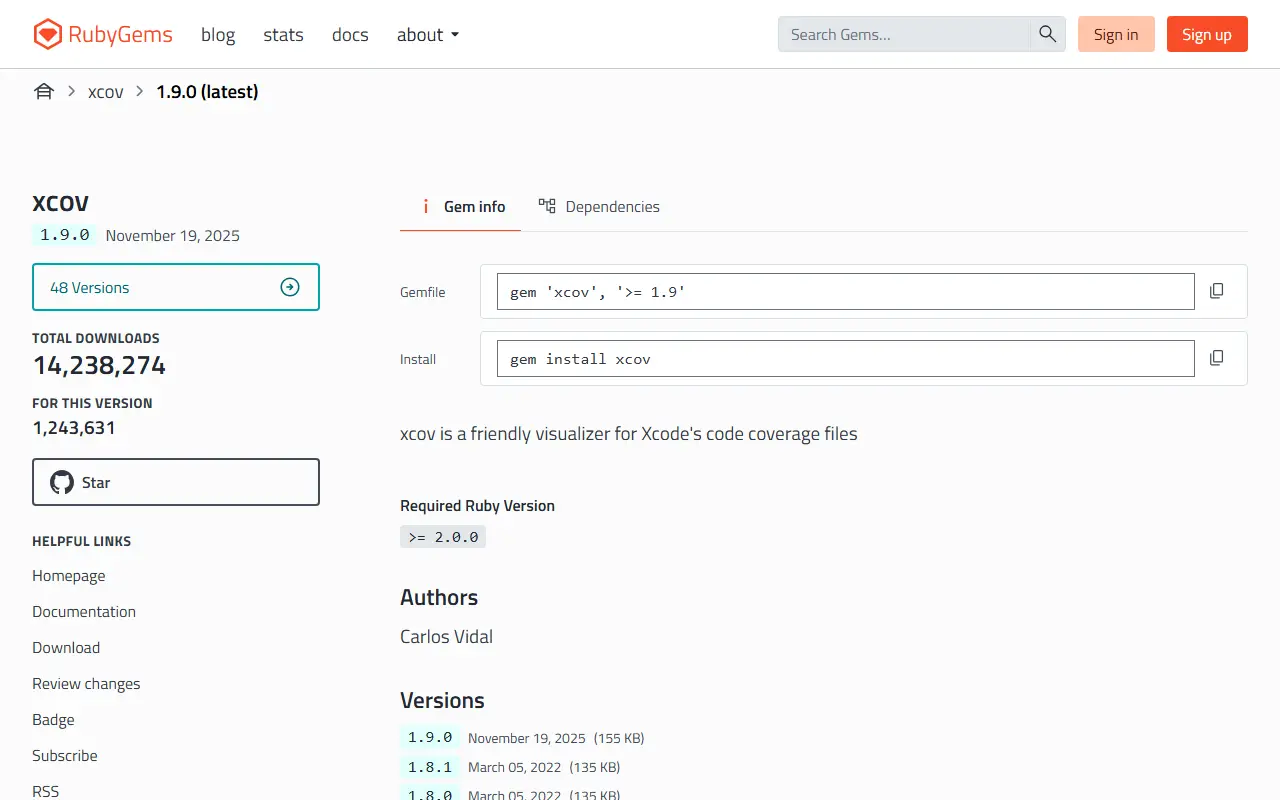
rubygems.orgXcov homepage screenshot

xcov is a visualizer for Xcode code coverage files. After your tests have run, it reads the coverage data and produces readable reports, which makes it useful in iOS and macOS continuous integration pipelines. It is built on fastlane, so it plugs into existing fastlane setups, and it is distributed as a Ruby gem.

The tool analyzes the coverage files that Xcode produces when tests run through Xcode, xcodebuild or scan. Reports can be generated in HTML, JSON and Markdown formats, and results can be posted to Slack. You can blacklist files whose coverage should be ignored, set a minimum acceptable coverage percentage so a build fails when it is not met, and send results to Coveralls. Command-line parameters cover the workspace, project, scheme, configuration, output directory and more.

To use it, you need Xcode 7 or later, up-to-date command line tools, a shared project scheme and the option to gather coverage data enabled on that scheme. xcov is MIT licensed and maintained by the fastlane community organization.

Key features

  • Reads Xcode coverage files
  • HTML, JSON and Markdown reports
  • Minimum coverage threshold
  • File blacklist for ignoring coverage
  • Slack and Coveralls integration
  • Built on fastlane for CI use

Pricing: Free and open source under the MIT license.

Read more about XcovWebsiteGitHub#2 Coveralls alternative

Commercial Coveralls alternatives

Hosted, closed-source products that compete with Coveralls.

Coveralls alternatives: questions

What is the best open-source alternative to Coveralls?
SonarQube is the top-ranked open-source alternative to Coveralls on Enlisted: Static code analysis platform that finds bugs, vulnerabilities and maintainability problems in code, in IDEs, pull requests and CI. Another strong option is Xcov.
What are the best commercial alternatives to Coveralls?
Codecov, Codacy, GoLand, Relay and Clover are among the hosted, closed-source alternatives to Coveralls listed on Enlisted, which lists 9 in total. Compare their pricing and features on each tool page.
Are these Coveralls alternatives free?
Both are open source, so the code is free to use under its licence, and both can be self-hosted on your own server or computer.
How is this list of Coveralls alternatives ranked?
By a score built from GitHub stars, star growth over the last 30 days and how recently the code changed. 1 of these projects shipped code in the last 30 days. Data is refreshed daily, and nobody can pay to move up.

People also look for alternatives to…

View all