
 Google Cloud Build
 CloudBees
 AWS CodeBuild
 Azure Pipelines
 AppVeyor
 Semaphore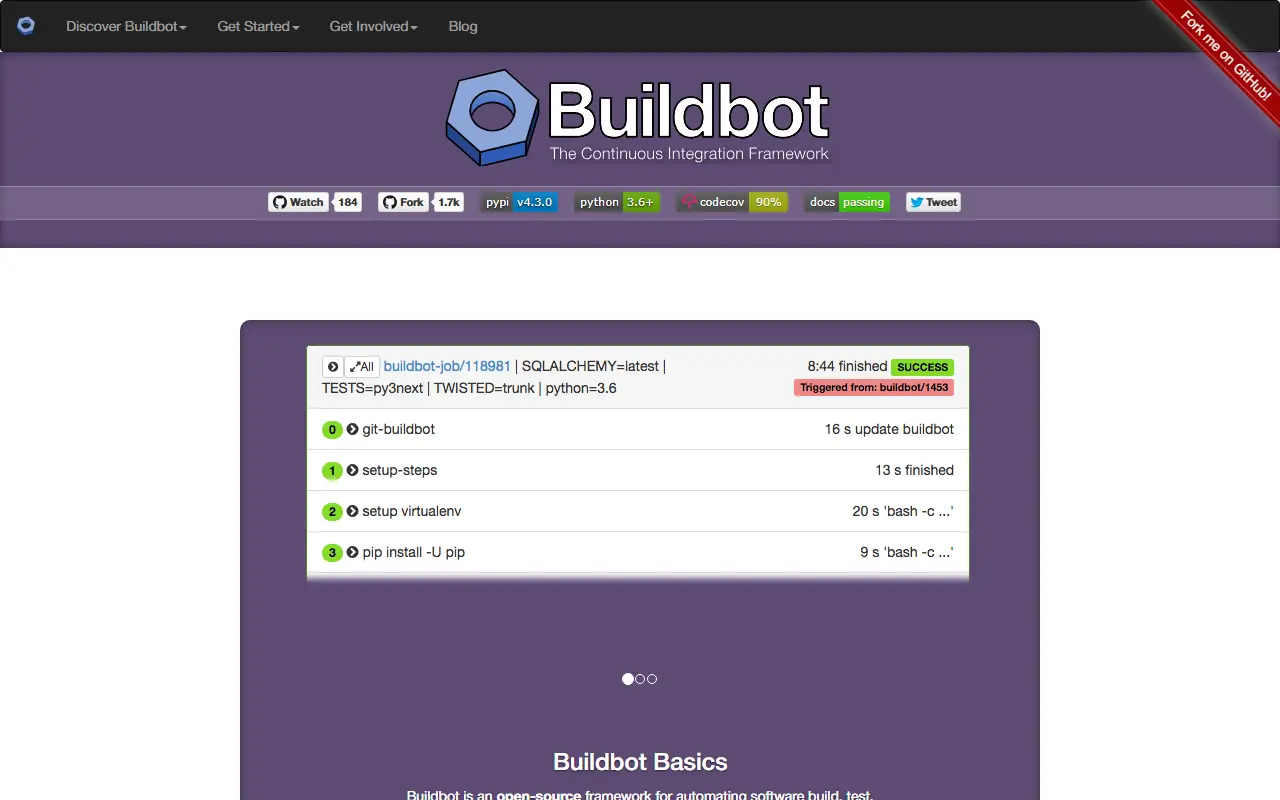
About Buildbot
Buildbot is an open-source continuous integration framework written in Python. Rather than a fixed service with a rigid workflow, it is a toolkit for automating the whole software development cycle, from compiling and testing code to packaging and releasing it, with configuration expressed in Python.
The project's site presents it as a framework with batteries included, covering automated build, test and release jobs, a web interface, and a tutorial and documentation to get started. A master process coordinates build workers that can run on different platforms, which makes it a good fit for projects that need to test across many operating systems and configurations. The site also lists success stories and a Metabuildbot used to build Buildbot itself.
Buildbot is licensed under GPL-2.0 and is typically self-hosted, with community support through a mailing list and IRC. It suits teams that want a highly customizable CI system they control, particularly for complex or multi-platform build setups.
Key features
- Python-configured build automation
- Automated build, test and release jobs
- Distributed workers across platforms
- Web interface for build status
- Extensible with custom steps
- Tutorial and extensive documentation
Good fit for
- →Multi-platform build and test farms
- →Custom CI pipelines for large projects
- Built with
- Python
- Tags
- continuous-integration
- ci
- python
- build-automation
- devops
- release-automation
- self-hosted
Buildbot: questions and answers
- What is Buildbot used for?
- Buildbot is a Python-based framework for automating software builds, tests and releases, configured in code and run on your own infrastructure. It is a good fit for multi-platform build and test farms, and custom CI pipelines for large projects.
- Is Buildbot open source?
- Yes. Buildbot is open source under the GPL-2.0 licence. Its source code is on GitHub at buildbot/buildbot and is written mainly in Python.
- Is Buildbot free?
- Yes. Buildbot is open source, so the software itself is free to use.
- Can I self-host Buildbot?
- Yes. Buildbot can be self-hosted on your own server or infrastructure; there is no official hosted version.
- What is Buildbot an alternative to?
- Buildbot is an open-source alternative to TeamCity, Bamboo, GitHub Actions and CircleCI. Other open-source alternatives to TeamCity include Concourse CI, Jenkins and Harness.
- Is Buildbot actively maintained?
- Yes. The most recent commit to Buildbot was on 28 September 2026, and the latest release is v4.3.0, published on 12 May 2025. The project has 5.5k stars on GitHub.
Open-source alternatives to Buildbot
See all
Concourse CI
CI/CD & DevOps
Concourse is a container-based automation system written in Go. It's mostly used for CI/CD
Apache-2.0vs GitHub Actions★ 7.9k
Jenkins
CI/CD & DevOps
Jenkins automation server
MITvs CircleCI★ 27k
Harness
CI/CD & DevOps
Harness Open Source is an end-to-end developer platform with Source Control Management, CI
Apache-2.0vs GitHub Actions★ 38k
Woodpecker CI
CI/CD & DevOps
Woodpecker is a simple, yet powerful CI/CD engine with great extensibility.
Apache-2.0vs GitHub Actions★ 7.9k
GoCD
CI/CD & DevOps
GoCD - Continuous Delivery server main repository
Apache-2.0vs TeamCity★ 7.4k
Semaphore
CI/CD & DevOps
All-in-one delivery platform for AI-driven development.
OSSvs GitHub Actions★ 1.6k
SaaS alternatives to Buildbot
See all
TeamCity
CI/CD & DevOps
JetBrains CI/CD server with build chains, available self-hosted or as a cloud service
SaaS
Bamboo
CI/CD & DevOps
Atlassian CI/CD server that ties builds and deployments to Jira and Bitbucket
SaaS
GitHub Actions
CI/CD & DevOps
GitHub Actions is GitHub's built-in automation and CI/CD service for building, testing and deploying code through workflows triggered by repository events.
SaaS
CircleCI
CI/CD & DevOps
Hosted continuous integration and delivery platform for build and test pipelines
SaaS
AWS CodePipeline
CI/CD & DevOps
Managed AWS service that automates build, test and deploy release pipelines
SaaS
Buildkite
CI/CD & DevOps
CI/CD platform that runs pipelines on build agents you host yourself
SaaS