7,363 open-source and SaaS tools, with GitHub stats refreshed every day.

11 alternatives ranked by real activity

Open-source TeamCity alternatives

A curated, ranked list of the 11 best open-source alternatives to TeamCity.

The best open-source alternative to TeamCity is Harness. If that doesn't suit you, other good options are Jenkins, Concourse CI, GoCD and Buildbot.

TeamCity alternatives are mainly CI/CD & DevOps tools. 9 of them shipped code in the last 30 days, 11 can be self-hosted, and 8 use a permissive licence.

Last updated October 2, 2026 · ranked by GitHub stars, growth and recent commits

Harness

An open-source developer platform combining Git hosting, CI/CD pipelines, cloud development environments called Gitspaces and artifact registries, the successor to Drone.

GitHub stars
38k
Last commit
yesterday
Latest release
v2.28.2
Licence
Apache-2.0
Self-hosted
Yes
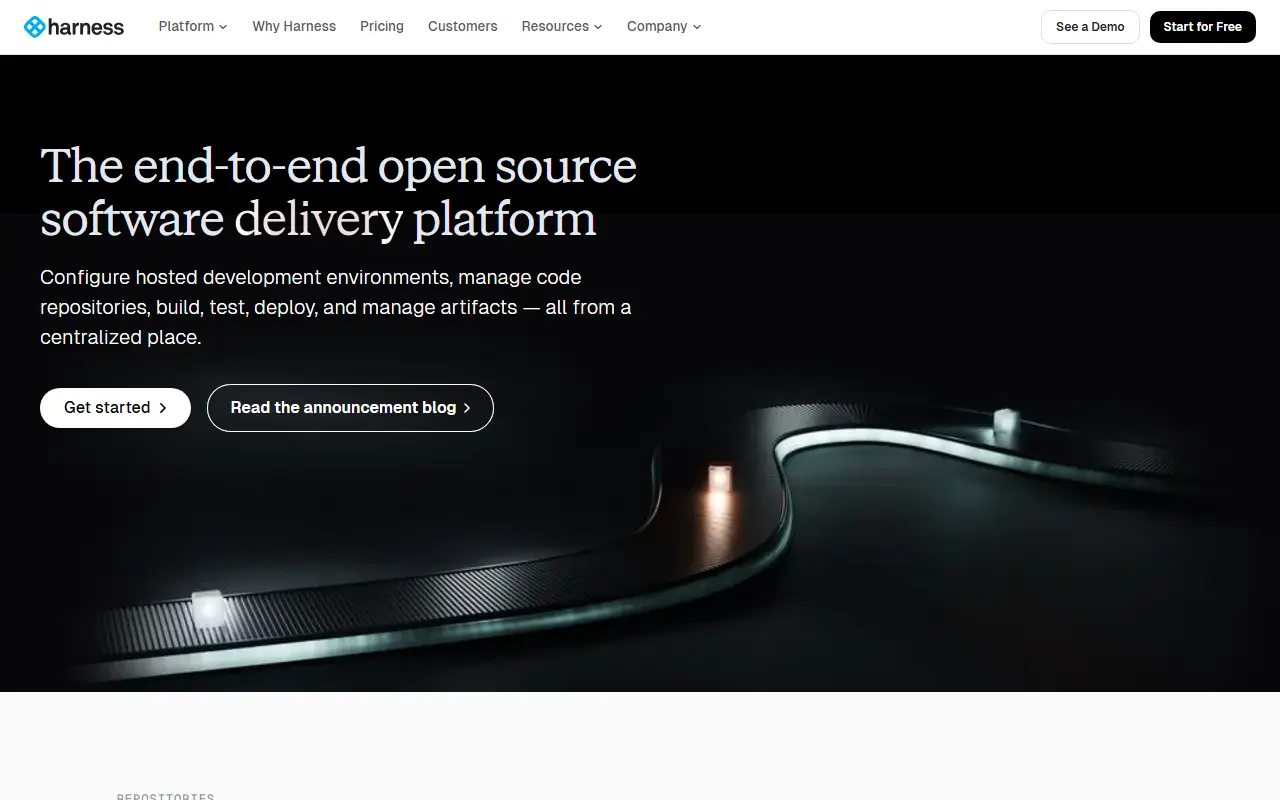
harness.ioHarness homepage screenshot

Harness Open Source is a developer platform written in Go that bundles source code hosting, automated pipelines, hosted development environments and artifact registries in one product. The idea is to give a team a complete, self-run DevOps toolchain rather than separate services for repositories, builds and package storage.

Its hosted development environments are called Gitspaces, and the platform also includes registries for build artifacts. Harness is presented as the next generation of Drone: Drone focused only on continuous integration, whereas Harness adds code hosting and developer environments. The maintainers say the goal is eventual parity with Drone's pipeline capabilities so users can migrate, and a snapshot of Drone lives on a separate branch so it can keep developing.

You can run Harness locally from the published Docker image and open it on port 3000. The image stores its database and repositories in a volume, so a bind mount or named volume is strongly recommended to avoid losing data when the container stops. The project is Apache-2.0 licensed, with documentation at developer.harness.io.

Key features

  • Git repository hosting
  • CI/CD pipelines for build automation
  • Gitspaces hosted development environments
  • Artifact registries for build outputs
  • Docker image for quick local setup
  • Migration path from Drone

Pricing: A free plan covers individual developers and small teams. The Essentials bundle and the modular Enterprise plan have no published prices and are quoted through sales.

Jenkins

Jenkins is an open-source, Java-based automation server for building, testing and deploying software, extended through plugins.

GitHub stars
27k
Last commit
yesterday
Latest release
jenkins-2.584
Licence
MIT
Self-hosted
Yes
jenkins.ioJenkins homepage screenshot

Jenkins is an open-source automation server written in Java. Teams use it to automate parts of their development workflow, including building projects, running tests to catch bugs early, performing static code analysis and deploying software. The README states that more than 2,000 plugins extend it to automate nearly any task. It is released under the MIT license, and its topics include continuous integration, delivery and pipelines as code.

The project distributes official downloads as WAR archives, Docker images, and native packages or installers for several Linux distributions and Windows. Two release lines exist: weekly releases carrying all new features and fixes, and Long-Term Support releases that receive periodic backported bug fixes. The repository links to contributing guidelines, good first issues, developer documentation, governance and adopters information. As a self-managed server, you operate and secure your own Jenkins instance.

Key features

  • Automation server for build, test and deploy
  • Plugin ecosystem with over 2,000 plugins
  • Pipelines as code
  • WAR, Docker image and native package installs
  • Weekly and Long-Term Support release lines
  • Static code analysis and deployment automation

Pricing: Free and open source under the MIT license.

Concourse CI

A container-based automation system in Go, mostly used for CI/CD, that defines pipelines declaratively and runs them on stateless workers.

GitHub stars
7.9k
Last commit
today
Latest release
v8.3.1
Licence
Apache-2.0
Self-hosted
Yes
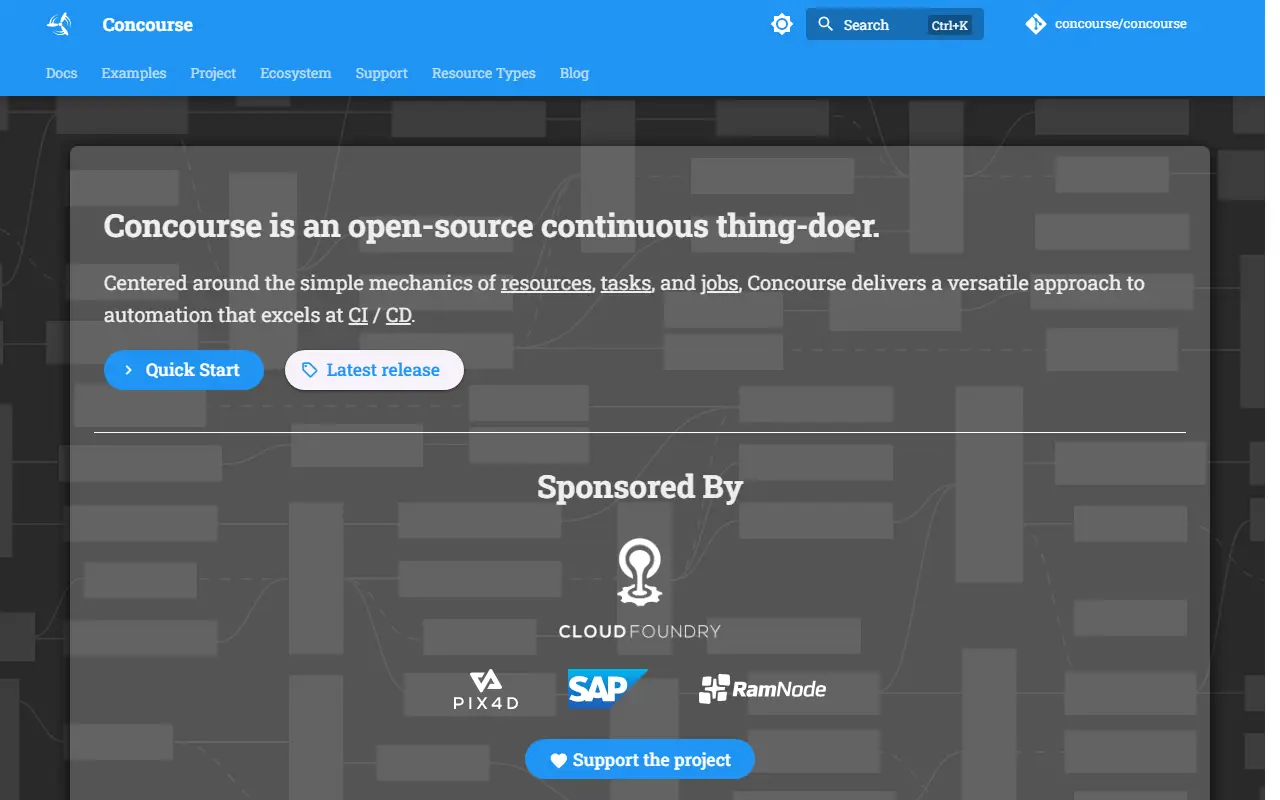
concourse-ci.orgConcourse CI homepage screenshot

Concourse is an automation system written in Go, most often used for CI/CD and built to scale from simple to complex pipelines. It is deliberately opinionated: the project emphasizes idempotency, immutability, declarative configuration, stateless workers and reproducible builds.

It is distributed as a single concourse binary on the releases page, and other supported formats include a Docker image, a Kubernetes Helm chart and a BOSH release. A quick start walks through running it locally. Topics show that tasks run in containers using containerd and runc, and the web interface was built with Elm.

Concourse is licensed under Apache-2.0. It is run on your own infrastructure by teams that prefer pipelines described as code, with each job's inputs and outputs explicit, over scripts configured through a UI. It suits platform and DevOps teams wanting repeatable, container-isolated build and deploy pipelines.

Key features

  • Declarative pipeline configuration
  • Container-based task execution
  • Stateless workers for scaling
  • Reproducible builds by design
  • Single binary distribution
  • Docker, Helm and BOSH packaging

Pricing: Free and open source under the Apache-2.0 licence.

GoCD

GoCD is a continuous delivery server that models build, test and release pipelines, sponsored by Thoughtworks and written mainly in Java and TypeScript.

GitHub stars
7.4k
Last commit
today
Latest release
26.1.0
Licence
Apache-2.0
Self-hosted
Yes
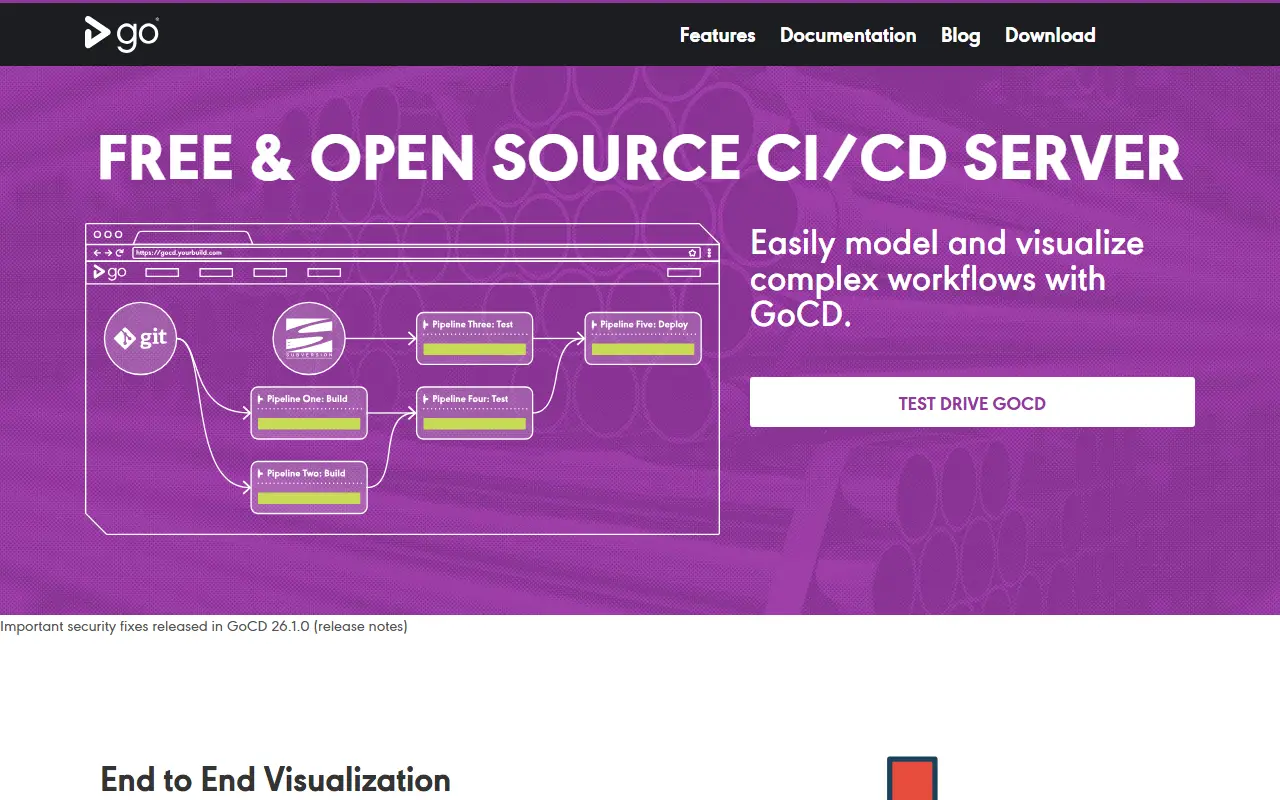
gocd.orgGoCD homepage screenshot

GoCD is a continuous delivery server that helps automate and streamline the build, test and release cycle so that software can be delivered continuously with fewer worries. The repository is the project's main code base, and the project is sponsored by Thoughtworks.

Newcomers can use the Test Drive GoCD page to build a first pipeline while learning the key concepts, download releases from the website and read the documentation for detailed help. It is predominantly a Java and TypeScript project that uses the Spring Framework, SparkJava and MithrilJS, is built with Gradle and Webpack and runs inside Eclipse Jetty, with a few older parts rendered server-side in JRuby on Rails. GoCD itself is built with GoCD.

The security policy explains how issues are reported, and contributing guides cover the development environment. GoCD is licensed under Apache-2.0 and is hosted by you. It suits teams that model deployment pipelines with explicit stages and dependencies across several services.

Key features

  • Pipelines for build, test and release
  • Test drive guide for first pipelines
  • Continuous delivery server
  • Java and TypeScript code base
  • Security policy and responsible disclosure
  • Built and released using GoCD itself

Pricing: Free and open source under the Apache-2.0 licence.

Buildbot

Buildbot is a Python-based framework for automating software builds, tests and releases, configured in code and run on your own infrastructure.

GitHub stars
5.5k
Last commit
4 days ago
Latest release
v4.3.0
Licence
GPL-2.0
Self-hosted
Yes
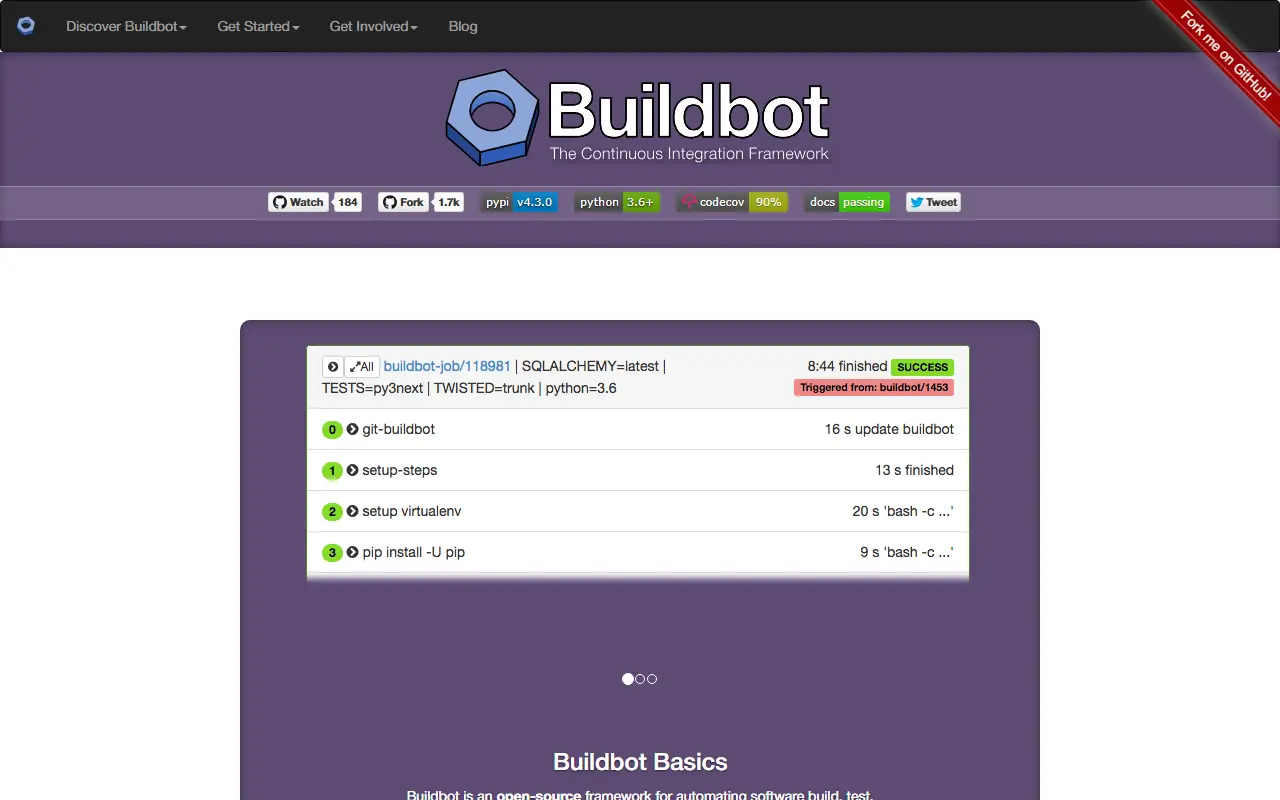
buildbot.netBuildbot homepage screenshot

Buildbot is an open-source continuous integration framework written in Python. Rather than a fixed service with a rigid workflow, it is a toolkit for automating the whole software development cycle, from compiling and testing code to packaging and releasing it, with configuration expressed in Python.

The project's site presents it as a framework with batteries included, covering automated build, test and release jobs, a web interface, and a tutorial and documentation to get started. A master process coordinates build workers that can run on different platforms, which makes it a good fit for projects that need to test across many operating systems and configurations. The site also lists success stories and a Metabuildbot used to build Buildbot itself.

Buildbot is licensed under GPL-2.0 and is typically self-hosted, with community support through a mailing list and IRC. It suits teams that want a highly customizable CI system they control, particularly for complex or multi-platform build setups.

Key features

  • Python-configured build automation
  • Automated build, test and release jobs
  • Distributed workers across platforms
  • Web interface for build status
  • Extensible with custom steps
  • Tutorial and extensive documentation

Pricing: Free and open source under GPL-2.0.

OVHcloud CDS

CDS is OVHcloud's open-source continuous delivery and DevOps automation platform, with a workflow UI and a scriptable command-line client.

GitHub stars
4.8k
Last commit
2 days ago
Latest release
v0.54.1
Licence
BSD-3-Clause
Self-hosted
Yes
ovh.github.ioOVHcloud CDS homepage screenshot

CDS, the Continuous Delivery Service, is an enterprise-oriented continuous delivery and DevOps automation platform written in Go and developed by OVH. It lets teams model build, test and deployment processes as workflows and run them across their infrastructure.

The platform offers a UI where complex workflows can be built, started and inspected down to the logs, and a command-line client called cdsctl that can script everything and includes commands such as a shell for browsing projects and workflows without a browser. Workflows can also be defined as code, according to the README, and the project is described as under active development with published documentation.

CDS is licensed under BSD-3-Clause and is self-hosted by organizations that want to run their own CI/CD platform. It suits platform engineering teams looking for an open, scriptable alternative to commercial pipeline tools.

Key features

  • Visual workflow builder and run viewer
  • cdsctl command-line client
  • Workflows defined as code
  • Log inspection for each run
  • Self-hosted Go platform
  • Scriptable automation of CI/CD tasks

Pricing: Free and open source under the BSD-3-Clause license.

BK-CI

Tencent BlueKing's free CI/CD platform with visual pipelines, code checking, artifact repositories, build acceleration, and environment management.

GitHub stars
2.5k
Last commit
3 days ago
Latest release
v4.1.0
Self-hosted
Yes
bk.tencent.comBK-CI homepage screenshot

bk-ci, also called Blueking Continuous Integration (蓝盾), is a free and open-source CI service for automating build, test, and release workflows. It handles compiling, static code analysis, running tests to catch bugs early, and deployment and release. The documentation is available in Chinese and English, and the input lists its license only as other. It is written in Kotlin and Java.

The platform is described as eight core services: pipelines that visualize a team's development process, code checking powered by BK-CodeCC, a code repository service that links existing source hosting, credential management, environment management for build machines, a store of pipeline plugins and templates, compile acceleration for C/C++ and Unreal Engine builds, and an artifact repository supporting formats such as Maven, npm, PyPI, Docker, Helm, and NuGet on COS or S3 storage. A cloud desktop service is also listed.

The README warns that the master branch can be unstable and that users should install from releases. bk-ci suits enterprises, particularly Chinese-speaking teams and game studios, that want a self-managed CI platform covering pipelines, artifacts, and build acceleration.

Key features

  • Visual pipelines for build, test, and deploy
  • Code checking through BK-CodeCC
  • Artifact repository for Maven, npm, Docker, and more
  • Build acceleration for C/C++ and Unreal Engine
  • Credential and environment management
  • Plugin and template store

Semaphore

An open-source CI/CD platform with YAML pipelines and parallel execution, offered as a community edition, an enterprise edition and a hosted cloud.

GitHub stars
1.6k
Last commit
today
Latest release
v1.5.0
Self-hosted
Yes
Hosted version
Available

Semaphore is a continuous integration and delivery platform that helps product teams build, test and ship software. Pipelines are defined in YAML, can run jobs in parallel, and work with containers, Kubernetes and multi-cloud environments. The project presents it as a delivery platform for AI-driven development as well as traditional workflows.

The code base is written mainly in Elixir and Go, and the repository describes three flavors. The Community Edition is free and open source under Apache 2.0 and meant for teams running Semaphore on their own infrastructure with community support. The Enterprise Edition adds features for larger organizations under a commercial licence with professional support. Semaphore Cloud is the hosted option at semaphoreci.com.

Installing the self-hosted version is said to take roughly 10 to 30 minutes, with detailed guides for different methods, and the repository links to documentation, a roadmap, governance information and a project board. It suits engineering teams that want a modern CI/CD system they can run themselves, or prefer a hosted service with the same engine.

Key features

  • YAML-based pipeline configuration
  • Parallel job execution
  • Container and Kubernetes support
  • Self-hosted Community Edition
  • Enterprise Edition with commercial support
  • Hosted Semaphore Cloud option

Pricing: Community Edition is free under Apache 2.0; the Enterprise Edition is commercially licensed; the hosted cloud offers free plans for small projects and larger plans.

Abstruse

Abstruse is a lightweight, distributed CI/CD platform written in Go that runs builds on a server with one or more worker nodes.

GitHub stars
961
Last commit
28 days ago
Latest release
v2.1.0
Licence
MIT
Self-hosted
Yes

Abstruse is a free and open-source continuous integration and delivery platform. It runs tests and builds for your code on infrastructure you operate, using Docker to isolate jobs, and reports results through a web interface.

Version 2 is a rewrite in Go; the 1.x line was based on Node.js. By default it runs as a single-node cluster with a server and a configurable number of workers, and the cluster can be extended with additional nodes when more capacity is needed. A quick-start Docker setup launches the abstruse-server, one abstruse-worker and a MySQL database, followed by a browser-based installation wizard.

Abstruse is licensed under MIT and is self-hosted. A live demo is available with a read-only user, so you can look around before installing. Building from source requires Node.js, yarn and Go, and the project describes itself as lightweight compared with a typical CI server.

Key features

  • Distributed server and worker architecture
  • Dockerized job execution
  • Scale out by adding worker nodes
  • Browser-based installation wizard
  • MySQL-backed state storage
  • Read-only live demo

Pricing: Free and open source under the MIT license.

PHP Censor

PHP Censor is a BSD-licensed, self-hosted continuous integration server for PHP projects, forked from PHPCI, with built-in test, code-quality and deploy plugins.

GitHub stars
687
Last commit
4 mo ago
Latest release
2.1.6
Licence
BSD-2-Clause
Self-hosted
Yes
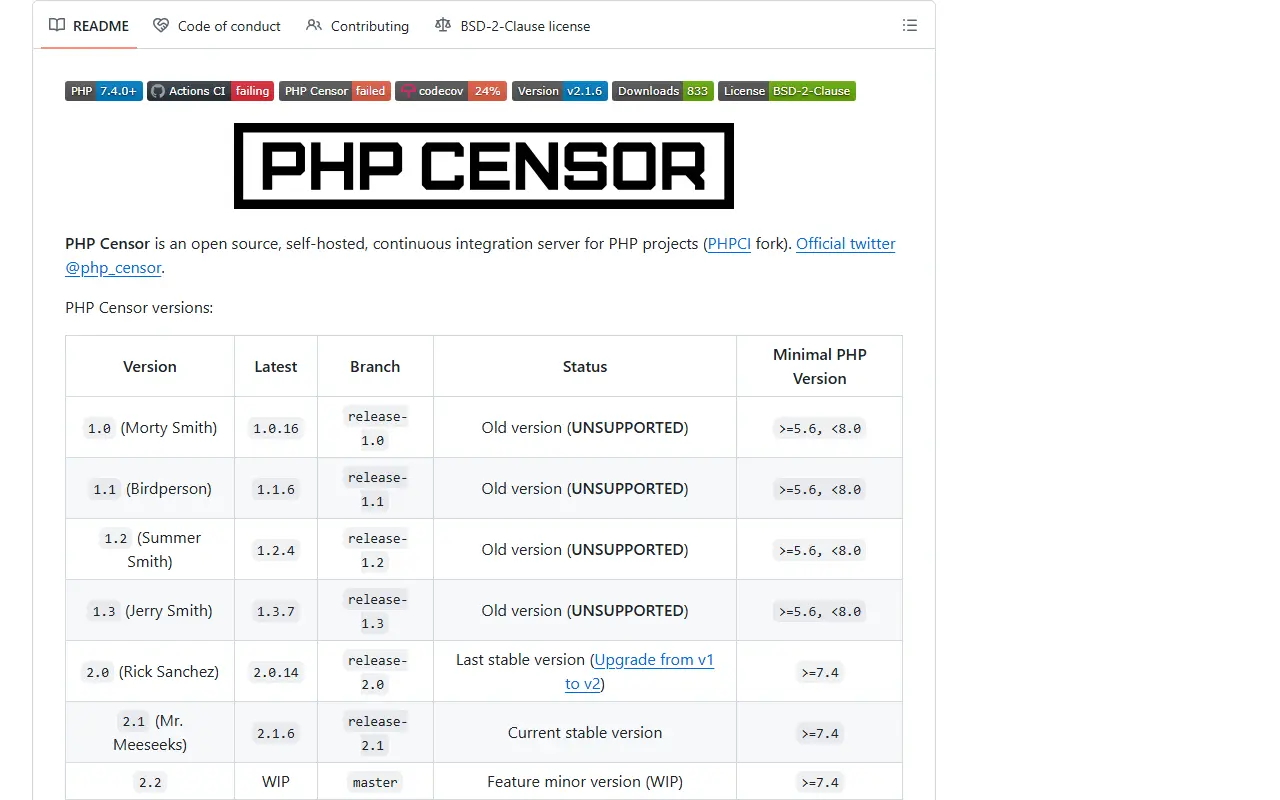
php-censor.infoPHP Censor homepage screenshot

PHP Censor is a self-hosted continuous integration server built for PHP projects. It is a fork of PHPCI and lets teams automatically fetch code, install dependencies, run tests and quality checks, and send notifications about the results from a server they control.

Projects can be cloned from GitHub, Bitbucket, GitLab, generic Git, Mercurial, Subversion or a local directory. Builds can set up database tests for PostgreSQL, MySQL and SQLite, install Composer dependencies, run PHPUnit, Atoum, Behat, Codeception and PHPSpec, and apply linting and static analysis tools such as PHP CodeSniffer, PHP Mess Detector and PHPLoc. Plugins such as Deployer, Phing, Grunt and Gulp are included, along with notifications to email, Slack, IRC and Telegram, and LDAP authentication.

The server needs a Unix-like OS, PHP 7.4 or newer, Nginx or Apache, a MySQL, MariaDB or PostgreSQL database and a Beanstalkd queue; Windows is not supported. It is released under the BSD-2-Clause license, with version 2.1 as the current stable line.

Key features

  • Clone repositories from GitHub, GitLab, Bitbucket and SVN
  • Runs PHPUnit, Behat, Codeception and PHPSpec tests
  • Code style and static analysis plugins
  • Database test setup for MySQL, PostgreSQL, SQLite
  • Notifications to email, Slack, IRC and Telegram
  • LDAP authentication support
  • Deployment plugins like Deployer and Phing

Pricing: Free and open source under the BSD-2-Clause license.

1 more TeamCity alternative

TeamCity alternatives: questions

What is the best open-source alternative to TeamCity?
Harness is the top-ranked open-source alternative to TeamCity on Enlisted: An open-source developer platform combining Git hosting, CI/CD pipelines, cloud development environments called Gitspaces and artifact registries, the successor to Drone. Other strong options are Jenkins, Concourse CI, GoCD and Buildbot.
Are these TeamCity alternatives free?
All 11 are open source, so the code is free to use under its licence, and all of them can be self-hosted on your own server or computer. 1 also offers a paid or managed cloud version if you'd rather not host it yourself.
How is this list of TeamCity alternatives ranked?
By a score built from GitHub stars, star growth over the last 30 days and how recently the code changed. 9 of these projects shipped code in the last 30 days. Data is refreshed daily, and nobody can pay to move up.

People also look for alternatives to…

View all