7,363 open-source and SaaS tools, with GitHub stats refreshed every day.

5 alternatives ranked by real activity

Open-source Travis CI alternatives

A curated, ranked list of the 5 best open-source alternatives to Travis CI.

The best open-source alternative to Travis CI is Jenkins. If that doesn't suit you, other good options are Woodpecker CI, Semaphore, Abstruse and PHP Censor.

Travis CI alternatives are mainly CI/CD & DevOps tools. 4 of them shipped code in the last 30 days, 5 can be self-hosted, and 4 use a permissive licence.

Last updated October 2, 2026 · ranked by GitHub stars, growth and recent commits

Jenkins

Jenkins is an open-source, Java-based automation server for building, testing and deploying software, extended through plugins.

GitHub stars
27k
Last commit
yesterday
Latest release
jenkins-2.584
Licence
MIT
Self-hosted
Yes
jenkins.ioJenkins homepage screenshot

Jenkins is an open-source automation server written in Java. Teams use it to automate parts of their development workflow, including building projects, running tests to catch bugs early, performing static code analysis and deploying software. The README states that more than 2,000 plugins extend it to automate nearly any task. It is released under the MIT license, and its topics include continuous integration, delivery and pipelines as code.

The project distributes official downloads as WAR archives, Docker images, and native packages or installers for several Linux distributions and Windows. Two release lines exist: weekly releases carrying all new features and fixes, and Long-Term Support releases that receive periodic backported bug fixes. The repository links to contributing guidelines, good first issues, developer documentation, governance and adopters information. As a self-managed server, you operate and secure your own Jenkins instance.

Key features

  • Automation server for build, test and deploy
  • Plugin ecosystem with over 2,000 plugins
  • Pipelines as code
  • WAR, Docker image and native package installs
  • Weekly and Long-Term Support release lines
  • Static code analysis and deployment automation

Pricing: Free and open source under the MIT license.

Woodpecker CI

A lightweight, extensible CI/CD engine that runs pipelines in containers, using SQLite by default and used as the main CI at Codeberg.

GitHub stars
7.9k
Last commit
today
Latest release
v3.18.1
Licence
Apache-2.0
Self-hosted
Yes
woodpecker-ci.orgWoodpecker CI homepage screenshot

Woodpecker is a simple CI/CD engine with a plugin system for extending what pipelines can do. It can be installed in several ways, including Docker and Kubernetes, and runs with SQLite as the default database, so a small setup needs little more than a server and one or more agents.

The README says the server needs around 100 MB of memory and the agent about 30 MB when idle, which makes it suitable for modest hardware. Plugins are browsed on a dedicated overview website and include both core-team and community-maintained ones. Translations are managed on a self-hosted Weblate instance, and the project is supported through Open Collective and GitHub Sponsors.

Woodpecker is written in Go and licensed under Apache-2.0, with documentation under Creative Commons Attribution-ShareAlike. Codeberg, a Git hosting platform focused on privacy and free software, uses it as its main CI/CD engine. It suits teams and individuals who self-host Git and want a lean container-based pipeline runner.

Key features

  • Container-based CI/CD pipelines
  • SQLite by default for small installs
  • Plugin system with community plugins
  • Low idle memory for server and agent
  • Docker and Kubernetes installation
  • Translations managed in Weblate

Pricing: Free and open source under the Apache-2.0 licence.

Semaphore

An open-source CI/CD platform with YAML pipelines and parallel execution, offered as a community edition, an enterprise edition and a hosted cloud.

GitHub stars
1.6k
Last commit
today
Latest release
v1.5.0
Self-hosted
Yes
Hosted version
Available

Semaphore is a continuous integration and delivery platform that helps product teams build, test and ship software. Pipelines are defined in YAML, can run jobs in parallel, and work with containers, Kubernetes and multi-cloud environments. The project presents it as a delivery platform for AI-driven development as well as traditional workflows.

The code base is written mainly in Elixir and Go, and the repository describes three flavors. The Community Edition is free and open source under Apache 2.0 and meant for teams running Semaphore on their own infrastructure with community support. The Enterprise Edition adds features for larger organizations under a commercial licence with professional support. Semaphore Cloud is the hosted option at semaphoreci.com.

Installing the self-hosted version is said to take roughly 10 to 30 minutes, with detailed guides for different methods, and the repository links to documentation, a roadmap, governance information and a project board. It suits engineering teams that want a modern CI/CD system they can run themselves, or prefer a hosted service with the same engine.

Key features

  • YAML-based pipeline configuration
  • Parallel job execution
  • Container and Kubernetes support
  • Self-hosted Community Edition
  • Enterprise Edition with commercial support
  • Hosted Semaphore Cloud option

Pricing: Community Edition is free under Apache 2.0; the Enterprise Edition is commercially licensed; the hosted cloud offers free plans for small projects and larger plans.

Abstruse

Abstruse is a lightweight, distributed CI/CD platform written in Go that runs builds on a server with one or more worker nodes.

GitHub stars
961
Last commit
28 days ago
Latest release
v2.1.0
Licence
MIT
Self-hosted
Yes

Abstruse is a free and open-source continuous integration and delivery platform. It runs tests and builds for your code on infrastructure you operate, using Docker to isolate jobs, and reports results through a web interface.

Version 2 is a rewrite in Go; the 1.x line was based on Node.js. By default it runs as a single-node cluster with a server and a configurable number of workers, and the cluster can be extended with additional nodes when more capacity is needed. A quick-start Docker setup launches the abstruse-server, one abstruse-worker and a MySQL database, followed by a browser-based installation wizard.

Abstruse is licensed under MIT and is self-hosted. A live demo is available with a read-only user, so you can look around before installing. Building from source requires Node.js, yarn and Go, and the project describes itself as lightweight compared with a typical CI server.

Key features

  • Distributed server and worker architecture
  • Dockerized job execution
  • Scale out by adding worker nodes
  • Browser-based installation wizard
  • MySQL-backed state storage
  • Read-only live demo

Pricing: Free and open source under the MIT license.
PHP Censor

PHP Censor is a BSD-licensed, self-hosted continuous integration server for PHP projects, forked from PHPCI, with built-in test, code-quality and deploy plugins.

GitHub stars
687
Last commit
4 mo ago
Latest release
2.1.6
Licence
BSD-2-Clause
Self-hosted
Yes
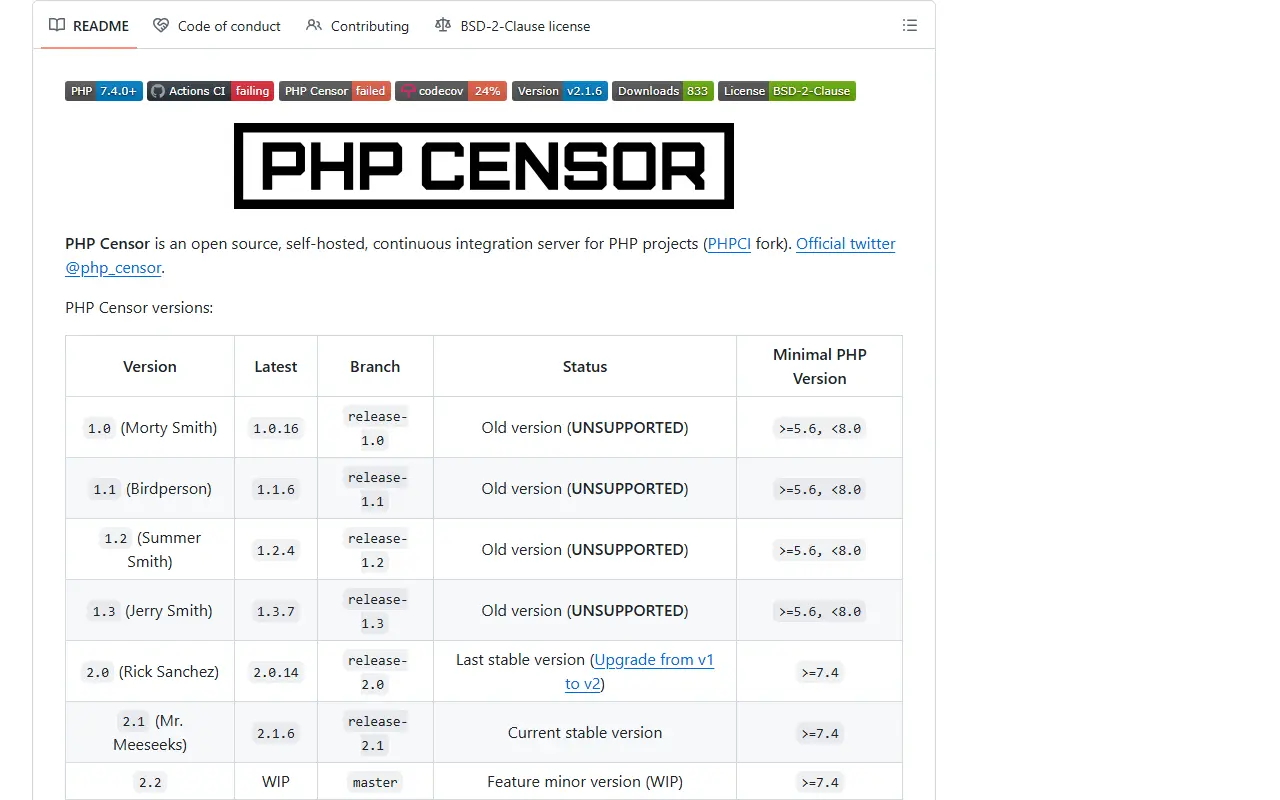
php-censor.infoPHP Censor homepage screenshot

PHP Censor is a self-hosted continuous integration server built for PHP projects. It is a fork of PHPCI and lets teams automatically fetch code, install dependencies, run tests and quality checks, and send notifications about the results from a server they control.

Projects can be cloned from GitHub, Bitbucket, GitLab, generic Git, Mercurial, Subversion or a local directory. Builds can set up database tests for PostgreSQL, MySQL and SQLite, install Composer dependencies, run PHPUnit, Atoum, Behat, Codeception and PHPSpec, and apply linting and static analysis tools such as PHP CodeSniffer, PHP Mess Detector and PHPLoc. Plugins such as Deployer, Phing, Grunt and Gulp are included, along with notifications to email, Slack, IRC and Telegram, and LDAP authentication.

The server needs a Unix-like OS, PHP 7.4 or newer, Nginx or Apache, a MySQL, MariaDB or PostgreSQL database and a Beanstalkd queue; Windows is not supported. It is released under the BSD-2-Clause license, with version 2.1 as the current stable line.

Key features

  • Clone repositories from GitHub, GitLab, Bitbucket and SVN
  • Runs PHPUnit, Behat, Codeception and PHPSpec tests
  • Code style and static analysis plugins
  • Database test setup for MySQL, PostgreSQL, SQLite
  • Notifications to email, Slack, IRC and Telegram
  • LDAP authentication support
  • Deployment plugins like Deployer and Phing

Pricing: Free and open source under the BSD-2-Clause license.

Travis CI alternatives: questions

What is the best open-source alternative to Travis CI?
Jenkins is the top-ranked open-source alternative to Travis CI on Enlisted: Jenkins is an open-source, Java-based automation server for building, testing and deploying software, extended through plugins. Other strong options are Woodpecker CI, Semaphore, Abstruse and PHP Censor.
Are these Travis CI alternatives free?
All 5 are open source, so the code is free to use under its licence, and all of them can be self-hosted on your own server or computer. 1 also offers a paid or managed cloud version if you'd rather not host it yourself.
How is this list of Travis CI alternatives ranked?
By a score built from GitHub stars, star growth over the last 30 days and how recently the code changed. 4 of these projects shipped code in the last 30 days. Data is refreshed daily, and nobody can pay to move up.

People also look for alternatives to…

View all