6 open-source alternatives ranked by real activity

Open-source Bitrise alternatives

A curated, ranked list of the 6 best open-source alternatives to Bitrise.

The best open-source alternative to Bitrise is Fastlane. If that doesn't suit you, other good options are Jenkins, Concourse CI, GoCD and Buildbot.

Commercial alternatives to Bitrise include Appcircle, Codemagic, Expo EAS and Travis CI. See all 21.

Bitrise alternatives are mainly CI/CD & DevOps tools. 6 of them shipped code in the last 30 days, 6 can be self-hosted, and 4 use a permissive licence.

Last updated November 13, 2026 · ranked by GitHub stars, growth and recent commits

Fastlane

A Ruby-based tool for iOS and Android developers that automates tedious release tasks such as screenshots, code signing profiles, building and publishing apps.

GitHub stars
42k
Last commit
yesterday
Latest release
2.241.2
Licence
MIT
Self-hosted
Yes
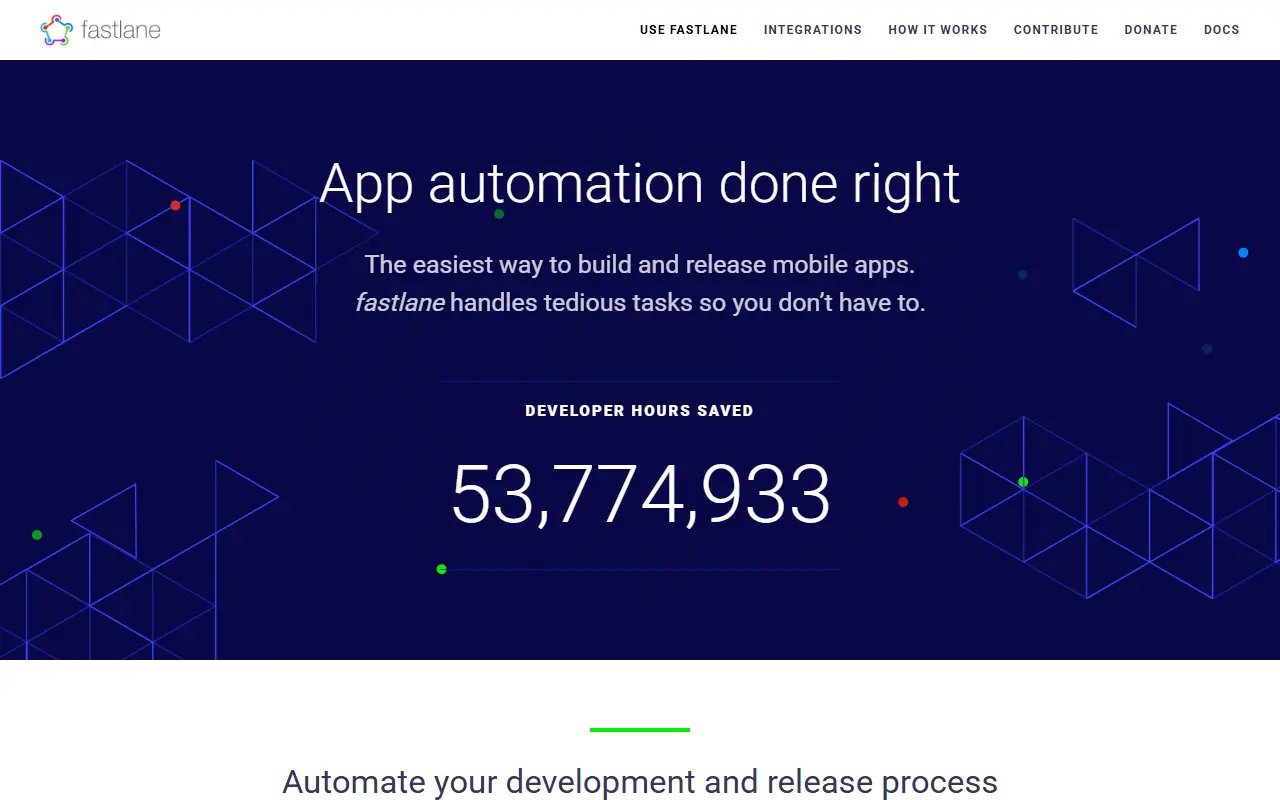
fastlane.toolsFastlane homepage screenshot

fastlane is a command line tool for iOS and Android developers that automates the repetitive parts of shipping a mobile app. Typical jobs include generating screenshots, dealing with provisioning profiles and code signing, building the app and releasing it to the stores or to testers, all scripted so that a release becomes one repeatable command.

It is written in Ruby and organized around lanes that chain together reusable actions, which you can run on a laptop or on a CI server. The project documentation lives at docs.fastlane.tools. When something goes wrong, the maintainers ask users to include the output of the fastlane env command in bug reports, and to label regressions so they can be tracked quickly.

fastlane is MIT licensed and maintained by a small core team with help from many contributors. It is open-source tooling you run yourself, so there is no hosted service involved. Mobile teams use it to cut manual release work and keep builds consistent between developers and CI.

Key features

  • Automates iOS and Android build and release steps
  • Screenshot generation for store listings
  • Provisioning profile and code signing handling
  • Reusable lanes and actions in Ruby
  • Runs locally or on CI servers
  • Environment report command for debugging

Pricing: Free and open source under the MIT license.

Jenkins

Jenkins is an open-source, Java-based automation server for building, testing and deploying software, extended through plugins.

GitHub stars
27k
Last commit
yesterday
Latest release
jenkins-2.590
Licence
MIT
Self-hosted
Yes
jenkins.ioJenkins homepage screenshot

Jenkins is an open-source automation server written in Java. Teams use it to automate parts of their development workflow, including building projects, running tests to catch bugs early, performing static code analysis and deploying software. The README states that more than 2,000 plugins extend it to automate nearly any task. It is released under the MIT license, and its topics include continuous integration, delivery and pipelines as code.

The project distributes official downloads as WAR archives, Docker images, and native packages or installers for several Linux distributions and Windows. Two release lines exist: weekly releases carrying all new features and fixes, and Long-Term Support releases that receive periodic backported bug fixes. The repository links to contributing guidelines, good first issues, developer documentation, governance and adopters information. As a self-managed server, you operate and secure your own Jenkins instance.

Key features

  • Automation server for build, test and deploy
  • Plugin ecosystem with over 2,000 plugins
  • Pipelines as code
  • WAR, Docker image and native package installs
  • Weekly and Long-Term Support release lines
  • Static code analysis and deployment automation

Pricing: Free and open source under the MIT license.
Concourse CI

A container-based automation system in Go, mostly used for CI/CD, that defines pipelines declaratively and runs them on stateless workers.

GitHub stars
7.9k
Last commit
today
Latest release
v8.3.3
Licence
Apache-2.0
Self-hosted
Yes
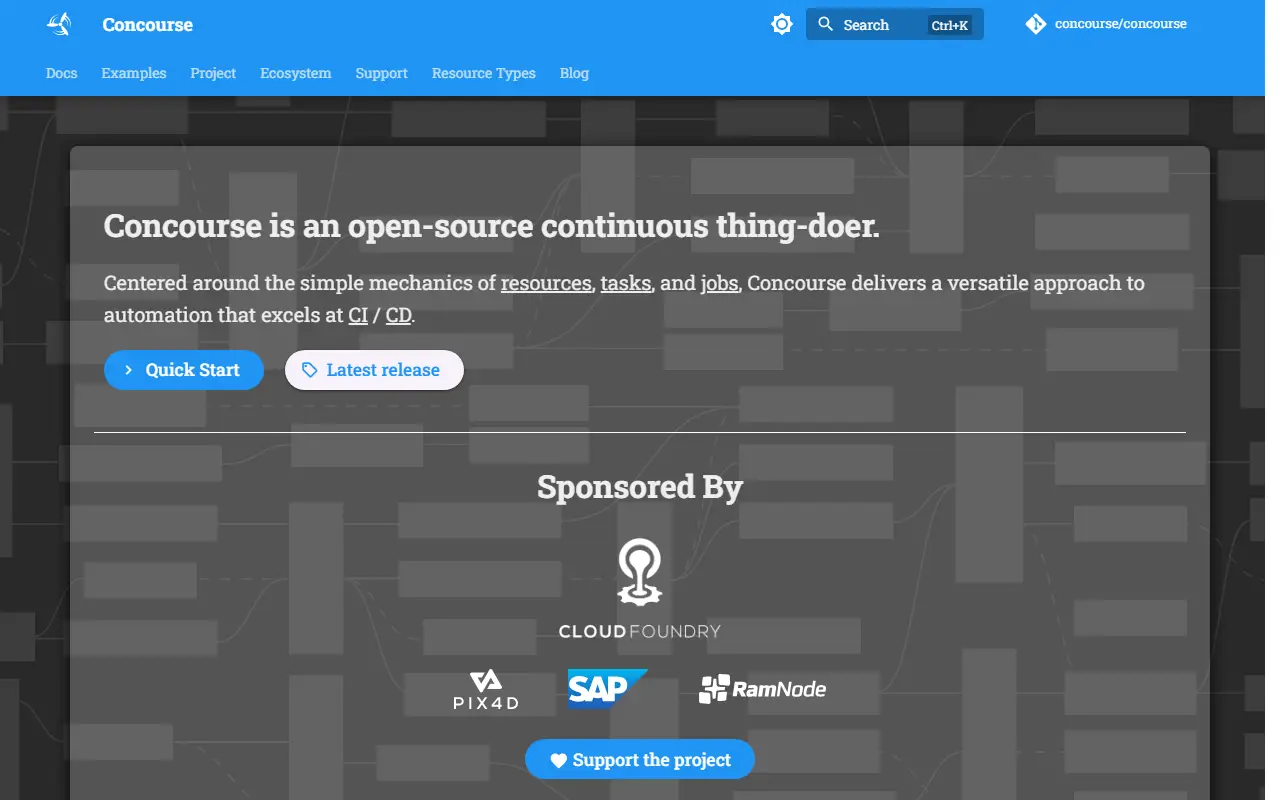
concourse-ci.orgConcourse CI homepage screenshot

Concourse is an automation system written in Go, most often used for CI/CD and built to scale from simple to complex pipelines. It is deliberately opinionated: the project emphasizes idempotency, immutability, declarative configuration, stateless workers and reproducible builds.

It is distributed as a single concourse binary on the releases page, and other supported formats include a Docker image, a Kubernetes Helm chart and a BOSH release. A quick start walks through running it locally. Topics show that tasks run in containers using containerd and runc, and the web interface was built with Elm.

Concourse is licensed under Apache-2.0. It is run on your own infrastructure by teams that prefer pipelines described as code, with each job's inputs and outputs explicit, over scripts configured through a UI. It suits platform and DevOps teams wanting repeatable, container-isolated build and deploy pipelines.

Key features

  • Declarative pipeline configuration
  • Container-based task execution
  • Stateless workers for scaling
  • Reproducible builds by design
  • Single binary distribution
  • Docker, Helm and BOSH packaging

Pricing: Free and open source under the Apache-2.0 licence.

GoCD

GoCD is a continuous delivery server that models build, test and release pipelines, sponsored by Thoughtworks and written mainly in Java and TypeScript.

GitHub stars
7.4k
Last commit
today
Latest release
26.1.0
Licence
Apache-2.0
Self-hosted
Yes
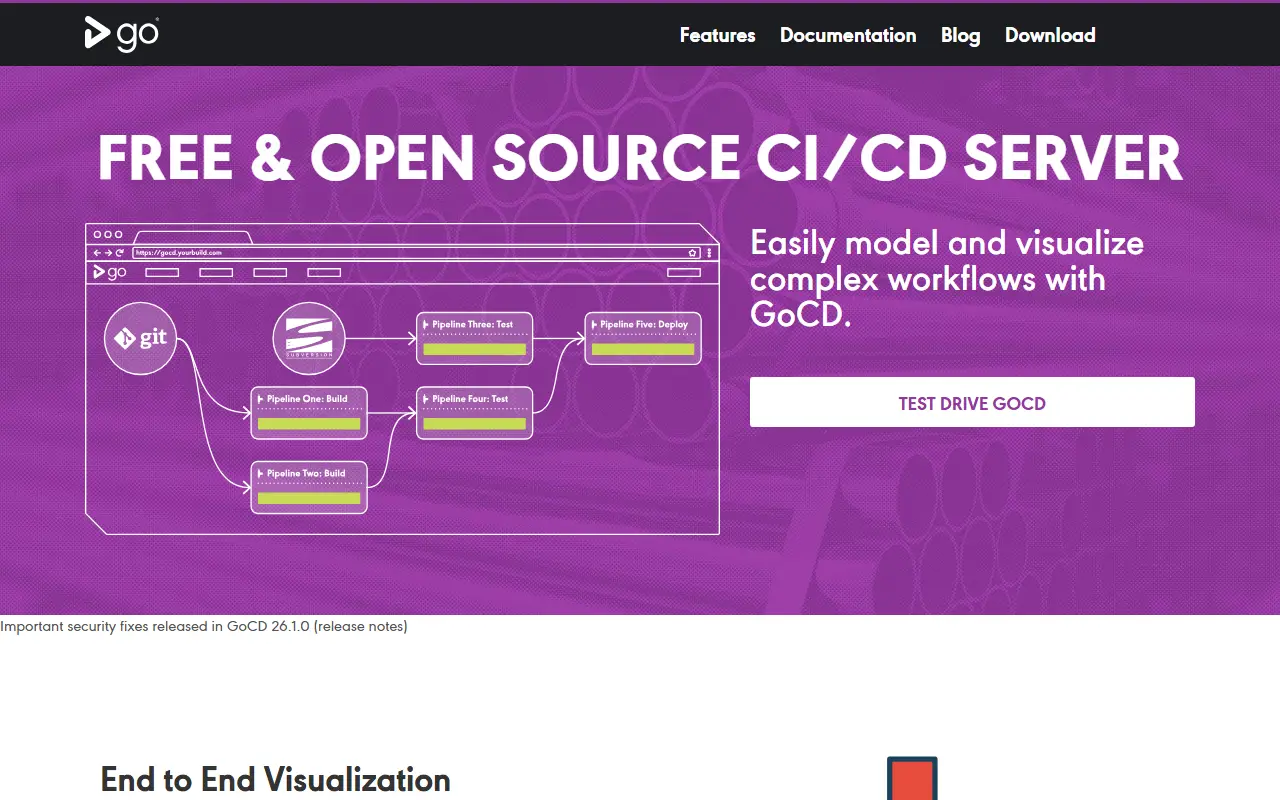
gocd.orgGoCD homepage screenshot

GoCD is a continuous delivery server that helps automate and streamline the build, test and release cycle so that software can be delivered continuously with fewer worries. The repository is the project's main code base, and the project is sponsored by Thoughtworks.

Newcomers can use the Test Drive GoCD page to build a first pipeline while learning the key concepts, download releases from the website and read the documentation for detailed help. It is predominantly a Java and TypeScript project that uses the Spring Framework, SparkJava and MithrilJS, is built with Gradle and Webpack and runs inside Eclipse Jetty, with a few older parts rendered server-side in JRuby on Rails. GoCD itself is built with GoCD.

The security policy explains how issues are reported, and contributing guides cover the development environment. GoCD is licensed under Apache-2.0 and is hosted by you. It suits teams that model deployment pipelines with explicit stages and dependencies across several services.

Key features

  • Pipelines for build, test and release
  • Test drive guide for first pipelines
  • Continuous delivery server
  • Java and TypeScript code base
  • Security policy and responsible disclosure
  • Built and released using GoCD itself

Pricing: Free and open source under the Apache-2.0 licence.

Read more about GoCDWebsiteGitHub#4 Bitrise alternative

Buildbot

Buildbot is a Python-based framework for automating software builds, tests and releases, configured in code and run on your own infrastructure.

GitHub stars
5.5k
Last commit
today
Latest release
v4.3.0
Licence
GPL-2.0
Self-hosted
Yes
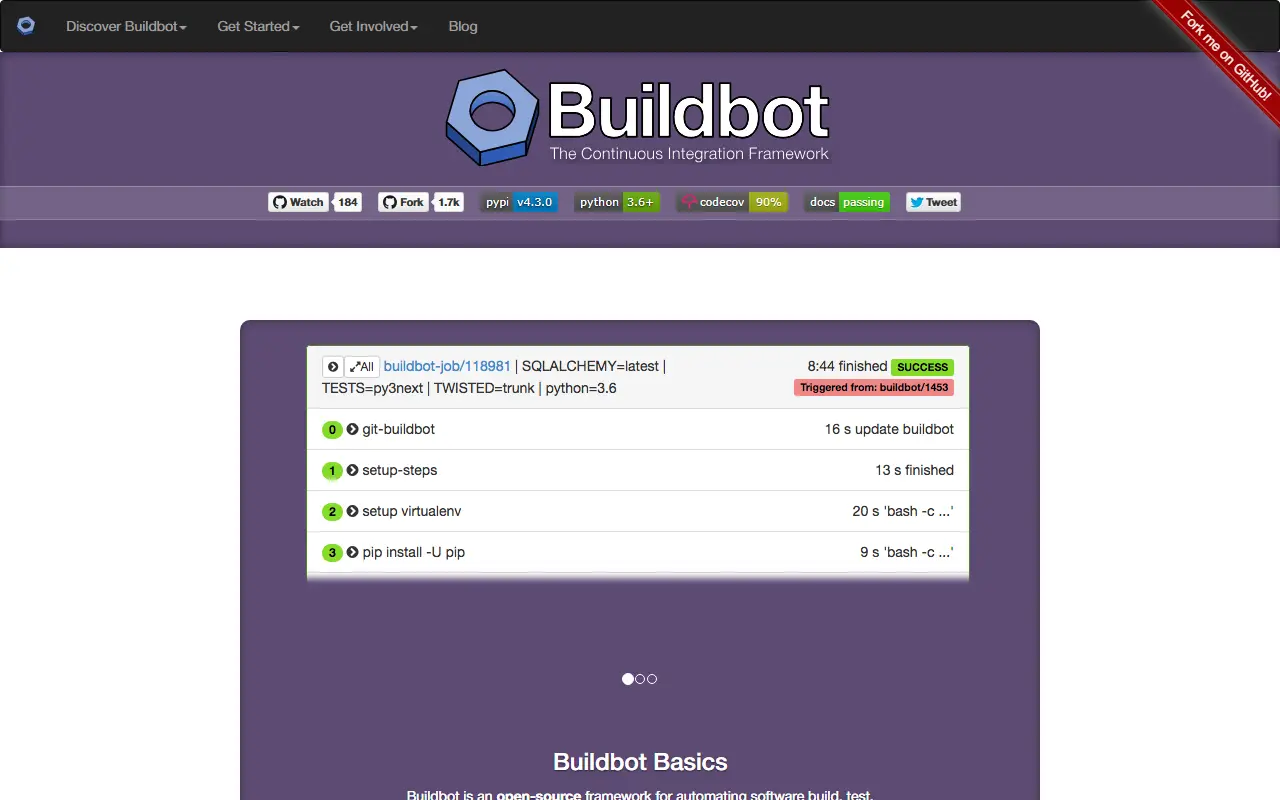
buildbot.netBuildbot homepage screenshot

Buildbot is an open-source continuous integration framework written in Python. Rather than a fixed service with a rigid workflow, it is a toolkit for automating the whole software development cycle, from compiling and testing code to packaging and releasing it, with configuration expressed in Python.

The project's site presents it as a framework with batteries included, covering automated build, test and release jobs, a web interface, and a tutorial and documentation to get started. A master process coordinates build workers that can run on different platforms, which makes it a good fit for projects that need to test across many operating systems and configurations. The site also lists success stories and a Metabuildbot used to build Buildbot itself.

Buildbot is licensed under GPL-2.0 and is typically self-hosted, with community support through a mailing list and IRC. It suits teams that want a highly customizable CI system they control, particularly for complex or multi-platform build setups.

Key features

  • Python-configured build automation
  • Automated build, test and release jobs
  • Distributed workers across platforms
  • Web interface for build status
  • Extensible with custom steps
  • Tutorial and extensive documentation

Pricing: Free and open source under GPL-2.0.

Screwdriver

Screwdriver is an open source build platform for continuous delivery, with a plugin model, a REST API and configuration kept in code.

GitHub stars
1.1k
Last commit
8 days ago
Latest release
v4.1.0
Self-hosted
Yes
screwdriver.cdScrewdriver homepage screenshot

Screwdriver is a build platform aimed at continuous delivery. Its site frames the design around easy configurability and isolation as a security measure, and the project started inside Yahoo before becoming an incubating project of the Continuous Delivery Foundation.

Teams choose the plugins that suit them rather than adopting a fixed stack, and the platform is not tied to a single compute platform. Source code services, execution engines and databases are supported through an expanding list of integrations, and a documented REST API sits alongside the web UI.

To try it, a Python script generates a Docker Compose file for a local cluster, wires in OAuth credentials and pulls the API, UI and log store images. Data written to a database goes into a local data directory. Production setups are covered in separate cluster management documentation, and the code is released under the BSD-3-Clause licence.

Key features

  • Build platform built for continuous delivery
  • Configurability and isolation as security goals
  • Choose plugins, not tied to one compute platform
  • Fully documented RESTful API
  • Local cluster via generated Docker Compose file
  • Integrations with source services, engines and databases

Commercial Bitrise alternatives

Hosted, closed-source products that compete with Bitrise. Showing 12 of 21.

See every Bitrise alternative on its tool page

Bitrise alternatives: questions

What is the best open-source alternative to Bitrise?
Fastlane is the top-ranked open-source alternative to Bitrise on Enlisted: A Ruby-based tool for iOS and Android developers that automates tedious release tasks such as screenshots, code signing profiles, building and publishing apps. Other strong options are Jenkins, Concourse CI, GoCD and Buildbot.
What are the best commercial alternatives to Bitrise?
Appcircle, Codemagic, Expo EAS, Travis CI and Semaphore are among the hosted, closed-source alternatives to Bitrise listed on Enlisted, which lists 21 in total. Compare their pricing and features on each tool page.
Are these Bitrise alternatives free?
All 6 are open source, so the code is free to use under its licence, and all of them can be self-hosted on your own server or computer.
How is this list of Bitrise alternatives ranked?
By a score built from GitHub stars, star growth over the last 30 days and how recently the code changed. 6 of these projects shipped code in the last 30 days. Data is refreshed daily, and nobody can pay to move up.

People also look for alternatives to…

View all