
 Buildkite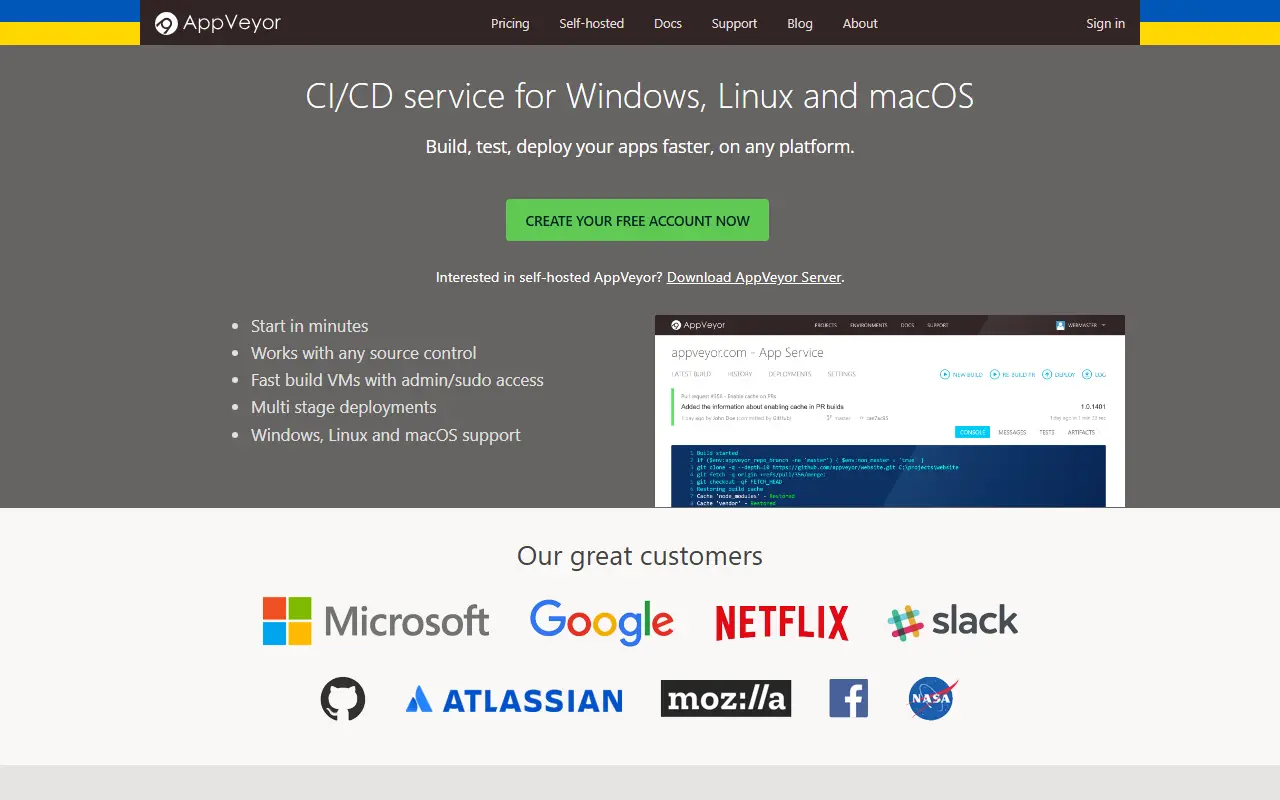
About AppVeyor
AppVeyor is a continuous integration and deployment service known for strong Windows support, but it also runs builds on Linux and macOS. Developers connect a repository, define the build in versioned YAML or through a web interface, and get tests and deployments triggered on every commit, branch or pull request.
Each build runs in an isolated, clean environment, and build virtual machines give administrator or sudo access, which helps with projects that need custom system setup. The service includes multi-stage deployments and a built-in NuGet server, and it works with GitHub, GitHub Enterprise, Bitbucket, GitLab, Azure Repos, Kiln, Gitea and custom repositories.
AppVeyor offers hosted accounts, including a free account to get started, and a downloadable AppVeyor Server for organizations that want to run it on their own infrastructure. Documentation, support and a community are available, and plans are listed on its pricing page.
Key features
- Builds on Windows, Linux and macOS
- Build configuration in versioned YAML or UI
- Isolated clean environment for every build
- Multi-stage deployments
- Built-in NuGet server
- Branch and pull request builds
- Works with many Git hosting services
Good fit for
- →CI for .NET and Windows projects
- →Cross-platform builds for open-source libraries
- Tags
- ci-cd
- continuous-integration
- windows
- dotnet
- nuget
- self-hosted
- deployment
AppVeyor: questions and answers
- What is AppVeyor used for?
- AppVeyor is a CI/CD service that builds, tests and deploys projects on Windows, Linux and macOS, with a self-hosted server edition. It is a good fit for CI for .NET and Windows projects, and cross-platform builds for open-source libraries.
- Is AppVeyor free?
- Yes. AppVeyor has a free plan, and paid plans start at $29 per month. A free trial is also available.
- Is AppVeyor open source?
- No. AppVeyor is proprietary (closed-source) software. Open-source alternatives to AppVeyor include Concourse CI, Woodpecker CI and Semaphore.
- Can I self-host AppVeyor?
- Yes. Although AppVeyor is closed source, it can be self-hosted on your own servers, and the vendor also offers a hosted version.
- What are some alternatives to AppVeyor?
- AppVeyor competes with CircleCI, Travis CI and GitHub Actions. For open-source options, see Enlisted's ranked list of open-source AppVeyor alternatives.
Open-source alternatives to AppVeyor
See all
Concourse CI
CI/CD & DevOps
Concourse is a container-based automation system written in Go. It's mostly used for CI/CD
Apache-2.0vs GitHub Actions★ 7.9k
Woodpecker CI
CI/CD & DevOps
Woodpecker is a simple, yet powerful CI/CD engine with great extensibility.
Apache-2.0vs GitHub Actions★ 7.9k
Semaphore
CI/CD & DevOps
All-in-one delivery platform for AI-driven development.
OSSvs GitHub Actions★ 1.6k
Abstruse
CI/CD & DevOps
Abstruse is a free and open-source CI/CD platform that tests your models and code.
MITvs Travis CI★ 961
flow.ci
CI/CD & DevOps
Powerful and user-friendly CI/CD server with high availability, parallel processing, runne
Apache-2.0vs GitHub Actions★ 1.6k
Gitea
CI/CD & DevOps
Gitea - Git with a cup of tea! Painless self-hosted all-in-one software development servic
MITvs Bitbucket★ 58k
SaaS alternatives to AppVeyor
See all
CircleCI
CI/CD & DevOps
Hosted continuous integration and delivery platform for build and test pipelines
SaaS
Travis CI
CI/CD & DevOps
Hosted continuous integration service that builds and tests code from Git repos
SaaS
GitHub Actions
CI/CD & DevOps
GitHub Actions is GitHub's built-in automation and CI/CD service for building, testing and deploying code through workflows triggered by repository events.
SaaS
Azure Pipelines
CI/CD & DevOps
CI/CD service in Azure DevOps for building and deploying to any platform
SaaS
TeamCity
CI/CD & DevOps
JetBrains CI/CD server with build chains, available self-hosted or as a cloud service
SaaS
Semaphore
CI/CD & DevOps
Hosted CI/CD service with parallel test pipelines and monorepo support
SaaS