
 Vast.ai
 Lightning AI
 Paperspace
 Google Vertex AI
 Azure Machine Learning
 Domino Data Lab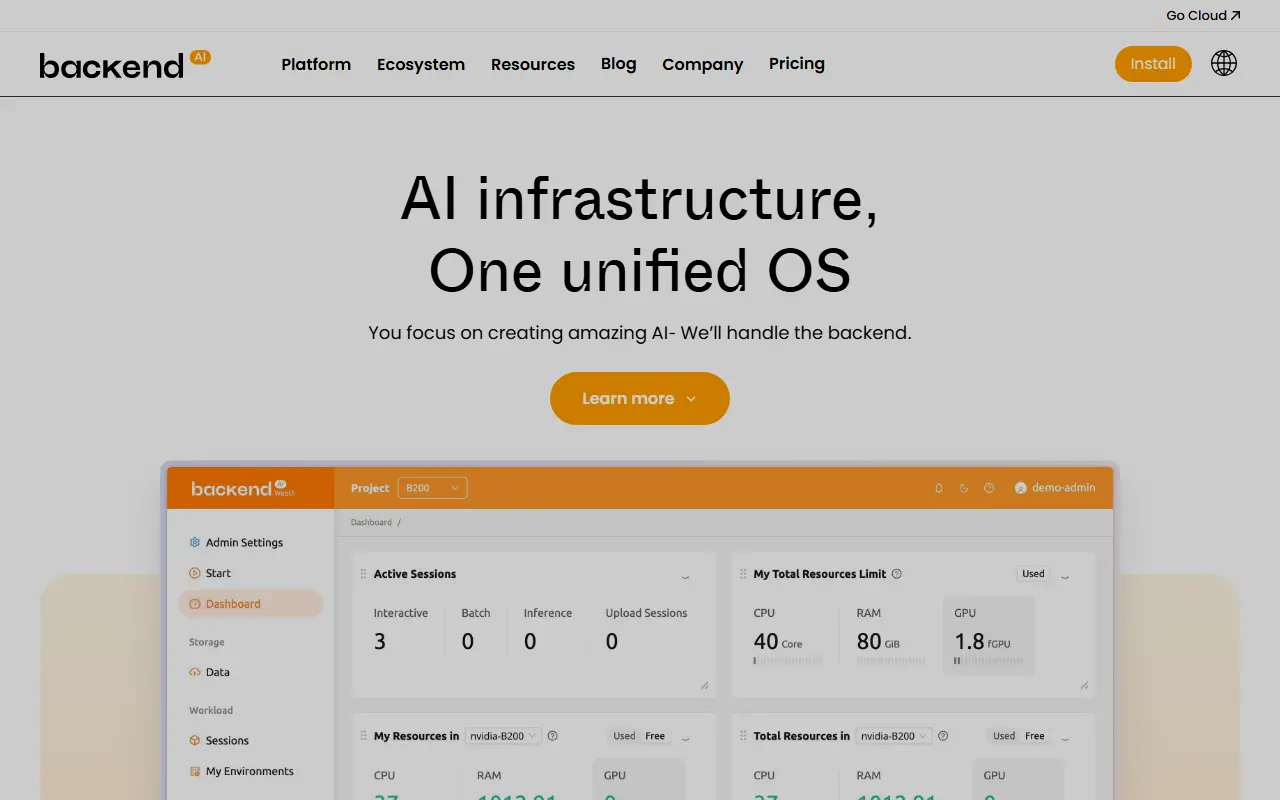
About Backend.AI
Backend.AI, from Lablup, is a streamlined, container-based computing cluster platform that hosts popular machine learning frameworks and many programming languages. Its distinguishing feature is pluggable support for heterogeneous accelerators, including CUDA and ROCm GPUs, Intel Gaudi, Google TPU, Graphcore IPU and NPUs from vendors such as Rebellions, FuriosaAI, HyperAccel and Tenstorrent.
It allocates and isolates computing resources for multi-tenant sessions on demand or in batches, using customizable job schedulers and its own orchestrator named Sokovan. All functions are exposed through REST and GraphQL APIs. The README lists requirements including Python 3.13 with Pantsbuild, Docker 20.10 or newer or Podman 5.4 or newer, Docker Compose v2, PostgreSQL 16 or newer, Valkey (Redis-compatible), etcd and Prometheus, with Grafana recommended for observability.
Backend.AI is written in Python and licensed under LGPL-3.0. It is aimed at organizations running shared GPU or accelerator clusters for research and ML workloads, and you operate it on your own infrastructure.
Key features
- Container-based compute sessions
- Support for many accelerator types
- Multi-tenant resource isolation
- Sokovan job scheduler and orchestrator
- REST and GraphQL APIs
- Docker and Podman container engines
Good fit for
- →Shared GPU clusters for ML teams
- →Batch and interactive training sessions
- Tags
- gpu-cluster
- machine-learning
- containers
- orchestration
- python
- hpc
- paas
- accelerators
Backend.AI: questions and answers
- What is Backend.AI used for?
- Backend.AI is a container-based computing cluster platform that allocates GPUs and other accelerators for multi-tenant ML sessions through REST and GraphQL APIs. It is a good fit for shared GPU clusters for ML teams, and batch and interactive training sessions.
- Is Backend.AI open source?
- Yes. Backend.AI is open source under the LGPL-3.0 licence. Its source code is on GitHub at lablup/backend.ai and is written mainly in Python.
- Is Backend.AI free?
- Yes. Backend.AI is open source, so the software itself is free to use.
- Can I self-host Backend.AI?
- Yes. Backend.AI can be self-hosted on your own server or infrastructure.
- What is Backend.AI an alternative to?
- Backend.AI is an open-source alternative to RunPod, Amazon SageMaker, Lambda and CoreWeave. Other open-source alternatives to RunPod include beta9.
- Is Backend.AI actively maintained?
- Yes. The most recent commit to Backend.AI was on 2 October 2026, and the latest release is 26.4.12, published on 2 October 2026. The project has 673 stars on GitHub.
Open-source alternatives to Backend.AI
See all
beta9
AI Infrastructure
Ultrafast serverless GPU inference, sandboxes, and background jobs
AGPL-3.0vs Modal★ 1.8k
MLflow
AI Infrastructure
The open source AI engineering platform for agents, LLMs, and ML models. MLflow enables te
Apache-2.0vs Weights & Biases★ 28k
KubeDL
AI Infrastructure
Run your deep learning workloads on Kubernetes more easily and efficiently.
Apache-2.0vs Amazon SageMaker★ 534
vLLM
AI Infrastructure
A high-throughput and memory-efficient inference and serving engine for LLMs
Apache-2.0vs Amazon Bedrock★ 93k
SGLang
AI Infrastructure
SGLang is a high-performance serving framework for large language models and multimodal mo
Apache-2.0vs Amazon Bedrock★ 37k
OpenPAI
AI Infrastructure
Resource scheduling and cluster management for AI
MITvs Azure Machine Learning★ 2.7k
SaaS alternatives to Backend.AI
See all
RunPod
AI Infrastructure
GPU cloud for AI training, inference and serverless endpoints
SaaS
Amazon SageMaker
AI Infrastructure
AWS platform for building, training and deploying machine learning models
SaaS
Lambda
AI Infrastructure
GPU cloud for AI training and inference, with on-demand and reserved clusters
SaaS
CoreWeave
AI Infrastructure
GPU cloud infrastructure provider for AI training and inference
SaaS
Crusoe
AI Infrastructure
AI cloud provider offering GPU compute and managed inference
SaaS
Nebius
AI Infrastructure
AI cloud platform with GPU clusters and managed services for training and inference
SaaS