 TrackMedia
 TrackRev

About KubeDL
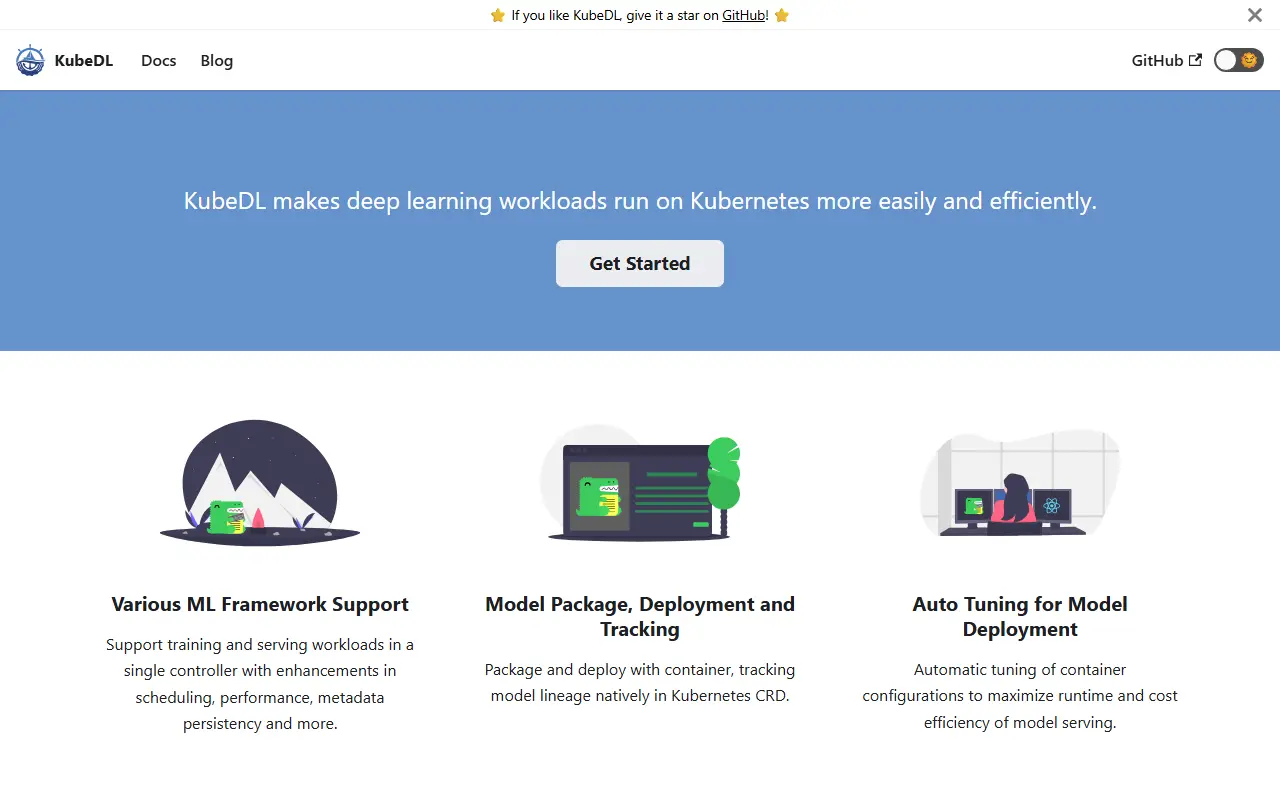
KubeDL is a Kubernetes-based system that makes it easier and more efficient to run deep learning workloads. It is a CNCF sandbox project and handles both training and inference jobs for frameworks such as TensorFlow, PyTorch and Mars through a single unified controller.
Features include advanced scheduling, cache-based acceleration, metadata persistence, file synchronization and service discovery for training jobs in host networking. It can automatically tune the best configuration for ML model deployment through the related Morphling project, and it can package and deploy models in containers while tracking model lineage natively using Kubernetes custom resources.
KubeDL is written in Go and released under Apache-2.0. A related research paper on Morphling, an auto-configuration approach for cloud-native model serving, is cited in the README. It suits platform teams that run machine learning jobs on shared Kubernetes clusters.
Key features
- Unified controller for training and inference
- Supports TensorFlow, PyTorch and Mars jobs
- Advanced job scheduling
- Model packaging with lineage tracking
- Auto-tuning of model deployment configs
- Cache acceleration and file sync
Good fit for
- ML platforms on Kubernetes
- Managing distributed training jobs
KubeDL: questions and answers
- What is KubeDL used for?
- KubeDL is a Kubernetes-native controller for running deep learning training and inference workloads, and a CNCF sandbox project. It is a good fit for ML platforms on Kubernetes and managing distributed training jobs.
- Is KubeDL open source?
- Yes. KubeDL is open source under the Apache-2.0 licence. Its source code is on GitHub at kubedl-io/kubedl and is written mainly in Go.
- Is KubeDL free?
- Yes. KubeDL is open source, so the software itself is free to use.
- Can I self-host KubeDL?
- Yes. KubeDL can be self-hosted on your own server or infrastructure.
- What is KubeDL an alternative to?
- KubeDL is an open-source alternative to Amazon SageMaker, Google Vertex AI, Azure Machine Learning and Domino Data Lab. Other open-source alternatives to Amazon SageMaker include MLflow, Backend.AI and Kubeflow.
- Is KubeDL actively maintained?
- The most recent commit to KubeDL was on 4 March 2024, and the latest release is v0.5.0, published on 5 December 2022. The project has 534 stars on GitHub.
Open-source alternatives to KubeDL
See all
MLflow
AI Infrastructure
The open source AI engineering platform for agents, LLMs, and ML models. MLflow enables te
Apache-2.0vs Weights & Biases★ 29k
Backend.AI
AI Infrastructure
Backend.AI is a streamlined, container-based computing cluster platform that hosts popular
LGPL-3.0vs RunPod★ 680
Kubeflow
AI Tools
The Cloud Native AI Platform
Apache-2.0vs Together AI★ 16k
Polyaxon
Workflow Automation
AI Infra / AI Orchestration / AI Control Plane
Apache-2.0vs Amazon SageMaker★ 3.7k
BentoML
AI Infrastructure
The easiest way to serve AI apps and models - Build Model Inference APIs, Job queues, LLM
Apache-2.0vs Amazon SageMaker★ 8.9k
MLRun
AI Infrastructure
MLRun is an open source MLOps platform for quickly building and managing continuous ML app
Apache-2.0vs Amazon SageMaker★ 1.7k
SaaS alternatives to KubeDL
See all
Amazon SageMaker
AI Infrastructure
AWS platform for building, training and deploying machine learning models
SaaS
Google Vertex AI
AI Infrastructure
Google Cloud platform for building, tuning and deploying machine learning and generative AI models
SaaS
Azure Machine Learning
AI Infrastructure
Microsoft cloud service for training, deploying and managing machine learning models
SaaS
Domino Data Lab
AI Infrastructure
Enterprise MLOps platform for building, governing and deploying data science models
SaaS
H2O.ai
AI Infrastructure
AI platform for predictive and generative AI model building and deployment
SaaS
Lightning AI
AI Infrastructure
Cloud platform for building, training and deploying AI models with studios and GPUs
SaaS