7,363 open-source and SaaS tools, with GitHub stats refreshed every day.

5 alternatives ranked by real activity

Open-source Google Vertex AI alternatives

A curated, ranked list of the 5 best open-source alternatives to Google Vertex AI.

The best open-source alternative to Google Vertex AI is vLLM. If that doesn't suit you, other good options are SGLang, MLflow, Backend.AI and KubeDL.

Google Vertex AI alternatives are mainly AI infrastructure tools. 4 of them shipped code in the last 30 days, 5 can be self-hosted, and 4 use a permissive licence.

Last updated October 3, 2026 · ranked by GitHub stars, growth and recent commits

vLLM

A Python library and server for fast, memory-efficient LLM inference and serving, with PagedAttention, continuous batching and broad quantization support.

GitHub stars
93k
Last commit
today
Latest release
v0.30.0
Licence
Apache-2.0
Self-hosted
Yes
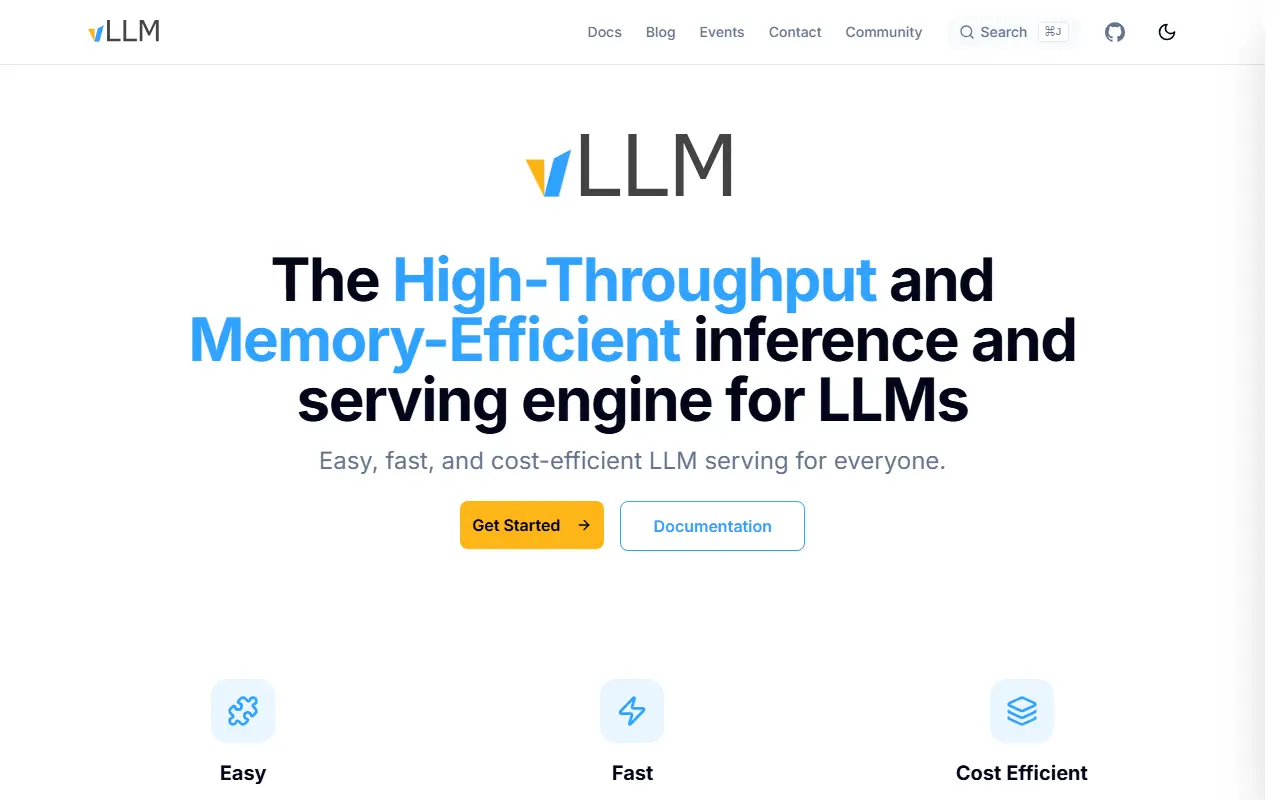
vllm.aivLLM homepage screenshot

vLLM is an open-source library for running and serving large language models efficiently. It originated at UC Berkeley's Sky Computing Lab and is now developed by a large community of contributors from academia and industry. It is written in Python and released under the Apache-2.0 license.

Speed comes from techniques such as PagedAttention for attention key-value memory, batching incoming requests continuously, chunked prefill, prefix caching, CUDA and HIP graphs, and optimized attention and mixture-of-experts kernels. It supports many quantization formats, including FP8, INT8, INT4, GPTQ and AWQ, as well as speculative decoding and disaggregated prefill and decode.

On the usability side, vLLM integrates with Hugging Face models and supports parallel sampling, beam search, streaming outputs, structured outputs and tool calling, plus several parallelism modes (tensor, pipeline, data, expert and context) for distributed inference. It targets NVIDIA, AMD and TPU hardware and suits teams that serve open models in production and need high throughput.

Key features

  • PagedAttention and continuous batching
  • Quantization including FP8, INT8, GPTQ and AWQ
  • Speculative decoding support
  • Tensor, pipeline and expert parallelism
  • OpenAI-compatible API server
  • Hugging Face model integration
  • Streaming and structured outputs

Pricing: Free and open source under the Apache-2.0 license.

Read more about vLLMWebsite GitHub

SGLang

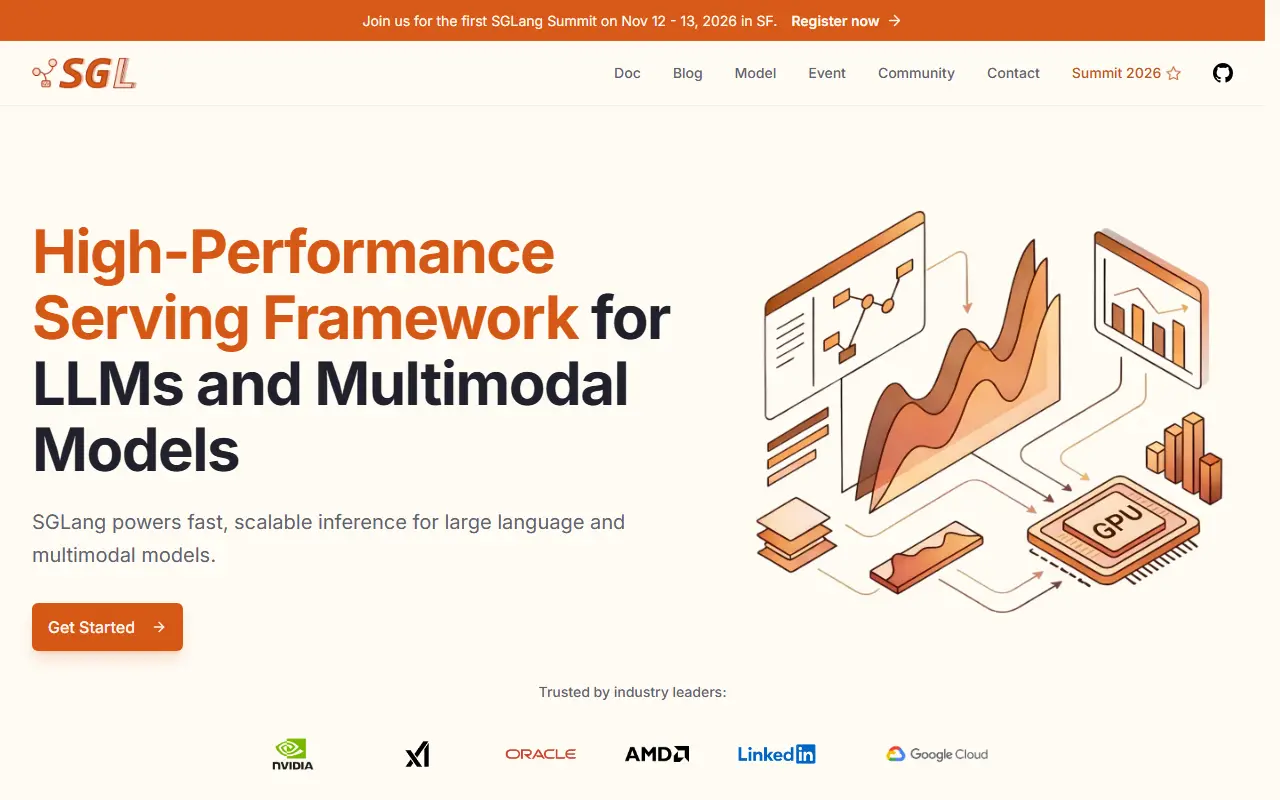
SGLang is an open-source framework for serving language, vision-language and diffusion models, built for fast inference at scale.

GitHub stars
37k
Last commit
today
Latest release
v0.5.21
Licence
Apache-2.0
Self-hosted
Yes
sglang.ioSGLang homepage screenshot

SGLang is an inference framework, released as open source, for language models, vision-language models and diffusion models. It is optimized for agentic workloads, reinforcement-learning rollouts and large-scale serving. The project includes SGLang Diffusion, a built-in engine for image and video generation that ships in the same repository and Python package. It is released under the Apache-2.0 license.

Getting started takes either a prebuilt Docker image or a Python install using uv, followed by a launch command for the chosen model. A cookbook helps pick a model and hardware pair and generates a ready-to-run command. Supported hardware spans NVIDIA and AMD GPUs, Google TPUs, Intel GPUs and CPUs, Apple Silicon through Metal and MLX, and Huawei Ascend NPUs, with more integrations in progress. The wider SGLang ecosystem adds educational projects and community events.

Key features

  • Serving for LLMs, vision-language and diffusion models
  • Docker image and uv-based Python install
  • Cookbook with ready-to-run launch commands
  • Runs on NVIDIA, AMD, TPU, Intel and Ascend hardware
  • Built-in image and video generation engine
  • Tuned for agentic and RL rollout workloads

Pricing: Free and open source under the Apache-2.0 license.
Read more about SGLangWebsite GitHub

MLflow

MLflow is an open-source platform for debugging, evaluating and monitoring AI agents, LLM applications and machine learning models.

GitHub stars
28k
Last commit
today
Latest release
v3.16.1
Licence
Apache-2.0
Self-hosted
Yes
Hosted version
Available
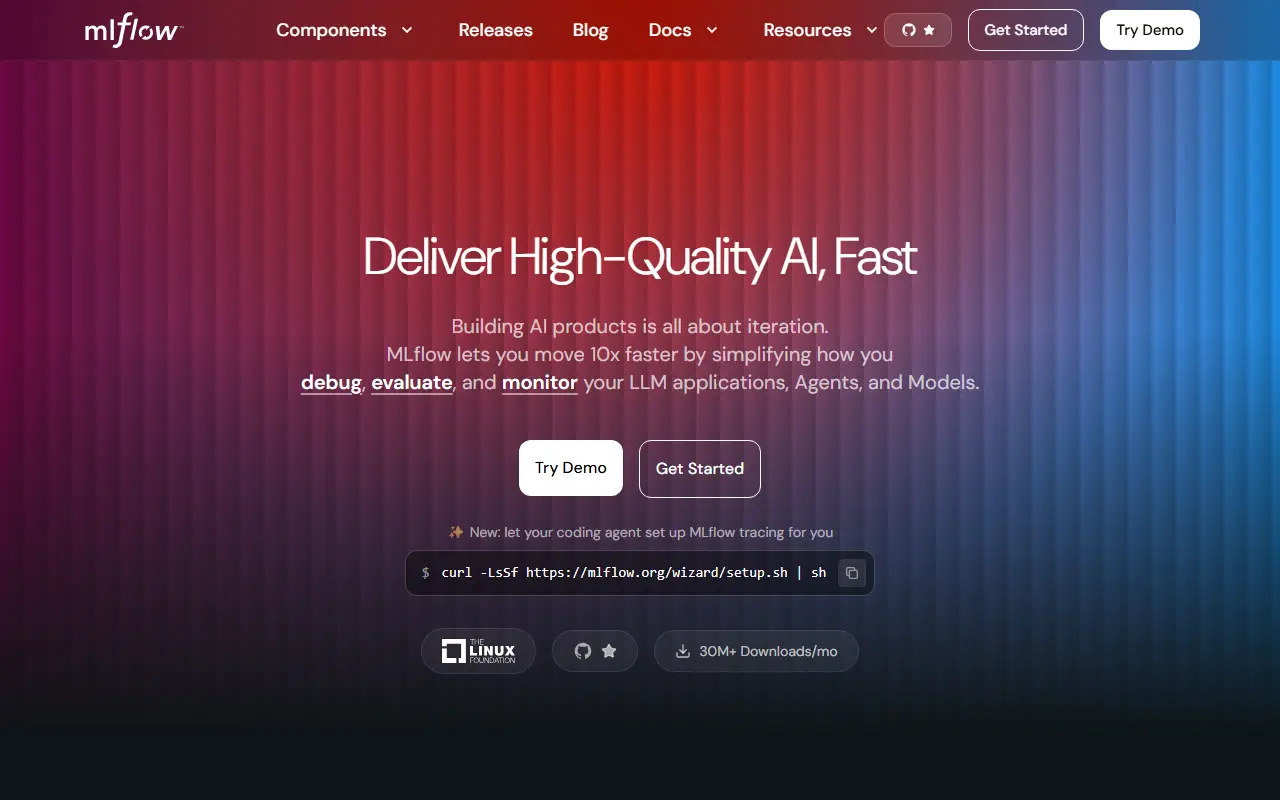
mlflow.orgMLflow homepage screenshot

MLflow is an open-source AI engineering platform for agents, LLM applications and ML models. It helps teams debug, evaluate, monitor and optimize AI applications in production while keeping control of costs and access to models and data. It is written in Python, released under the Apache-2.0 license, and has been developed since 2018, with topics covering MLOps, model management and LLMOps.

For LLM and agent work it offers production observability with traces, plus evaluation, prompt management and prompt optimization, and an AI Gateway that governs costs and model access. It works with Python, TypeScript and JavaScript, Java and other languages, and integrates with OpenTelemetry and MCP. Getting started means starting an MLflow server, enabling logging in your code and running it, then exploring traces and metrics in the web UI on port 5000. A setup wizard can connect to an MLflow server or a Databricks workspace and add tracing with a coding agent.

Key features

  • Tracing and observability for LLM apps and agents
  • Evaluation tools for models and agents
  • Prompt management and prompt optimization
  • AI Gateway for cost and model access control
  • OpenTelemetry and MCP integration
  • Web UI for exploring traces and metrics

Pricing: Free and open source under the Apache-2.0 license; the README also mentions connecting to a Databricks workspace.

Read more about MLflowWebsite GitHub

Backend.AI

Backend.AI is a container-based computing cluster platform that allocates GPUs and other accelerators for multi-tenant ML sessions through REST and GraphQL APIs.

GitHub stars
673
Last commit
today
Latest release
26.4.12
Licence
LGPL-3.0
Self-hosted
Yes
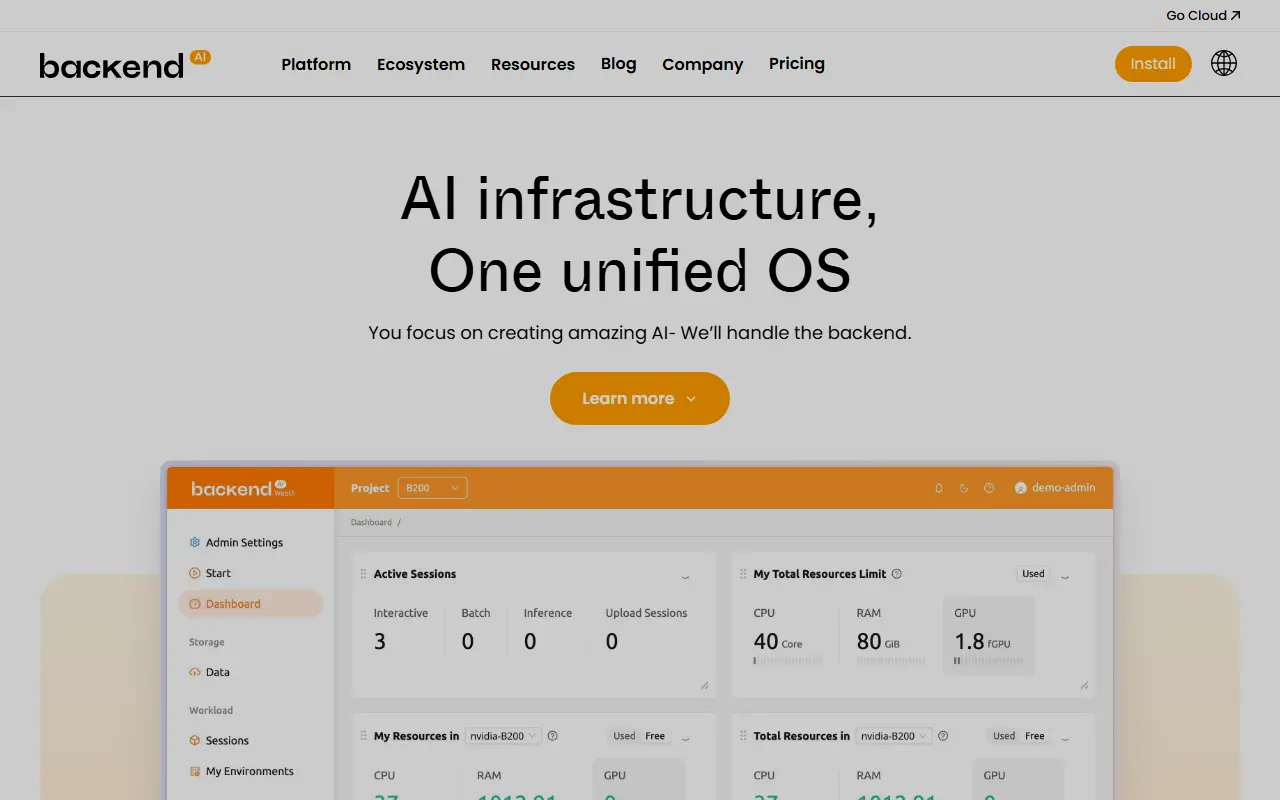
backend.aiBackend.AI homepage screenshot

Backend.AI, from Lablup, is a streamlined, container-based computing cluster platform that hosts popular machine learning frameworks and many programming languages. Its distinguishing feature is pluggable support for heterogeneous accelerators, including CUDA and ROCm GPUs, Intel Gaudi, Google TPU, Graphcore IPU and NPUs from vendors such as Rebellions, FuriosaAI, HyperAccel and Tenstorrent.

It allocates and isolates computing resources for multi-tenant sessions on demand or in batches, using customizable job schedulers and its own orchestrator named Sokovan. All functions are exposed through REST and GraphQL APIs. The README lists requirements including Python 3.13 with Pantsbuild, Docker 20.10 or newer or Podman 5.4 or newer, Docker Compose v2, PostgreSQL 16 or newer, Valkey (Redis-compatible), etcd and Prometheus, with Grafana recommended for observability.

Backend.AI is written in Python and licensed under LGPL-3.0. It is aimed at organizations running shared GPU or accelerator clusters for research and ML workloads, and you operate it on your own infrastructure.

Key features

  • Container-based compute sessions
  • Support for many accelerator types
  • Multi-tenant resource isolation
  • Sokovan job scheduler and orchestrator
  • REST and GraphQL APIs
  • Docker and Podman container engines

Pricing: The open-source version is free to install. On-premise and cloud Enterprise editions are priced by quote, and a limited-time cloud try-out can be requested.

Read more about Backend.AIWebsite GitHub

KubeDL

KubeDL is a Kubernetes-native controller for running deep learning training and inference workloads, and a CNCF sandbox project.

GitHub stars
534
Last commit
2 yr ago
Latest release
v0.5.0
Licence
Apache-2.0
Self-hosted
Yes
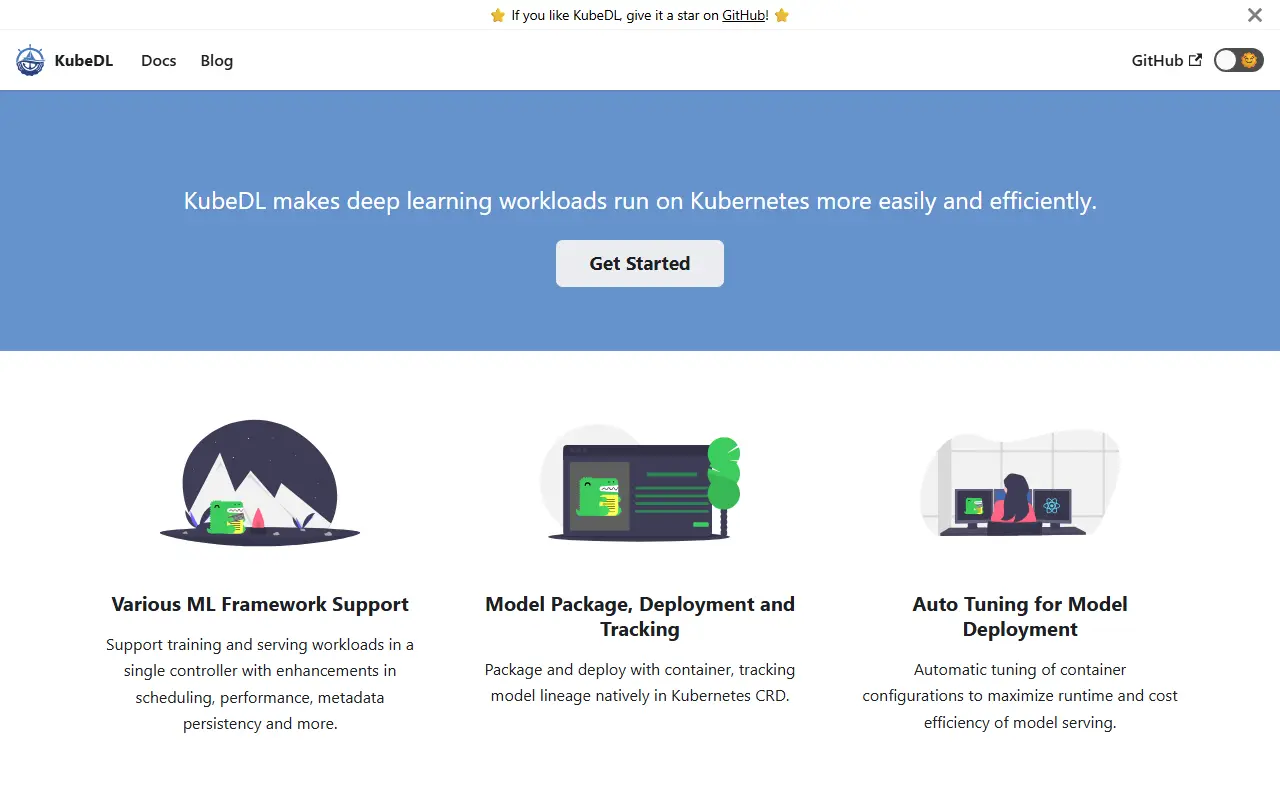
kubedl.ioKubeDL homepage screenshot

KubeDL is a Kubernetes-based system that makes it easier and more efficient to run deep learning workloads. It is a CNCF sandbox project and handles both training and inference jobs for frameworks such as TensorFlow, PyTorch and Mars through a single unified controller.

Features include advanced scheduling, cache-based acceleration, metadata persistence, file synchronization and service discovery for training jobs in host networking. It can automatically tune the best configuration for ML model deployment through the related Morphling project, and it can package and deploy models in containers while tracking model lineage natively using Kubernetes custom resources.

KubeDL is written in Go and released under Apache-2.0. A related research paper on Morphling, an auto-configuration approach for cloud-native model serving, is cited in the README. It suits platform teams that run machine learning jobs on shared Kubernetes clusters.

Key features

  • Unified controller for training and inference
  • Supports TensorFlow, PyTorch and Mars jobs
  • Advanced job scheduling
  • Model packaging with lineage tracking
  • Auto-tuning of model deployment configs
  • Cache acceleration and file sync

Pricing: Free and open source under the Apache-2.0 license.

Read more about KubeDLWebsite GitHub

Google Vertex AI alternatives: questions

What is the best open-source alternative to Google Vertex AI?
vLLM is the top-ranked open-source alternative to Google Vertex AI on Enlisted: A Python library and server for fast, memory-efficient LLM inference and serving, with PagedAttention, continuous batching and broad quantization support. Other strong options are SGLang, MLflow, Backend.AI and KubeDL.
Are these Google Vertex AI alternatives free?
All 5 are open source, so the code is free to use under its licence, and all of them can be self-hosted on your own server or computer. 1 also offers a paid or managed cloud version if you'd rather not host it yourself.
How is this list of Google Vertex AI alternatives ranked?
By a score built from GitHub stars, star growth over the last 30 days and how recently the code changed. 4 of these projects shipped code in the last 30 days. Data is refreshed daily, and nobody can pay to move up.

People also look for alternatives to…

View all