 TrackMedia
 TrackRev

 Nebius
 Vast.ai
 Lightning AI
 Paperspace
 Baseten
 Cloudflare Workers AI
About beta9
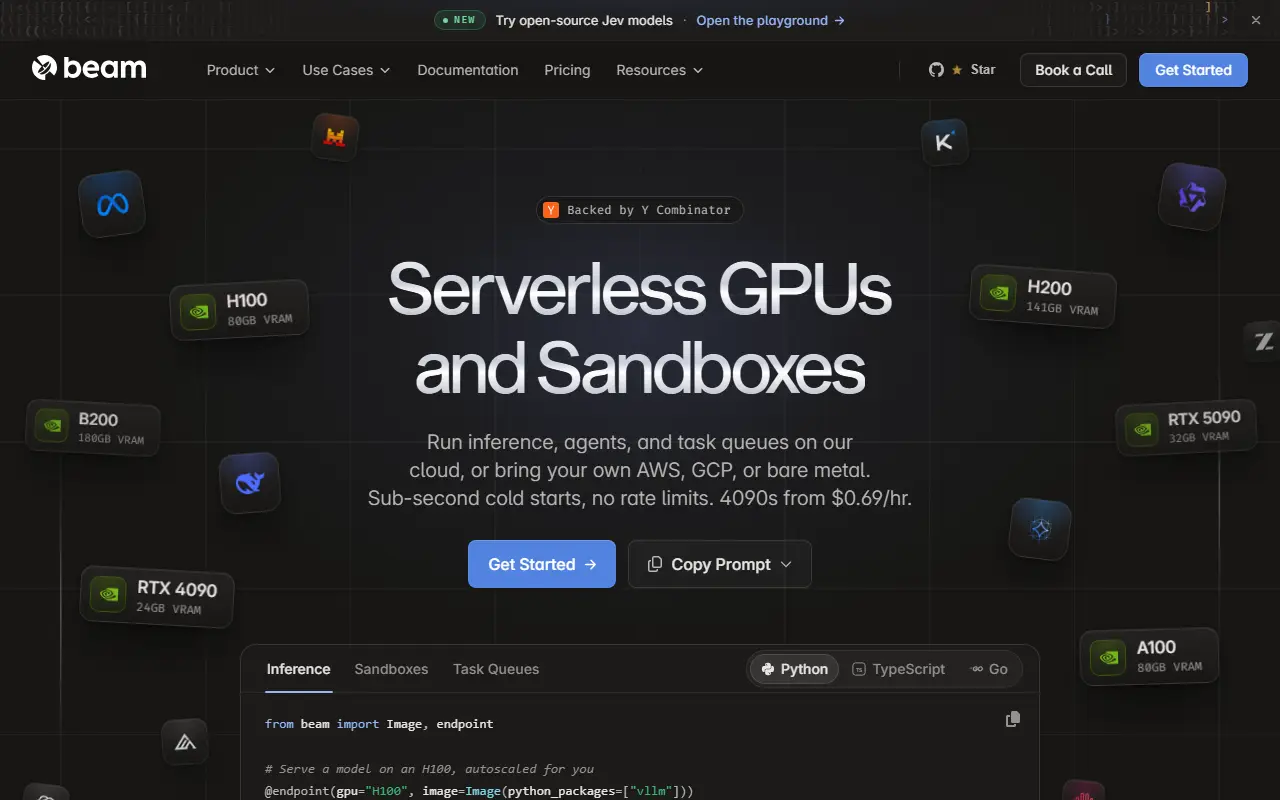
Beam, whose open-source engine lives in the beta9 repository, is a fast runtime for serverless AI workloads. It gives developers a Pythonic interface to deploy and scale AI applications without managing infrastructure. The code is written in Go and released under the AGPL-3.0 license, and topics include GPU, LLM inference, autoscaling, and functions as a service.
Features include sub-second container cold starts using a custom runtime, scheduler, and embedded caching, parallel fan-out to hundreds of containers, hot reloading, webhooks and scheduled jobs, scale-to-zero by default, and mounted distributed storage volumes. GPU support runs on the Beam cloud, with cards such as the RTX 4090 and H100 mentioned, or on your own GPUs.
The project can be self-hosted or used through the hosted platform, which requires creating an account. Beam suits machine learning engineers and startups that want to serve models, run batch jobs, or sandbox untrusted code without operating a Kubernetes GPU cluster themselves.
Key features
- Serverless GPU inference
- Sub-second container cold starts
- Scale-to-zero workloads
- Parallel fan-out to many containers
- Webhooks and scheduled jobs
- Volume storage and bring-your-own GPUs
Good fit for
- Serving ML models without managing servers
- Running background AI jobs at scale
beta9: questions and answers
- What is beta9 used for?
- beta9 is an open-source runtime for serverless AI workloads that deploys and scales GPU inference, sandboxes, and background jobs from a Python interface. It is a good fit for serving ML models without managing servers and running background AI jobs at scale.
- Is beta9 open source?
- Yes. beta9 is open source under the AGPL-3.0 licence. Its source code is on GitHub at beam-cloud/beta9 and is written mainly in Go.
- Is beta9 free?
- Yes. beta9 is open source, so the software itself is free to use. A managed cloud version is also available, with paid plans from $89 per month.
- Can I self-host beta9?
- Yes. beta9 can be self-hosted on your own server or infrastructure.
- What is beta9 an alternative to?
- beta9 is an open-source alternative to Modal, RunPod, Replicate and Lambda. Other open-source alternatives to RunPod include Backend.AI and Hugging Face Chat UI.
- Is beta9 actively maintained?
- Yes. The most recent commit to beta9 was on 12 November 2026. The project has 1.9k stars on GitHub, with 38 added in the last 30 days.
Open-source alternatives to beta9
See all
Backend.AI
AI Infrastructure
Backend.AI is a streamlined, container-based computing cluster platform that hosts popular
LGPL-3.0vs RunPod★ 680
Hugging Face Chat UI
AI Tools
The open source codebase powering HuggingChat
Apache-2.0vs ChatGPT★ 11k
Kubeflow
AI Tools
The Cloud Native AI Platform
Apache-2.0vs Together AI★ 16k
vLLM
AI Infrastructure
A high-throughput and memory-efficient inference and serving engine for LLMs
Apache-2.0vs Amazon Bedrock★ 97k
BentoML
AI Infrastructure
The easiest way to serve AI apps and models - Build Model Inference APIs, Job queues, LLM
Apache-2.0vs Amazon SageMaker★ 8.9k
MLflow
AI Infrastructure
The open source AI engineering platform for agents, LLMs, and ML models. MLflow enables te
Apache-2.0vs Weights & Biases★ 29k
SaaS alternatives to beta9
See all
Modal
Hosting & PaaS
Serverless cloud for running Python functions, GPU workloads and batch jobs
SaaS
RunPod
AI Infrastructure
GPU cloud for AI training, inference and serverless endpoints
SaaS
Replicate
AI Infrastructure
API platform for running open-source AI models in the cloud
SaaS
Lambda
AI Infrastructure
GPU cloud for AI training and inference, with on-demand and reserved clusters
SaaS
CoreWeave
AI Infrastructure
GPU cloud infrastructure provider for AI training and inference
SaaS
Crusoe
AI Infrastructure
AI cloud provider offering GPU compute and managed inference
SaaS