7 open-source alternatives ranked by real activity

Open-source Modal alternatives

A curated, ranked list of the 7 best open-source alternatives to Modal.

The best open-source alternative to Modal is Kubernetes. If that doesn't suit you, other good options are OpenFaaS, Nomad, Fission and Nuclio.

Commercial alternatives to Modal include AWS Lambda, Google Cloud Run, Cloudflare Workers and Google Cloud Functions. See all 35.

Modal alternatives are mainly infrastructure & container tools, but some are also hosting & PaaS tools and password managers. 6 of them shipped code in the last 30 days, 7 can be self-hosted, and 4 use a permissive licence.

Last updated November 13, 2026 · ranked by GitHub stars, growth and recent commits

Kubernetes

An open-source system for deploying, scaling and managing containerized applications across clusters of hosts, hosted by the CNCF.

GitHub stars
129k
Last commit
yesterday
Latest release
v1.37.2
Licence
Apache-2.0
Self-hosted
Yes
Hosted version
Available
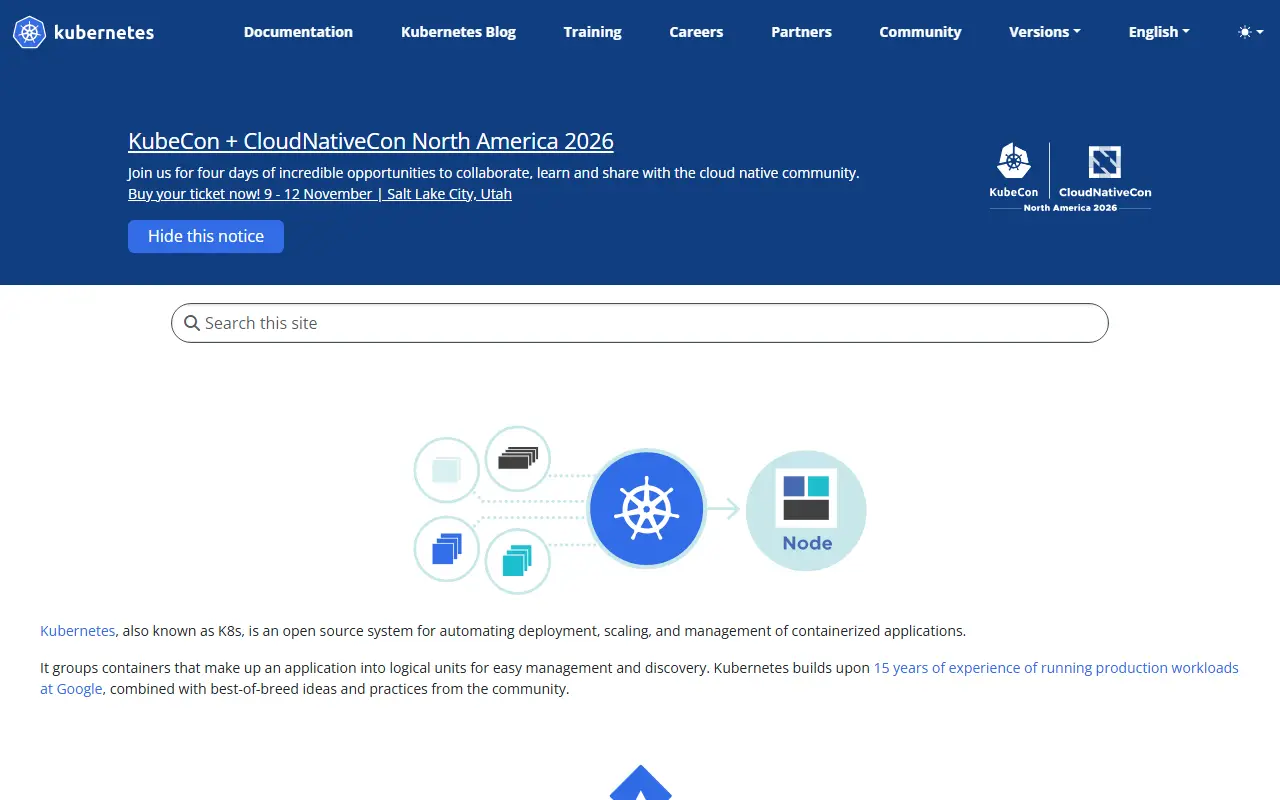
kubernetes.ioKubernetes homepage screenshot

Kubernetes, also written K8s, is an open-source system that manages containerized applications across multiple hosts. It provides the basic mechanisms for deploying, maintaining and scaling applications, so teams can run containers reliably without scheduling each one by hand. It is written in Go and released under the Apache-2.0 license.

The project builds on years of experience running production workloads at Google with an internal system called Borg, combined with practices from the wider community. The Cloud Native Computing Foundation hosts the project. Users interact with it through declarative configuration and the documentation on kubernetes.io, which includes tutorials and a free course on scalable microservices.

Kubernetes can be run on your own infrastructure, and major cloud providers also offer managed Kubernetes services. The README adds that the k8s.io/kubernetes module is not supported for use as a library. It suits platform and DevOps teams running microservices that need scheduling, scaling and automatic recovery.

Key features

  • Container scheduling across multiple hosts
  • Automated application deployment and rollouts
  • Scaling of containerized workloads
  • Maintenance and self-healing of applications
  • Declarative configuration of desired state
  • CNCF-hosted with extensive documentation

Pricing: Free and open source under the Apache-2.0 license; cloud providers sell managed services built on it.

OpenFaaS

OpenFaaS is a serverless framework for running event-driven functions and microservices on Kubernetes, with auto-scaling, metrics and a UI portal.

GitHub stars
26k
Last commit
21 days ago
Latest release
0.27.13
Self-hosted
Yes
openfaas.comOpenFaaS homepage screenshot

OpenFaaS is a serverless platform that lets developers run event-driven functions and microservices on Kubernetes with little boilerplate code. Your code or a ready-made binary goes into an OCI-compatible container image, and you receive a scalable HTTP endpoint that auto-scales and exposes metrics.

Highlights include ease of use through a UI portal and a one-click install, and the ability to write services and functions in many languages. The project integrates with Prometheus for metrics and with GitOps workflows, and its topics place it in the functions-as-a-service and PaaS categories. The gateway and tooling are written in Go.

Licensing needs attention. The README states that the Community Edition is licensed for individual exploration and hobbyist use, with a 60-day limit for commercial proofs of concept, and that commercial and production use calls for the paid OpenFaaS Standard or Enterprise editions. GitHub reports the license as 'Other'. You run it on your own Kubernetes cluster.

Key features

  • Deploy functions and microservices to Kubernetes
  • OCI image-based packaging
  • Endpoints that scale automatically
  • Built-in Prometheus metrics
  • UI portal and one-click install
  • Functions in many languages

Pricing: Community Edition is free for personal use, with a 60-day limit on commercial use. Standard costs $1250 per month; Enterprise is custom. A 14-day trial is offered, subject to approval.

Nomad

Nomad is HashiCorp's workload scheduler and orchestrator for containers, binaries and batch jobs, in the cloud or on-prem.

GitHub stars
17k
Last commit
8 days ago
Latest release
v2.1.1
Self-hosted
Yes
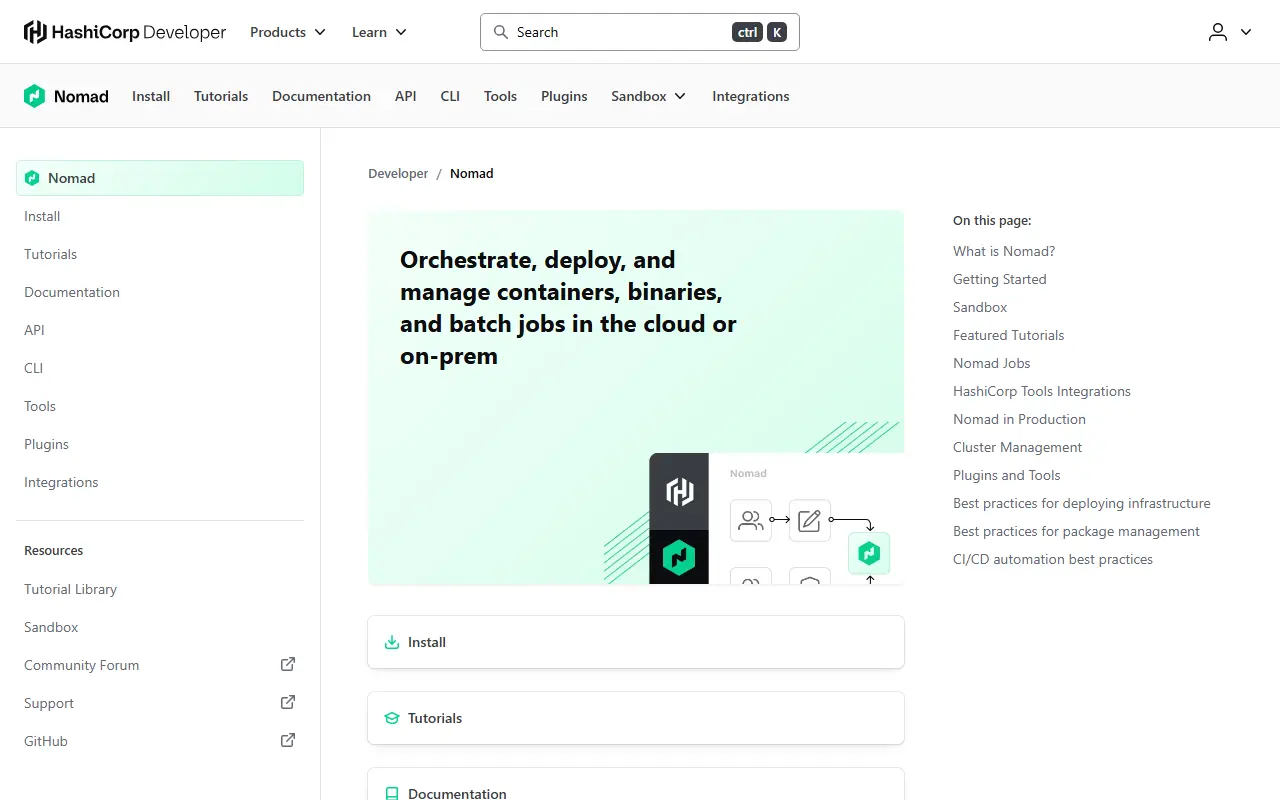
nomadproject.ioNomad homepage screenshot

Nomad is a scheduler and orchestrator from HashiCorp. It deploys and manages containers and non-containerized applications, including binaries and batch jobs, across on-prem environments and clouds.

Workloads are described as Nomad jobs. Parameterized jobs allow dynamic runtime behavior from a single job specification, and Nomad Pack provides reusable job templates. The tutorials show it working alongside Consul for service discovery and health checking, Vault for secrets and Terraform for creating clusters.

HashiCorp offers a sandbox with preinstalled tools for experimenting, and the site documents a separate Nomad Enterprise edition. The listed licence is Other, so check the project's terms before using it.

Key features

  • Containers, binaries and batch jobs
  • Containerized and non-containerized apps at scale
  • Parameterized jobs
  • Reusable job templates with Nomad Pack
  • Consul integration for service discovery and mesh
  • Vault integration for workload secrets

Fission

Fission is an open source, Kubernetes-native framework for running serverless functions, with fast cold-start and support for multiple languages.

GitHub stars
8.9k
Last commit
2 days ago
Latest release
v1.27.0
Licence
Apache-2.0
Self-hosted
Yes
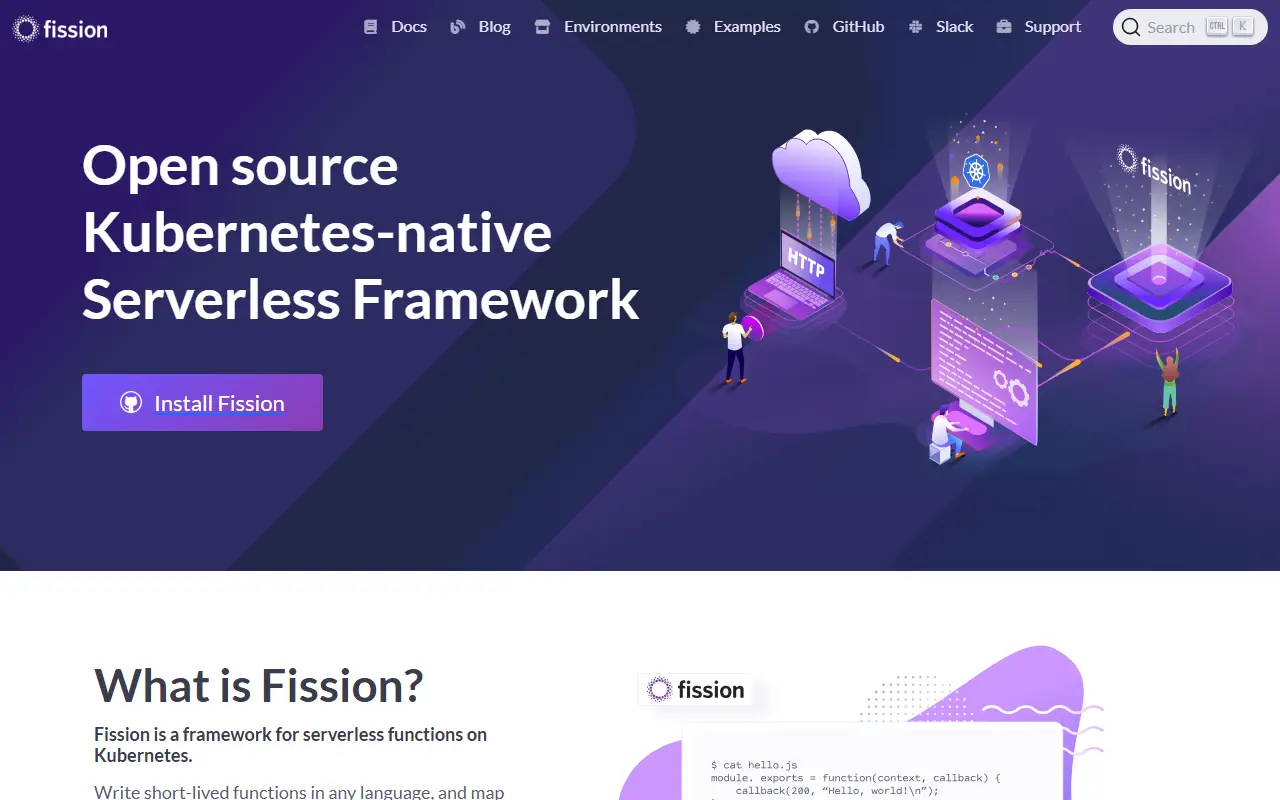
fission.ioFission homepage screenshot

Fission is a framework for serverless functions on Kubernetes. It allows developers to write short-lived functions in any language and map them to HTTP requests or other event triggers. Functions can be deployed instantly with one command, without building containers or managing Docker registries.

Fission is open source under the Apache license and works on any Kubernetes cluster, whether on a laptop, public cloud, or private data center. It aims to simplify operations by integrating with Fluentd for logs and Prometheus for metrics, and supports Istio for service mesh integration.

Key features

  • Kubernetes-native: runs on any Kubernetes cluster
  • Fast cold-start: maintains a configurable pool of containers for low latency (~100ms)
  • Declarative application specifications: define functions and triggers in source control
  • Administration simplicity: logs via Fluentd, metrics via Prometheus
  • Istio service-mesh integration for monitoring and tracing
  • Wide language support: Python, NodeJS, Go, Rust, C#, PHP

Nuclio

Nuclio is an open source serverless platform for automating data science pipelines, supporting high-performance event and data processing with GPU support.

GitHub stars
5.8k
Last commit
yesterday
Latest release
1.17.12
Licence
Apache-2.0
Self-hosted
Yes
Hosted version
Available
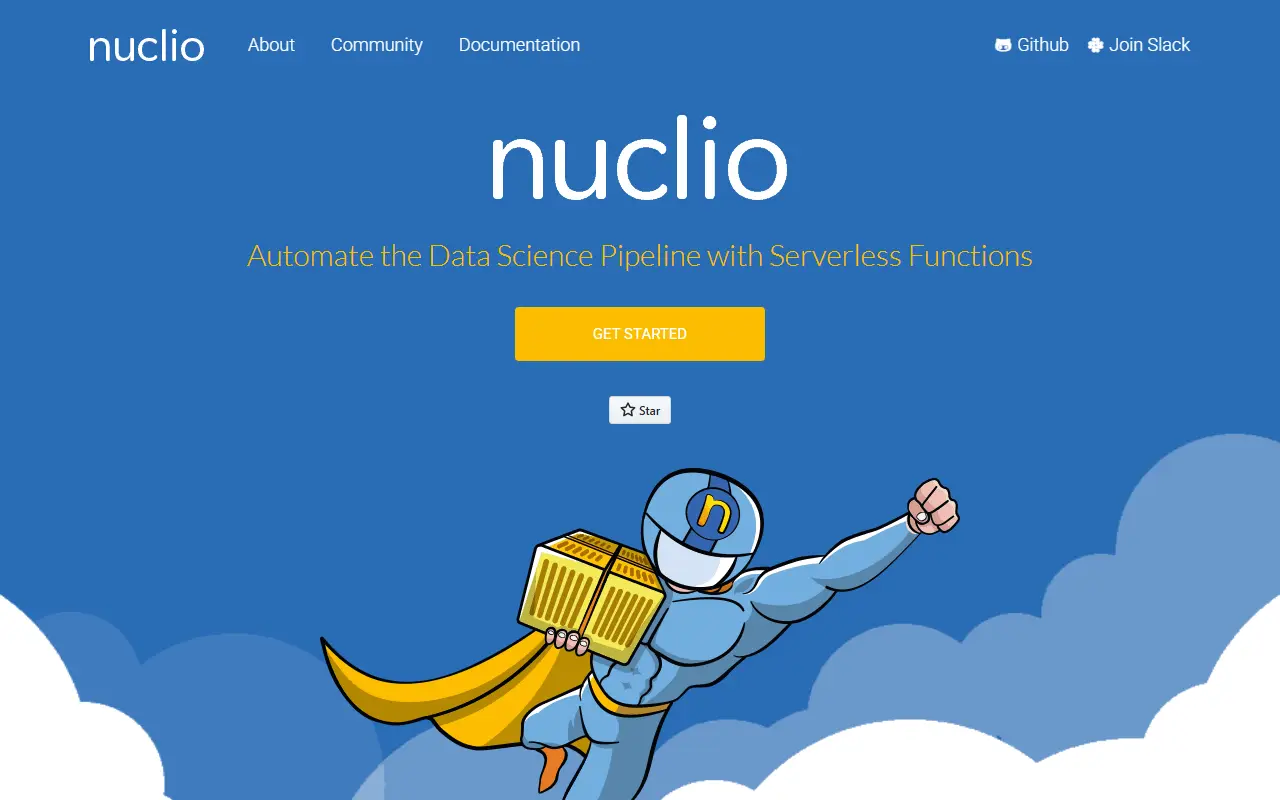
nuclio.ioNuclio homepage screenshot

Nuclio is an open source and managed serverless platform designed to minimize development and maintenance overhead and automate the deployment of data-science based applications. It is portable across laptops, edge, on-prem, and multi-cloud deployments.

The platform supports real-time performance with up to 400,000 function invocations per second and is the first serverless platform supporting GPUs for optimized utilization and sharing. It enables automated deployment to production in a few clicks from Jupyter notebook.

Key features

  • Real-time performance with up to 400,000 function invocations per second
  • Portable across laptops, edge, on-prem, and multi-cloud deployments
  • GPU support for optimized utilization and sharing
  • Automated deployment to production from Jupyter notebook
  • Dashboard for exploring and deploying functions via Docker

beta9

Open-source runtime for serverless AI workloads that deploys and scales GPU inference, sandboxes, and background jobs from a Python interface.

GitHub stars
1.9k
Last commit
yesterday
Latest release
worker-0.1.834
Licence
AGPL-3.0
Self-hosted
Yes
Hosted version
Available
beam.cloudbeta9 homepage screenshot

Beam, whose open-source engine lives in the beta9 repository, is a fast runtime for serverless AI workloads. It gives developers a Pythonic interface to deploy and scale AI applications without managing infrastructure. The code is written in Go and released under the AGPL-3.0 license, and topics include GPU, LLM inference, autoscaling, and functions as a service.

Features include sub-second container cold starts using a custom runtime, scheduler, and embedded caching, parallel fan-out to hundreds of containers, hot reloading, webhooks and scheduled jobs, scale-to-zero by default, and mounted distributed storage volumes. GPU support runs on the Beam cloud, with cards such as the RTX 4090 and H100 mentioned, or on your own GPUs.

The project can be self-hosted or used through the hosted platform, which requires creating an account. Beam suits machine learning engineers and startups that want to serve models, run batch jobs, or sandbox untrusted code without operating a Kubernetes GPU cluster themselves.

Key features

  • Serverless GPU inference
  • Sub-second container cold starts
  • Scale-to-zero workloads
  • Parallel fan-out to many containers
  • Webhooks and scheduled jobs
  • Volume storage and bring-your-own GPUs

Pricing: The Developer plan is $0 per month plus usage and Team is $89 per month plus usage; Growth is custom. Usage is billed by the millisecond, with H100 machines from $1.83 per hour.

Fn

Open-source, container-native serverless platform that runs functions packaged as Docker containers in any language, on any cloud or on-premises.

GitHub stars
6k
Last commit
1 mo ago
Latest release
0.3.25
Licence
Apache-2.0
Self-hosted
Yes
fnproject.ioFn homepage screenshot

Fn is an event-driven, open source Functions-as-a-Service platform written in Go that you can run anywhere: public, private or hybrid cloud, or on-premises. Any Docker container can serve as a function, any language is supported, and existing Lambda functions can be imported and run elsewhere.

Getting started needs Docker 17.10.0-ce or later, or Podman 5.7.0 or later. The command line tool is optional but recommended; it installs through Homebrew on macOS, a shell script on Linux and macOS, a Windows client, or a downloaded binary. Running fn start brings up a local server in single-server mode, and Podman or Rancher users should give it a volume for the unix socket file.

A first function takes a few commands: fn init with a runtime such as Go creates the project, fn create app makes the top-level app, fn deploy with the --local flag skips the registry push, and fn invoke runs it. The project also lists sub-projects called Flow, UI and FnLB, and the code is released under Apache License 2.0.

Key features

  • Any Docker container can be a function
  • Runs on public, private or hybrid cloud
  • Imports Lambda functions
  • Local server started with one command
  • CLI scaffolds functions in many runtimes
  • Local deploys skip the registry push
  • CLI available as a downloadable binary

Commercial Modal alternatives

Hosted, closed-source products that compete with Modal. Showing 12 of 35.

See every Modal alternative on its tool page

Modal alternatives: questions

What is the best open-source alternative to Modal?
Kubernetes is the top-ranked open-source alternative to Modal on Enlisted: An open-source system for deploying, scaling and managing containerized applications across clusters of hosts, hosted by the CNCF. Other strong options are OpenFaaS, Nomad, Fission and Nuclio.
What are the best commercial alternatives to Modal?
AWS Lambda, Google Cloud Run, Cloudflare Workers, Google Cloud Functions and Azure Functions are among the hosted, closed-source alternatives to Modal listed on Enlisted, which lists 35 in total. Compare their pricing and features on each tool page.
Are these Modal alternatives free?
All 7 are open source, so the code is free to use under its licence, and all of them can be self-hosted on your own server or computer. 3 also offer a paid or managed cloud version if you'd rather not host it yourself.
How is this list of Modal alternatives ranked?
By a score built from GitHub stars, star growth over the last 30 days and how recently the code changed. 6 of these projects shipped code in the last 30 days. Data is refreshed daily, and nobody can pay to move up.

People also look for alternatives to…

View all