
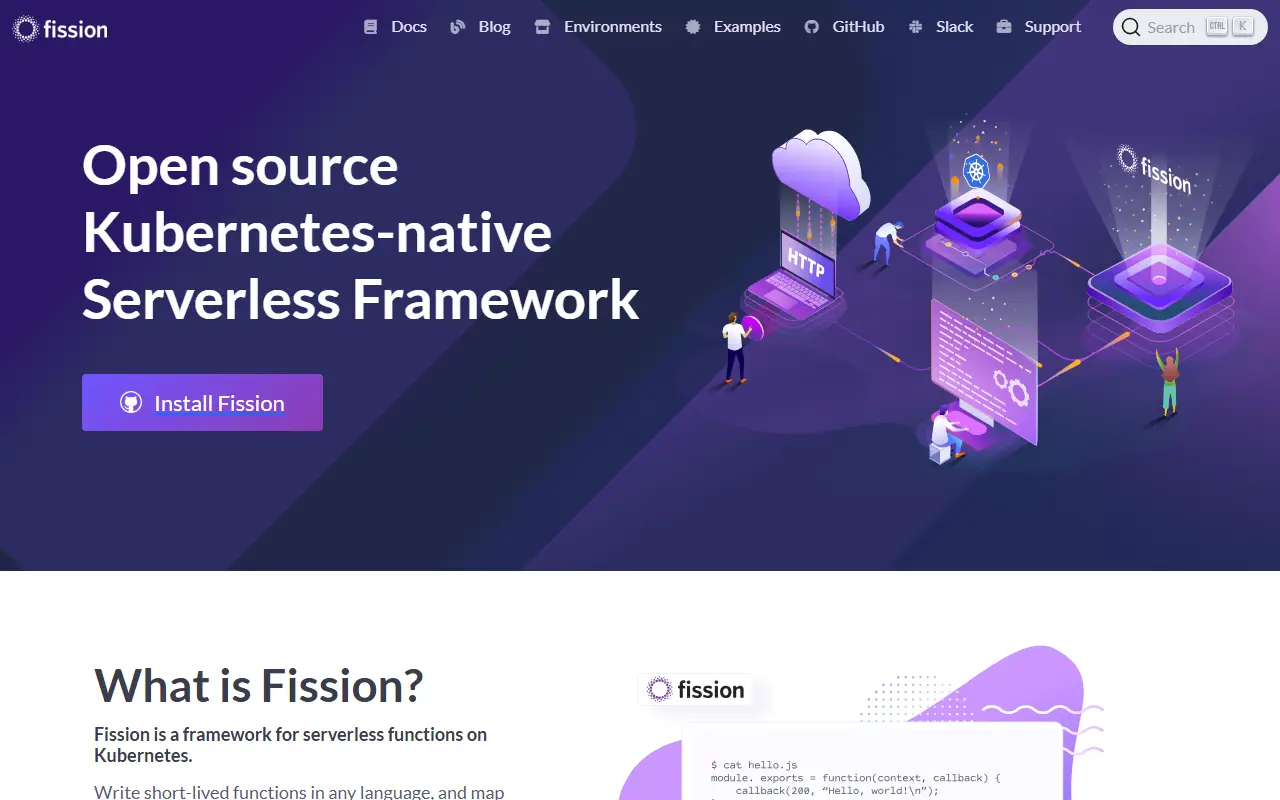
About Fission
Fission is a framework for serverless functions on Kubernetes. It allows developers to write short-lived functions in any language and map them to HTTP requests or other event triggers. Functions can be deployed instantly with one command, without building containers or managing Docker registries.
Fission is open source under the Apache license and works on any Kubernetes cluster, whether on a laptop, public cloud, or private data center. It aims to simplify operations by integrating with Fluentd for logs and Prometheus for metrics, and supports Istio for service mesh integration.
Key features
- Kubernetes-native: runs on any Kubernetes cluster
- Fast cold-start: maintains a configurable pool of containers for low latency (~100ms)
- Declarative application specifications: define functions and triggers in source control
- Administration simplicity: logs via Fluentd, metrics via Prometheus
- Istio service-mesh integration for monitoring and tracing
- Wide language support: Python, NodeJS, Go, Rust, C#, PHP
Good fit for
- Running serverless functions on Kubernetes
- Deploying functions triggered by HTTP requests or events
- Building portable Lambda-like services
Fission: questions and answers
- What is Fission used for?
- Fission is an open source, Kubernetes-native framework for running serverless functions, with fast cold-start and support for multiple languages. It is a good fit for running serverless functions on Kubernetes, deploying functions triggered by HTTP requests or events and building portable Lambda-like services.
- Is Fission open source?
- Yes. Fission is open source under the Apache-2.0 licence. Its source code is on GitHub at fission/fission and is written mainly in Go.
- Is Fission free?
- Yes. Fission is open source, so the software itself is free to use.
- Can I self-host Fission?
- Yes. Fission can be self-hosted on your own server or infrastructure.
- What is Fission an alternative to?
- Fission is an open-source alternative to Modal, AWS Lambda, Azure Functions and Firebase Remote Config. Other open-source alternatives to Modal include OpenFaaS, Fn and Nuclio.
- Is Fission actively maintained?
- Yes. The most recent commit to Fission was on 12 October 2026, and the latest release is v1.27.0, published on 22 June 2026. The project has 8.9k stars on GitHub.
Open-source alternatives to Fission
See all
OpenFaaS
Hosting & PaaS
OpenFaaS - Serverless Functions Made Simple
OSSvs AWS Lambda★ 26k
Fn
Infrastructure & Containers
The container native, cloud agnostic serverless platform.
Apache-2.0vs Modal★ 5.9k
Functions
Infrastructure & Containers
IronFunctions - the serverless microservices platform by
Apache-2.0vs AWS Lambda★ 3.2k
Tau
Hosting & PaaS
Fullstack Workspace for Humans & Machines
BSD-3-Clausevs Vercel★ 5.2k
Nuclio
Infrastructure & Containers
High-Performance Serverless event and data processing platform
Apache-2.0vs Modal★ 5.8k
Serverless
Infrastructure & Containers
⚡ Serverless Framework – Effortlessly build apps that auto-scale, incur zero costs when id
OSSvs AWS Lambda★ 47k
SaaS alternatives to Fission
See all
Modal
Hosting & PaaS
Serverless cloud for running Python functions, GPU workloads and batch jobs
SaaS
AWS Lambda
Hosting & PaaS
Serverless compute that runs functions on demand without managing servers
SaaS
Azure Functions
Hosting & PaaS
Serverless compute on Azure that runs event-driven code without managing servers
SaaS
Firebase Remote Config
Feature Flags
Service for changing app behavior and appearance without publishing an update
SaaS
Google Cloud Functions
Hosting & PaaS
Serverless functions service on Google Cloud that runs code in response to events
SaaS
Val Town
Hosting & PaaS
Platform for writing and hosting small serverless TypeScript functions
SaaS