#1
OpenProject is open-source project management software for agile planning, Gantt charts, issue tracking and time tracking, positioned as a Jira alternative.
- GitHub stars
- 17k
- Last commit
- yesterday
- Latest release
- v17.9.7
- Licence
- GPL-3.0
- Self-hosted
- Yes
- Hosted version
- Available
openproject.org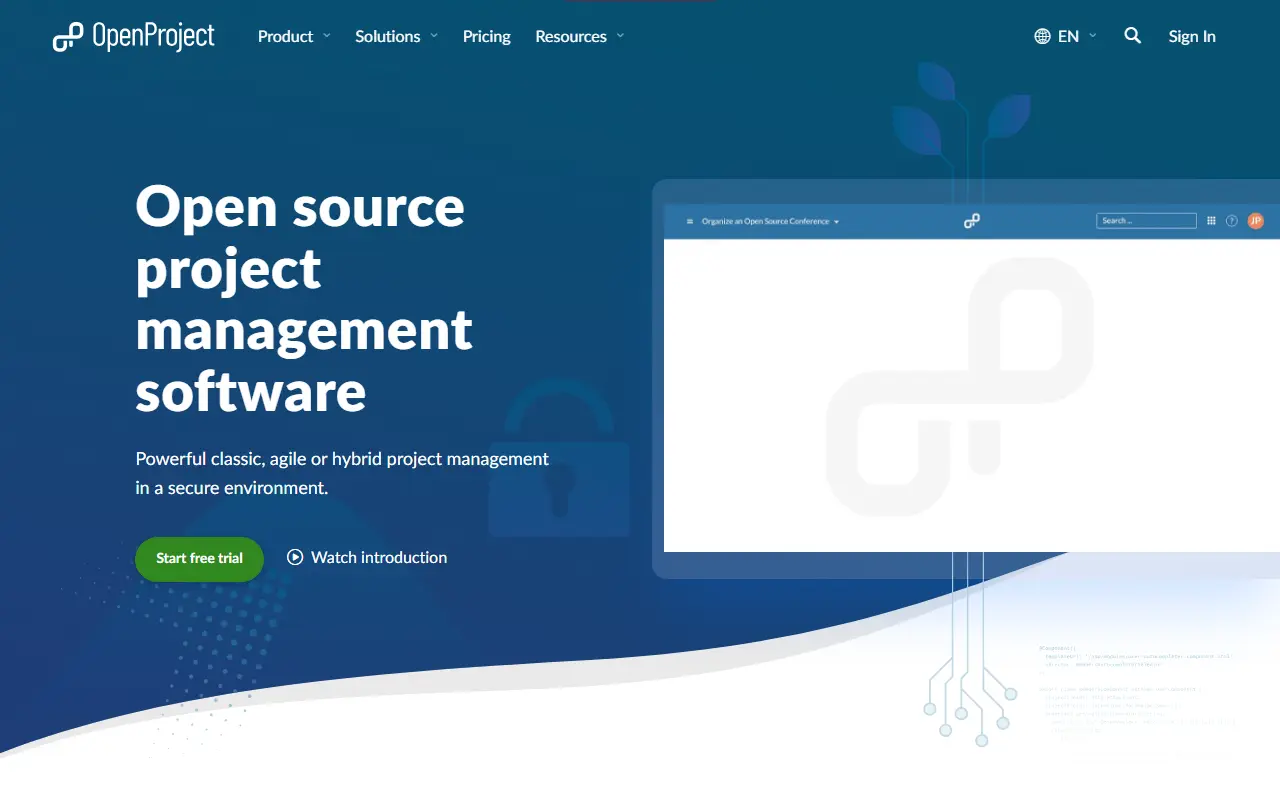
OpenProject is a web-based project management application for teams and organizations that value transparency, flexibility and control over their data. It covers projects, portfolios, products, tasks, bugs, agile workflows, roadmaps and team collaboration in one platform, and it is built with Ruby and Angular under the GPL-3.0 license.
Key capabilities include agile boards with Kanban and Scrum, project planning and scheduling with Gantt charts, product and release planning, bug tracking, and time tracking with cost reporting and budgeting. Collaboration tools cover wikis, forums, news, and meeting agendas and minutes. Integrations are listed for Nextcloud, XWiki, GitHub and GitLab, among others.
The project presents itself as an open-source alternative to Jira and Asana, along with tools such as MS Project, Monday and YouTrack. It can be self-hosted, which suits organizations with data sovereignty requirements. A free Community Edition is available to download, a 14-day free trial exists, and an Enterprise Edition adds support and add-ons in the cloud or on-premises.
Key features
- Agile boards for Kanban and Scrum
- Gantt chart planning and scheduling
- Roadmaps and release planning
- Time tracking, cost reporting and budgets
- Bug tracking and issue management
- Wikis, forums and meeting minutes
Pricing: The Community edition is free. Paid Enterprise plans cost 5.95 (Basic), 10.95 (Professional) or 15.95 (Premium) euros per user per month with user minimums; Corporate is on request. 14-day free trial.
#2
Super Productivity is a local-first to-do app with timeboxing, time tracking and integrations with Jira, GitHub, GitLab and more.
- GitHub stars
- 24k
- Last commit
- yesterday
- Latest release
- v20.0.0
- Licence
- MIT
super-productivity.com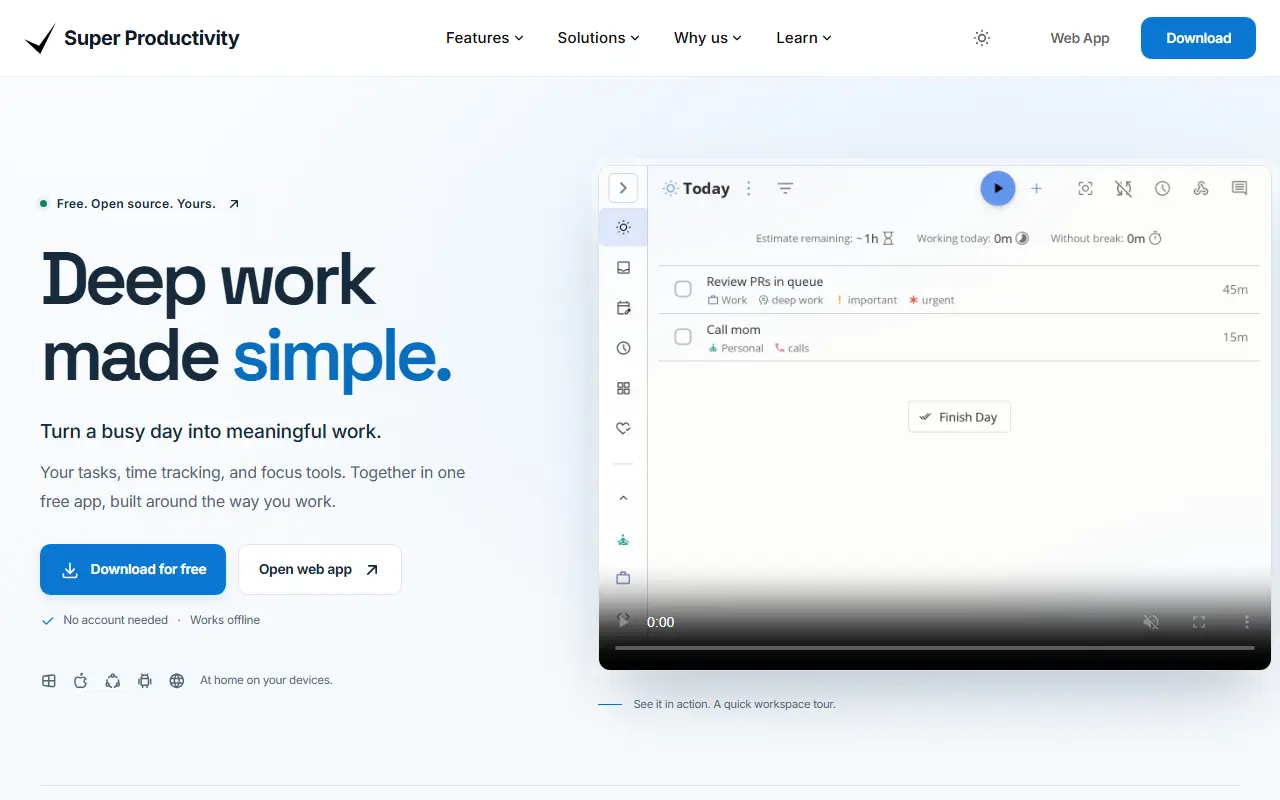
Super Productivity is a to-do list application that adds timeboxing and time tracking to everyday task planning. Tasks can be organized with sub-tasks, projects and color-coded tags, and viewed in a planner with a schedule timeline next to calendar events. Visual boards, including Kanban and Eisenhower Matrix layouts, help you sort work. It is written in TypeScript, released under the MIT license and tagged as local-first and privacy-friendly.
Time tracking produces time sheets and work summaries that can be exported to a company's tracking system. Habit tools include break reminders, an anti-procrastination feature and a focus mode with Pomodoro, Flowtime and countdown sessions, plus personal metrics. Integrations include Jira, Trello, GitHub, GitLab, Gitea and Linear, plus ClickUp, Redmine and Azure DevOps, importing assigned tasks and creating work logs automatically. It is available as a web app and as apps for Windows, macOS, Linux, Android and iOS.
Key features
- Tasks with sub-tasks, projects and tags
- Timeboxing and time tracking with exportable time sheets
- Kanban and Eisenhower Matrix boards
- Pomodoro, Flowtime and countdown focus sessions
- Integrations with Jira, GitHub, GitLab and others
- Web, desktop and mobile apps
Pricing: Completely free and open source with no premium tiers; development is supported by optional GitHub Sponsors donations.
#3
Vikunja is an open-source, self-hostable task and project manager with a Go backend and Vue front end, also offered as a hosted service.
- GitHub stars
- 6k
- Last commit
- today
- Latest release
- v2.8.0
- Licence
- AGPL-3.0
- Self-hosted
- Yes
- Hosted version
- Available
vikunja.io
Vikunja is a task manager that you can host and control yourself. It covers to-do lists and broader project management, and exposes an API so it can be connected to other tools. Its backend is written in Go and the web front end in Vue. The tagline stresses ownership: a task manager whose data and hosting you decide.
The README mentions an optional hosted version for people who want a hassle-free setup for themselves or a team, and a Vikunja Pro tier that adds an admin panel, audit logs and time tracking. The maintainers also note that they use LLM-assisted coding tools in parts of the codebase. The repository has documentation, a roadmap and contribution guidelines.
Vikunja is licensed under AGPL-3.0. The community version is free to self-host, which suits individuals, families and small teams who want an open alternative to hosted to-do and project apps. Support comes from donations, sponsorship and paid hosting or Pro plans.
Key features
- To-do lists and project management
- REST API for integrations
- Go backend with Vue web interface
- Self-hosted or vendor-hosted option
- Pro tier with admin panel and audit logs
- Time tracking in the Pro edition
Pricing: Self-hosting is free. Vikunja Cloud costs €4 per month for Personal, €10 for Family (up to 5 users) and €5 per user for Organization, each with a 14-day trial and yearly discounts.
#4
Habit and task tracker that gamifies daily goals with RPG-style levels, gold and gear, for people who stay motivated through game mechanics.
- GitHub stars
- 14k
- Last commit
- 2 days ago
- Latest release
- v5.52.0
- Hosted version
- Available
habitica.com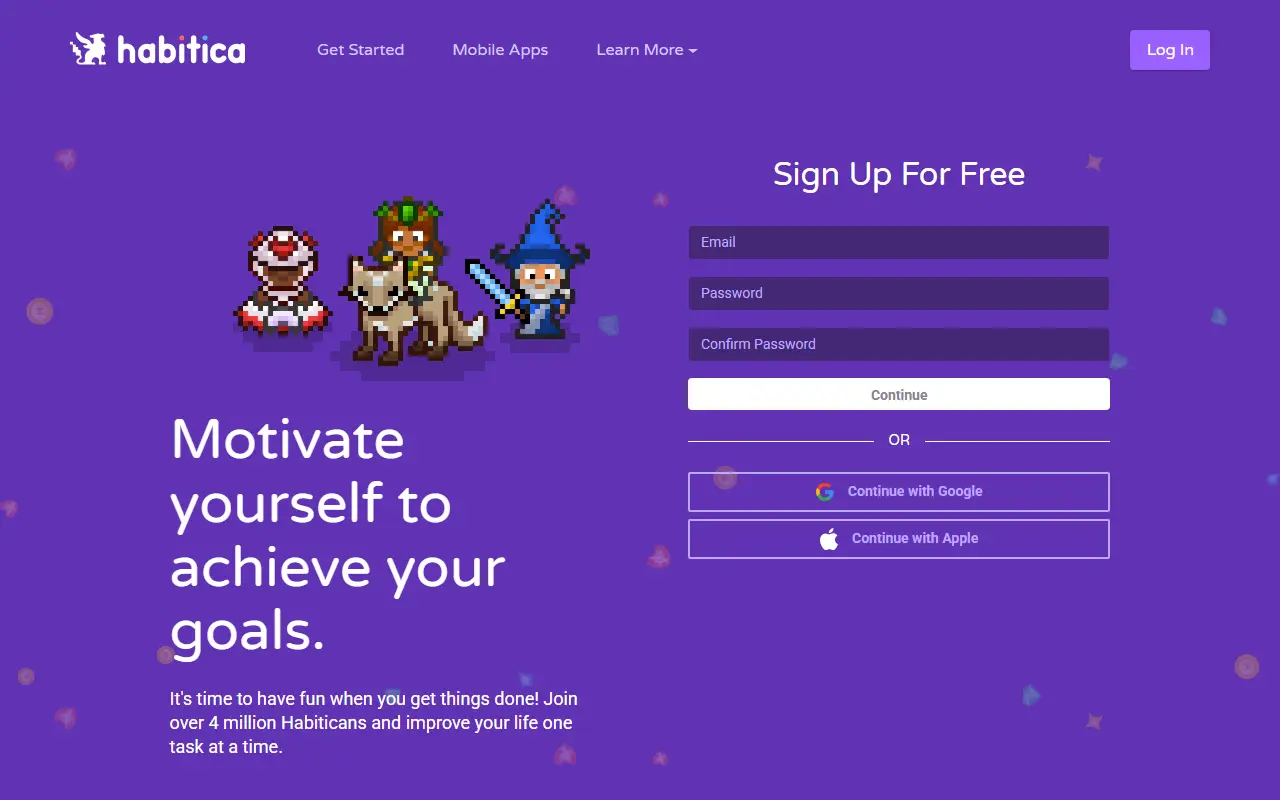
Habitica is an open-source habit-building app that turns personal goals and daily tasks into a role-playing game. Completing tasks earns experience and gold, while missed ones cost health points, which gives everyday routines a built-in reward and penalty loop. It is aimed at people who find plain to-do lists dull and respond better to game mechanics.
Players level up a character, collect weapons and armor, and spend the gold they earn on in-game gear. The web application is a JavaScript project built on Node.js and Express with a MongoDB database and a Vue front end, and the same service is reachable through separate Android and iOS apps maintained in their own repositories.
The source code is publicly visible under a custom license described in the repository rather than a standard SPDX license. The maintainers have paused outside code contributions and do not accept AI-generated code, but the codebase stays open. Developers who want a local copy can follow the project's wiki guide for setting up Habitica locally.
Key features
- Habits, dailies and to-do tracking
- Character leveling with experience and health points
- Gold rewards for buying in-game weapons and armor
- Web app plus native Android and iOS apps
- Open codebase on Node.js, MongoDB and Vue
Pricing: The source code is open; the hosted service at habitica.com can be used for free, with optional paid extras.
#5
Self-hostable task and project manager that organizes tasks, projects, areas, notes, and tags, with recurring tasks and Telegram integration.
- GitHub stars
- 3.5k
- Last commit
- 7 days ago
- Latest release
- v2.1.0
- Licence
- MIT
- Self-hosted
- Yes
- Hosted version
- Available
tududi.com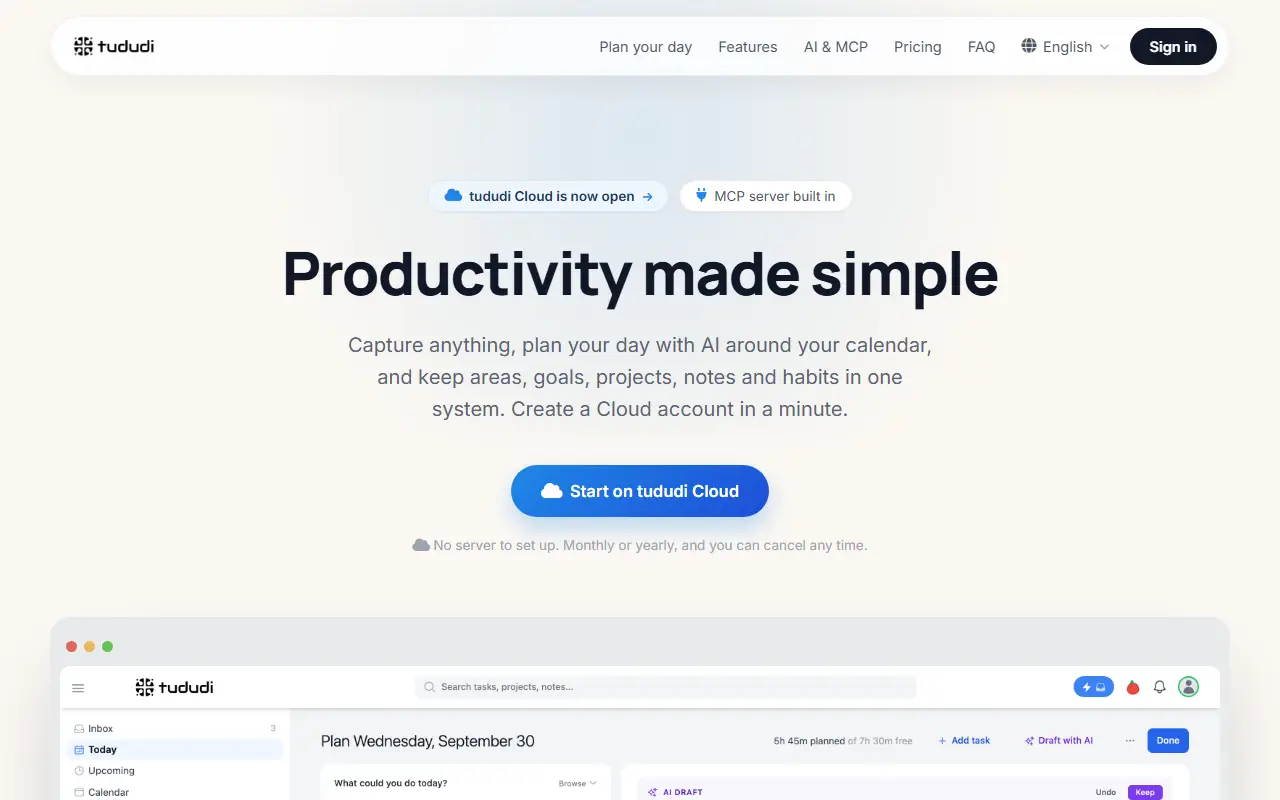
Tududi is an open-source system for organizing personal and work tasks in a hierarchy. Tasks belong to projects, projects can be grouped into areas, and notes and tags can be attached across the structure, which suits people who follow a getting-things-done style of planning. It is released under the MIT license.
Tasks can be filtered into views such as Today, Upcoming, and Someday and sorted by name, due date, creation date, or priority. It supports subtasks with progress tracking and a recurring-task system with daily, weekly, and monthly patterns, including monthly on specific weekdays. A Telegram integration lets you capture and manage items from chat, and your data stays under your control when self-hosted.
The application is built with React and Node.js with Express, and you can run it on your own server or buy a hosted subscription from the maintainer for a managed setup. It suits individuals and small teams who want a calm, privacy-minded alternative to hosted to-do and project apps.
Key features
- Tasks with subtasks and progress tracking
- Recurring tasks with flexible patterns
- Projects grouped into areas
- Notes and tags across tasks and projects
- Today, Upcoming, and Someday task views
- Telegram integration
Pricing: Self-hosting is free. Hosted Cloud costs €5 per month or €50 per year, with no free tier or trial but a 14-day money-back guarantee.
#6
Self-hosted task and chore manager for individuals and households with natural language entry, flexible recurring schedules, and shared groups.
- GitHub stars
- 2.7k
- Last commit
- 2 days ago
- Latest release
- v0.1.86
- Licence
- AGPL-3.0
- Self-hosted
- Yes
donetick.com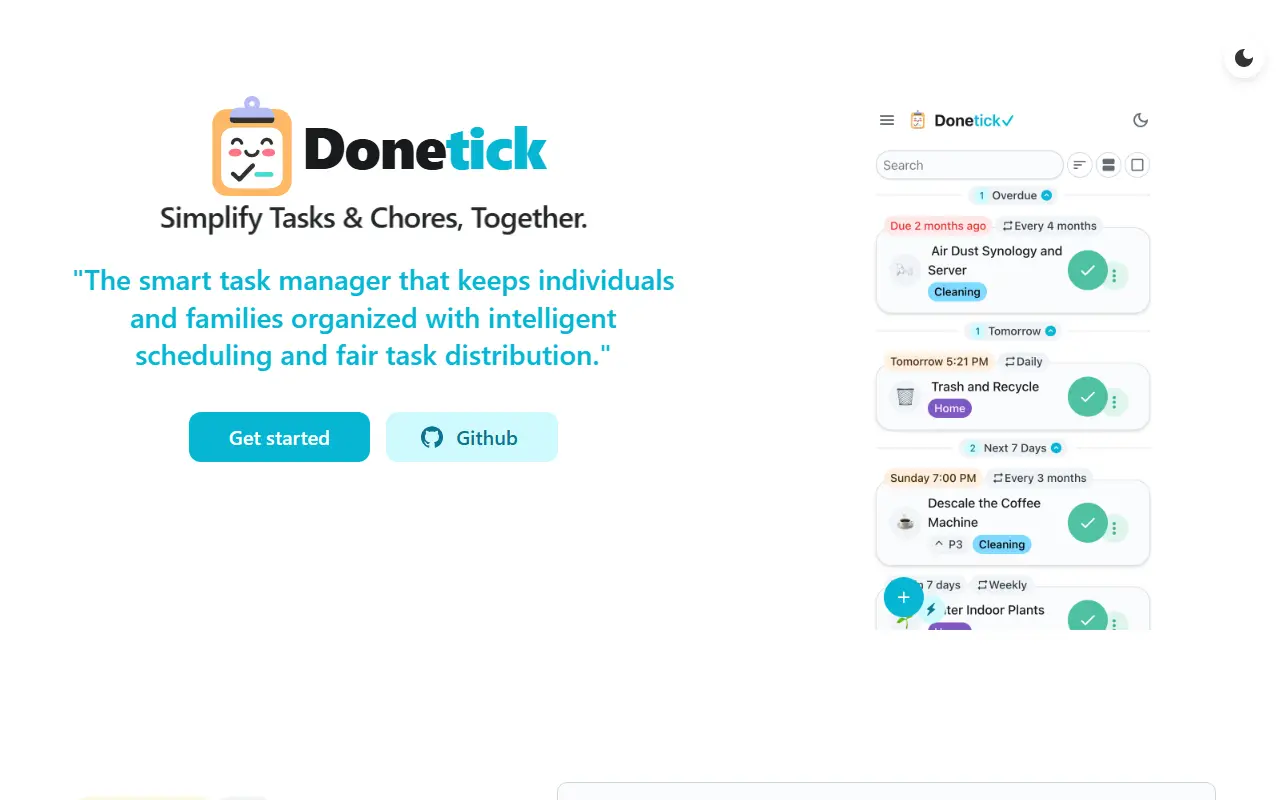
Donetick is an open-source app for organizing tasks and chores, either alone or together with family and friends. Groups can be created so that tasks are shared or assigned between members, which makes it popular for households. It is built with Go and React, ships a Docker image, and is released under the AGPL-3.0 license.
Tasks can be created in plain English: the app extracts dates, times, and recurrence from phrases such as every six months or every Monday and Tuesday at a set time. Scheduling is flexible, with daily, weekly, monthly, and yearly patterns, specific months or weekdays, and adaptive scheduling that learns from past completions. Recurrence can be based on the due date or on the actual completion date.
Other features include assignee rotation by fewest completed tasks, random choice, or round-robin, time tracking with session insights, and subtasks with smart reset. It suits families, roommates, and small teams who want a private, self-hosted way to share recurring responsibilities.
Key features
- Shared groups for household tasks
- Natural language task creation
- Flexible and adaptive recurring schedules
- Due-date or completion-date based recurrence
- Assignee rotation options
- Time tracking and subtasks
Pricing: Free and open source under the AGPL-3.0 license.
#7
An open-source Android to-do app that grew from Astrid's code, with an alpha desktop version and Pebble watch support, built with Kotlin.
- GitHub stars
- 5.7k
- Last commit
- yesterday
- Latest release
- 15.13
- Licence
- GPL-3.0
tasks.org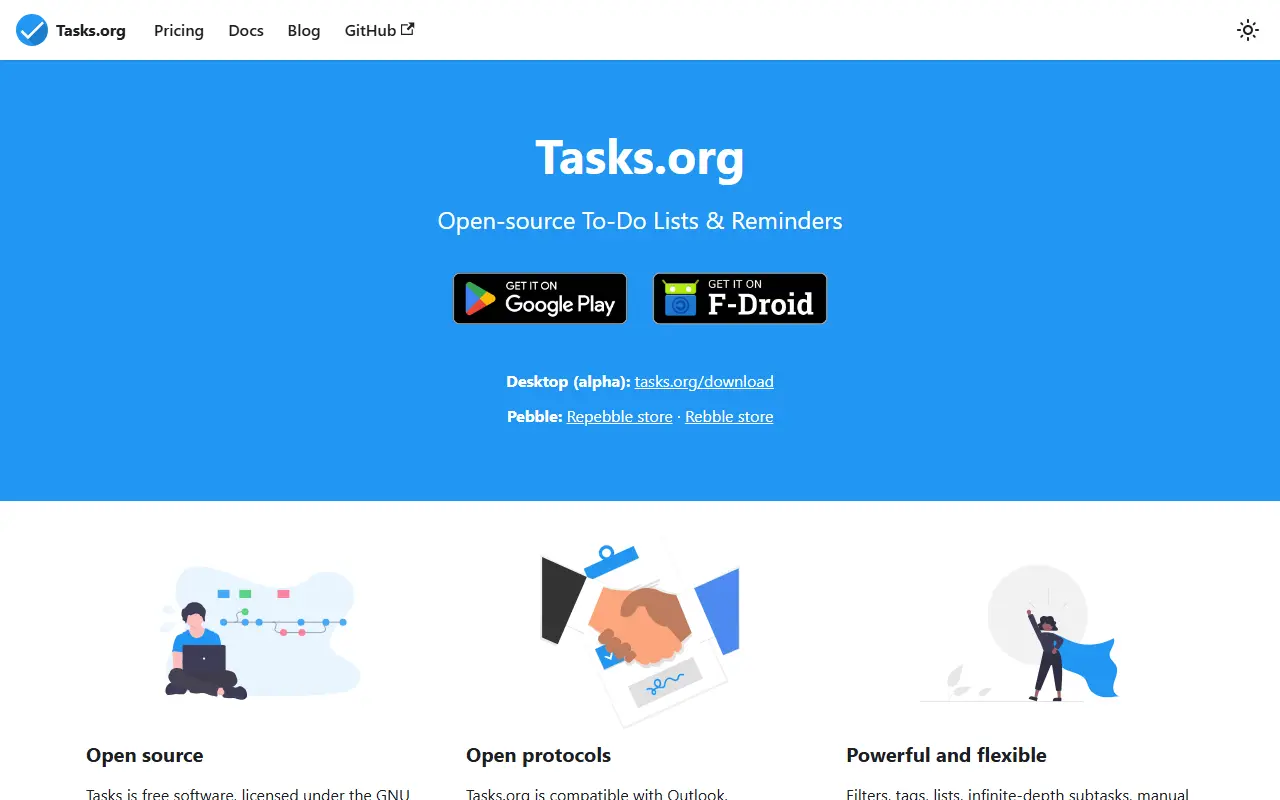
Tasks is an open-source task and to-do app for Android. It is based on the source code of Astrid, a cross-platform productivity service that was acquired and discontinued in 2013, and the project revives that app as a maintained codebase. It is licensed under GPL-3.0 and its end-user documentation lives on tasks.org.
Beyond the Android app, the project offers an alpha desktop version, and Pebble watch apps are available through the Rebble and Repebble stores. It is written in Kotlin and uses Compose Multiplatform. Release builds are distributed through Google Play, as APKs on GitHub Releases, as a macOS zip and through a Linux apt repository, with published signing fingerprints for verification.
Key features
- Android to-do and task management
- Alpha desktop version
- Pebble smartwatch support
- Signed releases with published fingerprints
- Linux apt repository
- Kotlin and Compose Multiplatform codebase
Pricing: Free forever on Android. Tasks.org Cloud costs $2.49 per month billed annually ($29.99 per year); a name-your-price subscription starts at $0.99 per year, with a 7-day trial on Google Play.
#8
Taskwarrior is a command-line task list manager with an ecosystem of tools, hooks and extensions, available for Linux, Unix, macOS and Windows.
- GitHub stars
- 6.2k
- Last commit
- yesterday
- Latest release
- v3.5.0
- Licence
- MIT
taskwarrior.org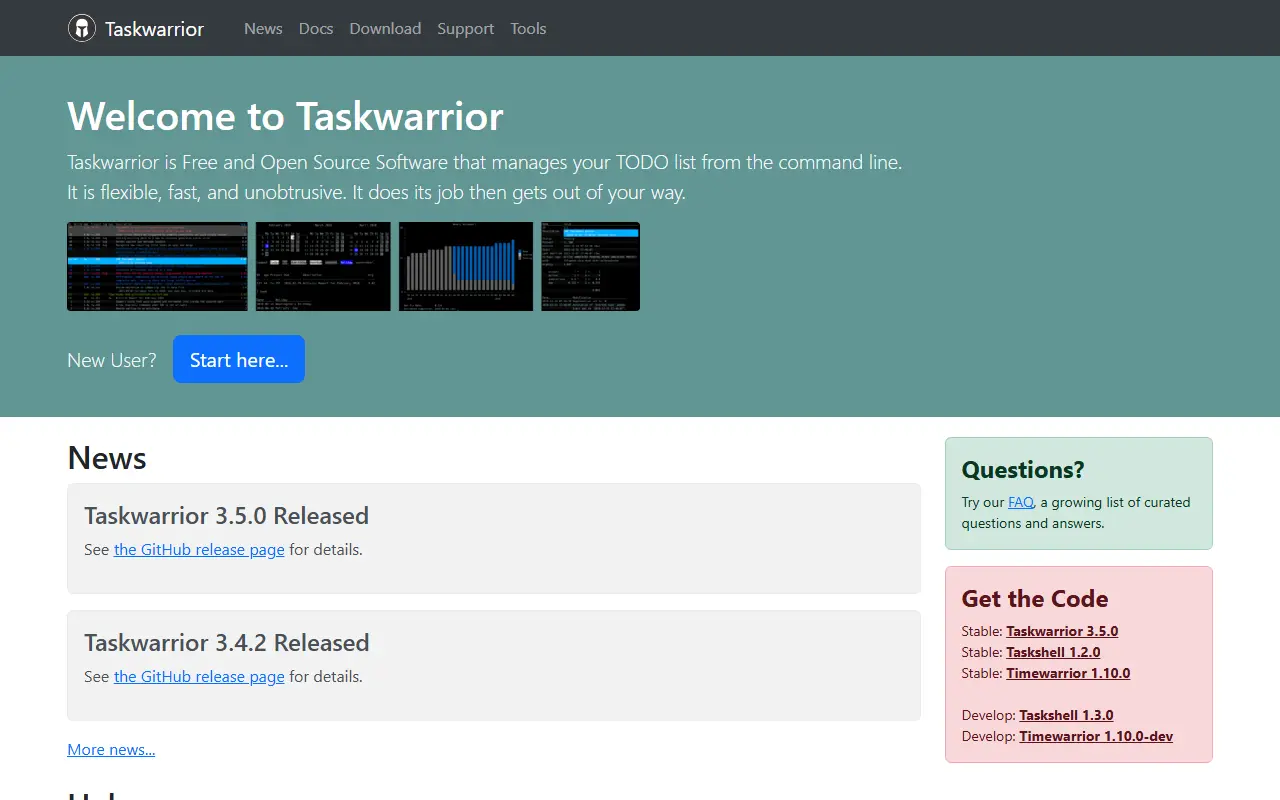
Taskwarrior is a utility for managing task lists from the command line. It is developed as a portable open-source project, and it is surrounded by an ecosystem of tools, hooks and extensions that adapt it to different workflows. Repository topics place it in the to-do list and GTD space.
It is packaged for a wide range of Linux and Unix systems, macOS and Windows, with packages tracked on Repology, and it can also be built from source. The project website holds the online documentation, downloads and news, while the GitHub discussions forum is the recommended place for questions. Contributions of all kinds are welcome, including code patches, ideas, bug reports and discussion.
Taskwarrior is written in C++ and released under the MIT licence. It has been developed since 2006, mostly by a small group of volunteers, and the maintainers invite users to sponsor the project through GitHub Sponsors so that core developers can devote more hours.
Key features
- Command-line task management
- Hooks and extensions ecosystem
- Packages for Linux, Unix, macOS and Windows
- Online documentation and community forum
- Open source under the MIT licence
Pricing: Free and open source under the MIT licence; sponsorship is welcome.
#9
A GNOME task manager that syncs with Todoist, Nextcloud and CalDAV, offering projects, sections, reminders and recurring tasks for Linux desktop users.
- GitHub stars
- 5.8k
- Last commit
- yesterday
- Latest release
- v4.20.0
- Licence
- GPL-3.0
- Self-hosted
- Yes
useplanify.com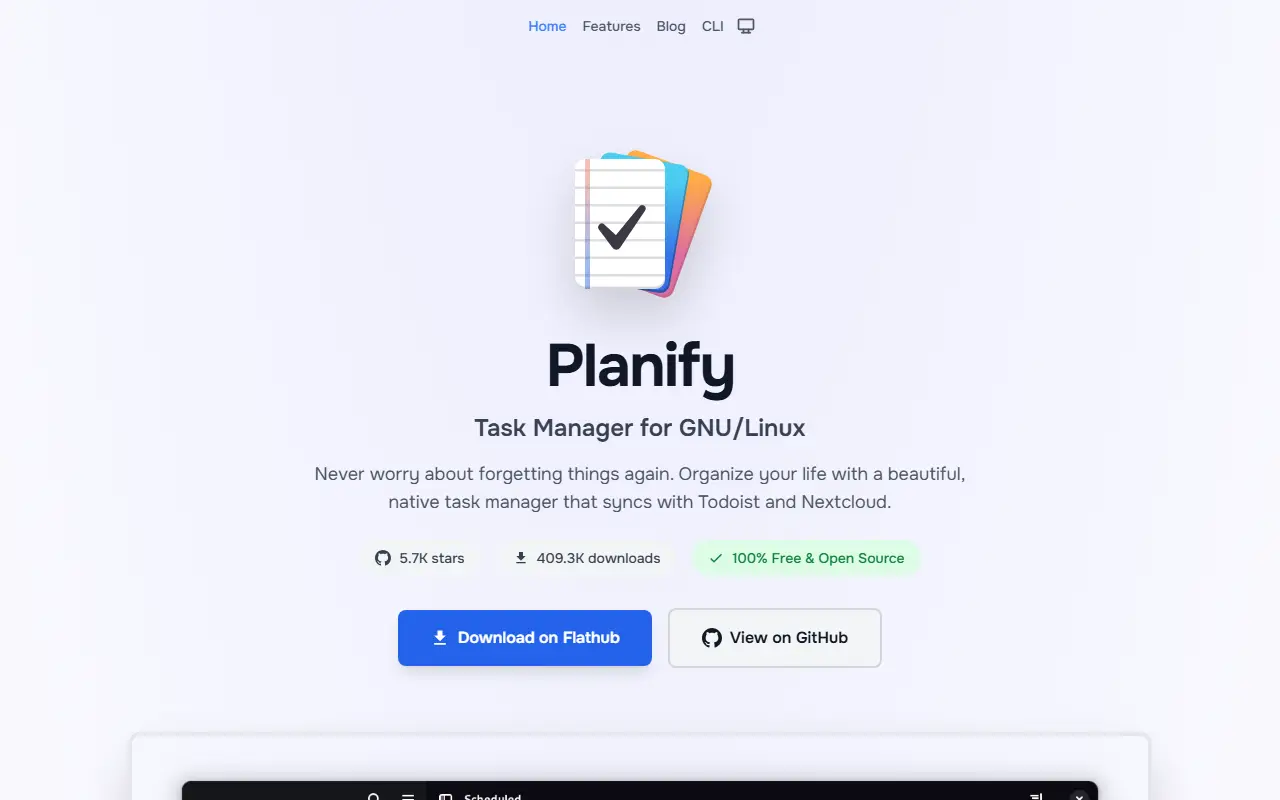
Planify is a desktop task manager designed for GNOME and built with GTK4 and libadwaita. It helps people capture to-dos, group them into projects and sections, and keep a plan for the day, while keeping the data in sync with services they may already use.
Tasks can be organized by drag and drop, tagged with labels, filtered, searched and given attachments or links. It supports several reminders per task, recurring schedules, a calendar view of upcoming work, progress indicators and a productivity overview, with an offline mode that syncs once a connection returns.
Synchronization options include Todoist, Nextcloud and CalDAV servers, which allows a self-hosted setup for people who want their data to stay private. The project states that it is not affiliated with or supported by Doist. Planify is written in Vala, released under GPL-3.0, and requires a Linux distribution with GTK4.
Key features
- Sync with Todoist, Nextcloud and CalDAV
- Projects with sections and drag and drop
- Multiple reminders per task
- Recurring tasks with flexible schedules
- Labels, filters and quick search
- Offline mode with later sync
- Calendar view and progress tracking
Pricing: Free and open source under the GPL-3.0 licence.
#10
Redmine is a flexible, self-hostable project management web application built on Ruby on Rails, with issue tracking, wikis, Gantt charts and time tracking.
- GitHub stars
- 6.1k
- Last commit
- yesterday
- Self-hosted
- Yes
redmine.org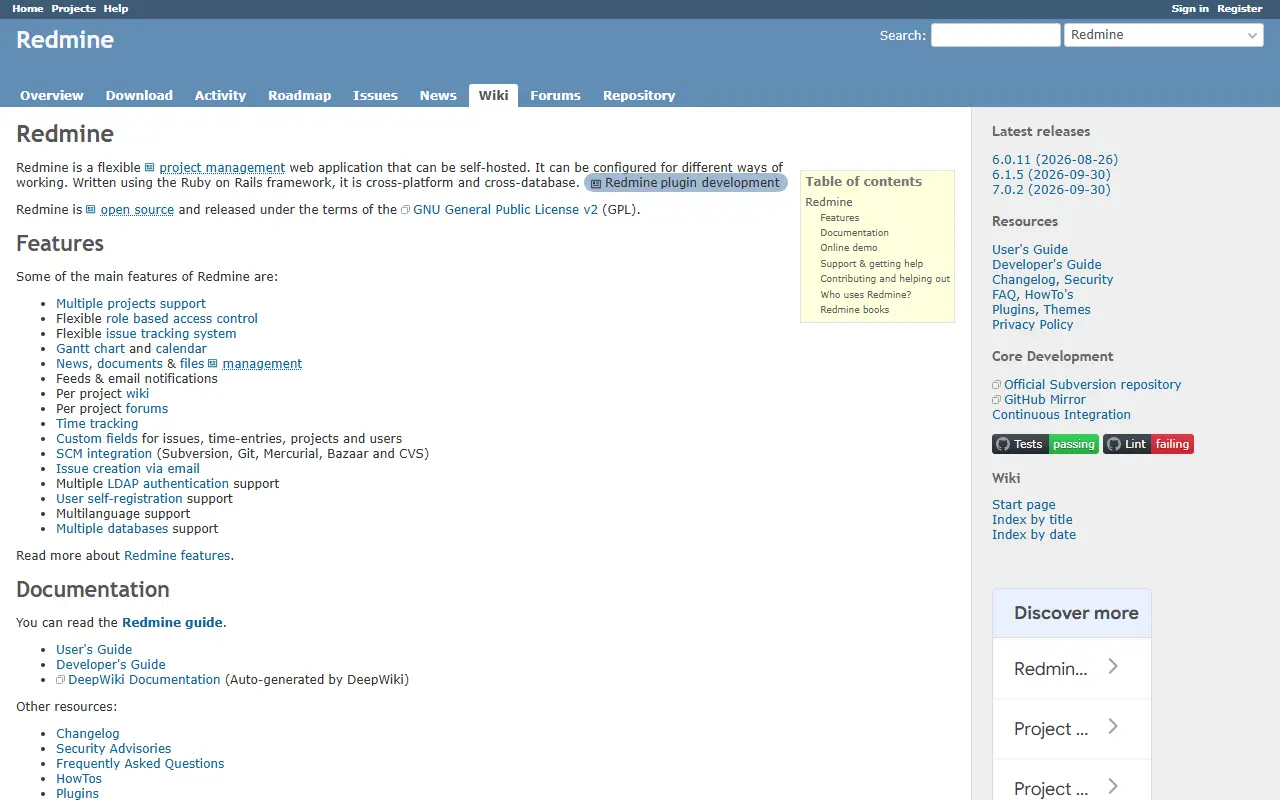
Redmine is a configurable project management web application that you can host yourself. It is written with the Ruby on Rails framework, is cross-platform and cross-database, and can be configured to fit different ways of working. This repository is a GitHub mirror of the official Subversion repository.
The project site lists the main features: support for multiple projects, flexible role-based access control, an issue tracking system, a Gantt chart and calendar, news, documents and file management, feeds and email notifications, a wiki and forums for each project, and time tracking. Custom fields can be added to issues, time entries, projects and users. Integration covers Subversion, Git, Mercurial, Bazaar and CVS, issues can be created by email, and LDAP authentication, user self-registration and multiple languages and databases are supported.
Redmine is open source software distributed under version 2 of the GNU General Public License. Plugins and themes extend it, and a user's guide, developer's guide, FAQ and online demo are available on the project site.
Key features
- Multiple projects with role-based access control
- Issue tracking system
- Gantt chart and calendar
- Per-project wiki and forums
- Time tracking and custom fields
- Git, Subversion and Mercurial integration
- LDAP authentication
Pricing: Free and open source under the GNU GPL v2.
3 more Todoist alternatives
Todoist alternatives: questions
- What is the best open-source alternative to Todoist?
- OpenProject is the top-ranked open-source alternative to Todoist on Enlisted: OpenProject is open-source project management software for agile planning, Gantt charts, issue tracking and time tracking, positioned as a Jira alternative. Other strong options are Super Productivity, Vikunja, Habitica and Tududi.
- What are the best commercial alternatives to Todoist?
- Microsoft To Do, ClickUp, Quire, Sunsama and Superlist are among the hosted, closed-source alternatives to Todoist listed on Enlisted, which lists 75 in total. Compare their pricing and features on each tool page.
- Are these Todoist alternatives free?
- All 13 are open source, so the code is free to use under its licence, and all of them can be self-hosted on your own server or computer. 4 also offer a paid or managed cloud version if you'd rather not host it yourself.
- How is this list of Todoist alternatives ranked?
- By a score built from GitHub stars, star growth over the last 30 days and how recently the code changed. 12 of these projects shipped code in the last 30 days. Data is refreshed daily, and nobody can pay to move up.
 TrackMedia
 TrackRev