#1
An open-source AI platform for enterprise search and chat that indexes knowledge from 50+ apps and works with any LLM, deployable on your own infrastructure.
- GitHub stars
- 33k
- Last commit
- today
- Latest release
- v5.1.2
- Self-hosted
- Yes
onyx.app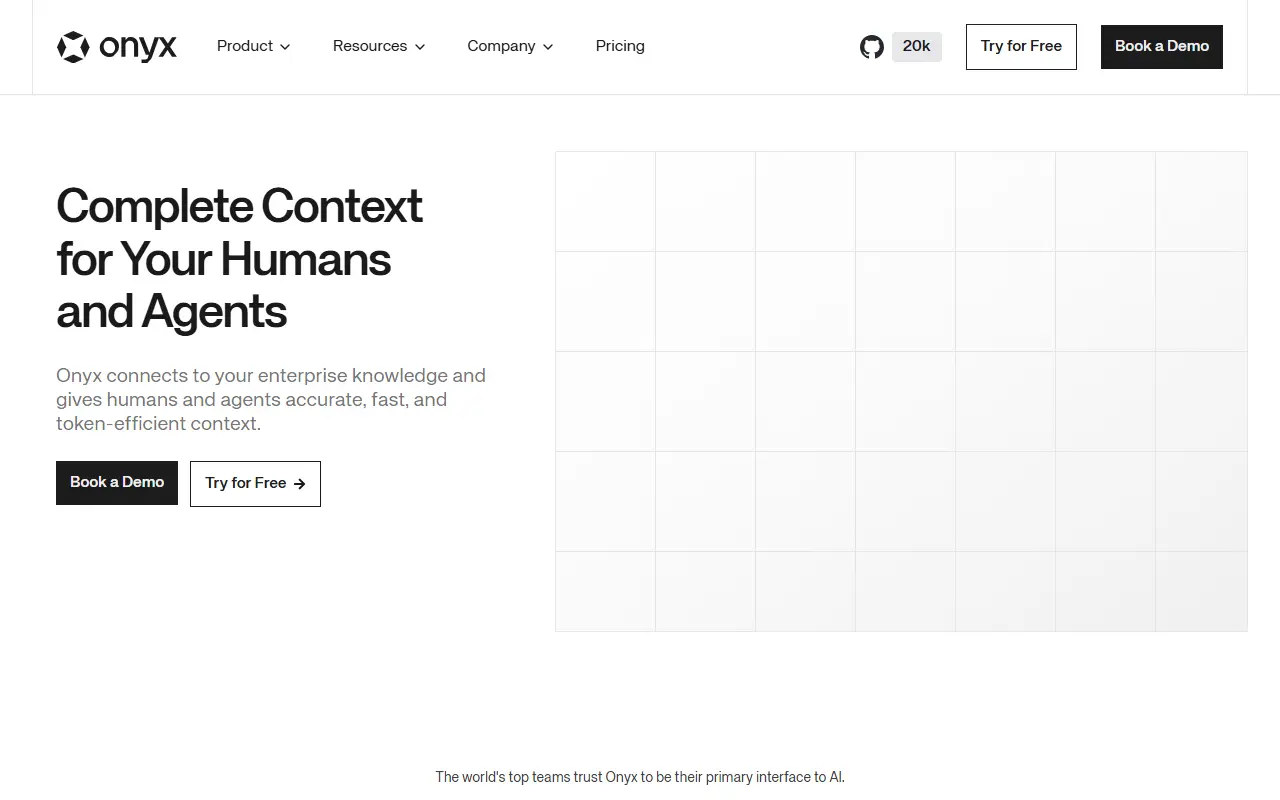
Onyx is an open-source AI platform that acts as a knowledge and context layer for teams and their AI agents. It connects to more than 50 applications, pulls in documents along with their metadata and permissions, and builds an internal representation so that LLMs can answer questions grounded in what your company actually knows.
The project argues that this indexed approach gives more reliable, lower-latency and cheaper context than approaches that have an agent search many tools iteratively through MCP. Features include agentic RAG on a hybrid index, a Deep Research mode for multi-step reports, custom agents with their own knowledge, instructions and actions, and live web search through providers such as Serper, Google PSE, Brave and SearXNG. Sandboxes and skills extend what models can do, and the chat interface works with every major LLM.
Onyx emphasizes data sovereignty through flexible self-hosted deployments, with a single-command deploy option. The code is written in Python and Next.js, and the license is listed as 'Other' on GitHub, so check the terms for the enterprise features. It suits organizations that want a private, ChatGPT-style assistant connected to internal documents.
Key features
- Connectors to 50+ workplace applications
- Hybrid index with agentic RAG
- Deep Research multi-step reports
- Custom agents with their own knowledge
- Web search via Serper, Brave and others
- Works with any LLM
- Indexing that respects source permissions
Pricing: Business costs $25 per user per month on monthly billing, or $20 per user per month billed annually, with a free trial. Enterprise pricing and deployment options are by contact.
#2
LlamaParse is a document processing platform that converts PDFs, scans, and Office files to markdown or JSON, and extracts structured data.
- GitHub stars
- 53k
- Last commit
- 2 days ago
- Latest release
- v0.14.25
- Licence
- MIT
- Hosted version
- Available
developers.llamaindex.ai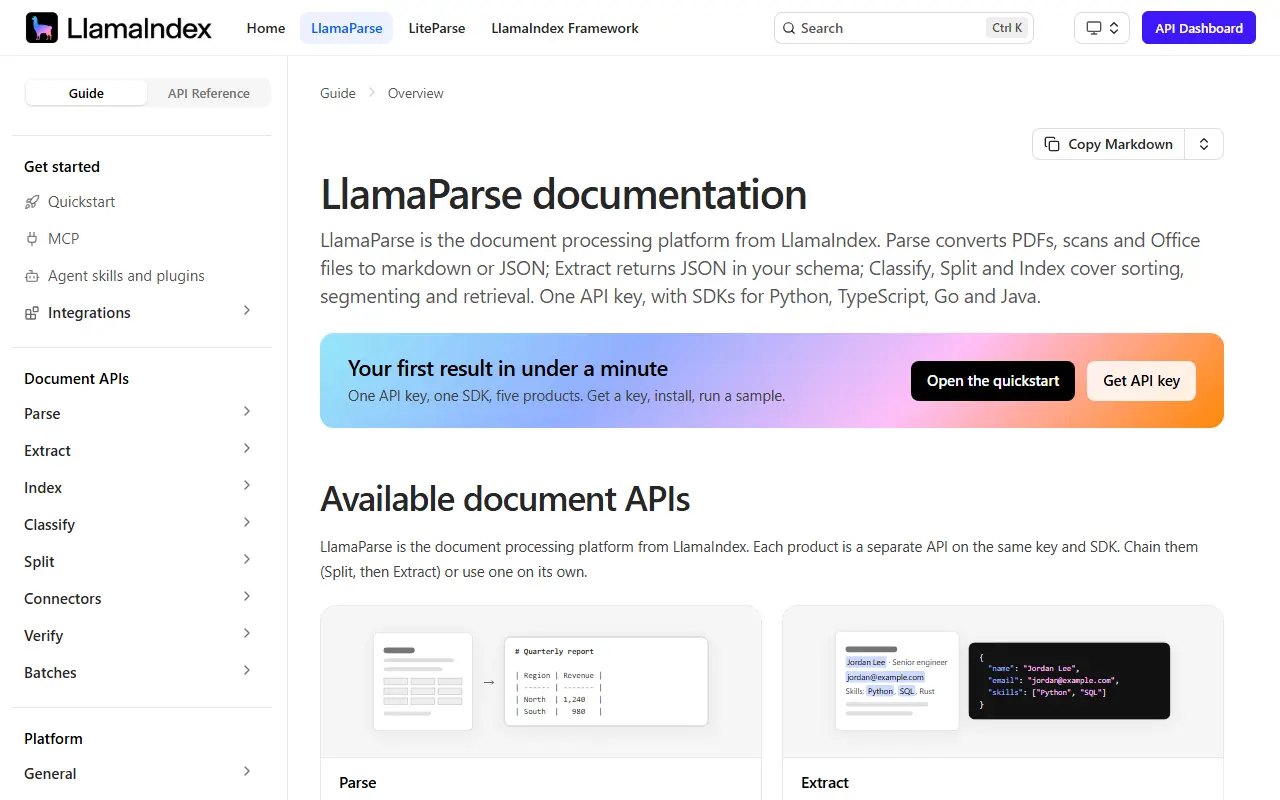
LlamaParse is a document processing platform from LlamaIndex. It provides APIs to parse PDFs, scans, and Office files into markdown or JSON, and to extract structured data in a user-defined schema. The platform also includes features for classifying, segmenting, and indexing documents.
It offers SDKs for Python, TypeScript, Go, and Java, and can be accessed via a single API key. The platform includes a web UI for extraction and supports batch processing, polling, and latency management for production use.
Key features
- Parse converts PDFs, scans, and Office files to markdown or JSON
- Extract returns JSON in a user-defined schema
- Classify, Split, and Index cover sorting, segmenting, and retrieval
- SDKs for Python, TypeScript, Go, and Java
- Web UI for extraction
- Supports batch processing, polling, and latency management

Kibana is the web interface for querying, visualizing and managing data stored in Elasticsearch, used for dashboards, observability and analytics.
- GitHub stars
- 21k
- Last commit
- yesterday
- Latest release
- v9.5.6
- Self-hosted
- Yes
- Hosted version
- Available
elastic.co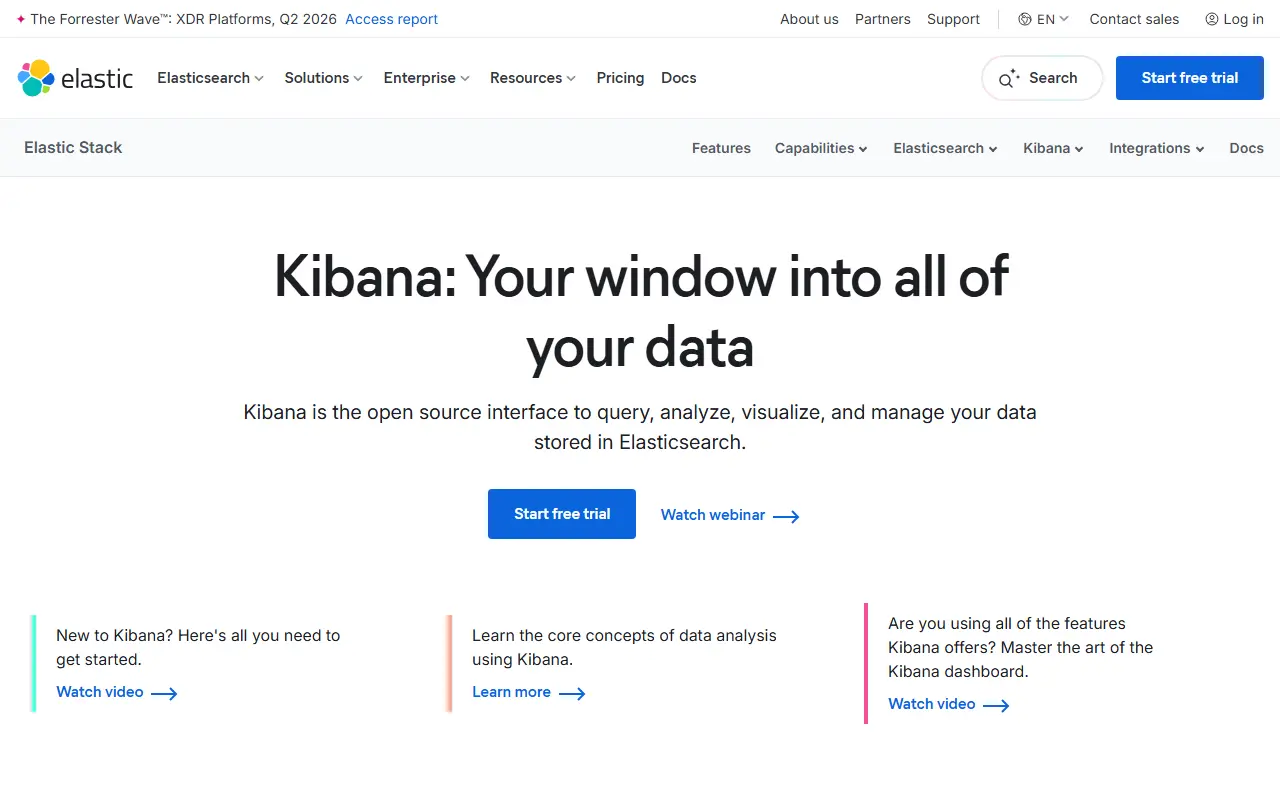
Kibana is the user interface that sits on top of Elasticsearch. It lets people query, analyze, visualize and manage the data stored there, turning indexes into charts, metrics views and dashboards. It is part of the Elastic Stack and is commonly used for log analysis, observability and general analytics work.
Teams build visualizations and assemble them into shared dashboards, explore documents with search, and use the interface to manage parts of an Elasticsearch deployment. The project advises running Kibana and Elasticsearch at the same version, with major versions required to match, because mismatches can cause problems and support may ask for an upgrade first.
The code is written in TypeScript. The repository lists its license as 'Other' rather than a standard SPDX identifier, so the license files should be read for the exact terms. Kibana can be downloaded and run on your own infrastructure, and Elastic also offers a hosted version through its Cloud service.
Key features
- Query and explore Elasticsearch data
- Visualizations and metrics charts
- Shared dashboards for monitoring
- Observability views for logs and metrics
- Management tools for Elasticsearch data
- Hosted option through Elastic Cloud

A cloud-native vector database that stores objects and embeddings and combines semantic search with keyword filtering, RAG and reranking in one query interface.
- GitHub stars
- 17k
- Last commit
- yesterday
- Latest release
- v1.40.5
- Self-hosted
- Yes
- Hosted version
- Available
weaviate.io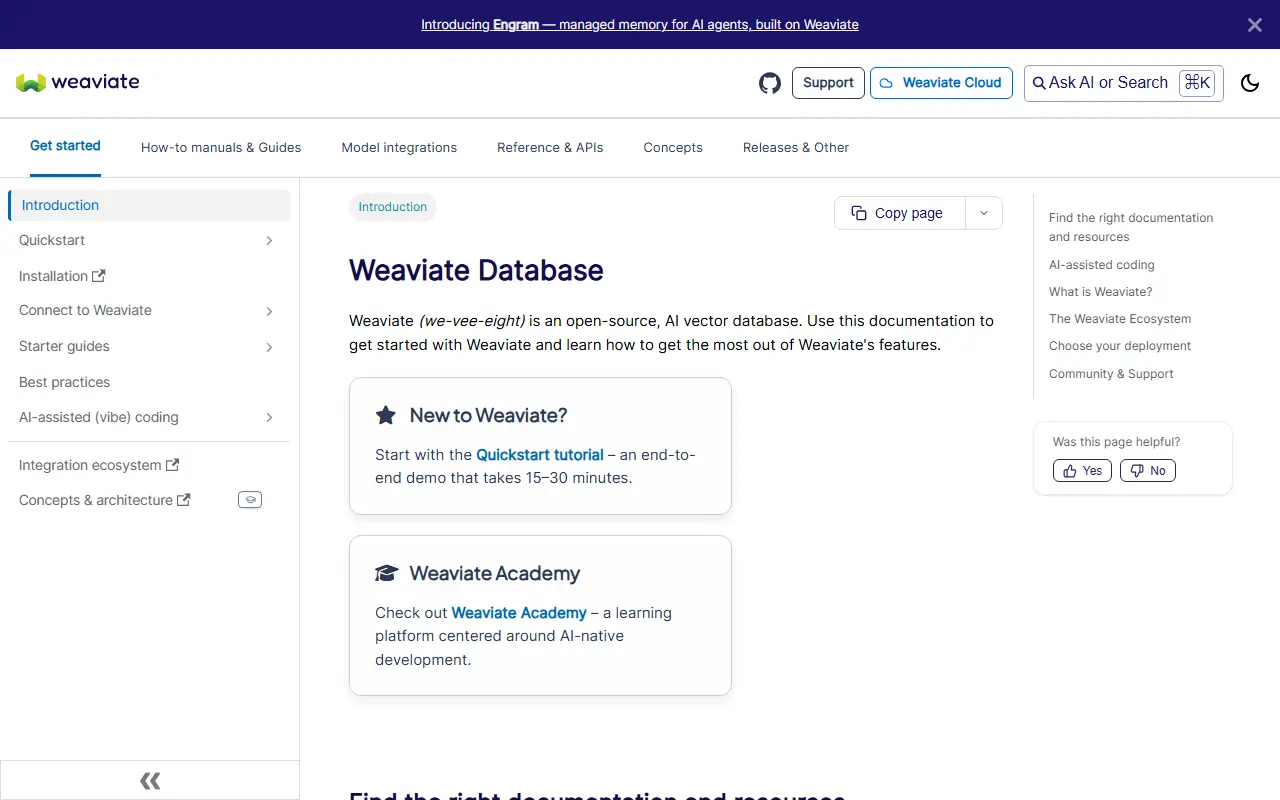
Weaviate is a vector database that stores both data objects and their vector embeddings, enabling semantic search at scale. One query interface can blend vector similarity search, keyword filtering, retrieval-augmented generation and reranking, and it is written in Go as a cloud-native system.
Common applications are RAG pipelines, semantic and image search, recommenders, chatbots and content classification. Vectors can be created automatically on import by integrated models from providers such as OpenAI, Cohere and Hugging Face, or you can import pre-computed embeddings. For production, it offers built-in multi-tenancy, replication and role-based access control. Topics reference approximate nearest neighbor search and HNSW indexing.
Weaviate can be deployed with Docker, on Kubernetes, or through the managed Weaviate Cloud, with guides for AWS and GCP, and the documentation includes quickstarts for both cloud and a local Docker instance. Its license is listed as 'Other' on GitHub, so check the repository terms. It suits teams building AI applications that need a scalable store for embeddings alongside structured filters.
Key features
- Stores objects and vectors together
- Hybrid vector and keyword search
- Integrated vectorizer models or bring your own
- Multi-tenancy and replication
- Role-based access control
- Docker, Kubernetes and Weaviate Cloud options

Botpress is a platform for building and deploying GPT and LLM-powered chatbots and agents, with an open-source hub of integrations and developer tools.
- GitHub stars
- 15k
- Last commit
- 2 days ago
- Latest release
- v12.30.9
- Licence
- MIT
- Self-hosted
- Yes
- Hosted version
- Available
botpress.com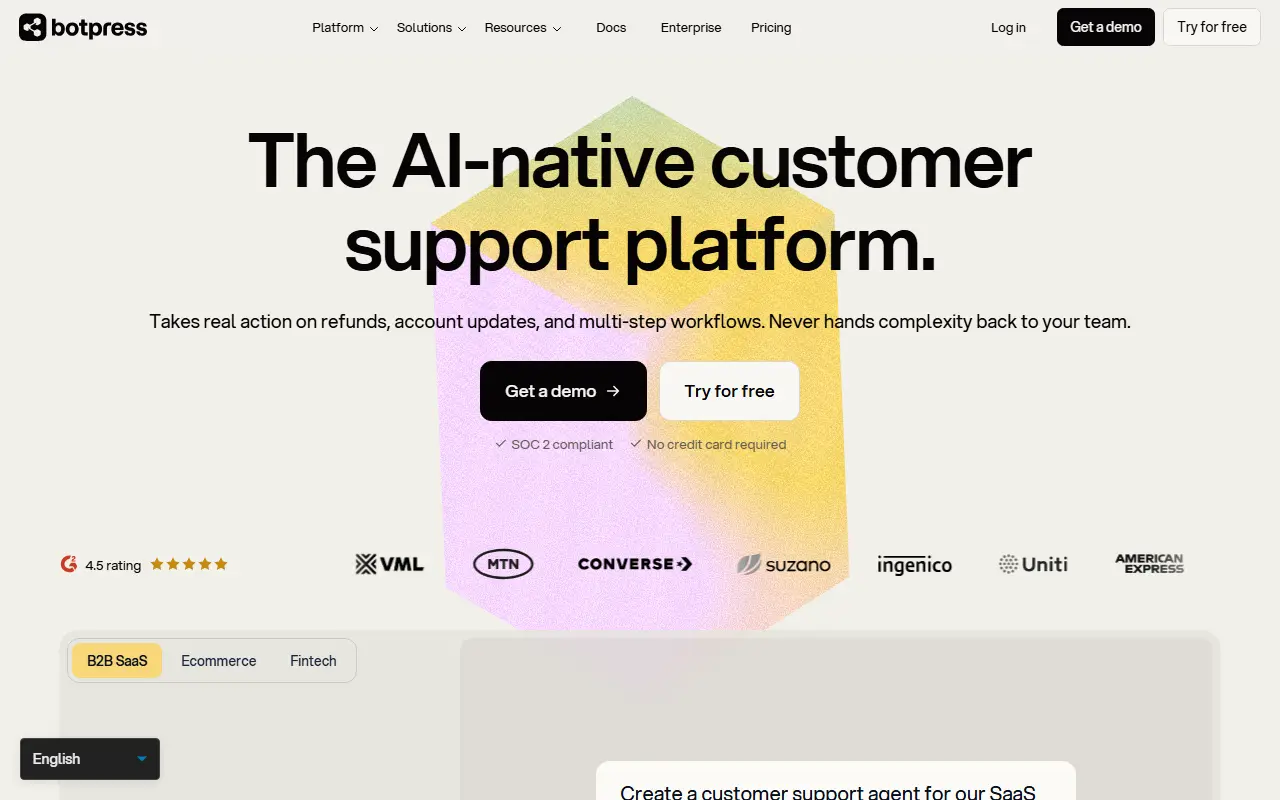
Botpress is a platform for building chatbots and AI assistants powered by large language models such as OpenAI's GPT. Its Botpress Cloud product is the main way to build and run agents, and this repository holds the open-source parts that surround it. It is written in TypeScript and released under the MIT license.
The repository contains the public integrations on the Botpress Hub that Botpress maintains, the developer tools for Botpress Cloud including the CLI, SDK and API client, examples of bots written as code with the SDK and CLI, and plugins for Botpress Studio. Developers can create their own integration from a template using the CLI and publish it to the Hub without forking the repository.
Contributions are welcome through pull requests and issues for the code in the repository, while Discord is suggested for faster responses about Cloud issues. On-premise Botpress version 12 is maintained in a separate repository, which is where problems with that version belong.
Key features
- Open-source integrations for the Botpress Hub
- CLI, SDK and API client for developers
- Example bots written as code
- Integration templates for new connectors
- Botpress Cloud for building and running agents
Pricing: Free plan with 25 conversations. Plus is $150 and Team $750 per month billed annually, priced by included conversations rather than seats; Enterprise is custom.
#6
SvelteKit chat interface for large language models that connects to any OpenAI-compatible API and powers HuggingChat.
- GitHub stars
- 11k
- Last commit
- yesterday
- Latest release
- v0.10.0
- Licence
- Apache-2.0
- Self-hosted
- Yes
- Hosted version
- Available
huggingface.co
Chat UI is a chat interface for LLMs built as a SvelteKit application. It is the open source codebase behind HuggingChat on Hugging Face and lets you run a similar conversational front end against models you choose, whether hosted or running locally.
The current version speaks only to OpenAI-compatible APIs, configured through a base URL and a models endpoint. The README lists the Hugging Face Inference Providers router, a llama.cpp server, Ollama through its OpenAI-compatible bridge, OpenRouter and Poe as example backends. Older provider-specific integrations were removed from the main branch but remain available on a legacy branch.
Setup involves creating an .env.local file with the endpoint and key, choosing a database option, and launching the app, with an optional Docker image. The project is written in TypeScript with Tailwind CSS and is licensed under Apache-2.0, making it a base for self-hosted assistants.
Key features
- Chat front end for any OpenAI-compatible API
- Works with llama.cpp, Ollama and OpenRouter
- Hugging Face Inference Providers support
- Configured through a simple .env.local file
- Optional Docker image
- SvelteKit and Tailwind CSS codebase
Pricing: Free and open source under the Apache-2.0 license.
#7
Federated AI search and RAG that queries your existing apps live, ranks results, and returns cited answers without copying data into a vector database.
- GitHub stars
- 3k
- Last commit
- 17 days ago
- Latest release
- v4.5.0.7
- Licence
- Apache-2.0
- Self-hosted
- Yes
swirlaiconnect.com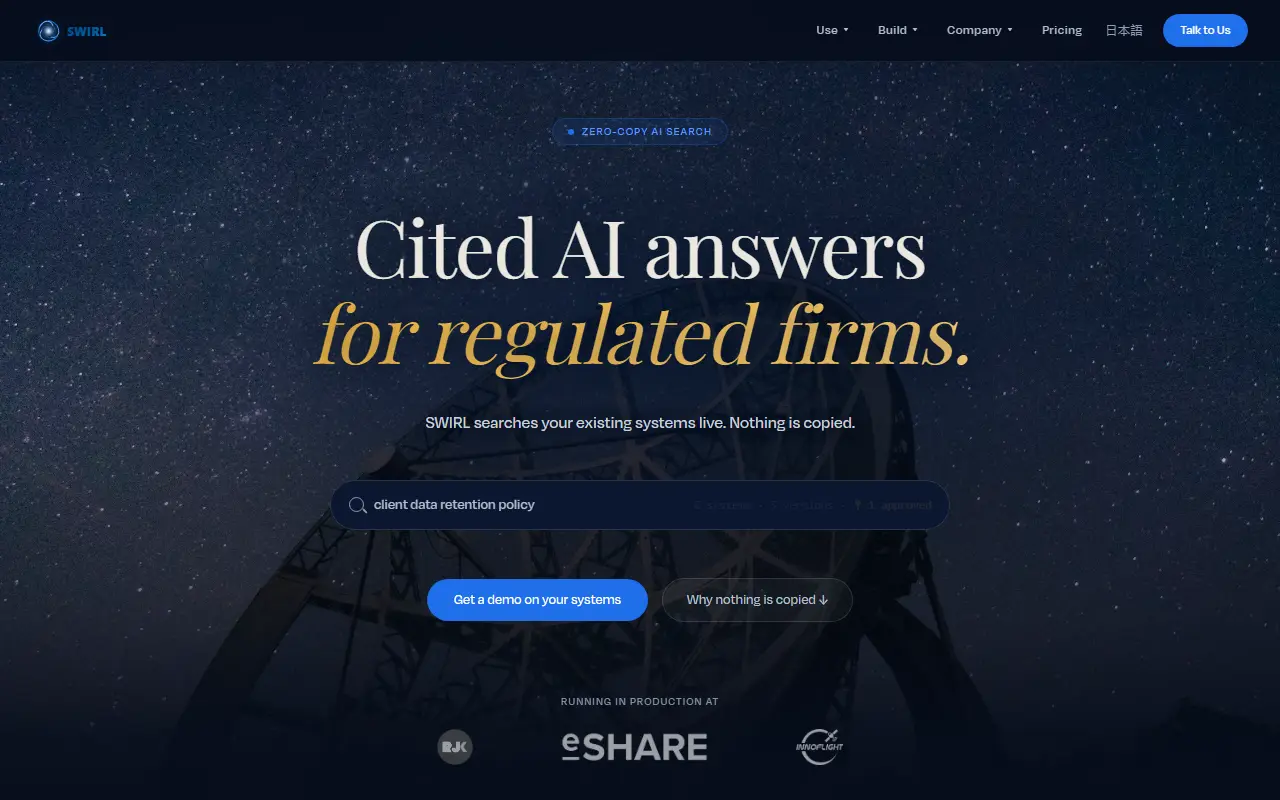
SWIRL is an AI search and retrieval-augmented generation tool that works without moving your data. Instead of copying content into a vector database, it queries your sources live with each user's own permissions, re-ranks the results, and can generate an answer with citations using the language model of your choice. The Community edition in this repository is released under the Apache-2.0 license.
Connectors reach many business applications, and the project's tagline refers to more than 100 apps. The approach avoids building ETL pipelines, standing up a vector store, or maintaining a second copy of data that needs security and audit controls, since permissions are enforced at the source. The stack is Python and Django, and a Docker quick start gets an instance running in about two minutes.
A separate SWIRL Enterprise edition adds a three-pass reranker, canonical answers, an MCP server for agents, and managed support. The Community edition is free to self-host. It suits IT and data teams wanting enterprise search across many systems while keeping data in place.
Key features
- Federated search across connected apps
- Live queries with source-level permissions
- No vector database or ETL needed
- Cited answers from your choice of language model
- Django-based with Docker quick start
- Enterprise tier adds reranking and MCP server
Pricing: Annual platform licences: Departmental $24K, Business $72K and Enterprise from $150K per year. No free plan is listed; a paid $12,000 pilot is credited to the first annual contract.
#8
Xyne is an AI search and answer engine for work data, positioned as an open-source alternative to Glean; the repository has moved to a new home.
- GitHub stars
- 698
- Last commit
- 4 days ago
- Latest release
- v3.1.1
- Licence
- Apache-2.0
- Self-hosted
- Yes
xyne.ai
Xyne is an AI-first search and answer engine for work, offered as an open-source alternative to enterprise search products such as Glean, and to Gemini and Microsoft Copilot in the same space. It connects to the applications where work information is scattered, indexes the data securely and maps relationships between items, so users can search and ask questions in a Google-plus-ChatGPT style with sources.
At the time of the README, it covered the whole Google Workspace, including Drive files, PDFs, documents, sheets and slides as well as calendar, contacts and Gmail with attachments, with Slack and Atlassian integrations planned next. It can be self-hosted on a laptop, on-premises or in the cloud, is model-agnostic so it can use any LLM or cloud provider, including a local model through Ollama, and emphasizes private, secure use without training on your data.
Important: the README states that this repository is no longer maintained and has moved to github.com/juspay/xyne-spaces. The code here is written in TypeScript with Bun and licensed under Apache-2.0; new users should evaluate the new repository.
Key features
- Search across Google Workspace content
- Answers with source citations
- Model-agnostic LLM support
- Self-hosted deployment
- Relationship graph over indexed data
- Planned Slack and Atlassian integrations
Pricing: Free and open source under the Apache-2.0 license; this repository has moved to a new home.
#9
Open-source company intelligence agent that navigates Slack, Drive, wikis, CRM and MCP servers to answer questions and builds its own wiki and CRM.
- GitHub stars
- 752
- Last commit
- 4 mo ago
- Licence
- Apache-2.0
- Self-hosted
- Yes
agno.com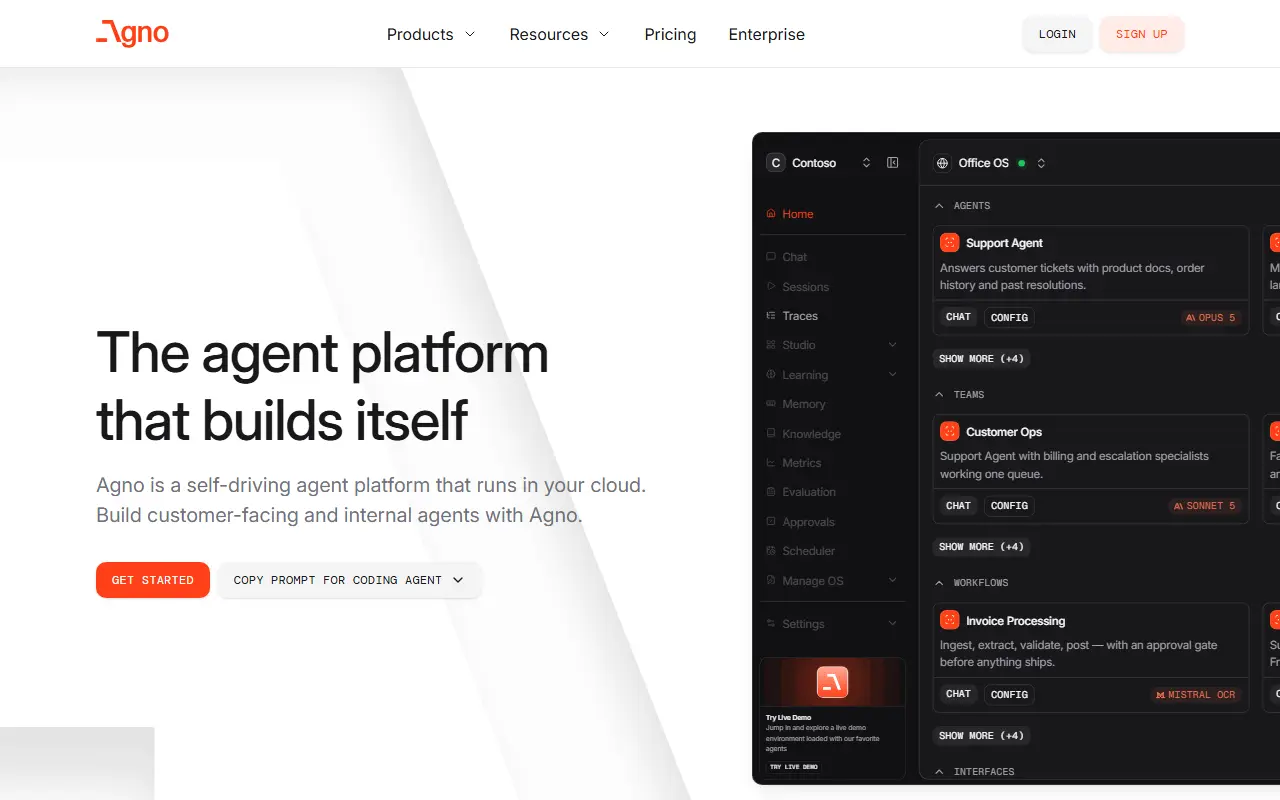
Scout, from the Agno team, is an open-source company intelligence agent, sometimes described as a company brain. It connects to live information sources such as the web, Slack, Google Drive, wikis, CRM systems and MCP servers, and assembles context on demand to answer questions or carry out work. It is aimed at teams whose knowledge is scattered across many tools.
Rather than ingesting everything into a vector database, Scout takes a navigation approach similar to coding agents, which list, search and open files and follow references. It combines context providers, agentic SQL and persistent memory. As it learns, it maintains its own wiki and CRM, for example adding a person to the CRM, summarizing a shared paper into the wiki and linking the two.
To try it locally you need Docker Desktop; the app then runs at localhost on port 8000 and can be added as a local OS in the Agno web console to chat with it. Scout can also live in Slack as a teammate. The project is written in Python and licensed under Apache-2.0.
Key features
- Navigates Slack, Drive, wikis and CRM live
- Connects to MCP servers
- Builds its own wiki and CRM from conversations
- Agentic SQL and persistent memory
- Context providers instead of vector ingestion
- Runs in Slack as a teammate
Pricing: Free plan available. Pro costs $150/month with 1 live connection and 3 team seats. Enterprise pricing is custom. Add-ons: $30/seat, $95/connection, $300 for SAML SSO.
Moveworks alternatives: questions
- What is the best open-source alternative to Moveworks?
- Onyx is the top-ranked open-source alternative to Moveworks on Enlisted: An open-source AI platform for enterprise search and chat that indexes knowledge from 50+ apps and works with any LLM, deployable on your own infrastructure. Other strong options are LlamaIndex, Kibana, Weaviate and Botpress.
- What are the best commercial alternatives to Moveworks?
- Kore.ai, Google Gemini Enterprise, Salesforce Agentforce, Microsoft Copilot Studio and Ada are among the hosted, closed-source alternatives to Moveworks listed on Enlisted, which lists 19 in total. Compare their pricing and features on each tool page.
- Are these Moveworks alternatives free?
- All 9 are open source, so the code is free to use under its licence, and all of them can be self-hosted on your own server or computer. 5 also offer a paid or managed cloud version if you'd rather not host it yourself.
- How is this list of Moveworks alternatives ranked?
- By a score built from GitHub stars, star growth over the last 30 days and how recently the code changed. 8 of these projects shipped code in the last 30 days. Data is refreshed daily, and nobody can pay to move up.
 TrackMedia
 TrackRev