7 open-source alternatives ranked by real activity

Open-source IT Glue alternatives

A curated, ranked list of the 7 best open-source alternatives to IT Glue.

The best open-source alternative to IT Glue is Outline. If that doesn't suit you, other good options are Wiki.js, BookStack, Scanopy and MediaWiki.

Commercial alternatives to IT Glue include Hudu, Passportal, Slab and Confluence. See all 14.

IT Glue alternatives are mainly documentation & wiki tools, but some are also networking & VPN tools. 7 of them shipped code in the last 30 days, 7 can be self-hosted, and 1 uses a permissive licence.

Last updated November 13, 2026 · ranked by GitHub stars, growth and recent commits

Outline

A collaborative team knowledge base and wiki with realtime editing and Markdown compatibility, built with React and Node.js and available hosted or self-run.

GitHub stars
41k
Last commit
today
Latest release
v1.12.0
Self-hosted
Yes
Hosted version
Available
getoutline.comOutline homepage screenshot

Outline is a knowledge base for teams, built with React and Node.js. It focuses on fast, collaborative writing: documents are edited together in realtime, stay compatible with Markdown, and are organized into collections so a growing team can find what it has written down.

The maintainers offer a hosted version at getoutline.com, and the repository contains the source that runs Outline and its associated services. If you only want to use Outline you do not need to run the code yourself, while teams that want their own copy can follow the documentation for a production configuration and use the published container images. Topics also mention a Slack integration.

The repository license is listed as 'Other', so review it before commercial redistribution. Outline suits teams looking for a wiki or internal documentation tool with a clean editor, as an alternative to products such as Confluence or Notion for company knowledge. The project does not accept AI-generated pull requests.

Key features

  • Realtime collaborative editing
  • Markdown-compatible document editing
  • Collections for organizing a wiki
  • Integration with Slack workspaces
  • Hosted service at getoutline.com
  • Container images for self-running

Pricing: Cloud pricing is by team size: $10 per month for 1-10 members, $79 for 11-100 and $249 for 101-200. The first 30 days are free; larger teams are quoted.

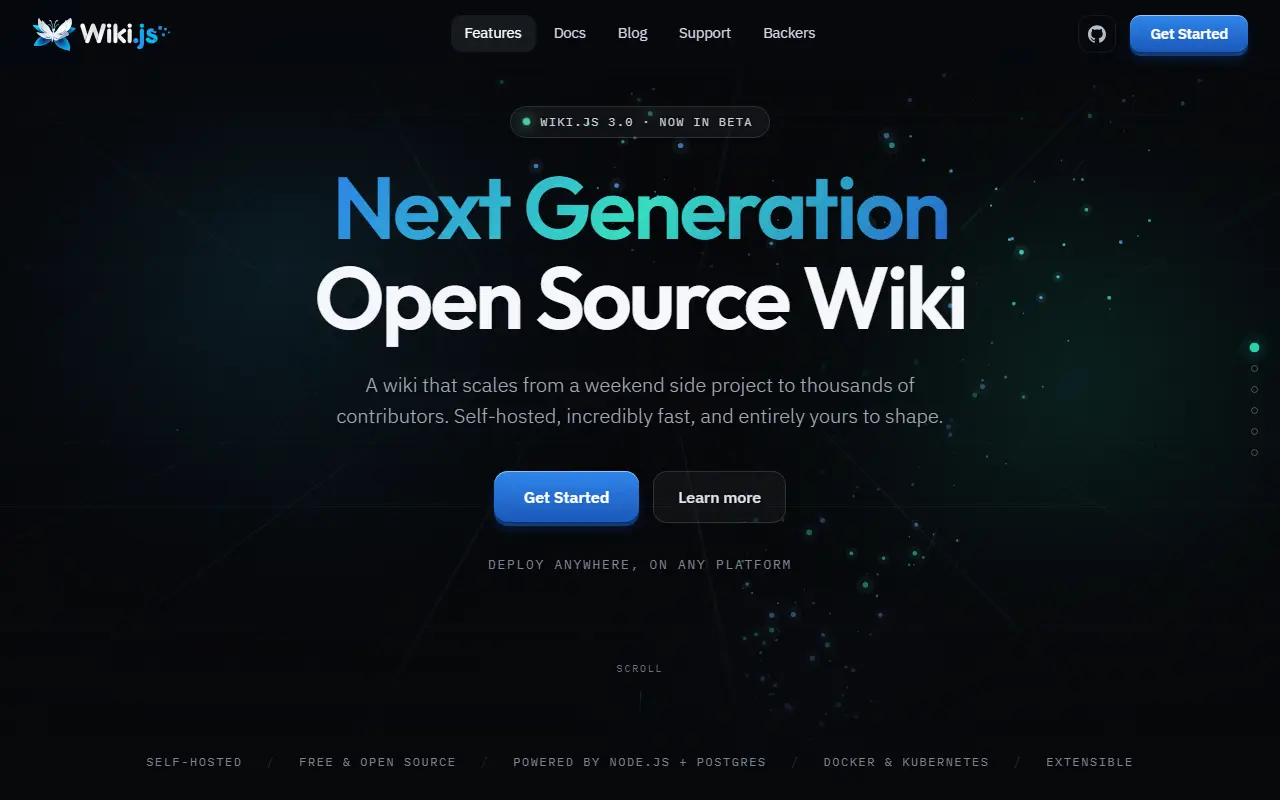
Wiki.js

Wiki.js is a Node.js-based open-source wiki; this repository holds the 3.0 beta, which is not intended for production use, while the stable 2.x line lives elsewhere.

GitHub stars
29k
Last commit
yesterday
Latest release
3.3.1
Licence
AGPL-3.0
Self-hosted
Yes
beta.js.wikiWiki.js homepage screenshot

Wiki.js is a next-generation open-source wiki platform built on Node.js with a Vue front end. This repository contains the upcoming 3.0 release in beta, and the README is explicit that it is not for production use. The current stable 2.x release is published at js.wiki and in a separate repository.

The project is aimed at documentation and knowledge sharing for teams. Topics list Markdown editing, Git, cross-platform operation and documentation, and the beta is accompanied by installation requirements, a changelog and a feature request channel. Contributors can help with translations, and the project is supported by sponsors, patrons and donations from the community.

Wiki.js is AGPL-3.0 licensed. It is software you run on your own server, so it suits teams that want a self-hosted wiki they control. Anyone who needs a dependable wiki today should look at the 2.x stable version rather than this beta, and treat the 3.0 code as a preview of what is coming.

Key features

  • Node.js wiki with a Vue front end
  • Markdown content editing
  • Git-friendly documentation workflow
  • Installs on multiple platforms
  • Community-driven translation effort
  • 3.0 beta preview with changelog

Pricing: Free and open source under the AGPL-3.0 license.

BookStack

A simple, self-hosted wiki and documentation platform built with PHP and Laravel that organizes content into books, chapters and pages.

GitHub stars
19k
Last commit
yesterday
Latest release
v26.09.3
Licence
MIT
Self-hosted
Yes
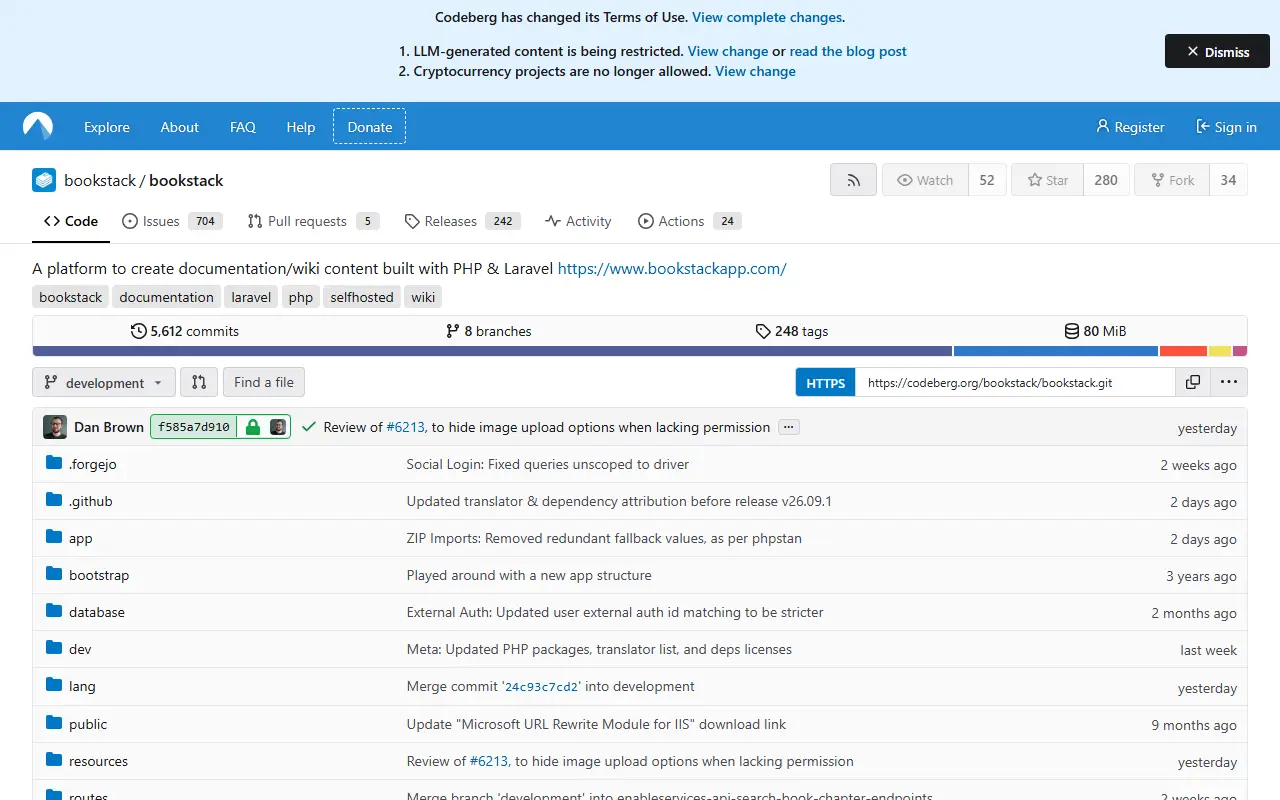
codeberg.orgBookStack homepage screenshot

BookStack is a platform for storing and organizing information and documentation, built with PHP and the Laravel framework. It is deliberately opinionated: the aim is a pleasant, intuitive experience out of the box where only basic word-processing skills are needed to create content, so non-technical colleagues can contribute.

Content is organized in a book metaphor, with shelves, books, chapters and pages. Advanced capabilities are available for those who want them, but the project says they should never get in the way of the simple core experience, and it is not intended as a general extensible platform for unrelated purposes. Development is relaxed and positive, evolving slowly while keeping upgrades stable and easy. There is a demo instance, installation instructions, documentation and a blog.

BookStack is licensed under MIT and is now managed on Codeberg, which is where the primary repository and issue list live. You host it on your own server with PHP and a database. It suits teams, schools and small organizations that want an approachable internal wiki rather than a highly configurable knowledge system.

Key features

  • Shelves, books, chapters and pages structure
  • Simple editor for non-technical users
  • Self-hosted PHP and Laravel application
  • Stable and easy upgrade path
  • Demo instance and documentation
  • Advanced options that stay out of the way

Pricing: Free and open source under the MIT license.

Scanopy

Scanopy automatically scans your network on a schedule and keeps physical, logical, workload and application diagrams up to date without manual drawing.

GitHub stars
6k
Last commit
today
Latest release
v0.19.6
Licence
AGPL-3.0
Self-hosted
Yes
Hosted version
Available
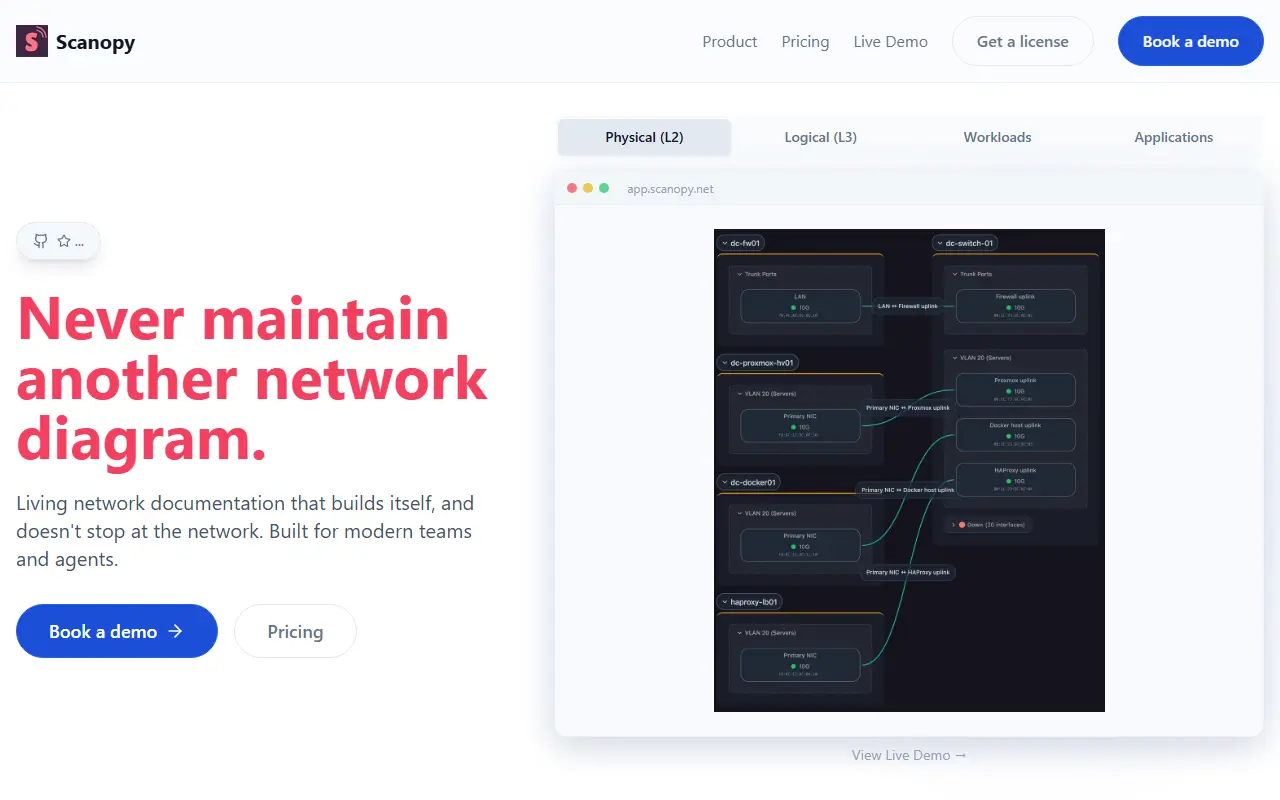
scanopy.netScanopy homepage screenshot

Scanopy is network documentation software that builds and maintains diagrams for you. A single daemon scans your infrastructure on a schedule and turns each scan into a model of what is actually running, so teams no longer have to redraw diagrams by hand whenever something changes. It is written in Rust.

Each scan produces four views: a physical layer 2 view of switches, ports and links, a logical layer 3 view of subnets, a workloads view and an applications view. The project contrasts this with hand-drawn diagrams that go stale quickly and with infrastructure-as-code state that can miss drift. Maps can be exported as SVG, Mermaid or Confluence content, embedded as live maps, or fed into an existing source of truth.

Scanopy is licensed under AGPL-3.0 and is aimed at home labs, network administrators and IT teams that want accurate network docs. You can host it yourself, or use the vendor's cloud version, which the README says is available with a free trial.

Key features

  • Scheduled network scanning by a single daemon
  • Physical layer 2 network view
  • Logical layer 3 subnet view
  • Workload and application views
  • Export to SVG, Mermaid and Confluence
  • Embeddable live network maps

Pricing: Free self-hosted Community Edition. Cloud plans start at $79.99 per month billed annually; commercial self-hosted licenses cost $4,000 or $6,000 per year, with no per-device fees.

MediaWiki

MediaWiki is the free PHP wiki software that powers Wikipedia and other Wikimedia sites, extensible with hundreds of extensions and available in many languages.

GitHub stars
5.2k
Last commit
today
Self-hosted
Yes
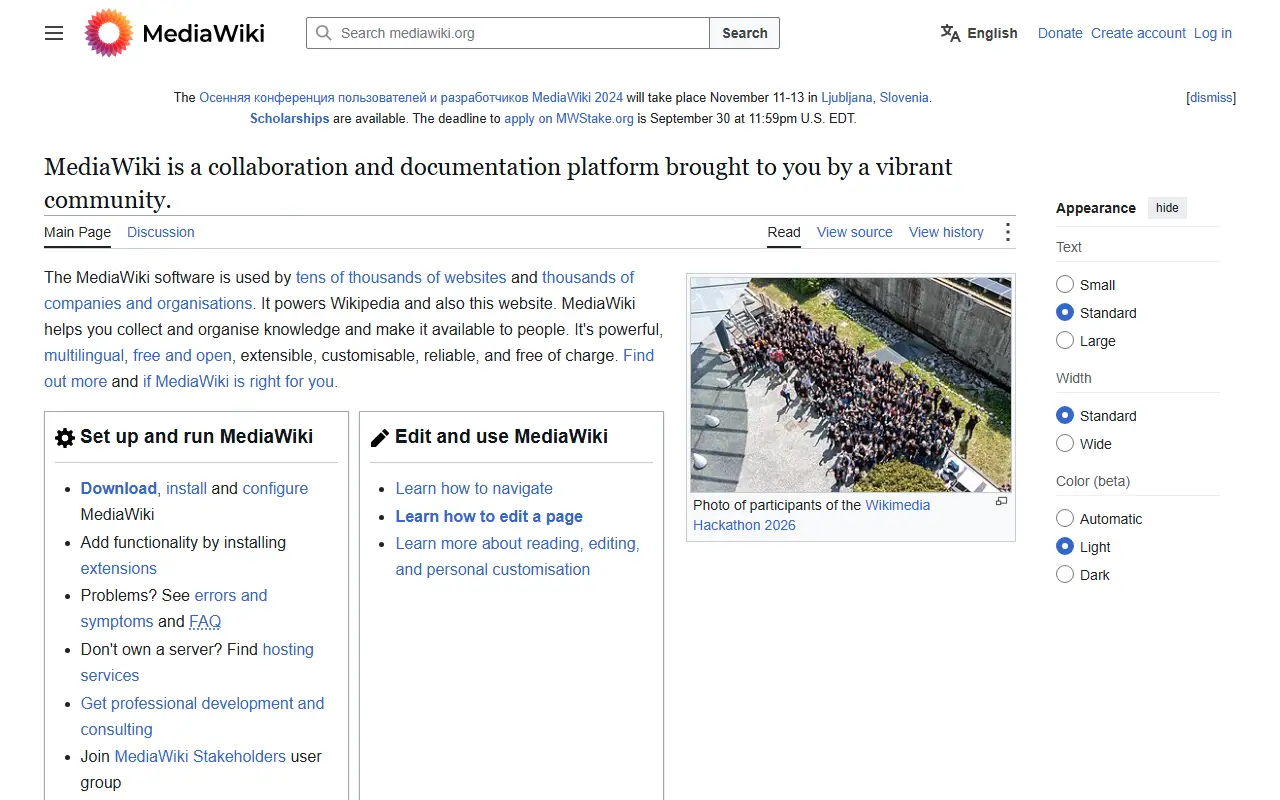
mediawiki.orgMediaWiki homepage screenshot

MediaWiki is free, open-source wiki software written in PHP. It was created for and still runs Wikipedia and the other Wikimedia projects, which gives it a long record at very large scale. Anyone can install it to host a knowledge base, documentation site or community encyclopedia.

The README describes it as extensible, with hundreds of extensions for both the on-wiki experience and the back end, and as scalable enough for small and large sites alike. It is simple to install on most hardware and software combinations and is localized in more than 350 languages, with a large community of third-party users and developers around it. System requirements and installation steps are documented on the project site.

The GitHub repository is a mirror of the code reviewed on Wikimedia's Gerrit server, and contributors are directed to the developer access page. MediaWiki is released under the GNU General Public License, which GitHub reports as 'Other'. You host it yourself, or use one of the many third-party wiki hosting providers.

Key features

  • Collaborative wiki editing with page history
  • Hundreds of extensions for added functionality
  • Localized in more than 350 languages
  • Scales from small sites to very large ones
  • Simple installation on common hosting setups
  • Powers Wikipedia and Wikimedia projects

Pricing: Free and open source software; hosting costs depend on where you run it.

DokuWiki

An open source wiki engine written in PHP that stores pages as plain text files, so it needs no database.

GitHub stars
4.7k
Last commit
2 days ago
Latest release
release-2026-07-14c
Licence
GPL-2.0
Self-hosted
Yes

DokuWiki is an open source wiki application written in PHP and licensed under GPLv2. It works on plain text files, which means it does not need a database. Its syntax is similar to the one used by MediaWiki, and it is often recommended as a lighter, easier to customize alternative.

Because it only needs files, it can be installed on local PCs, flash drives, and folders synced with file hosting services or file synchronization programs such as Dropbox or Syncthing. The name comes from the German word for documentation, Dokumentation.

Andreas Gohr created DokuWiki in June 2004. A parser and renderer redesign in January 2005 and a cache mechanism brought performance gains that made it usable for larger projects. Installation instructions and all documentation are published on dokuwiki.org.

Key features

  • Stores content in plain text files
  • Written in PHP and licensed under GPLv2
  • Syntax similar to MediaWiki
  • Can run from local PCs, flash drives or synced folders
  • Cache mechanism for larger projects

XWiki

XWiki Platform is a generic Java wiki platform that provides runtime services for applications built on top of it.

GitHub stars
1.3k
Last commit
yesterday
Latest release
xwiki-platform-17.10.15
Licence
LGPL-2.1
Self-hosted
Yes
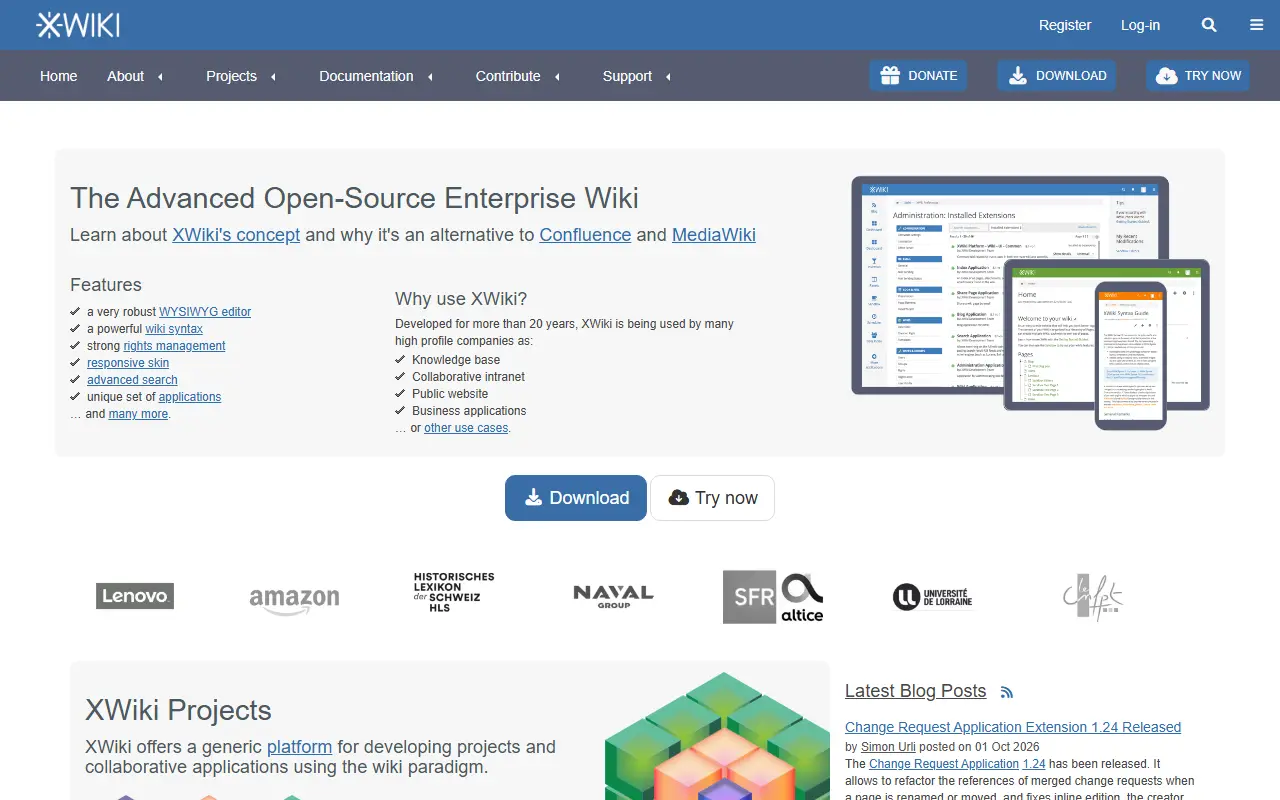
platform.xwiki.orgXWiki homepage screenshot

XWiki Platform is a generic wiki platform that offers runtime services for applications built on top of it. It is written in Java and licensed under LGPL-2.1. XWiki Commons, XWiki Rendering and XWiki Platform are part of the XWiki.org software forge, and they are released together and share the same version number.

The project provides separate guides for developers, administrators and users, an API reference, a development zone and release notes. Download and installation instructions are published on the platform site. The most recent release listed in the data is xwiki-platform-16.10.19.

Development tools include continuous integration that builds each commit, an issue tracker that is not GitHub Issues, and a documented development flow. The project invites contributions through a Get Involved guide and offers a forum and chat for the community, plus a blog with news. A project health page shows further statistics.

Key features

  • Generic wiki platform in Java
  • Runtime services for applications built on it
  • Guides for users, administrators and developers
  • Public API documentation
  • Released together with Commons and Rendering

Pricing: Free and open source under the LGPL-2.1 license.

Commercial IT Glue alternatives

Hosted, closed-source products that compete with IT Glue. Showing 12 of 14.

See every IT Glue alternative on its tool page

IT Glue alternatives: questions

What is the best open-source alternative to IT Glue?
Outline is the top-ranked open-source alternative to IT Glue on Enlisted: A collaborative team knowledge base and wiki with realtime editing and Markdown compatibility, built with React and Node.js and available hosted or self-run. Other strong options are Wiki.js, BookStack, Scanopy and MediaWiki.
What are the best commercial alternatives to IT Glue?
Hudu, Passportal, Slab, Confluence and Freshservice are among the hosted, closed-source alternatives to IT Glue listed on Enlisted, which lists 14 in total. Compare their pricing and features on each tool page.
Are these IT Glue alternatives free?
All 7 are open source, so the code is free to use under its licence, and all of them can be self-hosted on your own server or computer. 2 also offer a paid or managed cloud version if you'd rather not host it yourself.
How is this list of IT Glue alternatives ranked?
By a score built from GitHub stars, star growth over the last 30 days and how recently the code changed. 7 of these projects shipped code in the last 30 days. Data is refreshed daily, and nobody can pay to move up.

People also look for alternatives to…

View all