7,363 open-source and SaaS tools, with GitHub stats refreshed every day.

23 alternatives ranked by real activity

Open-source Confluence alternatives

A curated, ranked list of the 23 best open-source alternatives to Confluence.

The best open-source alternative to Confluence is AppFlowy. If that doesn't suit you, other good options are Outline, Wiki.js, Docmost and BookStack.

Confluence alternatives are mainly documentation & wiki tools, but some are also note-taking tools and project management tools. 16 of them shipped code in the last 30 days, 23 can be self-hosted, and 11 use a permissive licence.

Last updated October 2, 2026 · ranked by GitHub stars, growth and recent commits

AppFlowy

An open-source AI collaborative workspace for notes, wikis, tasks and projects, built as a Notion alternative that keeps you in control of your data.

GitHub stars
77k
Last commit
2 days ago
Latest release
0.14.6
Licence
AGPL-3.0
Self-hosted
Yes
Hosted version
Available
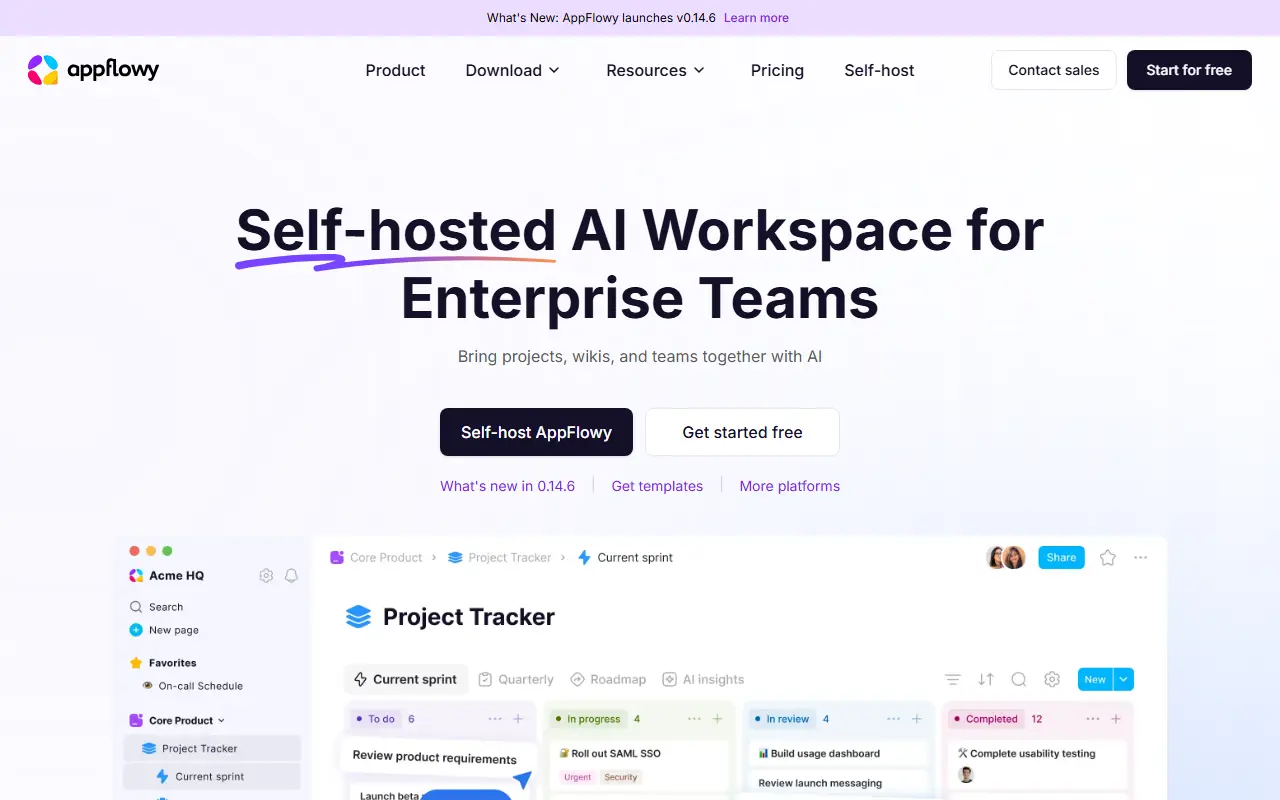
appflowy.comAppFlowy homepage screenshot

AppFlowy is an open-source workspace that brings documents, wikis, project and task management and team collaboration into one app. It is presented as an alternative to Notion, and its topics also tag it as a Confluence alternative, with the emphasis on keeping control of your own data.

The client is built with Flutter and a Rust core, giving apps for macOS, Windows and Linux plus iOS and Android versions. Desktop builds can be downloaded directly or from channels such as Flathub and Snapcraft. AI features are part of the workspace, and a public roadmap and active forum let users propose features. Translations are contributed through JSON files and tools such as inlang.

The project is AGPL-3.0 licensed and has documentation for self-hosting the server side, so organizations can keep content on their own infrastructure. A hosted version is available through appflowy.com for people who do not want to run servers. It suits teams looking for a Notion-style workspace with a privacy-first stance.

Key features

  • Notes, wikis and documentation in one workspace
  • Project and task management
  • AI features built into the workspace
  • Apps for desktop, iOS and Android
  • Self-hosting option for your own data
  • Public roadmap and community translations

Pricing: Free plan for up to 2 members. Pro costs $12.50 per user per month, or $10 billed annually. Self-hosted plans range from Free to Enterprise but their prices are not listed.

Outline

A collaborative team knowledge base and wiki with realtime editing and Markdown compatibility, built with React and Node.js and available hosted or self-run.

GitHub stars
41k
Last commit
yesterday
Latest release
v1.10.1
Self-hosted
Yes
Hosted version
Available
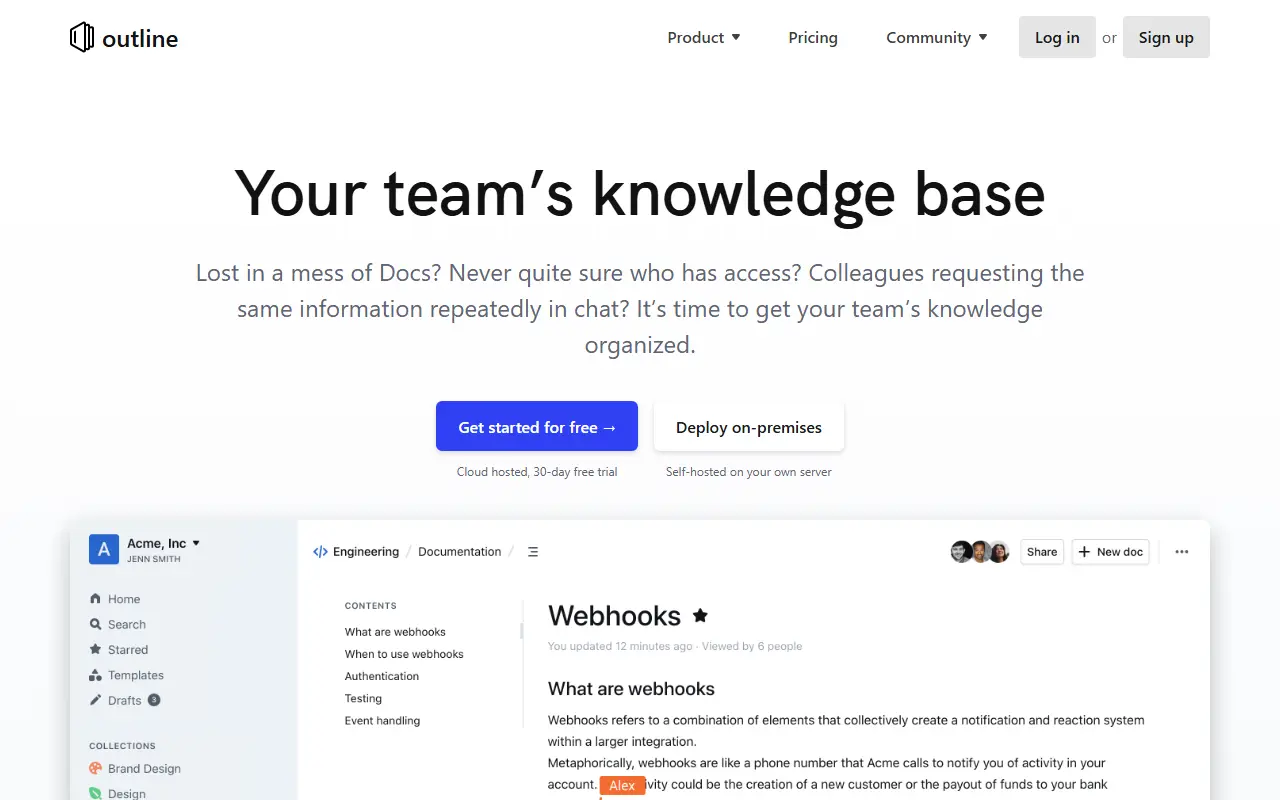
getoutline.comOutline homepage screenshot

Outline is a knowledge base for teams, built with React and Node.js. It focuses on fast, collaborative writing: documents are edited together in realtime, stay compatible with Markdown, and are organized into collections so a growing team can find what it has written down.

The maintainers offer a hosted version at getoutline.com, and the repository contains the source that runs Outline and its associated services. If you only want to use Outline you do not need to run the code yourself, while teams that want their own copy can follow the documentation for a production configuration and use the published container images. Topics also mention a Slack integration.

The repository license is listed as 'Other', so review it before commercial redistribution. Outline suits teams looking for a wiki or internal documentation tool with a clean editor, as an alternative to products such as Confluence or Notion for company knowledge. The project does not accept AI-generated pull requests.

Key features

  • Realtime collaborative editing
  • Markdown-compatible document editing
  • Collections for organizing a wiki
  • Integration with Slack workspaces
  • Hosted service at getoutline.com
  • Container images for self-running

Pricing: Cloud pricing is by team size: $10 per month for 1-10 members, $79 for 11-100 and $249 for 101-200. The first 30 days are free; larger teams are quoted.

Wiki.js

Wiki.js is a Node.js-based open-source wiki; this repository holds the 3.0 beta, which is not intended for production use, while the stable 2.x line lives elsewhere.

GitHub stars
29k
Last commit
yesterday
Latest release
3.0.0-beta.617
Licence
AGPL-3.0
Self-hosted
Yes
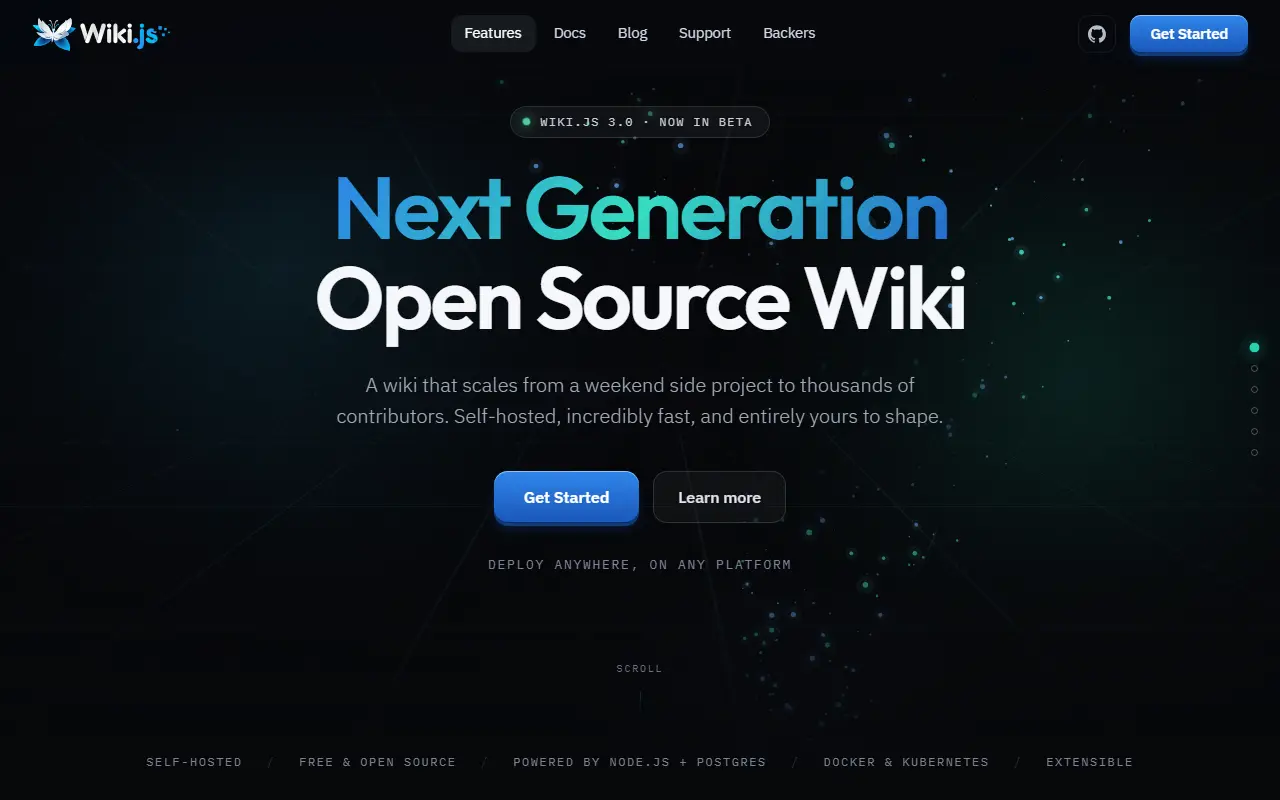
beta.js.wikiWiki.js homepage screenshot

Wiki.js is a next-generation open-source wiki platform built on Node.js with a Vue front end. This repository contains the upcoming 3.0 release in beta, and the README is explicit that it is not for production use. The current stable 2.x release is published at js.wiki and in a separate repository.

The project is aimed at documentation and knowledge sharing for teams. Topics list Markdown editing, Git, cross-platform operation and documentation, and the beta is accompanied by installation requirements, a changelog and a feature request channel. Contributors can help with translations, and the project is supported by sponsors, patrons and donations from the community.

Wiki.js is AGPL-3.0 licensed. It is software you run on your own server, so it suits teams that want a self-hosted wiki they control. Anyone who needs a dependable wiki today should look at the 2.x stable version rather than this beta, and treat the 3.0 code as a preview of what is coming.

Key features

  • Node.js wiki with a Vue front end
  • Markdown content editing
  • Git-friendly documentation workflow
  • Installs on multiple platforms
  • Community-driven translation effort
  • 3.0 beta preview with changelog

Pricing: Free and open source under the AGPL-3.0 license.

Docmost

An open-source collaborative wiki and documentation tool, positioned as an alternative to Confluence and Notion, with real-time editing, diagrams and permissions.

GitHub stars
22k
Last commit
2 days ago
Latest release
v0.96.0
Licence
AGPL-3.0
Self-hosted
Yes
Hosted version
Available
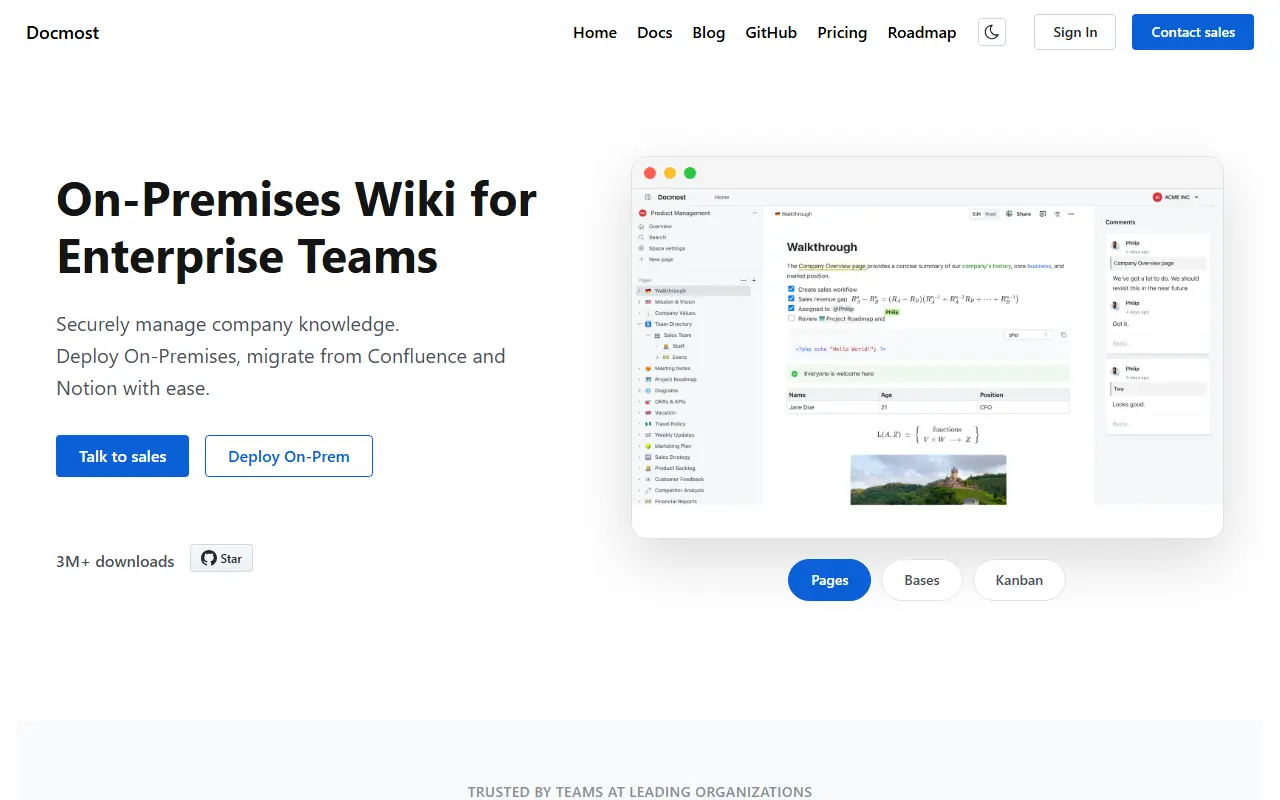
docmost.comDocmost homepage screenshot

Docmost is a collaborative wiki and documentation tool, open source and presented as an alternative to Confluence and Notion with a focus on secure, on-premise use. Teams write and organize knowledge together in real time, and the project emphasizes that its self-hosted deployment fits organizations with strict compliance requirements.

Its feature list covers real-time collaboration, diagrams through Draw.io, Excalidraw and Mermaid, spaces for organizing content, permission management with groups, comments, page history, search, file attachments and embeds for tools such as Airtable, Loom and Miro. The interface is translated into more than ten languages. Topics mention an AI feature, real-time collaboration and drop-in migration from other wikis.

The Docmost core is licensed under AGPL-3.0, while enterprise features sit in specific directories under a separate enterprise license. You can follow the documentation to self-host it or try the cloud version. It suits teams looking for an internal knowledge base or documentation hub with a lighter footprint than Confluence.

Key features

  • Real-time collaborative editing
  • Diagrams with Draw.io, Excalidraw and Mermaid
  • Spaces, groups and permission management
  • Comments and page history
  • Full-text search and file attachments
  • Embeds for Airtable, Loom and Miro

Pricing: The self-managed Community edition is free. Business costs $6 per seat per month billed annually with a 10-seat minimum; Enterprise is custom and trial licenses are available.

BookStack

A simple, self-hosted wiki and documentation platform built with PHP and Laravel that organizes content into books, chapters and pages.

GitHub stars
19k
Last commit
yesterday
Latest release
v26.09.1
Licence
MIT
Self-hosted
Yes
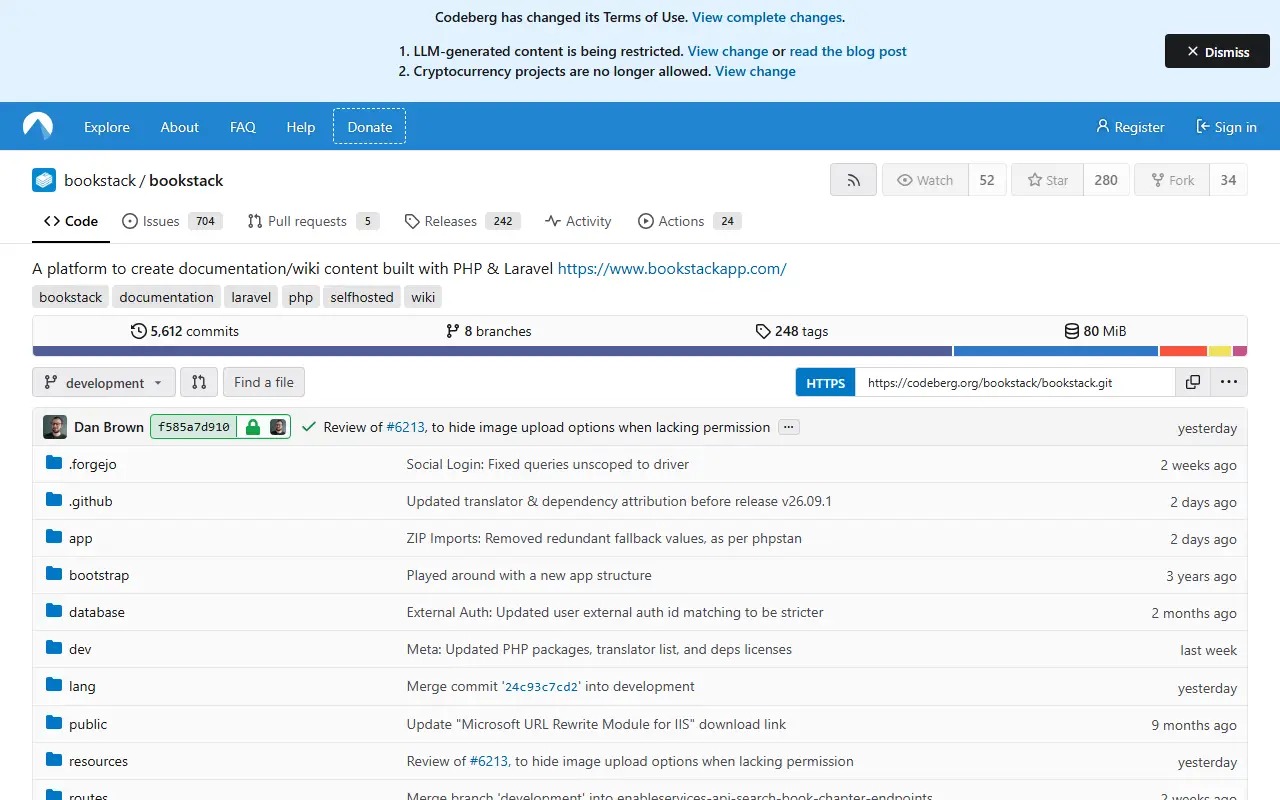
codeberg.orgBookStack homepage screenshot

BookStack is a platform for storing and organizing information and documentation, built with PHP and the Laravel framework. It is deliberately opinionated: the aim is a pleasant, intuitive experience out of the box where only basic word-processing skills are needed to create content, so non-technical colleagues can contribute.

Content is organized in a book metaphor, with shelves, books, chapters and pages. Advanced capabilities are available for those who want them, but the project says they should never get in the way of the simple core experience, and it is not intended as a general extensible platform for unrelated purposes. Development is relaxed and positive, evolving slowly while keeping upgrades stable and easy. There is a demo instance, installation instructions, documentation and a blog.

BookStack is licensed under MIT and is now managed on Codeberg, which is where the primary repository and issue list live. You host it on your own server with PHP and a database. It suits teams, schools and small organizations that want an approachable internal wiki rather than a highly configurable knowledge system.

Key features

  • Shelves, books, chapters and pages structure
  • Simple editor for non-technical users
  • Self-hosted PHP and Laravel application
  • Stable and easy upgrade path
  • Demo instance and documentation
  • Advanced options that stay out of the way

Pricing: Free and open source under the MIT license.

MediaWiki

MediaWiki is the free PHP wiki software that powers Wikipedia and other Wikimedia sites, extensible with hundreds of extensions and available in many languages.

GitHub stars
5.2k
Last commit
today
Self-hosted
Yes
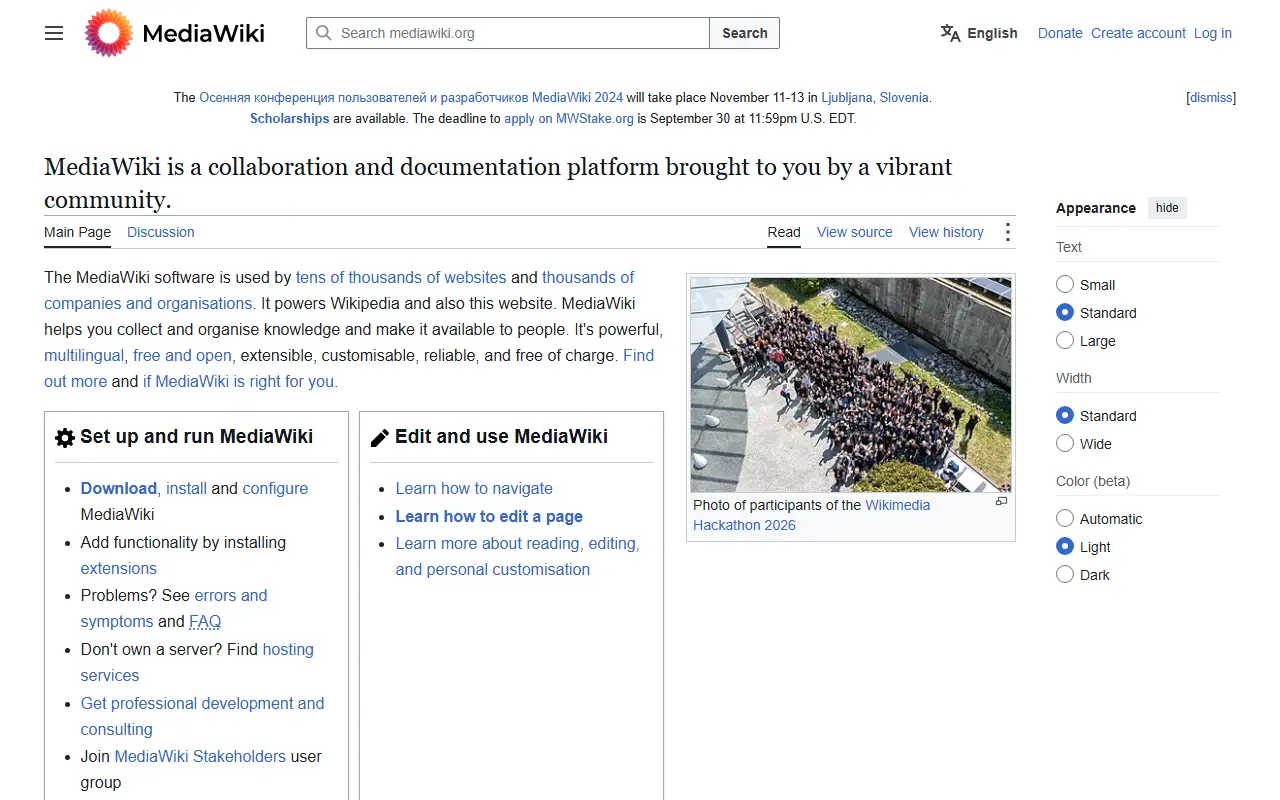
mediawiki.orgMediaWiki homepage screenshot

MediaWiki is free, open-source wiki software written in PHP. It was created for and still runs Wikipedia and the other Wikimedia projects, which gives it a long record at very large scale. Anyone can install it to host a knowledge base, documentation site or community encyclopedia.

The README describes it as extensible, with hundreds of extensions for both the on-wiki experience and the back end, and as scalable enough for small and large sites alike. It is simple to install on most hardware and software combinations and is localized in more than 350 languages, with a large community of third-party users and developers around it. System requirements and installation steps are documented on the project site.

The GitHub repository is a mirror of the code reviewed on Wikimedia's Gerrit server, and contributors are directed to the developer access page. MediaWiki is released under the GNU General Public License, which GitHub reports as 'Other'. You host it yourself, or use one of the many third-party wiki hosting providers.

Key features

  • Collaborative wiki editing with page history
  • Hundreds of extensions for added functionality
  • Localized in more than 350 languages
  • Scales from small sites to very large ones
  • Simple installation on common hosting setups
  • Powers Wikipedia and Wikimedia projects

Pricing: Free and open source software; hosting costs depend on where you run it.

DokuWiki

DokuWiki is an open-source wiki engine written in PHP, aimed at documentation and knowledge bases that are easy to install and maintain.

GitHub stars
4.7k
Last commit
3 days ago
Latest release
release-2026-07-14c
Licence
GPL-2.0
Self-hosted
Yes

DokuWiki is an open-source wiki engine written in PHP. It is commonly used for documentation, internal knowledge bases and project wikis, and is known for storing pages as plain text files rather than requiring a separate database, which keeps installation and backups simple.

The homepage could not be fetched when this entry was prepared, so the details here come from the repository description, topics and widely known project traits. The project is licensed under GPL-2.0, publishes dated releases and is extended with plugins and templates maintained by its community.

Key features

  • Wiki engine written in PHP
  • File-based page storage
  • Plugin and template support
  • Suited to documentation wikis
  • Regular dated releases

Pricing: Free and open source under GPL-2.0.

MrDoc

Self-hosted document and knowledge base system built with Python and Django, for individuals and small teams writing notes, wikis, and product docs.

GitHub stars
3.2k
Last commit
3 days ago
Latest release
v1.1.1
Licence
GPL-3.0
Self-hosted
Yes
mrdoc.ioMrDoc homepage screenshot

MrDoc is an online document and knowledge management system you host yourself. It covers capturing and storing content, organizing it into collections, AI-assisted question answering, writing, and sharing, so individuals and small teams can keep personal notes, internal wikis, product documentation, and tutorials in one place. Its own description compares it to a self-hosted Yuque or an online-editable GitBook.

Content is written in Markdown, and the project provides several ways in: the web application, browser extensions for web clipping and quick notes, desktop clients for Windows, macOS, and Linux, a mobile client for Android, and an Obsidian plugin for two-way sync. The web app comes in an open-source edition and a professional edition, so some features are reserved for the paid tier.

MrDoc is written in Python with the Django framework and released under the GPL-3.0 license, with documentation in both Chinese and English and a demo site. It suits teams that want full ownership of their knowledge base data and a simple self-hosted alternative to cloud documentation tools.

Key features

  • Markdown document editing and organization
  • Wiki and knowledge base structure
  • AI knowledge base question answering
  • Browser extension for web clipping
  • Desktop and mobile clients
  • Two-way sync with Obsidian

Pricing: The open-source edition is free under the GPL-3.0 license; a separate Professional Edition exists.

Read more about MrDocWebsite GitHub

Alexandrie

Self-hosted, offline-first knowledge base with an extended Markdown editor, team workspaces, OIDC single sign-on, and one-command Docker deployment.

GitHub stars
2.8k
Last commit
8 days ago
Latest release
v8.14.2
Licence
MIT
Self-hosted
Yes
alexandrie-hub.frAlexandrie homepage screenshot

Alexandrie is an open-source, self-hosted wiki and knowledge management platform for individuals and teams. It combines an extended Markdown editor with offline support, collaboration tools, and fine-grained permissions, and is pitched as an alternative to Notion, Obsidian, and Confluence. It is released under the MIT license.

The Markdown engine supports LaTeX, custom containers, interactive checkboxes, frames, snippets, and integrated diagrams. Content is organized in a multi-tenant structure of teams, workspaces, categories, and nested documents. It works as an offline-first progressive web app that can be installed on devices, and it supports OIDC single sign-on and local S3 backups. The topics also mention kanban boards.

The whole stack comes up with one Docker command. It uses a Go backend and a Nuxt and Vue front end. Alexandrie suits teams and individuals who want a private knowledge base with enterprise-style permissions and who prefer to keep their notes on their own infrastructure.

Key features

  • Extended Markdown editor with LaTeX and diagrams
  • Teams, workspaces, categories, and nested documents
  • Offline-first installable web app
  • OIDC single sign-on
  • Local S3 backups
  • One-command Docker deployment

Pricing: Free and open source under the MIT license.

Gollum

Gollum is a simple wiki built on Git, storing pages as editable text files and offering a local web editor and many markup formats.

GitHub stars
14k
Last commit
10 mo ago
Latest release
v6.1.0
Licence
MIT
Self-hosted
Yes

Gollum is a wiki system built on top of Git. A Gollum wiki is simply a Git repository of text or markup files that humans can edit, organized into directories however you like, and it can also hold images, PDFs and page headers and footers. Pages can be written in a variety of markups and edited with your own editor or with the built-in web interface.

Because it is Git, every page keeps its history, can be displayed in all versions and can be reverted. Gollum aims to stay compatible with GitHub and GitLab wikis, so you can clone one of those wikis and view or edit it locally. Advanced features include diagrams with Mermaid or PlantUML, BibTeX and citation support, annotations with CriticMarkup, mathematics via KaTeX or MathJax, macros, redirects and an RSS feed of recent changes.

It is written in Ruby and released under the MIT license. It runs on Unix-like systems and Windows using either standard Ruby or JRuby, though on Windows only JRuby is supported. You can install it as a Ruby gem, run it with Docker or deploy it as a Java web application resource. It also supports Rack, authentication servers and running as a service.

Key features

  • Wiki stored as a Git repository
  • Built-in web editor and local file editing
  • Compatible with GitHub and GitLab wikis
  • Mermaid and PlantUML diagrams
  • Math with KaTeX or MathJax
  • Page redirects and macros
  • RSS feed of recent changes

Pricing: Free and open source under the MIT license.

Read more about GollumGitHub

13 more Confluence alternatives

Confluence alternatives: questions

What is the best open-source alternative to Confluence?
AppFlowy is the top-ranked open-source alternative to Confluence on Enlisted: An open-source AI collaborative workspace for notes, wikis, tasks and projects, built as a Notion alternative that keeps you in control of your data. Other strong options are Outline, Wiki.js, Docmost and BookStack.
Are these Confluence alternatives free?
All 23 are open source, so the code is free to use under its licence, and all of them can be self-hosted on your own server or computer. 4 also offer a paid or managed cloud version if you'd rather not host it yourself.
How is this list of Confluence alternatives ranked?
By a score built from GitHub stars, star growth over the last 30 days and how recently the code changed. 16 of these projects shipped code in the last 30 days. Data is refreshed daily, and nobody can pay to move up.

People also look for alternatives to…

View all