7,363 open-source and SaaS tools, with GitHub stats refreshed every day.

6 alternatives ranked by real activity

Open-source Confidence alternatives

A curated, ranked list of the 6 best open-source alternatives to Confidence.

The best open-source alternative to Confidence is PostHog. If that doesn't suit you, other good options are Unleash, GrowthBook, Flagsmith and FeatBit.

Confidence alternatives are mainly feature flag tools, but some are also analytics tools. 5 of them shipped code in the last 30 days, 6 can be self-hosted, and 3 use a permissive licence.

Last updated October 3, 2026 · ranked by GitHub stars, growth and recent commits

PostHog

An open-source product platform combining analytics, session replay, feature flags, experiments, surveys and error tracking, with AI that turns signals into reports.

GitHub stars
40k
Last commit
yesterday
Latest release
desktop-v0.61.621
Self-hosted
Yes
Hosted version
Available
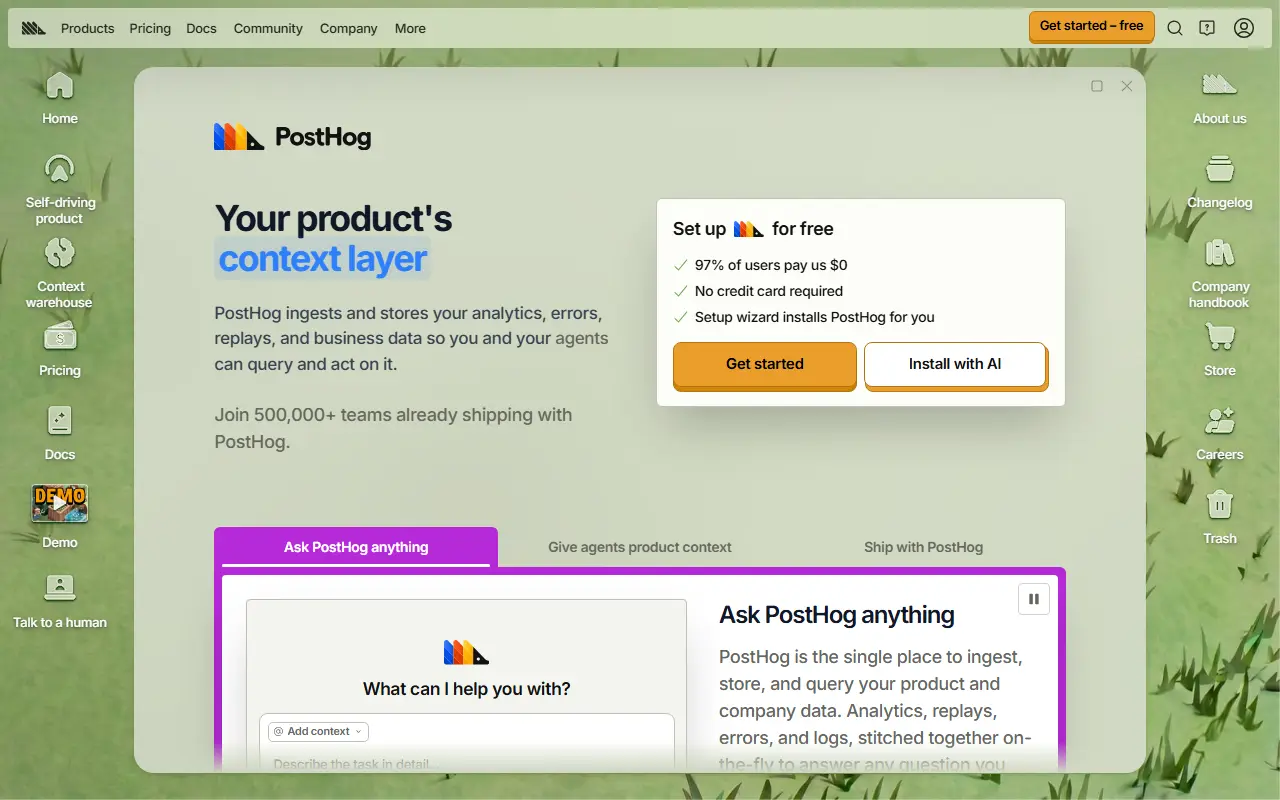
posthog.comPostHog homepage screenshot

PostHog is an open-source platform that bundles the tools product teams use to understand and improve what they ship. It captures event data, user sessions and errors in one place, and its newer self-driving mode aims to turn signals such as errors, rage clicks and failed queries into researched reports and pull requests that engineers review and merge.

The product suite includes product analytics with autocapture or manual instrumentation and SQL analysis, web analytics with a dashboard resembling Google Analytics, session replays for web and mobile, feature flags, experiments with statistical measurement, surveys, error tracking, logs, a data warehouse and a customer data platform. The back end is Python and the front end is React and TypeScript.

PostHog's repository license is listed as 'Other' on GitHub, so check which parts are open source and which are enterprise-only. It can be self-hosted, and the company also runs a managed cloud service. It suits product and engineering teams that prefer a single tool over separate analytics, flagging and replay vendors.

Key features

  • Product analytics with autocapture and SQL
  • Web analytics dashboard
  • Session replay for web and mobile
  • Feature flags and experiments
  • Surveys and error tracking
  • Data warehouse and customer data platform
  • AI-assisted detection of product issues

Pricing: Every product has a free monthly tier with no credit card needed. Pay-as-you-go charges only for usage beyond the free limits; per-unit rates are not shown here and volume discounts are available.

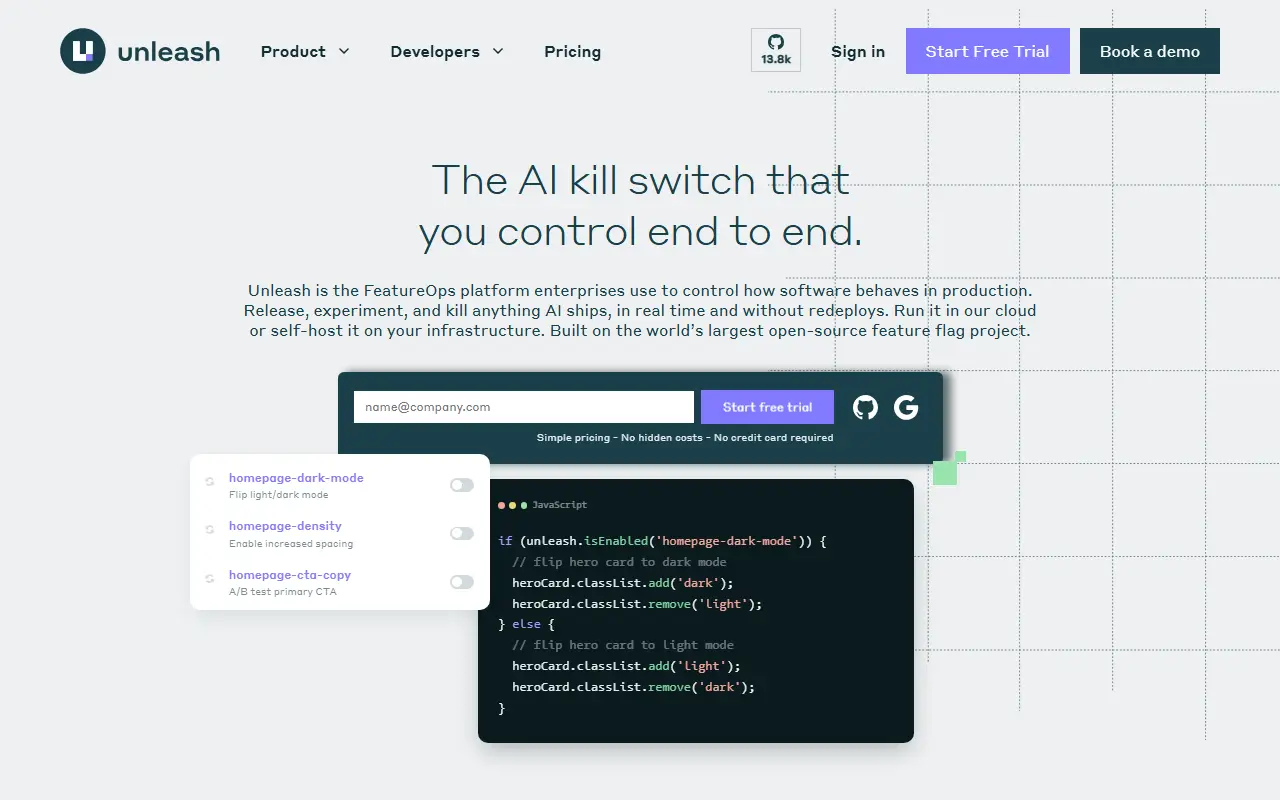
Unleash

An open-source feature management platform for rolling out features gradually with flags, strategies and variants, with many SDKs and an Enterprise edition.

GitHub stars
14k
Last commit
yesterday
Latest release
v8.2.0
Licence
AGPL-3.0
Self-hosted
Yes
Hosted version
Available
getunleash.ioUnleash homepage screenshot

Unleash is an open-source feature management platform. Teams wrap new functionality in feature flags, deploy code to production in smaller releases, and then decide when and for whom each feature is switched on. This lowers the risk of releases and lets several features be developed at once without long-lived feature branches.

Flags can be tested against real production data and controlled using activation strategies and variants, and the project topics also point to experiments and toggles. Unleash provides 15 official client and server SDKs plus community SDKs and works with any language or framework. The Enterprise edition adds single sign-on, SCIM user provisioning, change requests and fine-grained roles, with unlimited projects and environments in a hosted instance.

The open-source edition is licensed under AGPL-3.0 and can be run locally with git and Docker, serving its interface on port 4242, or directly from source with Node.js. A live demo is available, and a free trial gives access to a hosted Enterprise instance.

Key features

  • Feature flags with gradual rollouts
  • Activation strategies and variants
  • 15 official client and server SDKs
  • Role-based access control in Enterprise
  • Change requests for flag updates
  • SSO and SCIM provisioning in Enterprise
  • Multiple projects and environments
  • Run locally with Docker

Pricing: The open-source edition is free to self-host. Pay-as-you-go costs $75 per seat per month with a 14-day trial; annual Enterprise contracts are quoted.

GrowthBook

An open-source platform for feature flags, A/B experimentation and product analytics that queries your data warehouse, available in the cloud or self-hosted.

GitHub stars
8.5k
Last commit
yesterday
Latest release
v5.1.0
Self-hosted
Yes
Hosted version
Available
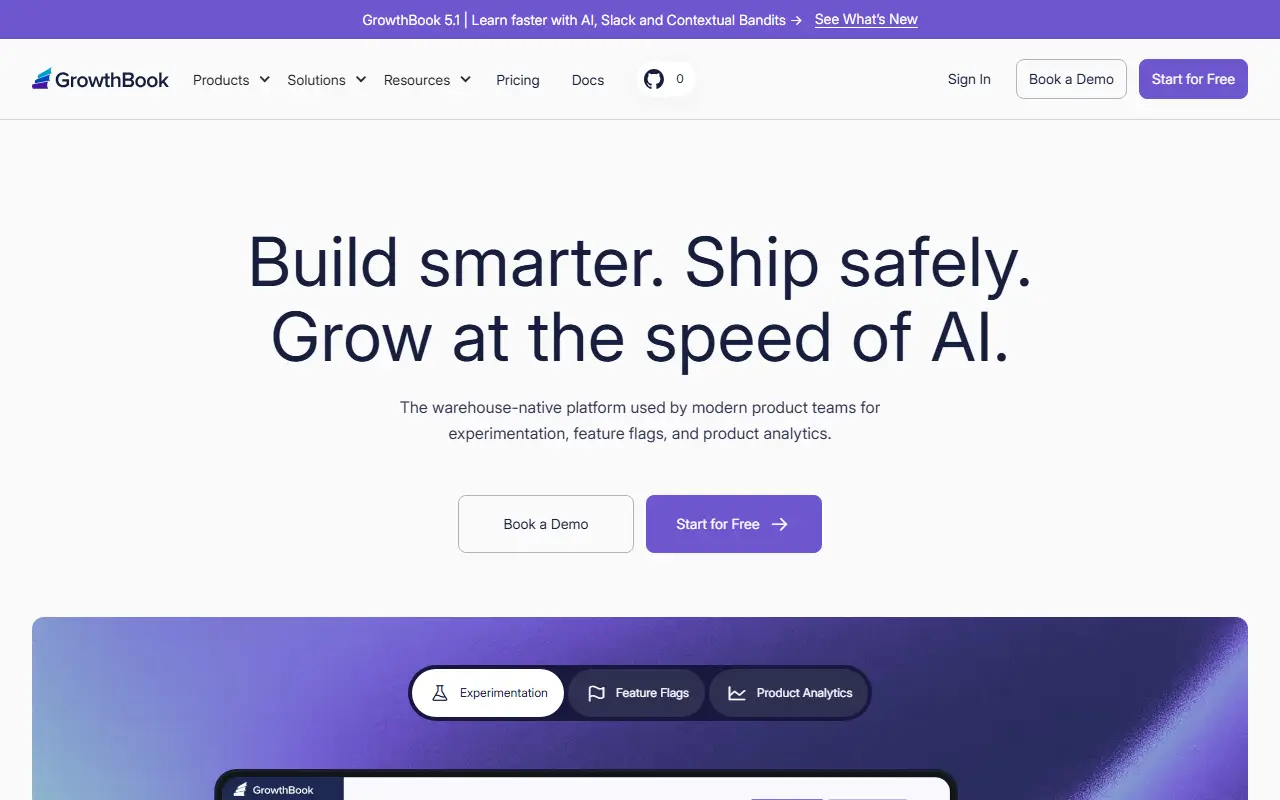
growthbook.ioGrowthBook homepage screenshot

GrowthBook combines feature flagging, experimentation and product analytics in one open-source platform. The project's stated philosophy is that most companies cannot build an in-house platform of this kind, so it aims to give them the flexibility of one without the effort, instead of paying for closed SaaS tools or stitching together unmaintained libraries.

Feature flags support targeting, gradual rollouts and experiments, with 24 SDKs including React, Python, Android and iOS. The statistics engine offers methods such as CUPED, sequential and Bayesian testing, post-stratification, bandits and sample ratio mismatch checks. It is warehouse native, querying data sources such as BigQuery, Snowflake and Databricks, with metrics defined in flexible SQL. A built-in analytics suite supports dashboards, and there are webhooks, a REST API and an MCP server.

You can start with a free GrowthBook Cloud account or run it yourself with Docker and the prebuilt public image. The repository lists the licence as Other, so review the licence terms for the exact conditions on the open-source and enterprise parts. It suits product and data teams that want to run experiments on their own warehouse data.

Key features

  • Feature flags with advanced targeting
  • A/B tests with a Bayesian stats engine
  • Warehouse-native data source queries
  • SQL-based metric definitions
  • Built-in product analytics dashboards
  • 24 SDKs across many languages
  • REST API, webhooks and MCP server

Pricing: Free Starter cloud plan and a free self-hosted Open Source edition. Pro costs $40 per seat per month for up to 30 users; Enterprise is custom.

Flagsmith

An open-source feature flag and remote config platform with segments, A/B testing and SDKs, deployable self-hosted, in a private cloud or as a managed cloud service.

GitHub stars
6.6k
Last commit
yesterday
Latest release
v2.279.0
Licence
BSD-3-Clause
Self-hosted
Yes
Hosted version
Available
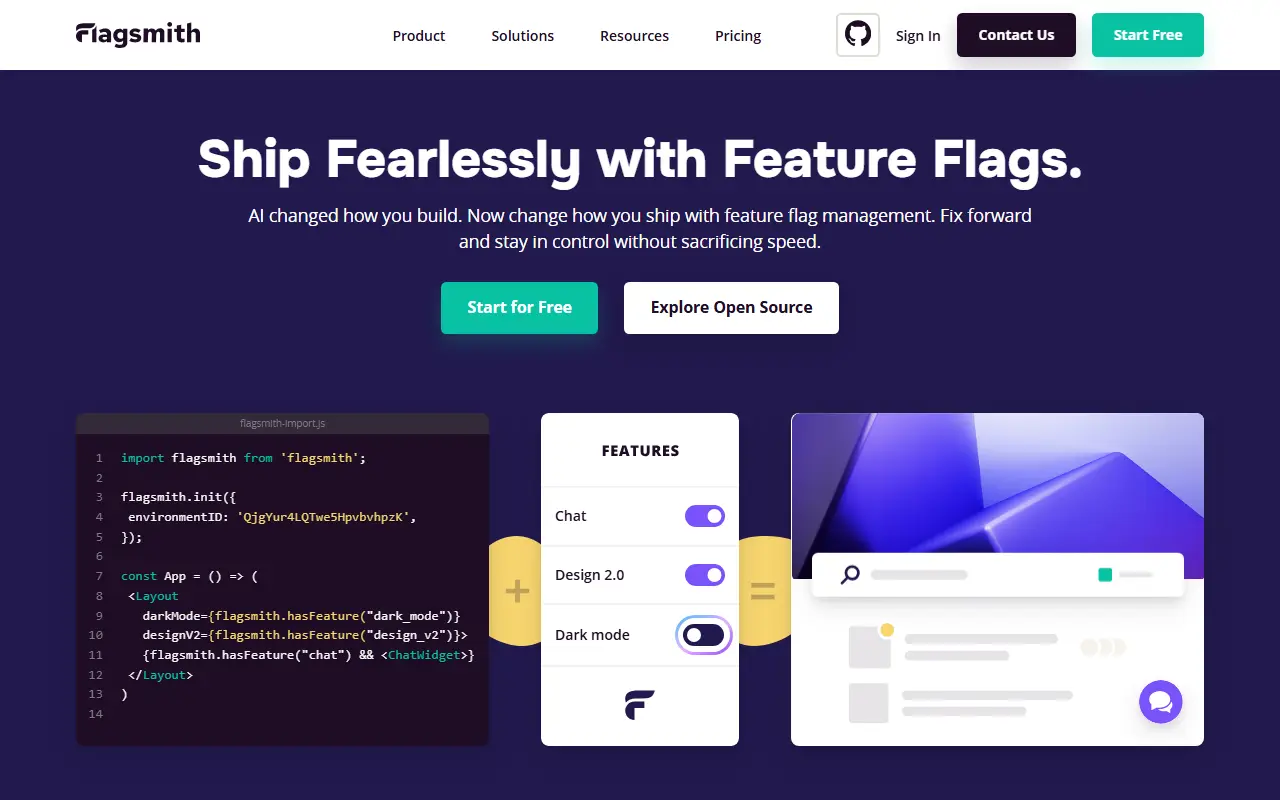
flagsmith.comFlagsmith homepage screenshot

Flagsmith is a feature management platform, released as open source, offering feature flags, remote configuration and experimentation. It provides three deployment options: self-hosted, available as a free open-source build or as a fully supported Enterprise edition, a private cloud and a standard cloud service. Its partnership with OpenFeature is intended to avoid vendor lock-in.

Teams wrap sections of code in flags and toggle features on or off remotely for different environments, users or segments without deploying new code. Segments let you release to beta testers and gather feedback, and A/B and multivariate tests run on top of segments. Organisation management covers orgs, projects and roles for team members, and SDKs cover more than 15 languages with support for frameworks such as React and Next.js, plus integrations and an MCP server.

Flagsmith is written in Python and React, ships as Docker images and is released under the BSD 3-Clause licence for the open-source build. It suits product and engineering teams that want controlled rollouts and remote configuration across web, mobile and server-side applications.

Key features

  • Feature flags with remote toggling
  • Remote configuration values
  • Segments for targeted releases
  • A/B and multivariate testing
  • Organisations, projects and roles
  • SDKs for 15+ languages
  • Integrations and MCP server

Pricing: Free plan with 50,000 requests a month. Start-Up costs $45 and Scale-Up $300 per month ($40 and $250 billed yearly), each with a 14-day trial; Enterprise is quoted.

FeatBit

Self-hostable feature flag platform for progressive rollouts, targeting, remote config, and A/B testing, built on .NET with SDKs for several languages.

GitHub stars
1.9k
Last commit
2 days ago
Latest release
6.0.0
Licence
MIT
Self-hosted
Yes
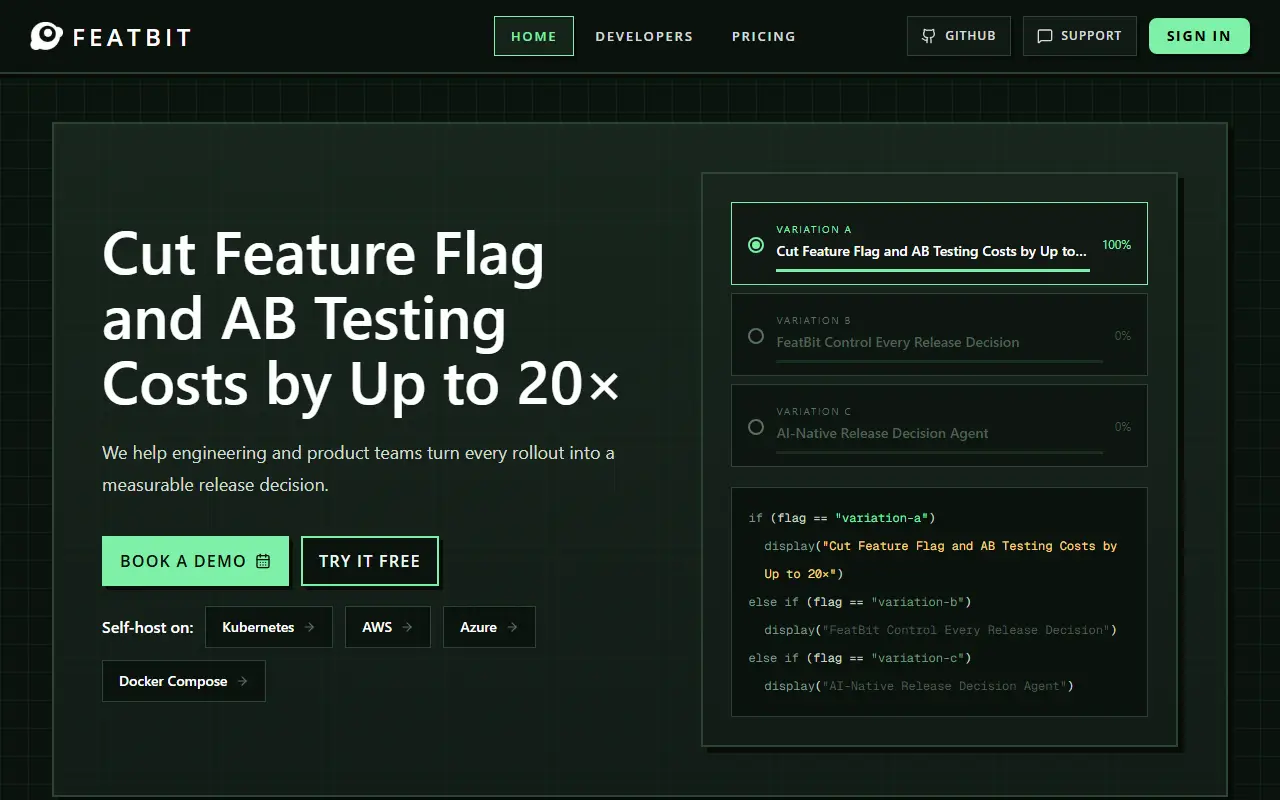
featbit.coFeatBit homepage screenshot

FeatBit is an open-source feature flag management platform that developers can host themselves. It helps teams ship code safely by testing in production, releasing to a small share of users first, expanding gradually, and recovering instantly from errors without redeploying. It is written in C# and .NET and released under the MIT license.

Teams control who sees each feature and when, release to specific target users, and run A/B tests and experiments to measure outcomes. Topics list remote configuration, entitlement, release as code, and progressive delivery. SDKs are available for languages including .NET, Python, and TypeScript, and the project provides documentation, a Discord community, and an online demo.

FeatBit suits engineering teams adopting continuous delivery who want an enterprise-style flag system under their own control, as an alternative to commercial platforms such as LaunchDarkly.

Key features

  • Feature flags with targeted rollouts
  • Progressive percentage-based release
  • A/B testing and experimentation
  • Remote configuration
  • SDKs for .NET, Python, and TypeScript
  • Self-hosted with online demo

Pricing: Self-hosted Foundation is free forever with no usage limits. Enterprise costs $3,999 per year, and Enterprise Premium is custom-priced.

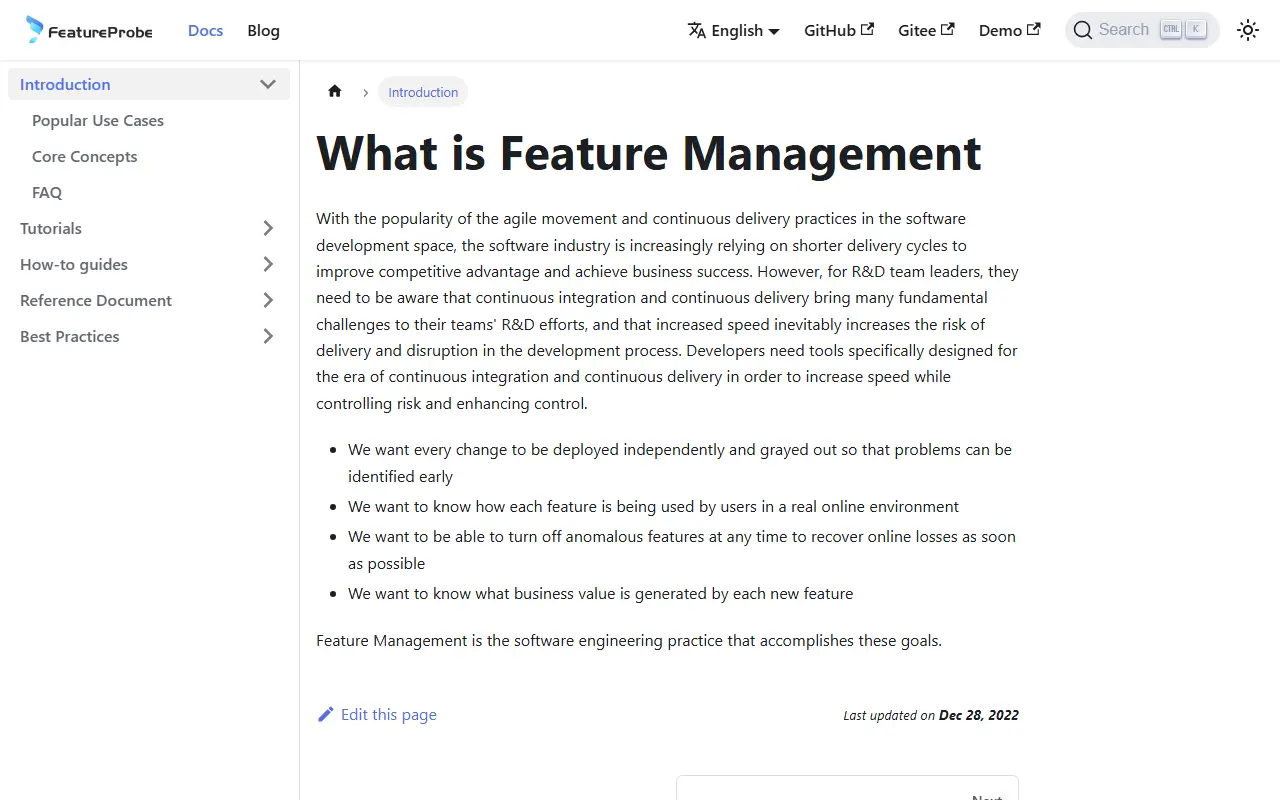
FeatureProbe

Open-source feature management service for feature toggles, gradual rollouts and A/B experiments, aimed at development, SRE and operations teams.

GitHub stars
1.6k
Last commit
4 mo ago
Latest release
2.7.0
Licence
Apache-2.0
Self-hosted
Yes
featureprobe.github.ioFeatureProbe homepage screenshot

FeatureProbe is an open-source feature management service that helps engineering, SRE and operations teams release new features or switch implementations with less risk. It supports feature toggles, gradual (gray) releases and A/B experiments, and lets teams change online parameters within seconds or roll out configuration progressively, without redeploying. The README is bilingual, with a Chinese-language version.

The authors describe several benefits. Feature toggles on the main branch reduce the effort of merging long-lived feature branches. If a feature misbehaves, the SRE team can switch it off or degrade a service from the interface instead of waking developers. New features can also be tested in production with a small share of users, which saves the cost of extra test environments. The team says the product was used internally for years before being open sourced.

FeatureProbe is written mainly in TypeScript and licensed under Apache-2.0. Its topics include feature flags, configuration management, continuous delivery and A/B testing. It is designed to run as a service you operate yourself, with SDKs and documentation on the project site.

Key features

  • Feature toggles managed from a visual interface
  • Gradual release and progressive rollout
  • A/B experiments
  • Online configuration changes within seconds
  • Targeting small user groups in production
  • Works for development and operations teams

Confidence alternatives: questions

What is the best open-source alternative to Confidence?
PostHog is the top-ranked open-source alternative to Confidence on Enlisted: An open-source product platform combining analytics, session replay, feature flags, experiments, surveys and error tracking, with AI that turns signals into reports. Other strong options are Unleash, GrowthBook, Flagsmith and FeatBit.
Are these Confidence alternatives free?
All 6 are open source, so the code is free to use under its licence, and all of them can be self-hosted on your own server or computer. 4 also offer a paid or managed cloud version if you'd rather not host it yourself.
How is this list of Confidence alternatives ranked?
By a score built from GitHub stars, star growth over the last 30 days and how recently the code changed. 5 of these projects shipped code in the last 30 days. Data is refreshed daily, and nobody can pay to move up.

People also look for alternatives to…

View all