7,363 open-source and SaaS tools, with GitHub stats refreshed every day.

7 alternatives ranked by real activity

Open-source Backlog alternatives

A curated, ranked list of the 7 best open-source alternatives to Backlog.

The best open-source alternative to Backlog is Plane. If that doesn't suit you, other good options are OpenProject, Redmine, ZenTao and Taiga.

Backlog alternatives are mainly project management tools. 7 of them shipped code in the last 30 days, 7 can be self-hosted, and 2 use a permissive licence.

Last updated October 2, 2026 · ranked by GitHub stars, growth and recent commits

Plane

An open-source project management platform for issues, sprint cycles, roadmaps, docs and triage, positioned as an alternative to Jira, Linear, Monday and ClickUp.

GitHub stars
60k
Last commit
yesterday
Latest release
v1.4.2
Licence
AGPL-3.0
Self-hosted
Yes
Hosted version
Available

Plane is an open-source project management tool for tracking issues, running sprints and managing product roadmaps. It is positioned as an alternative to Jira, Linear, Monday and ClickUp, and aims to keep the tool itself from getting in the way of the work.

The platform covers task and issue tracking, cycles for sprints, product roadmaps, documentation and a triage flow for incoming work, and topics also mention kanban boards and product management. It is built with a React and TypeScript front end and a Django and Python back end, using PostgreSQL and Redis, and it is packaged for Docker deployments.

You can start with a free account on Plane Cloud, the hosted option, or self-host Plane on your own servers using the deployment guides for full control over data and infrastructure. The code is AGPL-3.0 licensed. It suits teams moving off Jira or Linear who want an open codebase and the choice between a managed service and their own hardware.

Key features

  • Issue tracking with kanban boards
  • Sprint cycles and roadmaps
  • Triage flow for incoming work
  • Built-in docs and wikis
  • Plane Cloud or self-hosted deployment
  • Docker-based installation guides

Pricing: Free plan for up to 12 users. Pro is $6 and Business $13 per seat per month; Enterprise Grid is quoted on request. Paid plans have a two-week trial and Plane can be self-hosted.

OpenProject

OpenProject is open-source project management software for agile planning, Gantt charts, issue tracking and time tracking, positioned as a Jira alternative.

GitHub stars
16k
Last commit
today
Latest release
v17.9.1
Licence
GPL-3.0
Self-hosted
Yes
Hosted version
Available
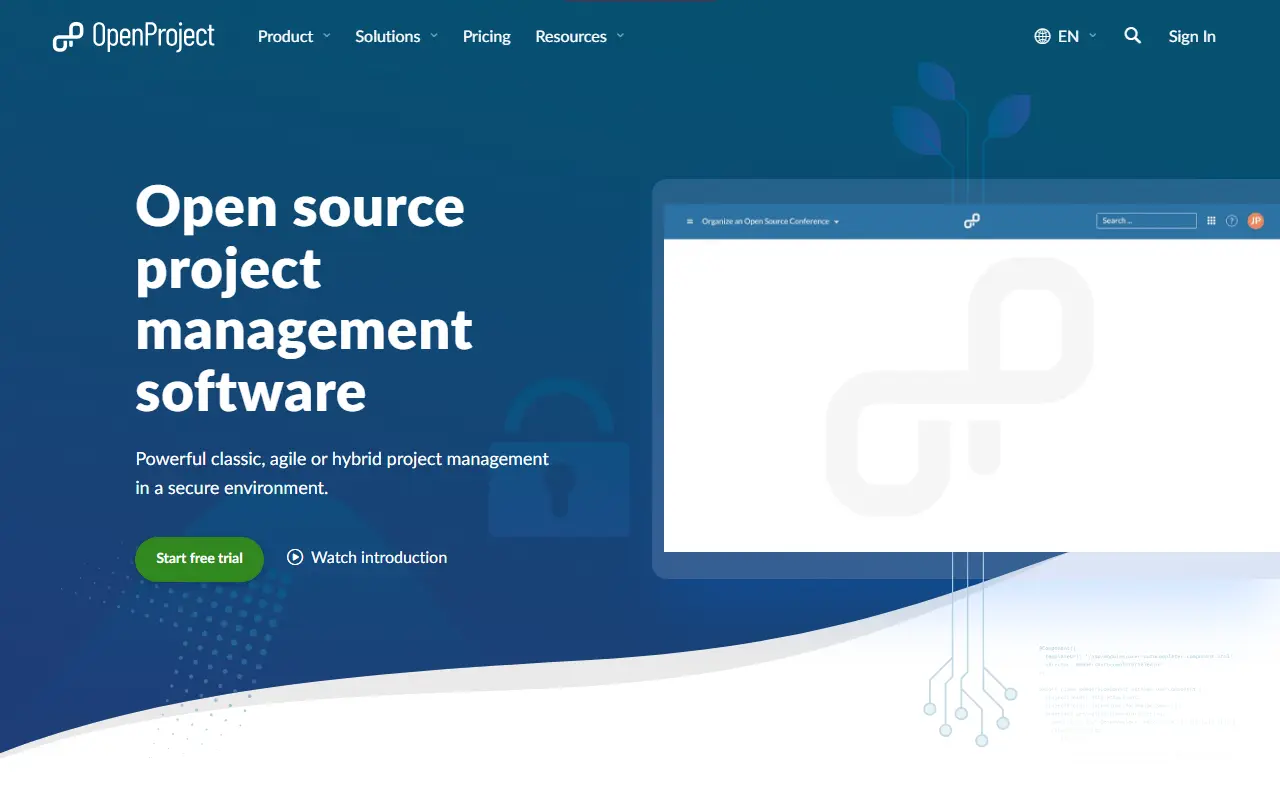
openproject.orgOpenProject homepage screenshot

OpenProject is a web-based project management application for teams and organizations that value transparency, flexibility and control over their data. It covers projects, portfolios, products, tasks, bugs, agile workflows, roadmaps and team collaboration in one platform, and it is built with Ruby and Angular under the GPL-3.0 license.

Key capabilities include agile boards with Kanban and Scrum, project planning and scheduling with Gantt charts, product and release planning, bug tracking, and time tracking with cost reporting and budgeting. Collaboration tools cover wikis, forums, news, and meeting agendas and minutes. Integrations are listed for Nextcloud, XWiki, GitHub and GitLab, among others.

The project presents itself as an open-source alternative to Jira and Asana, along with tools such as MS Project, Monday and YouTrack. It can be self-hosted, which suits organizations with data sovereignty requirements. A free Community Edition is available to download, a 14-day free trial exists, and an Enterprise Edition adds support and add-ons in the cloud or on-premises.

Key features

  • Agile boards for Kanban and Scrum
  • Gantt chart planning and scheduling
  • Roadmaps and release planning
  • Time tracking, cost reporting and budgets
  • Bug tracking and issue management
  • Wikis, forums and meeting minutes

Pricing: The Community edition is free. Paid Enterprise plans cost 5.95 (Basic), 10.95 (Professional) or 15.95 (Premium) euros per user per month with user minimums; Corporate is on request. 14-day free trial.

Redmine

Redmine is a flexible, self-hostable project management web application built on Ruby on Rails, with issue tracking, wikis, Gantt charts and time tracking.

GitHub stars
6k
Last commit
yesterday
Self-hosted
Yes
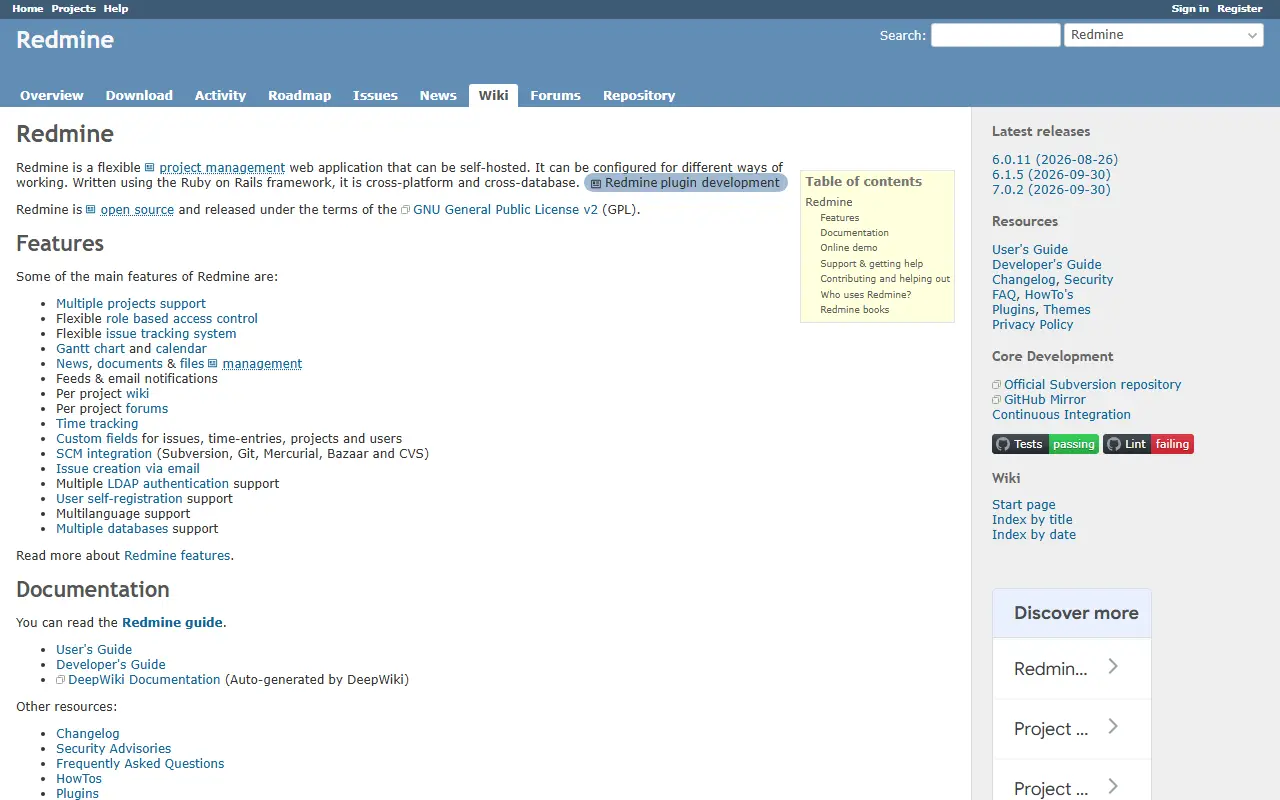
redmine.orgRedmine homepage screenshot

Redmine is a configurable project management web application that you can host yourself. It is written with the Ruby on Rails framework, is cross-platform and cross-database, and can be configured to fit different ways of working. This repository is a GitHub mirror of the official Subversion repository.

The project site lists the main features: support for multiple projects, flexible role-based access control, an issue tracking system, a Gantt chart and calendar, news, documents and file management, feeds and email notifications, a wiki and forums for each project, and time tracking. Custom fields can be added to issues, time entries, projects and users. Integration covers Subversion, Git, Mercurial, Bazaar and CVS, issues can be created by email, and LDAP authentication, user self-registration and multiple languages and databases are supported.

Redmine is open source software distributed under version 2 of the GNU General Public License. Plugins and themes extend it, and a user's guide, developer's guide, FAQ and online demo are available on the project site.

Key features

  • Multiple projects with role-based access control
  • Issue tracking system
  • Gantt chart and calendar
  • Per-project wiki and forums
  • Time tracking and custom fields
  • Git, Subversion and Mercurial integration
  • LDAP authentication

Pricing: Free and open source under the GNU GPL v2.

ZenTao

ZenTao is an agile project management suite covering Scrum, Waterfall and Kanban, with product, project, bug and document management in one system.

GitHub stars
1.7k
Last commit
16 days ago
Latest release
zentaopms_21.7.1_20250529
Self-hosted
Yes
zentao.pmZenTao homepage screenshot

ZenTao is an all-in-one project management system built around agile development. Its scope goes beyond task boards to cover product management, project management, quality management with bug tracking, documentation, organization and office management, so teams can handle most of their process in a single self-hosted application.

The design supports three methodologies. The Scrum model is meant for fast software iterations, the Waterfall model puts weight on stages and strict process control for well-defined projects, and the Kanban model focuses on visualizing the flow of value. The maintainers present it as the first open-source project management software in China, with a history going back to 2009.

ZenTao is written in PHP and its project topics emphasize that it is self-hosted. The GitHub description promises free upgrades forever for the open-source edition, and the project website offers more detail on its other offerings. It suits software teams that want a single system for backlogs, sprints, test cases and bug reports and that are comfortable running a PHP application on their own server.

Key features

  • Scrum, Waterfall, and Kanban project models
  • Product and project management
  • Bug tracking and quality management
  • Documentation management
  • Organization and office management
  • Self-hosted PHP application

Pricing: The open-source edition is described as free, with free upgrades promised by the project.

Taiga

Python backend of Taiga, the project management platform, providing the API and server logic you install on your own server.

GitHub stars
855
Last commit
4 days ago
Licence
MPL-2.0
Self-hosted
Yes

Taiga Back is the backend part of Taiga, a project management platform. It is a Python codebase that serves the data and logic used by the Taiga front end, and it exposes an API that developers can use to build on top of Taiga.

The project maintains separate documentation hubs: an API reference for developers, installation guides for people who want to run Taiga on their own server, and a resources page for end users. Bugs can be reported through Taiga's own issue tracker, GitHub issues or by email, and a community forum handles setup questions. Code contributions are accepted under the MPL-2.0 license.

Key features

  • Backend service powering the Taiga platform
  • Documented API for developers
  • Installable on your own server
  • Python codebase under the MPL-2.0 license
Read more about TaigaGitHub

Trac

Trac is a minimalistic wiki and issue tracking system for software projects that integrates with Subversion and Git.

GitHub stars
545
Last commit
6 days ago
Self-hosted
Yes
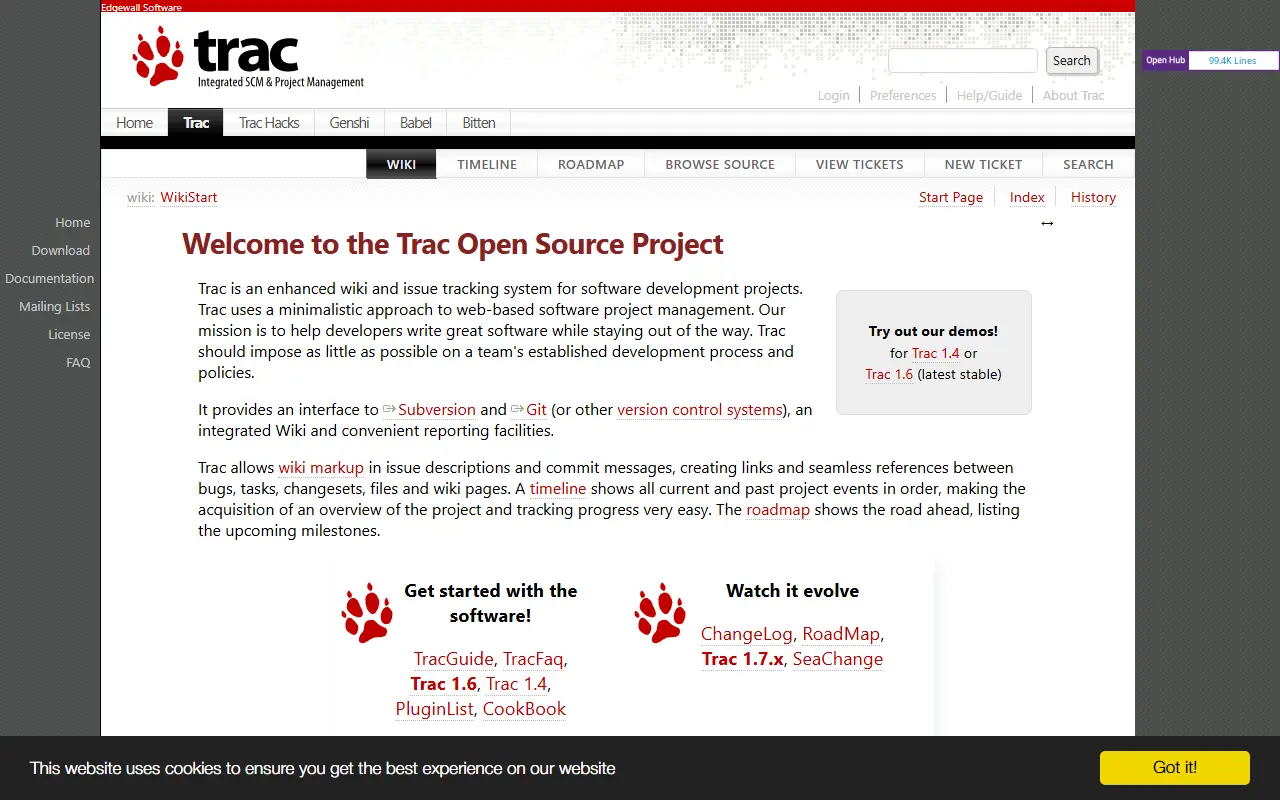
trac.edgewall.orgTrac homepage screenshot

Trac is an enhanced wiki and issue tracking system for software development projects, written in Python. It takes a minimalistic approach to web-based project management, with the stated mission of helping developers write great software while staying out of the way and imposing as little as possible on a team's established process.

It provides an interface to Subversion and Git, and other version control systems through plugins, an integrated wiki and convenient reporting. Wiki markup can be used in issue descriptions and commit messages, creating links and cross-references between bugs, tasks, changesets, files and wiki pages. A timeline lists all current and past project events in order, and a roadmap lists upcoming milestones. The Trac Project site provides a guide, FAQ, plugin list, cookbook and demos of the current stable release.

The GitHub repository is a mirror of the project maintained by Edgewall Software, the license is listed as Other with a BSD-style license in the topics, and you host Trac yourself on your own server. Its community runs on mailing lists and an IRC channel.

Key features

  • Integrated wiki and ticket tracker
  • Subversion and Git integration
  • Wiki links between tickets, commits and pages
  • Timeline of project events
  • Roadmap with milestones
  • Reports and plugin ecosystem

Yona

Installable project collaboration platform with a built-in issue tracker, boards, code review and Git, SVN or Mercurial repositories, rewritten in Kotlin and Spring Boot.

GitHub stars
501
Last commit
2 days ago
Latest release
v2.0.0-rc1
Licence
Apache-2.0
Self-hosted
Yes
yona.ioYona homepage screenshot

Yona is a self-installed project collaboration platform that combines an issue tracker, discussion boards and code review with built-in source repositories. It supports Git, SVN and Mercurial, and the maintainers emphasize that an installable platform avoids worries about service shutdowns or data lock-in.

Issues are project-based and flexible, with moves between projects, subtasks, change history and templates. Code review works on individual code blocks with review threads and scores, and groups let you manage issues, posts, projects and members across an organization. Security options include LDAP, OAuth2 social login, two-factor authentication with TOTP and passkeys, SSH keys, GPG commit signature checks and deploy keys. Audit logs track important events.

This repository is a rewrite of the original Java and Play Framework application in Kotlin with Spring Boot, JPA and Thymeleaf on JDK 21, with the goal of keeping screens and behavior close to the legacy version. It works with MariaDB, PostgreSQL, MySQL, SQL Server, CUBRID or embedded H2, adds scoped API tokens, an OAuth2 authorization server and a built-in MCP server for AI agents, and is licensed under Apache-2.0.

Key features

  • Project-based issue tracker with subtasks and templates
  • Built-in Git, SVN and Mercurial repositories
  • Block-level code review with scores
  • Groups for organization-wide management
  • LDAP, OAuth2 and two-factor sign-in with passkeys
  • Scoped API tokens and built-in MCP server

Pricing: Free and open source under the Apache-2.0 licence.

Backlog alternatives: questions

What is the best open-source alternative to Backlog?
Plane is the top-ranked open-source alternative to Backlog on Enlisted: An open-source project management platform for issues, sprint cycles, roadmaps, docs and triage, positioned as an alternative to Jira, Linear, Monday and ClickUp. Other strong options are OpenProject, Redmine, ZenTao and Taiga.
Are these Backlog alternatives free?
All 7 are open source, so the code is free to use under its licence, and all of them can be self-hosted on your own server or computer. 2 also offer a paid or managed cloud version if you'd rather not host it yourself.
How is this list of Backlog alternatives ranked?
By a score built from GitHub stars, star growth over the last 30 days and how recently the code changed. 7 of these projects shipped code in the last 30 days. Data is refreshed daily, and nobody can pay to move up.

People also look for alternatives to…

View all