 TrackMedia
 TrackRev

About Volcano
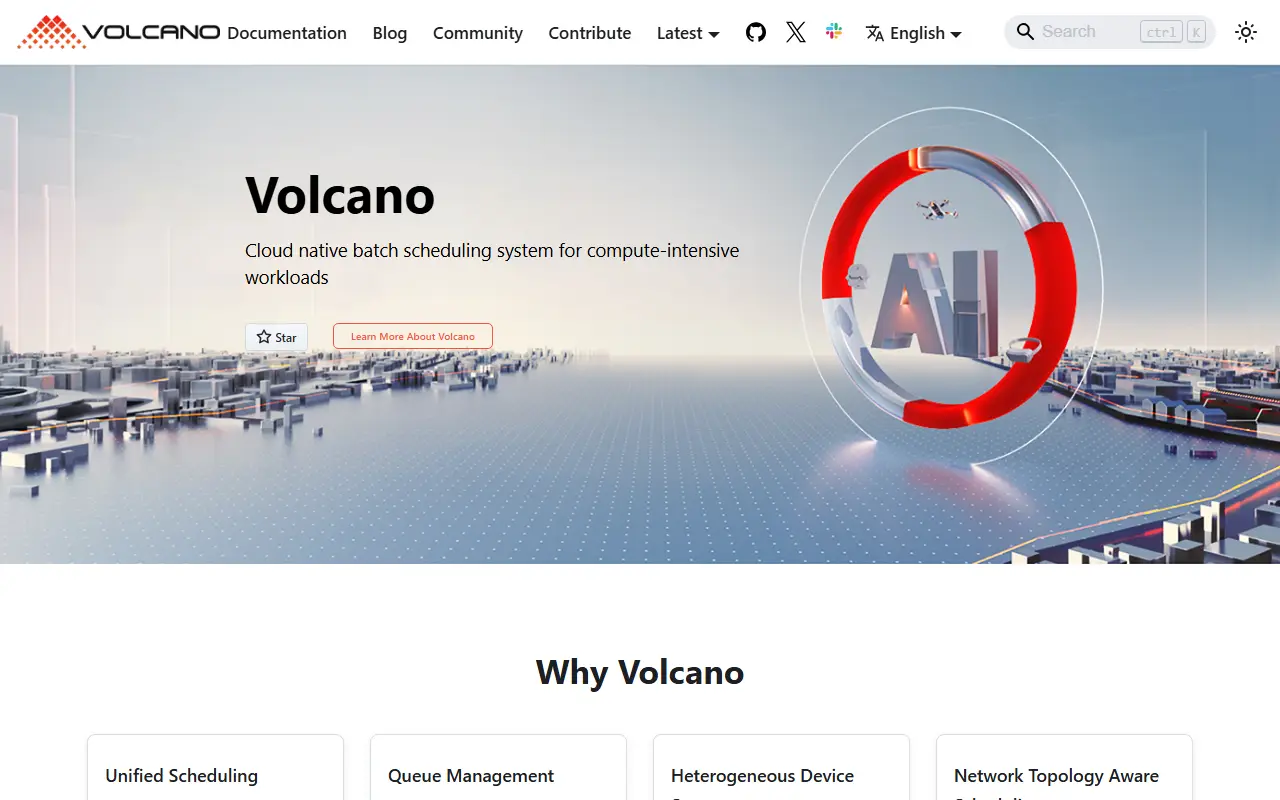
Volcano is a cloud native batch scheduling system designed for compute-intensive workloads such as AI, big data, and scientific computing. It provides unified scheduling for Kubernetes native workloads and mainstream computing frameworks including TensorFlow, Spark, PyTorch, Ray, and Flink.
The system offers multi-level queue management for resource quota control and task priority scheduling, supports heterogeneous devices like GPU and NPU, and includes features such as network topology aware scheduling, multi-cluster scheduling, and online/offline workload colocation. It also provides multiple scheduling policies including Gang scheduling, Fair-Share, Binpack, DeviceShare, NUMA-aware scheduling, and Task Topology.
Key features
- Unified scheduling for Kubernetes native workloads and mainstream computing frameworks
- Multi-level queue management with fine-grained resource quota control and task priority scheduling
- Heterogeneous device support for GPU and NPU
- Network topology aware scheduling for AI distributed training
- Multi-cluster job scheduling for resource pool management and load balancing
- Online and offline workload colocation to improve cluster resource utilization
Good fit for
- AI distributed training
- Big data processing
- Scientific computing
Volcano: questions and answers
- What is Volcano used for?
- Volcano is a cloud native batch scheduling system for compute-intensive workloads, supporting Kubernetes and mainstream computing frameworks. It is a good fit for AI distributed training, big data processing and scientific computing.
- Is Volcano open source?
- Yes. Volcano is open source under the Apache-2.0 licence. Its source code is on GitHub at volcano-sh/volcano and is written mainly in Go.
- Is Volcano free?
- Yes. Volcano is open source, so the software itself is free to use.
- Can I self-host Volcano?
- Yes. Volcano can be self-hosted on your own server or infrastructure.
- What is Volcano an alternative to?
- Volcano is an open-source alternative to CoreWeave. Other open-source alternatives to CoreWeave include Kubeflow, Ray and Kubernetes.
- Is Volcano actively maintained?
- Yes. The most recent commit to Volcano was on 12 November 2026, and the latest release is v1.16.0, published on 14 October 2026. The project has 6.1k stars on GitHub, with 73 added in the last 30 days.
Open-source alternatives to Volcano
See all
Kubeflow
AI Tools
The Cloud Native AI Platform
Apache-2.0vs Together AI★ 16k
Ray
Hosting & PaaS
Ray is an AI compute engine. Ray consists of a core distributed runtime and a set of AI Li
Apache-2.0vs OpenRouter★ 44k
Kubernetes
Infrastructure & Containers
Production-Grade Container Scheduling and Management
Apache-2.0vs Amazon EKS★ 129k
Slurm
Open source
Slurm: A Highly Scalable Workload Manager
OSSvs CoreWeave★ 4.5k
beta9
AI Infrastructure
Ultrafast serverless GPU inference, sandboxes, and background jobs
AGPL-3.0vs Modal★ 1.9k
Backend.AI
AI Infrastructure
Backend.AI is a streamlined, container-based computing cluster platform that hosts popular
LGPL-3.0vs RunPod★ 680
SaaS alternatives to Volcano
See all
CoreWeave
AI Infrastructure
GPU cloud infrastructure provider for AI training and inference
SaaS628 VC
AI Tools
AI tool that gives founders instant feedback on their venture context and investor pitch
SaaS
AdviselyAI
AI Tools
AI chatbot that gathers details from the user and then gives tailored expert-style advice
SaaS
Apptime AI
AI Tools
Create, host and share AI-powered apps from one place
SaaS
AppWispr
AI Tools
Finds app ideas backed by demand and turns them into briefs, mockups, screenshots and launch copy
SaaS
Ascend AI
AI Tools
iOS app that analyzes your face with AI and gives a feature breakdown with ratings and tips
SaaS