 TrackMedia
 TrackRev

 CoreWeave
About Slurm
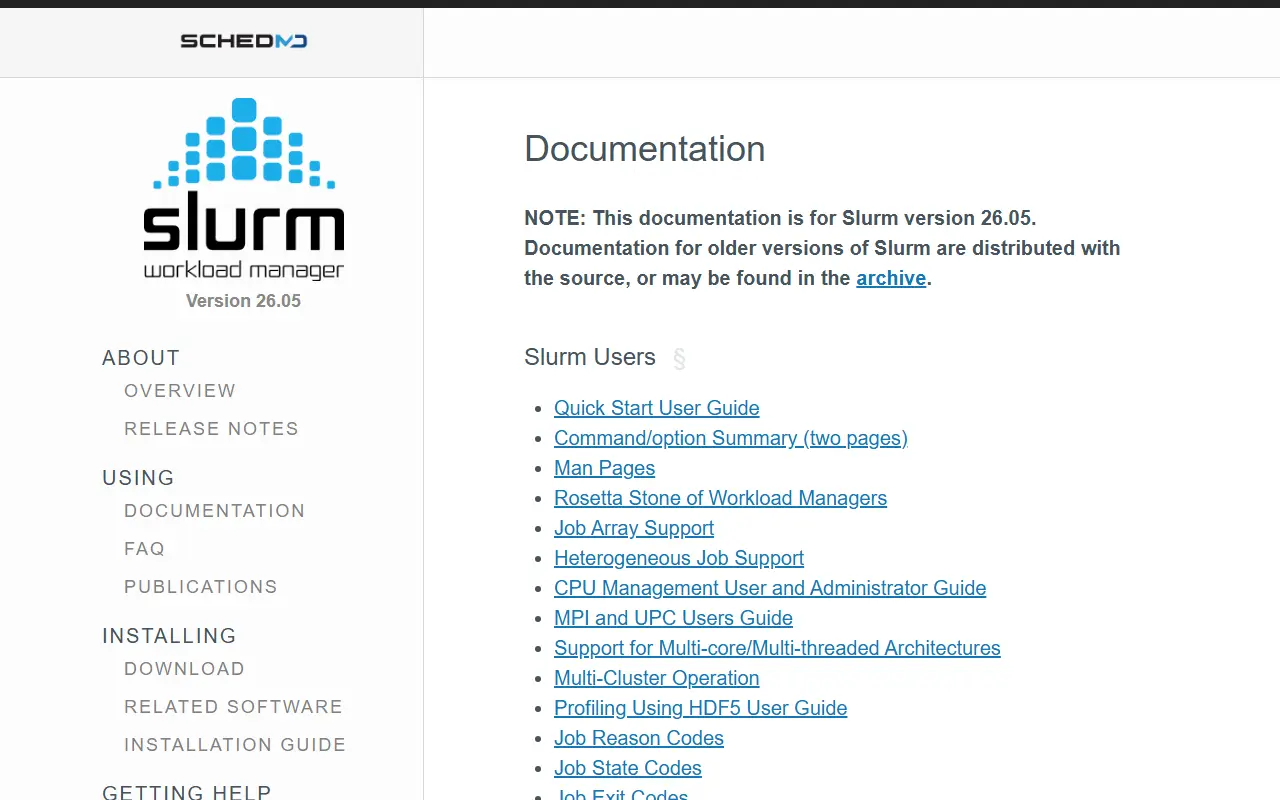
Slurm Workload Manager is published by SchedMD, and the documentation on its site is for version 26.05. Older versions' documentation ships with the source or can be found in the archive. The site offers an overview, release notes, downloads, an installation guide, mailing lists, support and training.
The documentation is split by audience. Users get a quick start guide, a command summary, man pages and guides to job arrays, heterogeneous jobs, multi-cluster operation and MPI. Administrators get guides on accounting, authentication plugins, cgroups, containers, federated scheduling, power saving and the Slurm REST API.
Scheduling topics include multifactor job priority, fair-share algorithms, gang scheduling, preemption, quality of service, resource limits and reservations, and generic resource scheduling. Cloud guides cover Google Cloud Platform, AWS Parallel Computing Service, and Microsoft Azure with CycleCloud.
Key features
- Job array and heterogeneous job support
- Multi-cluster operation and federated scheduling
- Fair-share and multifactor job priority algorithms
- Gang scheduling, preemption and quality of service
- REST API for interacting with Slurm
- Guides for running on Google Cloud, AWS and Azure
Good fit for
- Scheduling batch jobs on a cluster
- Managing accounting and resource limits
- Running scheduling in the cloud
Slurm: questions and answers
- What is Slurm used for?
- Slurm is a workload manager from SchedMD with documentation covering job scheduling, accounting, resource limits and cloud deployment. It is a good fit for scheduling batch jobs on a cluster, managing accounting and resource limits, and running scheduling in the cloud.
- Is Slurm open source?
- Yes. Slurm is open source under a custom licence. Its source code is on GitHub at SchedMD/slurm and is written mainly in C.
- Is Slurm free?
- Yes. Slurm is open source, so the software itself is free to use under the terms of its own licence.
- Can I self-host Slurm?
- Yes. Slurm can be self-hosted on your own server or infrastructure.
- What is Slurm an alternative to?
- Slurm is an open-source alternative to CoreWeave. Other open-source alternatives to CoreWeave include Backend.AI, Kubernetes and Ray.
- Is Slurm actively maintained?
- Yes. The most recent commit to Slurm was on 12 November 2026. The project has 4.5k stars on GitHub, with 84 added in the last 30 days.
Open-source alternatives to Slurm
See all
Backend.AI
AI Infrastructure
Backend.AI is a streamlined, container-based computing cluster platform that hosts popular
LGPL-3.0vs RunPod★ 680
Kubernetes
Infrastructure & Containers
Production-Grade Container Scheduling and Management
Apache-2.0vs Amazon EKS★ 129k
Ray
Hosting & PaaS
Ray is an AI compute engine. Ray consists of a core distributed runtime and a set of AI Li
Apache-2.0vs OpenRouter★ 44k
Volcano
AI Tools
A Cloud Native Batch System (Project under CNCF)
Apache-2.0vs CoreWeave★ 6.1k
Kubeflow
AI Tools
The Cloud Native AI Platform
Apache-2.0vs Together AI★ 16k
beta9
AI Infrastructure
Ultrafast serverless GPU inference, sandboxes, and background jobs
AGPL-3.0vs Modal★ 1.9k