 TrackMedia
 TrackRev

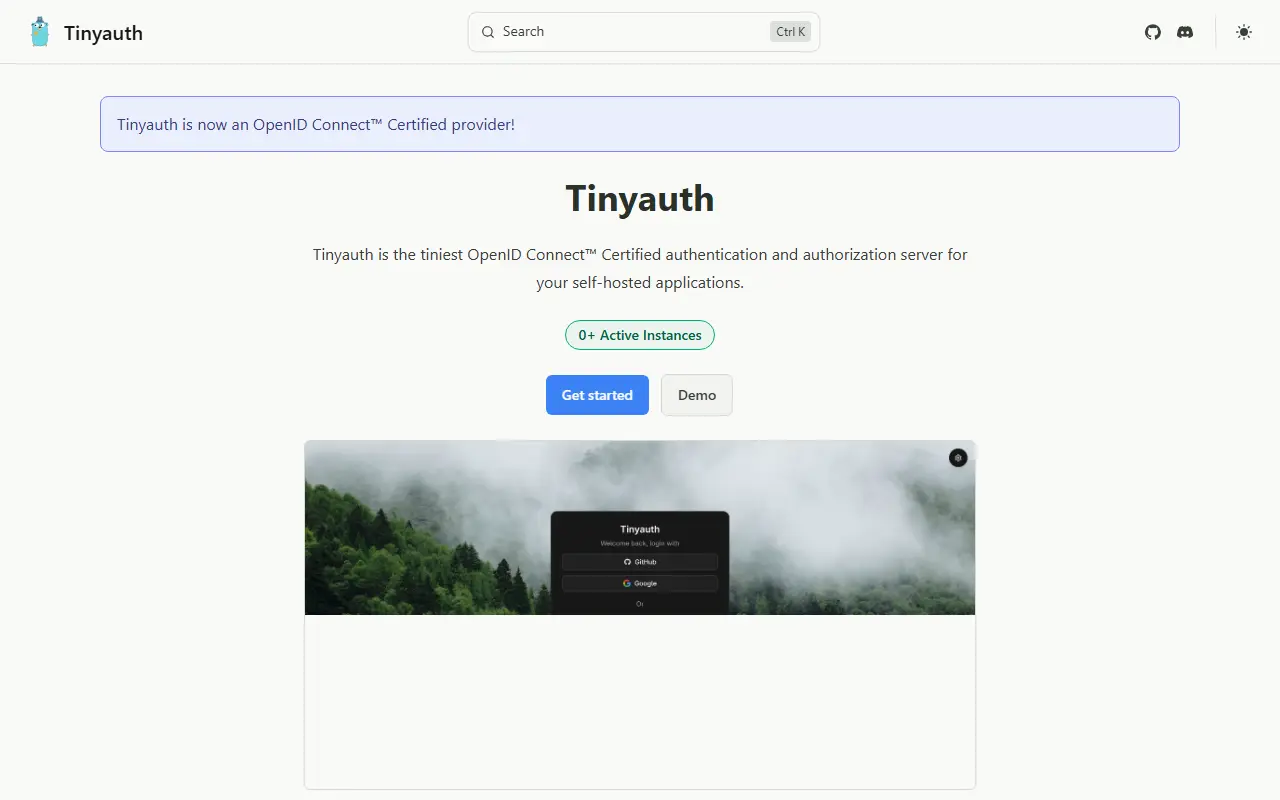
About Tinyauth
Tinyauth is a minimal authentication and authorization server aimed at self-hosters and homelabs. It can sit in front of your apps as authentication middleware, with support for OAuth, LDAP and access controls, or run on its own as a standalone server, and it works with common proxies including Traefik, Nginx and Caddy.
The project reports that version 5.1.0 achieved OpenID Certification for the Basic OP profile, and its topics mention OIDC, SSO and two-factor authentication with TOTP. A docker-compose file demonstrates it alongside Traefik and a whoami test service, and a public demo and documentation site explain the configuration options.
Tinyauth is written in Go and licensed under AGPL-3.0. The README warns that it is in active development and that configuration may change often, so release notes should be read before updating. It suits people who want single sign-on for self-hosted services without running a heavier identity platform.
Key features
- Authentication middleware for reverse proxies
- OIDC provider with OpenID Certification
- OAuth and LDAP support
- Access controls per application
- TOTP two-factor authentication
- Traefik, Nginx and Caddy integration
- Docker Compose example
Good fit for
- Protecting self-hosted apps behind Traefik
- Single sign-on for a homelab
- Lightweight alternative to larger identity servers
Tinyauth: questions and answers
- What is Tinyauth used for?
- Tinyauth is a small, OpenID-certified authentication and authorization server that works as middleware for reverse proxies such as Traefik, Nginx and Caddy or as a standalone server. It is a good fit for protecting self-hosted apps behind Traefik and single sign-on for a homelab.
- Is Tinyauth open source?
- Yes. Tinyauth is open source under the AGPL-3.0 licence. Its source code is on GitHub at tinyauthapp/tinyauth and is written mainly in Go.
- Is Tinyauth free?
- Yes. Tinyauth is open source, so the software itself is free to use.
- Can I self-host Tinyauth?
- Yes. Tinyauth can be self-hosted on your own server or infrastructure.
- What are some alternatives to Tinyauth?
- Similar open-source tools in the Auth & Identity category include Pocket ID, Casdoor and Logto. SaaS products in the same category include FusionAuth, Scalekit and Auth0.
- Is Tinyauth actively maintained?
- Yes. The most recent commit to Tinyauth was on 12 November 2026, and the latest release is v5.2.0, published on 7 September 2026. The project has 8.5k stars on GitHub, with 128 added in the last 30 days.
Open-source alternatives to Tinyauth
See all
Pocket ID
Auth & Identity
An easy-to-use OpenID Connect Certified™ and OAuth 2.0 provider that lets users sign in to
BSD-2-Clausevs Auth0★ 10k
Casdoor
Auth & Identity
An open-source Agent-first Identity and Access Management (IAM) /LLM MCP & agent gateway a
Apache-2.0vs Auth0★ 15k
Logto
Auth & Identity
🧑🚀 Authentication and authorization infrastructure for SaaS and AI apps, built on OIDC
MPL-2.0vs Auth0★ 15k
OAuth2 Proxy
Auth & Identity
A reverse proxy that provides authentication with Google, Azure, OpenID Connect and many m
MITvs Cloudflare Zero Trust★ 15k
Keycloak
Auth & Identity
Open Source Identity and Access Management For Modern Applications and Services
Apache-2.0vs Auth0★ 38k
Authentik
Auth & Identity
The authentication glue you need.
OSSvs Auth0★ 26k
SaaS alternatives to Tinyauth
See all
FusionAuth
Auth & Identity
Customer identity platform for login, MFA and SSO, self-hosted or cloud
SaaS
Scalekit
Auth & Identity
Auth platform for AI agents and B2B apps with SSO, scoped tokens and connectors
SaaS
Auth0
Auth & Identity
Auth0 is an authentication and authorization platform that lets developers add login, single sign-on and access control to apps with SDKs and quickstarts.
SaaS
Amazon Cognito
Auth & Identity
AWS user pools and identity federation for app sign-up and sign-in
SaaS
Authress
Auth & Identity
Hosted login with fine-grained access control for SaaS applications
SaaS
Clerk
Auth & Identity
Drop-in sign-in, user management and organization components for web apps
SaaS