
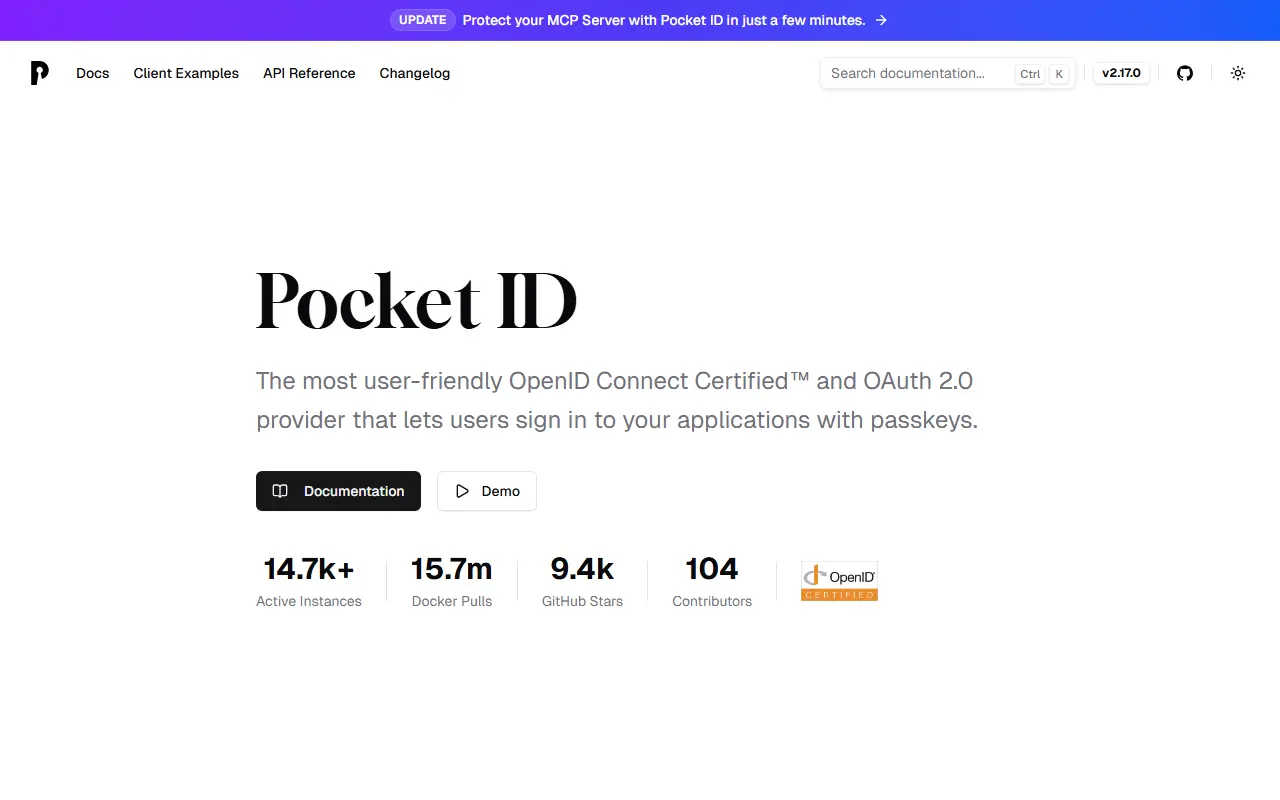
About Pocket ID
Pocket ID is a self-hosted identity provider that speaks OpenID Connect and OAuth 2.0 and is described as OpenID Connect certified. Users sign in to your applications with passkeys, so there are no passwords to store, reset or leak, and a hardware key such as a YubiKey can unlock all of your self-hosted services.
Its goal is simplicity. The author notes that existing self-hosted providers like Keycloak or ORY Hydra are often too complex for simple use cases, and Pocket ID aims to be easy to set up and use. The distinctive design choice is that it supports only passkey authentication, which the project argues is the future, and a demo is available to try it.
The recommended installation is Docker, with a setup guide in the documentation. Pocket ID is written in Go and released under the BSD 2-Clause licence. It suits homelab users and small teams who want single sign-on across self-hosted applications without administering a heavyweight identity system.
Key features
- OpenID Connect and OAuth 2.0 provider
- Passkey-only sign-in for users
- No passwords to manage
- Hardware key sign-in such as YubiKey
- Recommended setup with Docker
- Lightweight Go server
Good fit for
- →Single sign-on for homelab services
- →Passwordless login for small teams
- →Simple alternative to Keycloak
- Built with
- Go
- Tags
- oidc
- oauth
- passkeys
- sso
- identity-provider
- self-hosted
- passwordless
- golang
Pocket ID: questions and answers
- What is Pocket ID used for?
- Pocket ID is a simple self-hosted identity provider for OpenID Connect and OAuth 2.0 that signs users in to your apps with passkeys only, without passwords. It is a good fit for single sign-on for homelab services and passwordless login for small teams.
- Is Pocket ID open source?
- Yes. Pocket ID is open source under the BSD-2-Clause licence. Its source code is on GitHub at pocket-id/pocket-id and is written mainly in Go.
- Is Pocket ID free?
- Yes. Pocket ID is open source, so the software itself is free to use.
- Can I self-host Pocket ID?
- Yes. Pocket ID can be self-hosted on your own server or infrastructure.
- What is Pocket ID an alternative to?
- Pocket ID is an open-source alternative to Auth0, Beyond Identity and HYPR. Other open-source alternatives to Auth0 include Hanko, Authentik and Authgear.
- Is Pocket ID actively maintained?
- Yes. The most recent commit to Pocket ID was on 2 October 2026, and the latest release is v2.17.0, published on 1 October 2026. The project has 9.4k stars on GitHub.
Open-source alternatives to Pocket ID
See all
Hanko
Auth & Identity
Open source, privacy-first, and built to scale. Hanko is the fastest way you integrate pas
OSSvs Auth0★ 9k
Authentik
Auth & Identity
The authentication glue you need.
OSSvs Auth0★ 26k
Authgear
Auth & Identity
Open source Auth0/Keycloak alternative. Passkeys, SSO, MFA, passwordless, biometric login.
Apache-2.0vs Auth0★ 2.1k
privacyIDEA
Auth & Identity
:closed_lock_with_key: multi factor authentication system (2FA, MFA, OTP, FIDO Server)
AGPL-3.0vs Duo Security★ 1.8k
ZITADEL
Auth & Identity
ZITADEL - Identity infrastructure, simplified for you.
AGPL-3.0vs Auth0★ 15kRauthy
Auth & Identity
Single Sign-On Identity & Access Management via OpenID Connect, OAuth 2, PAM
Apache-2.0vs Auth0★ 1.4k
SaaS alternatives to Pocket ID
See all
Auth0
Auth & Identity
Auth0 is an authentication and authorization platform that lets developers add login, single sign-on and access control to apps with SDKs and quickstarts.
SaaS
Beyond Identity
Auth & Identity
Phishing-resistant passwordless MFA with device trust checks
SaaS
HYPR
Auth & Identity
Passwordless and phishing-resistant MFA for workforce and customers
SaaS
Corbado
Auth & Identity
Passkey platform that adds passkey login on top of existing identity systems
SaaS
Transmit Security
Auth & Identity
Passwordless authentication, fraud prevention and identity verification platform
SaaS
FusionAuth
Auth & Identity
Customer identity platform for login, MFA and SSO, self-hosted or cloud
SaaS