 TrackMedia
 TrackRev
 Zalo
 KakaoTalk
 Kik
 Messenger
 AWS Wickr
 imo
About Session
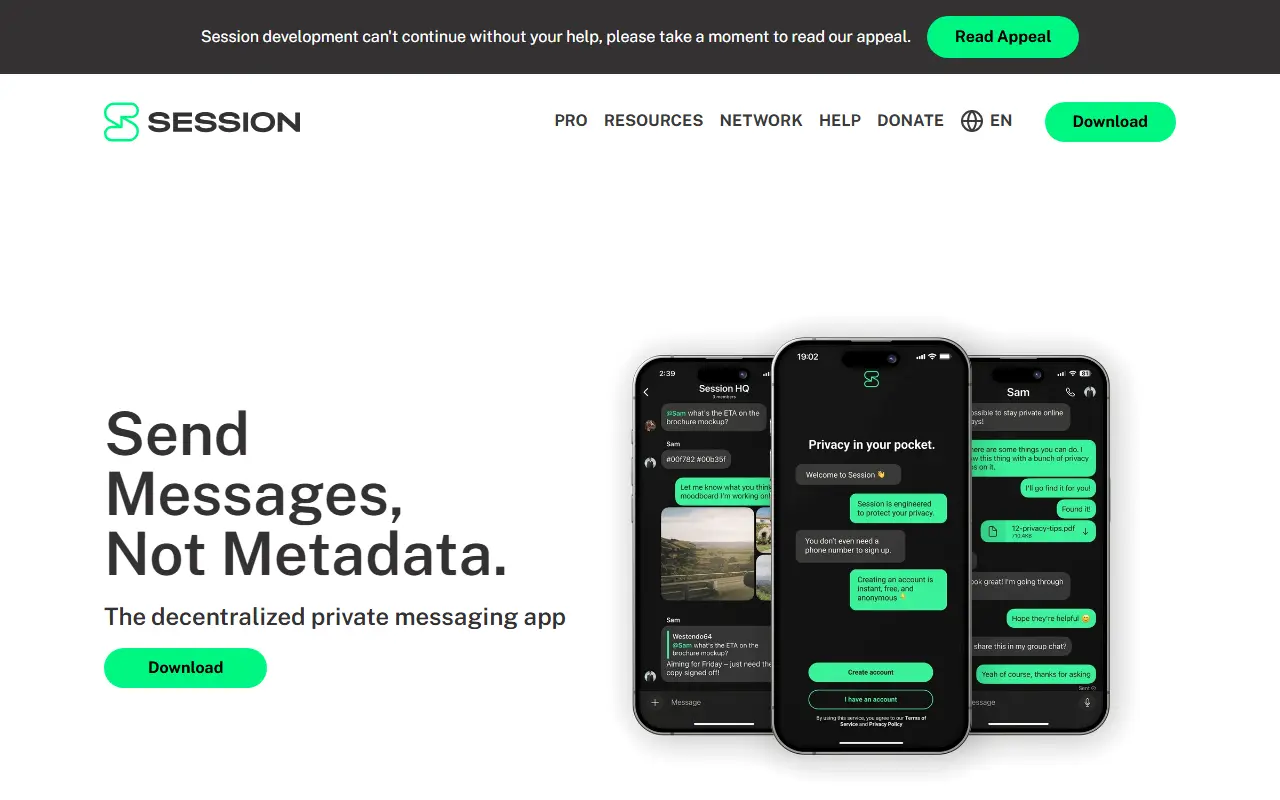
Session Desktop is the desktop application for Session, a private messenger that is decentralized and uses onion routing. It connects to Oxen Service Nodes, a set of distributed, Sybil-resistant servers. Some of these nodes store messages while a recipient is offline, and others provide onion routing that hides users' IP addresses.
Releases are signed, and the README walks through verifying them by checking a GPG signature on the published hashes and then comparing the hash of the downloaded file. The project also lists supported platforms and system requirements, accepts pull requests on a development branch, and invites volunteers to help with translations. Build instructions are in the contributing guide.
The client is written in TypeScript and licensed under GPL-3.0. It is distributed from getsession.org and maintained under the Session Foundation. The README points to the Session whitepaper for a full explanation of how the system works.
Key features
- Decentralized messaging over service nodes
- Onion routing that hides IP addresses
- Offline message storage on the network
- GPG-signed releases with hash verification
- Desktop client written in TypeScript
Good fit for
- Private chats without a central account server
- Messaging where IP privacy matters
Session: questions and answers
- What is Session used for?
- Session is a desktop client for Session, a decentralized private messenger that routes messages through onion-routed service nodes. It is a good fit for private chats without a central account server and messaging where IP privacy matters.
- Is Session open source?
- Yes. Session is open source under the GPL-3.0 licence. Its source code is on GitHub at session-foundation/session-desktop and is written mainly in TypeScript.
- Is Session free?
- Yes. Session is open source, so the software itself is free to use.
- Can I self-host Session?
- Yes. Session can be self-hosted on your own server or infrastructure.
- What is Session an alternative to?
- Session is an open-source alternative to Signal, WhatsApp, Telegram and Viber. Other open-source alternatives to Signal include Element, SimpleX Chat and Wire.
- Is Session actively maintained?
- Yes. The most recent commit to Session was on 10 November 2026, and the latest release is v1.18.3, published on 26 October 2026. The project has 611 stars on GitHub, with 18 added in the last 30 days.
Open-source alternatives to Session
See all
Element
Team Chat
A glossy Matrix collaboration client for the web.
AGPL-3.0vs Slack★ 14k
Signal Android
Team Chat
A private messenger for Android.
AGPL-3.0vs WhatsApp★ 30k
SimpleX Chat
Team Chat
SimpleX - the first messaging network operating without user identifiers of any kind - 100
AGPL-3.0vs WhatsApp★ 20k
Signal Desktop
Team Chat
A private messenger for Windows, macOS, and Linux.
AGPL-3.0vs WhatsApp★ 17k
Wire
Team Chat
🇪🇺 Wire back-end services
AGPL-3.0vs Slack★ 2.8k
Telegram Desktop
Team Chat
Telegram Desktop messaging app
GPL-3.0vs WhatsApp★ 34k
SaaS alternatives to Session
See all
Signal
Team Chat
Privacy-focused messenger with end-to-end encrypted chats and calls
SaaS
WhatsApp
Team Chat
Messaging and calling app with a Business version for customer chats
SaaS
Telegram
Team Chat
Cloud-based messenger with large groups, channels and bots
SaaS
Viber
Team Chat
Messaging and calling app with communities and business messaging
SaaS
LINE
Team Chat
Messenger and super-app popular in Japan, Taiwan and Thailand
SaaS
WeChat
Team Chat
Tencent's messaging and mobile payments app
SaaS