 TrackMedia
 TrackRev

 UXPin
 Superblocks
 WeWeb
 Justinmind
 FlowMapp
 MasterGo
 Pixso
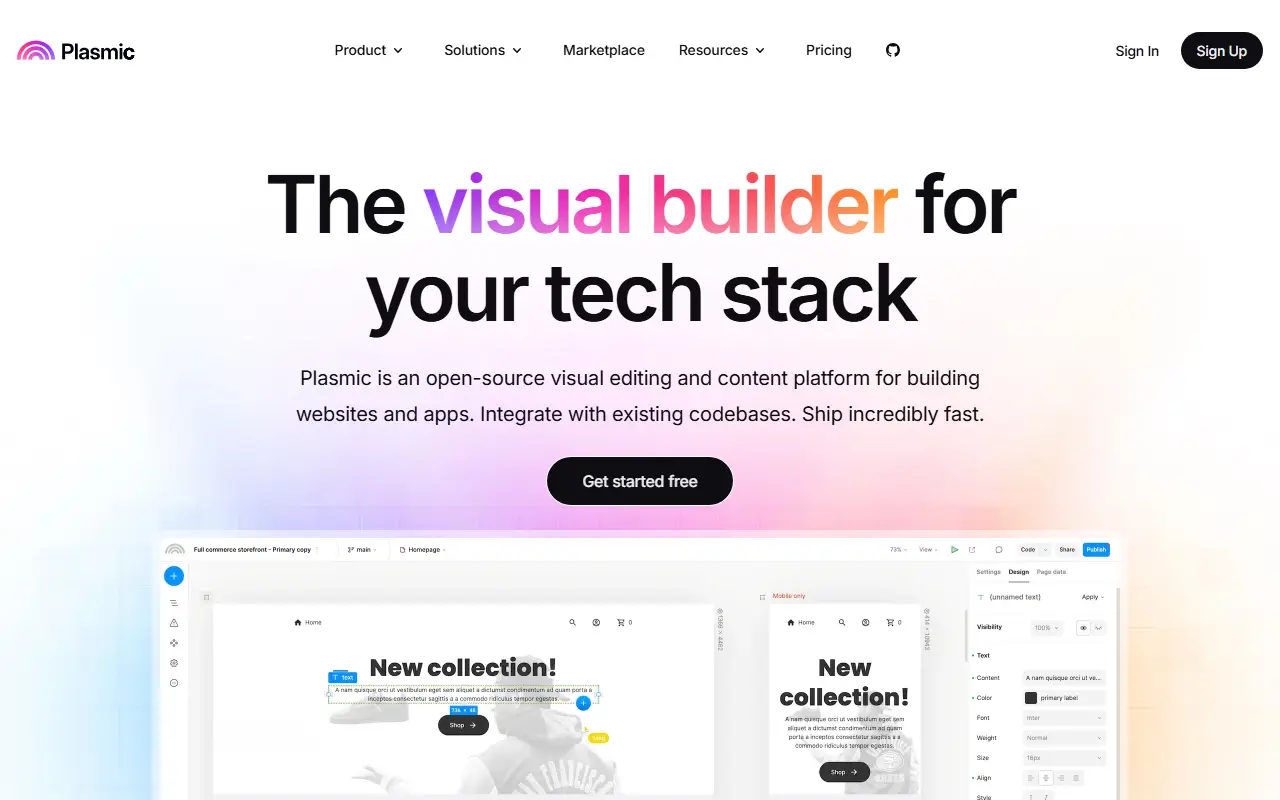
About Plasmic
Plasmic is a visual builder for the web that enables rapidly designing and building applications and websites, with code optional. Its distinguishing idea is codebase integration: you register your own React components so that marketers and designers can arrange them visually, which the project says removes the ceiling usually associated with low-code tools.
The README names three main use cases: content management, where marketing teams drag and drop React components to build landing pages in a Next.js site within design guardrails, applications such as internal tools, client portals and business software built quickly by developers and technical users, and a website builder and design tool that is not limited to a built-in ecommerce platform, CMS or hosting. It works with Next.js, Gatsby and other frameworks, and also acts as a headless CMS.
Plasmic is licensed under MIT and written in TypeScript, with documentation, a quickstart, a forum and a Slack community. The visual editor is offered as a hosted service at plasmic.app, and demos show examples such as a Shopify headless storefront. It suits front-end teams that want non-developers to build with their component library.
Key features
- Drag-and-drop visual builder for React
- Register your own code components
- Works with Next.js and Gatsby
- Headless CMS capabilities
- Design guardrails for content editors
- Internal tools and website building
Good fit for
- Marketing landing pages in a Next.js site
- Internal tools and client portals
- Visual editing on top of a design system
Plasmic: questions and answers
- What is Plasmic used for?
- Plasmic is a visual builder for React that lets teams drag and drop their own components to build pages, apps and content, integrated with an existing codebase. It is a good fit for marketing landing pages in a Next.js site, internal tools and client portals, and visual editing on top of a design system.
- Is Plasmic open source?
- Yes. Plasmic is open source under the MIT licence. Its source code is on GitHub at plasmicapp/plasmic and is written mainly in TypeScript.
- Is Plasmic free?
- Yes. Plasmic is open source, so the software itself is free to use. A managed cloud version is also available, with paid plans from $39 per month.
- Can I self-host Plasmic?
- Yes. Plasmic can be self-hosted on your own server or infrastructure.
- What is Plasmic an alternative to?
- Plasmic is an open-source alternative to Webflow, Framer, Relume and Anima. Other open-source alternatives to Webflow include Onlook, Builder.io and Webstudio.
- Is Plasmic actively maintained?
- Yes. The most recent commit to Plasmic was on 12 November 2026. The project has 7.2k stars on GitHub, with 66 added in the last 30 days.
Open-source alternatives to Plasmic
See all
Onlook
AI Tools
The Developer Tool for Designers • An Open-Source AI-First Design tool • Visually build, s
Apache-2.0vs Lovable★ 27k
OpenPencil
Design
Generate complete, multi-screen product interfaces on a live canvas. Refine every layer wi
MITvs Figma★ 7.2k
Penpot
Design
Penpot: The open-source design platform for Product teams that need scalable collaboration
MPL-2.0vs Figma★ 62k
Builder.io
CMS
Visual Development for React, Vue, Svelte, Qwik, and more
MITvs Webflow★ 8.9k
Doop
Design
The open-source alternative to Paper.design. A multiplayer design canvas where humans and
AGPL-3.0vs Figma★ 2k
Webstudio
CMS
Open source website builder and Webflow alternative. Webstudio is an advanced visual build
AGPL-3.0vs Webflow★ 9.2k
SaaS alternatives to Plasmic
See all
Webflow
CMS
Webflow is a visual web design and hosting platform that combines a designer, CMS, hosting and SEO tools so teams can build and run websites without coding.
SaaS
Framer
CMS
Visual website builder and design tool that publishes live sites
SaaS
Relume
Design
AI site builder and component library for planning and designing marketing websites
SaaS
Anima
Design
Design-to-code platform that converts Figma designs into React, HTML and other code
SaaS
v0
AI Tools
Vercel's AI app builder that generates UI and full-stack code from prompts
SaaS
Magic Patterns
AI Tools
AI design tool that generates UI prototypes and components from prompts
SaaS