7,363 open-source and SaaS tools, with GitHub stats refreshed every day.

4 alternatives ranked by real activity

Open-source Relume alternatives

A curated, ranked list of the 4 best open-source alternatives to Relume.

The best open-source alternative to Relume is Onlook. If that doesn't suit you, other good options are Webstudio, Plasmic and Silex.

Relume alternatives are mainly CMS tools, but some are also AI tools. 3 of them shipped code in the last 30 days, 4 can be self-hosted, and 2 use a permissive licence.

Last updated October 3, 2026 · ranked by GitHub stars, growth and recent commits

Onlook

An open-source visual editor for Next.js and Tailwind apps that lets designers and developers edit real code in the browser with AI, an alternative to Bolt.new and Lovable.

GitHub stars
27k
Last commit
1 mo ago
Latest release
v0.2.32
Licence
Apache-2.0
Self-hosted
Yes
Hosted version
Available
onlook.comOnlook homepage screenshot

Onlook is an open-source, visual-first code editor for building websites, prototypes and designs in Next.js and Tailwind CSS. Edits are made directly on the browser DOM with a Figma-like interface, while the changes are written to real code, so design and development share one source of truth.

You can create a Next.js app from text or an image or start from templates, then edit it visually, manage brand assets and tokens, create pages, browse layers and manage images. Developer tools include a real-time code editor, checkpoints you can restore, branching for design experiments, a CLI, an app marketplace, one-click deploys, shareable links and custom domains. Team collaboration is on the roadmap.

The README describes this repository as the open-source editor that started Onlook, while the hosted product for AI-native designers is in early access through a waitlist. It is licensed under Apache-2.0 and presented as an open alternative to tools such as Webflow, Figma Make, V0, Replit Agent, Lovable and Bolt.new. It suits designers who want to ship real code and developers who want a visual layer.

Key features

  • Visual editing on the browser DOM
  • Figma-like interface for Next.js apps
  • Start from text prompts or images
  • Real-time code editor with checkpoints
  • Branching for design experiments
  • Brand assets and design tokens
  • One-click deployment with custom domains

Pricing: Onlook can be self-hosted for free. The hosted cloud version is in closed beta with custom team pricing arranged by contacting the team.


Webstudio

An open-source visual website builder positioned as a Webflow alternative, connecting to any headless CMS and supporting all CSS properties, hosted by Webstudio or yourself.

GitHub stars
9k
Last commit
today
Latest release
0.304.0
Licence
AGPL-3.0
Self-hosted
Yes
Hosted version
Available
webstudio.isWebstudio homepage screenshot

Webstudio is a visual development platform, released as open source, for developers, designers and cross-functional teams, and is presented as an alternative to Webflow. It is a visual builder that connects to any headless CMS and supports all CSS properties, and you own the data, components and infrastructure.

You can choose the hosted version or deploy your own instance, and the topics mention Cloudflare Workers, React, Remix and accessibility via Radix UI. The project provides a blog, documentation, a roadmap and an issue tracker for the builder, and a community on Discord.

Licensing is split. The Webstudio core, meaning all functionality in the repository, is free and open source under AGPL-3.0-or-later, while the optional sdk-components-animation package is proprietary and requires accepting the Webstudio, Inc. EULA. It is written in TypeScript. It suits designers and developers who want Webflow-style visual building with the option to self-host.

Key features

  • Visual builder for websites
  • Support for all CSS properties
  • Connects to any headless CMS
  • Host on Webstudio or self-host
  • React and Remix based codebase
  • Optional proprietary animation package

Pricing: Core is open source under AGPL-3.0-or-later; an optional animation package is proprietary. A hosted version is offered.

Plasmic

A visual builder for React that lets teams drag and drop their own components to build pages, apps and content, integrated with an existing codebase.

GitHub stars
7.1k
Last commit
yesterday
Licence
MIT
Hosted version
Available
plasmic.appPlasmic homepage screenshot

Plasmic is a visual builder for the web that enables rapidly designing and building applications and websites, with code optional. Its distinguishing idea is codebase integration: you register your own React components so that marketers and designers can arrange them visually, which the project says removes the ceiling usually associated with low-code tools.

The README names three main use cases: content management, where marketing teams drag and drop React components to build landing pages in a Next.js site within design guardrails, applications such as internal tools, client portals and business software built quickly by developers and technical users, and a website builder and design tool that is not limited to a built-in ecommerce platform, CMS or hosting. It works with Next.js, Gatsby and other frameworks, and also acts as a headless CMS.

Plasmic is licensed under MIT and written in TypeScript, with documentation, a quickstart, a forum and a Slack community. The visual editor is offered as a hosted service at plasmic.app, and demos show examples such as a Shopify headless storefront. It suits front-end teams that want non-developers to build with their component library.

Key features

  • Drag-and-drop visual builder for React
  • Register your own code components
  • Works with Next.js and Gatsby
  • Headless CMS capabilities
  • Design guardrails for content editors
  • Internal tools and website building

Pricing: Free forever plan with 3 collaborators. Starter is $39, Pro $103 and Scale $399 per month on yearly billing; Enterprise is custom.

Silex

Free, open-source visual website builder that exports clean static HTML and CSS, positioned as a libre alternative to Webflow.

GitHub stars
3k
Last commit
2 days ago
Latest release
v3.9.0
Licence
AGPL-3.0
Self-hosted
Yes
Hosted version
Available
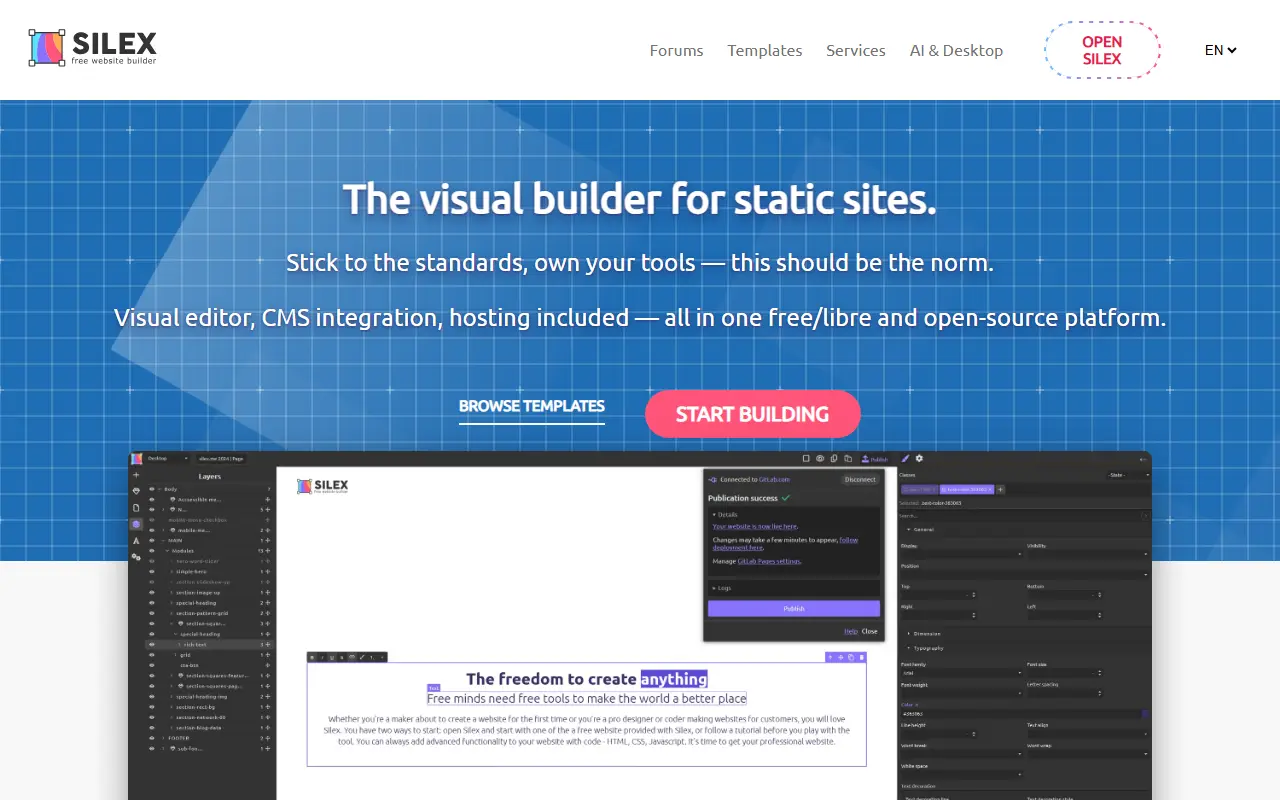
silex.meSilex homepage screenshot

Silex is a visual builder for static websites that can also pull in dynamic data. You design pages visually and export standard HTML and CSS that can be hosted anywhere, so there is no proprietary format, forced hosting, or subscription. It is released under the AGPL-3.0 license and presented as an open alternative to Webflow.

It is maintained by Silex Labs, a non-profit organization, and describes itself as free forever with all features included and no premium tier. It follows JAMstack practices, uses the GrapesJS editor according to its topics, and can pull content from WordPress through GraphQL. An MCP server is also mentioned among the project topics, and a desktop app can be downloaded alongside the online version.

You can try Silex online or run it yourself with Node.js. It suits web agencies, WordPress developers, freelance designers, and no-code builders who want a visual workflow with output they fully own. Because the output is standard web files, learning it also builds transferable HTML, CSS, and JAMstack skills.

Key features

  • Visual page design with clean HTML and CSS export
  • Host the exported site anywhere
  • Dynamic data for static sites
  • WordPress content through GraphQL
  • Desktop app and online editor
  • Built on the GrapesJS editor

Pricing: Silex is free to use hosted through a free GitLab account, as a desktop app, or self-hosted. Training, development and managed hosting are optional services quoted separately.

Relume alternatives: questions

What is the best open-source alternative to Relume?
Onlook is the top-ranked open-source alternative to Relume on Enlisted: An open-source visual editor for Next.js and Tailwind apps that lets designers and developers edit real code in the browser with AI, an alternative to Bolt.new and Lovable. Other strong options are Webstudio, Plasmic and Silex.
Are these Relume alternatives free?
All 4 are open source, so the code is free to use under its licence, and all of them can be self-hosted on your own server or computer. 4 also offer a paid or managed cloud version if you'd rather not host it yourself.
How is this list of Relume alternatives ranked?
By a score built from GitHub stars, star growth over the last 30 days and how recently the code changed. 3 of these projects shipped code in the last 30 days. Data is refreshed daily, and nobody can pay to move up.

People also look for alternatives to…

View all